
Topic 3.4 key terms
- ideal gas law
- PV = nRT: the pressure, volume, amount (moles) and kelvin temperature of an ideal gas are related by the gas constant R.
- pressure
- How hard a gas pushes on each unit of area of its container's walls; in PV = nRT it is absolute pressure (atm, kPa or torr; 1 atm = 101.325 kPa = 760 torr).
- gas constant (R)
- R = 0.08206 L·atm·mol⁻¹·K⁻¹ = 8.314 J·mol⁻¹·K⁻¹ (also kPa·L·mol⁻¹·K⁻¹). Use the value whose units match P and V.
- kelvin temperature
- Absolute temperature: K = °C + 273.15. Gas relationships (V ∝ T, P ∝ T) hold only on the kelvin scale.
- combined gas law
- For a fixed amount of gas, P₁V₁/T₁ = P₂V₂/T₂ (PV = nRT with n and R constant).
- partial pressure
- The pressure one gas in a mixture would exert alone in the same volume at the same temperature: Pᵢ = nᵢRT/V. It does not depend on the other gases.
- mole fraction (X)
- One component's share of the total moles: X_A = moles A / total moles. P_A = X_A × P_total.
- Dalton's law of partial pressures
- The total pressure of a mixture of gases is the sum of the partial pressures: P_total = P_A + P_B + P_C + …
Transcript
2,618 words · 8 parts
Almost empty
On the morning of August seventeenth, 2018, a NASA crew laid out the largest balloon of its type the agency had ever flown, on a launch field at Fort Sumner, New Mexico. When it’s full, this balloon holds sixty million cubic feet of gas, which NASA compares to a football stadium, and it’s made of plastic thinner than kitchen wrap.
But look at how they launch it, because this surprised me. That bubble of helium at the top is all the gas it will ever get, and everything below it is loose plastic, waiting. When the crew lets go, the bubble drags the whole envelope up off the ground until it stands over the desert, with a sixteen-hundred-fifty-pound payload of instruments hanging at the bottom.
Over the next four hours it climbs to a hundred fifty-nine thousand feet, about thirty miles up, a record for a balloon like this one. And watch it on the way up. Nobody adds a single atom of helium, and the gas still spreads out until it fills the entire balloon. It’s the same helium, in a balloon that’s now hundreds of times bigger.
If we could look inside, we’d see the same atoms, the exact same number of them, just spreading farther apart as the walls move away. Here are the two side by side, the little bubble that left the ground and the balloon it became. There’s a football field underneath for scale.
Here’s the puzzle the balloon team solves before every launch, and you’re going to solve it too. How small does that bubble have to be on the ground, so that thirty miles up, the balloon is exactly full?
You’ll also figure out something strange about the air up there, because it’s still twenty-one percent oxygen, just like the air you’re breathing right now, and you still couldn’t breathe it. So let’s start a lot closer to the ground, with the four numbers that describe any sample of gas.
Four numbers, one equation
Chemists describe any gas with four numbers. The first is pressure, P, how hard the gas pushes on the walls of whatever holds it, in atmospheres, kilopascals or torr. The second is volume, V, in liters, and since a gas spreads out to fill whatever it’s in, its volume is just the volume of its container. The third is n, the amount of gas in moles, and the fourth is temperature, T, which in every gas calculation has to be in kelvins.
And the reason this is one lesson and not five is that one equation ties those four numbers together, P V equals n R T, and it’s on your AP equation sheet. R is the gas constant, and your sheet gives it two ways, one for liters and atmospheres and one in joules. Pick the R whose units match yours.
Temperature is one of the places AP readers see students lose points. If a gas warms from twenty degrees Celsius to forty, it’s tempting to say its temperature doubled. But the zero on the Celsius scale is just the temperature where water freezes, and gases don’t care about that.
To the gas, it went from about two hundred ninety-three kelvin to three hundred thirteen, only about seven percent warmer, which is why every temperature goes into this equation in kelvins. Real gases follow this equation very closely at everyday conditions, and lesson three point six shows where they don’t.
Lock two, watch one
Let’s borrow the balloon team’s hangar tonight and set up a rig with a sample of gas inside. It’s a glass cylinder with a piston, a heater around the bottom, and a pressure gauge. One equation ties all four numbers together. That lets us hold two of them steady, change a third, and watch the fourth. We’ll make that move all lesson.
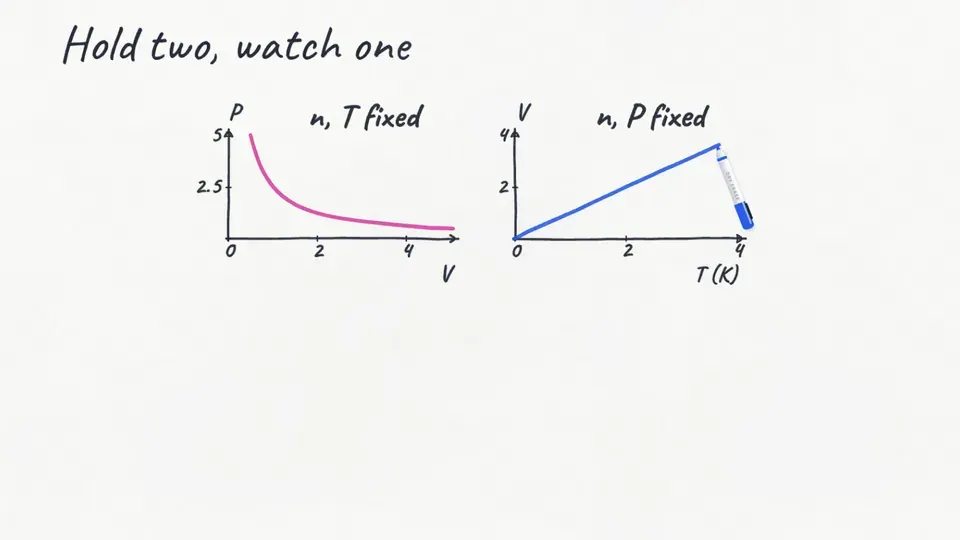
First, let’s lock the amount of gas and the temperature. The valve is shut and the heater holds the temperature steady while I push the piston down to half the volume. And the pressure doubles. The same gas packed into half the room hits the walls twice as often, and the gauge climbs from one atmosphere to two.
Pressure times volume stays the same, which is exactly what the equation says when n, R and T don’t change, and on a graph that makes this curve, steep at first and then gentler. Now watch what happens when I plot the same points against one over the volume. The curve straightens into a line through zero, which is how a graph tells you two things are inversely proportional.
Next, let’s lock the pressure instead. I’ll open the clamp so the piston floats on the gas and the pressure can’t change, and then I’ll turn up the heat. As the gas warms, it lifts the piston, and the volume grows in a straight line with temperature. But look where that line goes if I run it backwards.
On a Celsius scale it reaches zero volume near minus two hundred seventy-three degrees. A real gas condenses long before that, but that’s exactly where the kelvin scale puts its zero. Switch the axis to kelvins, and the line runs through the origin, so volume is directly proportional to kelvin temperature. Now let’s lock the volume. With the piston clamped, heating the gas can’t make it bigger, so the pressure climbs instead, in proportion to the kelvin temperature.
And this exact setup, a sealed, rigid container that gets heated, is a classic AP question. The first thing the exam wants from you is what stays constant, before you say anything else. Last, lock the pressure and temperature, and pump in more gas. The volume grows right along with the moles.
Okay, now you try one with the rig. Make the pressure in this cylinder exactly double, without letting the piston move at all.
Here are all four pictures, each with the pair we held constant written above it. Pressure against volume curves, and the other three are straight lines through zero, as long as temperature is in kelvins. And whichever pair you lock, it’s still the same equation, P V equals n R T, with two of its letters frozen. Which graph shows the pressure in a sealed, rigid tank as you heat it? The temperature is in degrees Celsius.
Predict, then calculate
Plenty of AP problems change a couple of things at once. If the amount of gas doesn’t change, then P V over T always equals n R, which never changes either. So P V over T before has to equal P V over T after, and that’s the combined gas law, also right there on your equation sheet.
Let’s try it on a small sealed balloon, with five liters of helium at one atmosphere and three hundred kelvin, which floats up until the air around it is at a tenth of an atmosphere and two hundred forty kelvin. Before I touch a calculator, I want a guess. The pressure drops to a tenth, and on its own that would make the volume ten times bigger.
The temperature drops to eight tenths of what it was, which shrinks the volume back down to eight tenths, so I’m expecting about eight times bigger. Now the algebra. The new volume is five liters times one atmosphere over a tenth of an atmosphere, times two forty kelvin over three hundred, and the atmospheres and kelvins cancel, leaving liters. That’s forty point oh liters, eight times bigger, just like we guessed, with three significant figures from the data.
Notice that this gas got colder and bigger at the same time. Cooling on its own would shrink it, but the pressure dropped to a tenth, and that wins easily. Eight times the volume sounds enormous, but the balloon only gets twice as wide, because volume grows with the cube of the width, and two times two times two is eight. That’s how a balloon can grow hundreds of times in volume while getting only several times wider.
The air up there
Back up at the Big 60, the air outside is the same mixture you breathe, about seventy-eight percent nitrogen and twenty-one percent oxygen, because air stays mixed nearly all the way up. But up here it’s spread out to about a thousandth of an atmosphere, so how much of that pressure belongs to the oxygen?
To answer that, picture a mixture in one container. Every gas fills the whole container at the same temperature, so each one follows P V equals n R T with its own moles. That gives every gas its own pressure, called its partial pressure, and the total pressure on the walls is just the partial pressures added up. Divide one gas’s partial pressure by the total, and R, T and V cancel, leaving that gas’s share of the moles, its mole fraction, X.
Turn that around and you get the equation on your sheet, a gas’s partial pressure is its mole fraction times the total pressure. In this box, oxygen is two of the eight molecules, so its mole fraction is a quarter, and at a total of two atmospheres its partial pressure is a quarter of that, zero point five oh oh atmospheres.
Up at the balloon, oxygen is still twenty-one percent of the molecules, but twenty-one percent of a thousandth of an atmosphere is about a thousand times less oxygen pressure than at sea level, and that’s why you couldn’t breathe it. That leads to a question that trips up a lot of people. Here’s a rigid tank of oxygen, with gauges for the oxygen, for helium, and for the total.
I’m going to pump helium into this rigid tank of oxygen and keep the temperature the same. What do you think happens to the oxygen’s pressure? That’s what independent means. Oxygen’s partial pressure is its own moles times R T over V, and there’s no helium in that expression.
That only works while the volume and temperature stay fixed. Now I’ll unclamp the piston, so the total pressure can’t change. Then I’ll add the same helium. What do you think happens to the oxygen’s pressure this time?
The mole-fraction equation says the same thing. Oxygen used to be all of the gas. Now it’s three quarters of it. The total is still zero point seven three nine, and three quarters of that is zero point five five four, the oxygen gauge’s reading.
Now go four hundred kilometers up, outside the International Space Station. NASA pressurizes its spacewalk suits with pure oxygen to only about twenty-nine point six kilopascals, less than a third of the air pressure around you, which makes the glove much easier to bend. So, at the same temperature, how do you think the oxygen inside this suit compares with the oxygen in the air you’re breathing right now?
Here are equal samples at the same temperature, your air on the left and the suit on the right. Your air is far more crowded, but count only the oxygen, and the suit has more. Your oxygen’s partial pressure is twenty-one percent of a hundred one point three kilopascals, about twenty-one point three, and the suit’s is all twenty-nine point six, about forty percent more oxygen in every liter.
Here’s a design problem for you. Keep the suit at twenty-nine point six kilopascals, and mix its gas so its oxygen pressure matches the air you’re breathing.
Filling the Big 60
Now let’s keep the promise from the start. The envelope holds sixty million cubic feet, one point seven oh times ten to the ninth liters, and it should be exactly full at a hundred fifty-nine thousand feet. Up there, standard atmosphere tables give about nine point five times ten to the minus four atmospheres and two hundred seventy kelvin, and in our model the helium matches the air around it.
The launch field sits about four thousand feet above sea level, at about zero point eight five eight atmospheres, and we’ll call it a twenty-degree morning, two hundred ninety-three kelvin. So there are two steps. First, the moles of helium that fill the balloon up there, which never change on the way up, and then the room those same moles take on the ground.
Let’s set up the first step together. Moles equals P V over R T, so it’s the float pressure times the volume, over the liter-atmosphere R times two hundred seventy kelvin. Use the calculator to finish it. How many moles of helium fill the Big 60 at float? Times four point oh oh grams per mole, that’s about two hundred ninety kilograms of helium, and it’s all the gas the balloon will ever get.
Before we calculate the bubble, let’s guess. On the ground the pressure is about nine hundred times higher, squeezing the gas nine hundred times smaller, and the warmer air puffs it back up by about nine percent. So the bubble should come out roughly eight hundred times smaller than the full balloon. The second step is yours. You’ll do it right on the launch field, with the real balloon.
Work out the volume of helium on the ground. Then set the bubble to that size, and launch it. Here’s that helium going up, climbing for four hours until, thirty miles up, it fills the balloon right to the edge.
Two thousand cubic meters on the ground against one point seven million up there means the Big 60 left the ground about a tenth of a percent full, which is why it looks almost empty at launch. The real crew adds a little extra helium so the balloon climbs briskly. They vent the extra at the top. But your calculation is why the bubble is so small.
On the AP exam
This is exactly the kind of question the AP exam asks, and here’s a real one, from 2025. Picture a mixture heated to a hundred ninety-eight degrees Celsius in a sealed, rigid twelve point five liter container. Both compounds are gases at that point, and the total pressure is two point three oh atmospheres. How many moles of gas particles are in the container? Use the calculator, and watch your units.
First the temperature goes into kelvins, a hundred ninety-eight plus two seventy-three point one five, about four seventy-one. Then n is P V over R T, two point three oh times twelve point five, over zero point oh eight two oh six times four seventy-one. And this one line, with four hundred seventy-one kelvin, the liter-atmosphere R, and the actual numbers written in before the answer, is the work that earns the point on the scoring guide.
The readers who scored this question saw students lose that point by plugging in a hundred ninety-eight instead of four seventy-one, or by using the joule R with atmospheres and liters. And watch out for twenty-two point four liters per mole too, because that shortcut only works at zero degrees Celsius and one atmosphere.
Thirty miles up
Let’s go back up one last time. Thirty miles over New Mexico, the Big 60 is full of the same helium that left the ground as a little bubble, and you can explain every part of it. Four numbers describe a gas, and P V equals n R T ties them together. Lock any two and you can predict what the other two do before calculating, which is how we knew the bubble had to start hundreds of times smaller.
And in a mixture each gas has its own partial pressure, its mole fraction times the total, which is why the air up here is twenty-one percent oxygen and still unbreathable. All lesson long we’ve treated a gas as something that simply obeys an equation. Next time, we’ll zoom in on the particles themselves and see why it has to.