
Topic 3.7 key terms
- heterogeneous mixture
- A mixture whose macroscopic properties depend on location in the mixture: samples from different places differ.
- solution
- A homogeneous mixture: its macroscopic properties do not vary throughout the sample. Solutions can be solids, liquids or gases.
- solvent
- The component of a solution that does the dissolving, usually the one present in the largest amount (water in an aqueous solution).
- solute
- A substance dissolved in the solvent. A solution can contain several solutes.
- molarity
- Moles of solute per liter of solution: M = nsoluteLsolution (AP equation sheet). Unit mol/L, written M ('molar').
- dilution
- Adding solvent to a solution: the moles of solute stay the same and the volume grows, so the molarity falls (M₁V₁ = M₂V₂ for the portion diluted).
- volumetric flask
- A flask with one etched calibration line on its neck: filled until the bottom of the meniscus sits on the line, it contains its rated volume of solution, within a small tolerance at its calibration temperature.
- standard solution
- A solution whose concentration is known accurately, used to calibrate an instrument such as a fluorometer.
Transcript
2,568 words · 6 parts
The day the Pacific turned pink
This is a real beach in San Diego, and on January twentieth, twenty twenty-three, a team of scientists turned its waves pink on purpose. The pink is pouring out of a lagoon called Los Peñasquitos, under this little bridge, and when the tide goes out and the mouth is open, the lagoon empties straight into the surf.
Rain washes mud and pollution off the land into that lagoon, and tiny larvae drift in its water too, so scientists from the Scripps Institution of Oceanography wanted to see exactly where its water goes once it hits the waves. So how do you see where water goes? The easiest way is to dye it.
So they poured in fifteen gallons of a pink dye called rhodamine W T, and chased it with a jet ski carrying a sensor that measures how much dye is in the water underneath it, and drones filming from above. Over the next few hours, the pink spread out and got paler and paler, until it disappeared completely, and if you’d walked onto this beach that evening, you’d have sworn the dye was gone.
But the team’s sensors could still find the dye about a day later, because the dye hadn’t vanished. It was still in the water, just spread through so much more ocean that our eyes couldn’t see it. So by the end of this lesson, you’ll be able to take one bottle of this water. Long after the pink is gone, you’ll work out how many dye particles are still hiding in it.
I’ll warn you now, it’s a number so big it doesn’t sound real. You’ll also see why you can pour half of a sample like that down the drain and what’s left is just as strong. It’s one of the sneakiest ideas in this topic, and one the AP exam loves to test. Before we count anything, though, we need to answer a question a little kid could ask about this water. Is it the same everywhere?
Is it the same everywhere?
Here’s the jet ski on one of its survey runs. That little bar is its sensor reading, and it climbs the more dye there is right underneath it. See how it rises in the pink and drops again on the other side? Some parts of this water have far more dye in them than others.
Now it’s your turn to drive. Take the jet ski into the most concentrated water you can find. So let’s take three samples. One from the core, one from the edge, and one from the open water, out past the pink.
All three came out of the same surf, and they read completely differently. When a mixture’s properties depend on where you take your sample, chemists call it a heterogeneous mixture. Now let’s scoop a bottle of water from the edge of the plume. Look closely at it. You can still see streaks of pink dye swirling through the water.
But give it a good shake, and the streaks disappear. Now a sample from the top, the middle or the bottom gives exactly the same reading. A mixture that’s the same all the way through like this is called a homogeneous mixture, or a solution, and in a solution it doesn’t matter where you take your sample.
So there are two kinds of mixtures. In a heterogeneous one, like the plume, the properties change from place to place, and in a solution, they’re the same everywhere. The solvent is what does the dissolving, usually the biggest part, like the water in our bottle, and the solute is whatever’s dissolved in it, like the dye.
Solutions don’t even have to be liquids. Clean air is a solution of gases, mostly nitrogen with oxygen and argon mixed evenly through it. Seawater is a liquid solution, and the brass in a trumpet is a solid one, with zinc atoms spread evenly through the copper. So if you ever think a solution has to be a liquid, cross that out, and cross out “clear means pure,” too, because salt water is perfectly clear and it’s still a mixture.
The AP exam likes to test this by describing a mixture and asking whether a sample from the top would match one from the bottom, and if it’s a solution, the answer is always yes. Let’s see if you can spot it. Which one of these is not a solution?
How much dye is in there?
Our shaken bottle is a solution now, so let’s shrink down and go inside it to see what’s really in there. This glowing one is a single particle of the pink dye, and the little bent ones crowding around it are water molecules. I’ve made this sample far stronger than the beach water. So there are only about a hundred and thirty of them for every dye particle.
Each glowing particle here stands for a whole crowd of real ones, a thousandth of a mole, so these hundred are a tenth of a mole of dye, in a quarter of a liter of solution. Now look at these two samples. The big one holds a whole liter, with a hundred dye particles. The little one holds a tenth of a liter, with only forty.
The big one has more dye, a hundred against forty. But look how crowded the little one is, because a sip from it would hand you about four times as much dye. So the little one has less dye, and it’s more concentrated, because concentration is about how much solute comes with every bit of solution, and that’s what makes a solution strong or weak.
Chemists measure concentration in moles of solute per liter of solution, and they call it molarity, so M equals moles of solute divided by liters of solution, right there on the AP equation sheet. For the big sample, a tenth of a mole in one liter is zero point one molar. And for the little one, four hundredths of a mole in a tenth of a liter is zero point four molar, four times as concentrated.
That M stands for molar, moles per liter, and it’s liters of the whole solution, not liters of the water you poured in. Dye sensors often use parts per billion instead, but in a chemistry lab, molarity is the one everybody uses.
So let’s go back to our sample. A tenth of a mole of dye in a quarter of a liter is zero point four molar. Before I touch anything, I want a prediction from you. If I pour out half of this sample, what happens to its molarity?
So let’s pour out half. Each half now has fifty dye particles in an eighth of a liter, so both are still exactly zero point four molar. That surprises a lot of people, but we took away half the dye and half the solution together, so the ratio between them didn’t move.
Now let’s try something a little different. I’ll put a ring around each of the original hundred dye particles. That way, we can keep an eye on every one of them. Now let’s add pure water, with no dye in it at all. First up to half a liter, and then a whole liter.
Count the rings, and all hundred are still there, so the amount of dye didn’t change, but it’s spread through four times as much solution, so the molarity drops to a quarter, zero point one molar. So pouring some out and adding water are really different moves. When you pour some out, solute and solution leave together and the concentration stays put, but when you add water, all the solute stays and gets more room, so the concentration drops. So whenever a concentration changes, ask yourself what changed, the solute, the solution, or both.
Now you try it. This new sample is zero point three molar, and I want you to add water until it’s exactly zero point one molar.
Molarity, worked
Now let’s put real numbers on this. Say we dissolve five point eight four four grams of table salt and add water to make two hundred fifty milliliters of solution. What’s the molarity? Molarity wants moles, not grams, so first I need the molar mass of sodium chloride, twenty-two point nine nine plus thirty-five point four five, which is fifty-eight point four four grams per mole.
So I multiply the five point eight four four grams by one mole for every fifty-eight point four four grams, the grams cancel, and that’s exactly a tenth of a mole of salt. Molarity also wants liters, so two hundred fifty milliliters becomes zero point two five liters. Now we divide moles by liters, and a tenth of a mole in a quarter of a liter is zero point four molar.
Our numbers had four significant figures, so the answer gets four. And it makes sense, since a quarter liter holding a tenth of a mole means a full liter would hold four tenths. That’s a fun number, because real seawater has a little under half a mole of sodium ions per liter, so our salt water has almost as much sodium as the ocean.
A molarity works as a conversion factor in both directions, because zero point four molar just means zero point four moles in every one liter. Multiply it by a volume to get moles, or divide moles by it to get a volume. So let’s try it on the ocean. If a wave ever knocked you over and you swallowed a mouthful of seawater, that’s maybe twenty-five milliliters, at about zero point four eight moles of sodium ions per liter.
So how many sodium ions did you swallow? We’ll go from milliliters to liters, then use the molarity to get moles, and then Avogadro’s number to get ions, and you can do the middle step.
How many moles of sodium ions are in that twenty-five milliliter mouthful? Times six point oh two two times ten to the twenty-third, that’s about seven point two times ten to the twenty-first sodium ions, more than seven thousand billion billion, in one accidental gulp of ocean.
We keep two significant figures because of the zero point four eight. And notice I said sodium ions, not salt molecules, because dissolved salt falls apart into separate sodium and chloride ions, so always say what you’re counting.
A solution you can trust
There’s a problem we skipped. How does the jet ski’s sensor know what any concentration looks like? Somebody has to teach it, in a lab, with solutions whose concentrations they know very accurately. Dye-tracing teams make standards, solutions that are each ten times more dilute than the last, and the sensor learns what each one looks like.
To make them you dilute, and dilution works the way we saw inside the sample, because adding water never changes the amount of solute, so the moles you start with are the moles you end with. Say we take twenty-five milliliters of a zero point eight molar stock solution and add water until we have two hundred milliliters of solution. What’s the new concentration?
First, how much solute did we move? Zero point eight moles per liter times zero point oh two five liters is zero point oh two moles, and all of it is still there. Divide those zero point oh two moles by the new volume, zero point two liters, and we get zero point one oh oh molar. The volume went up eight times, so the concentration fell to an eighth.
Chemists squish that into one line, M one V one equals M two V two, moles before equal moles after, where V one is just the portion you pour in. And notice we never added two hundred milliliters of water. We added water until the total was two hundred milliliters. In the lab, the twenty-five milliliters goes in with a pipet, then water goes in until the bottom of the curved surface, the meniscus, sits right on this line, which marks the whole solution’s volume.
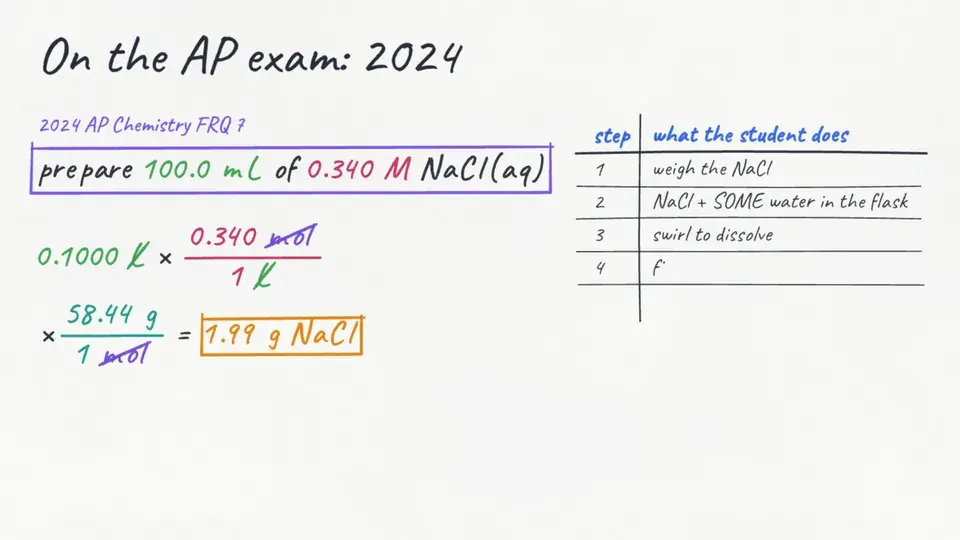
The AP exam asked about this exact skill in twenty twenty-four. A student needs a hundred milliliters of zero point three four oh molar sodium chloride, and part a asks what mass of salt they need. A hundred milliliters is zero point one liters, times zero point three four moles per liter gives moles of salt, and times fifty-eight point four four grams per mole, everything cancels but grams, and we get one point nine nine grams.
Part b gives a five-step procedure with two steps missing, and those are putting the salt and some water in the volumetric flask, and, once it dissolves, adding water up to the calibration mark. Each of those two sentences earns a point on the scoring guide. And look at the last step they give you, mix until it’s homogeneous. That’s the same word we learned at the beach.
So let’s make it. We weigh out one point nine nine grams of salt and tip it into the flask, then add some water and swirl until every crystal is gone. Now it’s your turn to bring it up to the line. Add the water slowly. Stop when the bottom of the meniscus sits right on the mark.
Stopper on, turn it over a few times, and now it’s the same everywhere, just like our shaken bottle at the beach. Just pouring in a hundred milliliters of water wouldn’t work, because the dissolved salt takes up room too and the liquid would end up above the line, so the concentration would come out low.
Here’s one from twenty twenty-two, and it’s all yours. A student needs a hundred milliliters of purple permanganate solution, one point six eight times ten to the minus three molar, from a stock that’s two point four oh times ten to the minus three molar. How many milliliters of the stock solution does the student need?
Count what you can’t see
So let’s go back to the beach, hours after the pink disappeared. We’ll scoop up one bottle of water, about a cup, two hundred fifty milliliters. It looks perfectly clear, but the sensor still reads two point oh times ten to the minus nine molar dye, which is a model number, though well within what these sensors can measure.
And now you have everything you need. It’s time to keep the promise I made at the start of this lesson. Let’s count those dye particles in the cup. How many dye particles are in that two-hundred-fifty-milliliter cup?
That’s three hundred trillion dye particles in a cup of water you’d swear was empty, and the pink is gone because they’re spread so thin. And if you poured out half the cup, what’s left would still read two point oh times ten to the minus nine molar, with half as many particles. That’s what the sensor’s view is showing, dye spread far along this coast, long after our eyes gave up on it.
So let’s pull it together. A solution is a mixture that’s the same everywhere, and it can be a gas, a liquid or a solid. Molarity is moles of solute per liter of solution. And whenever a concentration changes, ask what changed, the solute, the solution, or both. Next time, we’ll zoom in closer and draw what’s happening when water molecules grab hold of a dissolved ion, which is how chemists show what’s inside a solution without any sensor at all.