
Topic 3.3 key terms
- crystalline solid
- A solid whose particles are arranged in a regular, repeating three-dimensional pattern (ice, table salt, olivine). The particles vibrate in place and do not move past one another.
- amorphous solid
- A solid whose particles have no regular, repeating arrangement (glass, the black volcanic sand). Like a crystal, its particles only vibrate in place, so it keeps its shape.
- liquid (particle model)
- Particles in close contact that are continually moving, colliding and sliding past one another. A liquid flows and takes the shape of its container but keeps a nearly fixed volume.
- gas (particle model)
- Particles far apart compared with their size, in constant motion, with minimal effects of attractions between them. A gas has neither a definite shape nor a definite volume.
- molar volume
- The volume occupied by one mole of a substance: Vm = M/. For water near 0 °C: 19.7 mL (ice), 18.0 mL (liquid); at 100 °C: 18.8 mL (liquid), 30.1 L (vapor).
- particulate model
- A drawing of a substance at the level of its particles that shows their arrangement and motion. Particles keep their size and identity in every phase; only spacing and motion change.
Transcript
1,483 words · 4 parts
Solids, liquids and gases: crystal, glass and lava
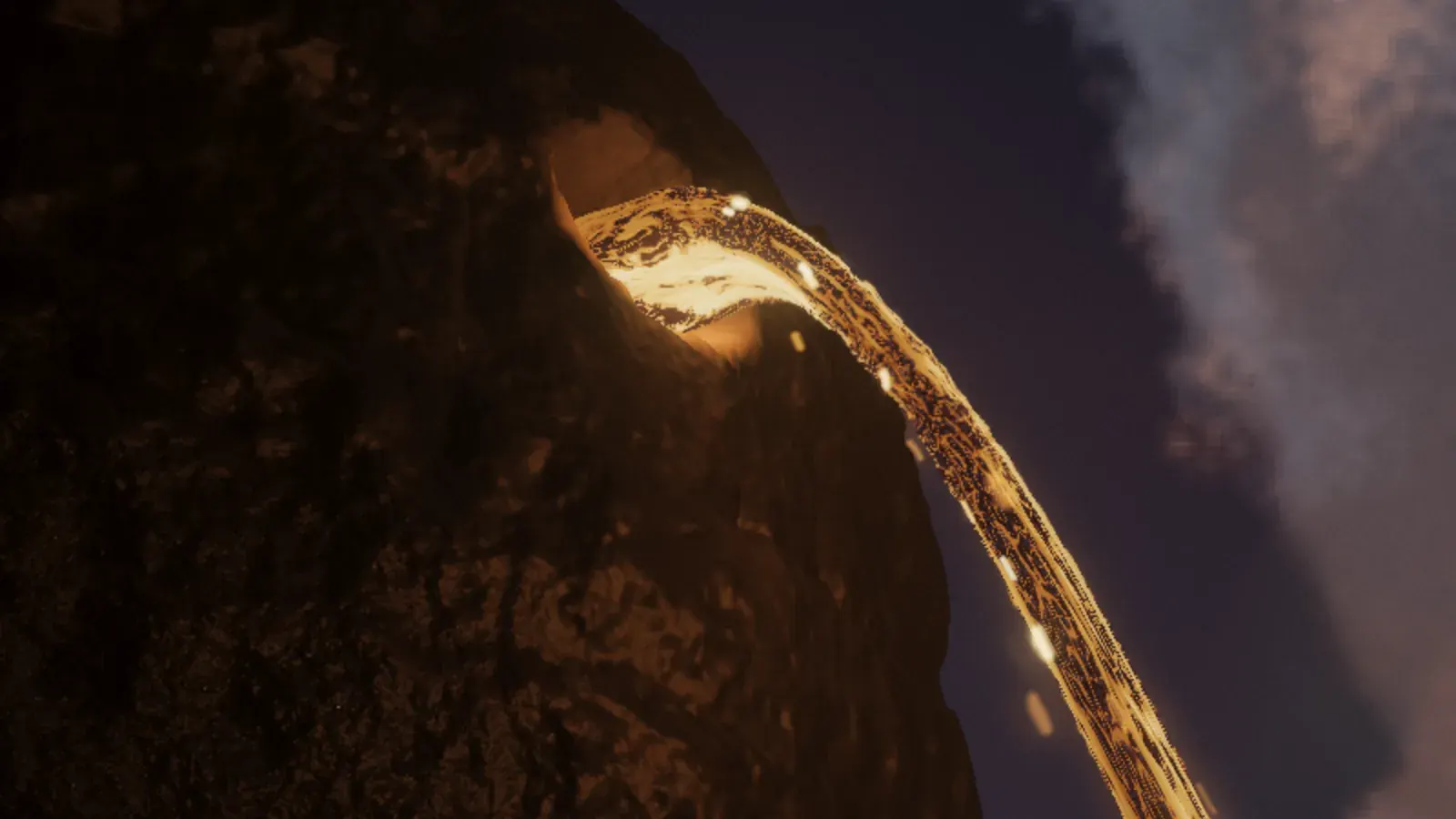
Back at Kamokuna, the lava often carries little green crystals of a mineral called olivine, and if we zoom into one, its particles sit in a pattern that repeats, row after row after row. And here’s a grain of the black glass sand, its particles jumbled with no pattern at all, and yet just as stuck, each one only shivering in its own spot.
So solids come in two kinds, crystalline ones with a repeating pattern, like olivine, ice or salt, and amorphous ones with no pattern at all, like glass. In both kinds the particles are touching and vibrating in place, but they never slide past their neighbors, and that’s why a solid keeps its own shape and its own volume. Which arrangement does a solid end up in? That depends on the attractions between its particles, and how well they can pack together.
Now melt the ice. The molecules in liquid water are still touching, about as crowded as in the solid, but now they keep moving, bumping into each other and sliding right past one another. Let’s follow just one of them, and see how it keeps squeezing past its neighbors, so a moment later it’s surrounded by completely different molecules.
That’s why a liquid flows and takes the shape of its container, while it keeps its own volume, because its molecules are still touching. How they move depends on how strongly they attract each other, and polar water molecules pull on each other hard through hydrogen bonds, so each molecule clings to its neighbors a little longer. Warming the liquid makes them move faster and trade places more often.
Remember the copper bar? The hammer had to force its ions into new places, but the particles in a liquid move past each other all the time, completely on their own. Now this next part trips up a lot of people. Take a single snapshot of the liquid and put it next to the glass, and they look almost exactly alike, crowded and jumbled, with no pattern.
So let’s try it with the real thing. One snapshot comes from the flowing lava and one from the black glass, and I’ve painted them the same color, so the glow can’t give it away.
So you get to be the scientist here. Tag one particle in each sample and let time run. Then tap the one you think is the liquid.
So the evidence that something is a liquid is time, whether its particles keep the same neighbors or keep swapping them, and a single snapshot can’t show you that. And now we can see what happens when the lava hits the sea. The water cools it so fast that its particles get stuck wherever they are, before they can line up into a crystal. It stops flowing but never gets organized, and that’s a glass, a solid whose particles froze mid-jumble, so a solid can be a complete jumble, as long as its particles are stuck.
Touching means about the same room
If solid and liquid particles are both touching, a mole of ice and a mole of liquid water should take up about the same room, so let’s check with real numbers. From the periodic table, a mole of water has a mass of eighteen point oh two grams, and liquid water near freezing has a density of one point oh oh grams per milliliter.
So we start with one point oh oh moles of water and multiply by eighteen point oh two grams for every mole, so the moles cancel and we’re left with grams. To turn grams into a volume, I use the density upside down, one milliliter per one point oh oh grams, so the grams cancel, and one mole of liquid water takes up eighteen point oh milliliters, a little more than a tablespoon.
Now let’s do ice together. Ice near zero degrees has a density of zero point nine one seven grams per milliliter, and the setup is exactly the same. So what volume does one mole of ice take up, in milliliters, to three significant figures?
So that’s nineteen point seven milliliters of ice against eighteen point oh of liquid, only about nine percent apart, just as we predicted, because in both the molecules are touching. But notice that the ice is the bigger one, and that’s water’s famous twist, because for most substances the solid is a little more compact. Either way the two are close, so solids and liquids typically take up similar room.
In ice, hydrogen bonds hold the molecules in an open, honeycomb-like pattern, and melting partly collapses it, so the molecules crowd a little closer, and that’s why ice floats. Those two volumes also settle a classic drawing mistake, a liquid with big gaps, which is wrong, because a liquid’s molecules touch, about as close as in the solid.
Far apart: gases
Boil the water, and its molecules break away and fly apart. In a gas they’re far apart and always moving, in straight lines until they hit another molecule or a wall. And between the molecules there’s nothing at all, just empty space, which is one of the strangest ideas in chemistry. So, with its molecules flying fast and barely pulling on each other, a gas has no shape or volume of its own and fills whatever container it’s in, and unlike a solid or a liquid, it’s easy to squeeze.
Grab the piston and push it down slowly. Stop when the gas takes up half the space it has now. Warming a gas in a sealed, rigid box makes its molecules fly faster and collide more often, at the same spacing, but if the container can expand, they push outward and spread into the extra room. So the spacing and the collisions depend on temperature, pressure and volume.
So how much more room does a gas take? At a hundred degrees Celsius, steam’s density is zero point five nine eight grams per liter, and notice that’s per liter, not per milliliter. So now it’s your turn. How many liters does one mole of steam take up at a hundred degrees Celsius?
Hot water takes a little more room. At a hundred degrees, a mole of liquid water fills eighteen point eight milliliters. Divide thirty point one by eighteen point eight, and you get one point six. That’s wrong. One number is in liters, and the other is in milliliters. So turn thirty point one liters into thirty thousand one hundred milliliters first, and the gas takes up about sixteen hundred times the room.
Where the gas really is
So back to Kamokuna one last time, where every drop of seawater that boils off becomes a gas that takes up about sixteen hundred times the room it did as a liquid. Now look at that white cloud again.
What do you think the lens is going to find inside that white cloud? Make your guess before we go in. Let’s go in. The white is made of tiny droplets, and every droplet is a crowd of water molecules, touching and tumbling past each other, so the white you see is liquid water. Out here, between the droplets, are molecules of water vapor mixed with the nitrogen and oxygen of the air, far apart and flying, and that’s the gas.
And the gas is completely invisible, so the white you see is liquid, just like over a kettle, where the real steam is the clear gap at the spout. So now we can label everything in this picture. The lava is a liquid, the green olivine in it is a crystalline solid, and the black sand is an amorphous solid. The white you see is droplets of liquid water. And the gas is all around them, right where you can’t see it.
The AP exam might ask you to draw exactly this, ten water molecules as a solid, a liquid and a gas, and a few rules earn the points. Every molecule stays whole and the same size, ten in every box. The solid is orderly and touching, the liquid is touching but jumbled at the bottom with a surface, and the gas is spread through the whole box.
And show the motion, jiggles for the solid, curvy arrows for the liquid and long straight ones for the gas, because the motion is half of each picture. This drawing is supposed to show liquid water, and it has the classic mistake in it. Drag the molecules to fix it.
So everything here comes down to questions about particles, what they are and what holds them together, which decides whether a solid shatters or bends, and whether they touch and move past each other, which tells you what’s solid, what’s liquid and where the gas really is. And exactly how much a gas grows when you heat it or shrinks when you squeeze it follows a law you can calculate with, and that’s next.