
Topic 3.1 key terms
- intermolecular force
- An attraction between separate particles (molecules, atoms or ions), as opposed to a covalent bond, which holds atoms together within one molecule. Boiling a molecular liquid overcomes intermolecular forces; the molecules stay intact.
- London dispersion force
- The Coulombic attraction between temporary, fluctuating dipoles in neighboring electron clouds. Present between all particles; often the strongest net intermolecular force between large molecules. Not a synonym for 'van der Waals forces'.
- polarizability
- How easily an electron cloud is distorted. It increases with the number of electrons and the size of the cloud, and is enhanced by pi bonding. More polarizable particles have stronger dispersion forces.
- dipole–dipole force
- The attraction between polar molecules when the δ⁺ end of one faces the δ⁻ end of another. Its strength depends on the size of the dipoles and their orientation; it acts in addition to dispersion.
- dipole–induced dipole force
- The attraction between a polar molecule and a nonpolar particle whose electron cloud the dipole distorts. Always attractive; stronger with a bigger dipole and a more polarizable partner.
- ion–dipole force
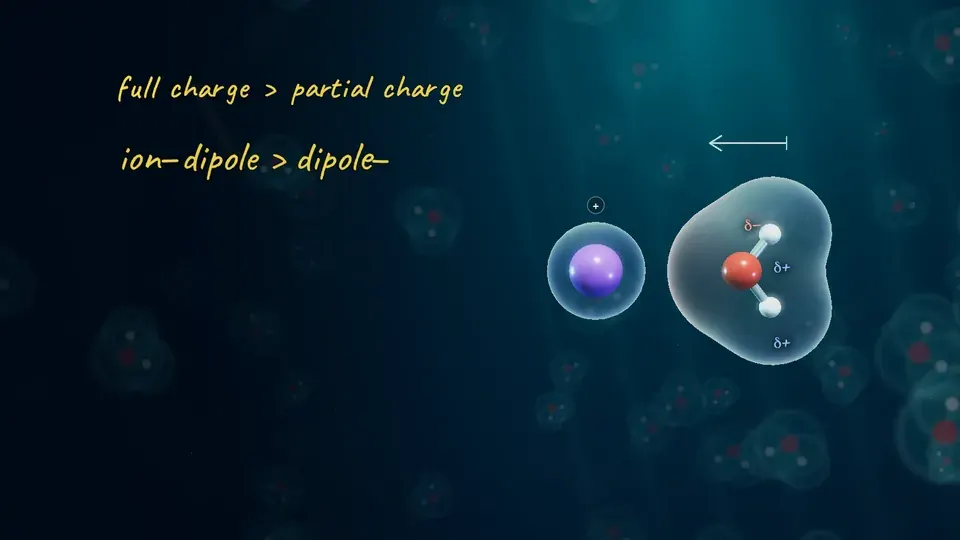
- The attraction between an ion and a polar molecule: a cation attracts the δ⁻ end, an anion the δ⁺ end. Usually stronger than dipole–dipole forces because the ion carries a full charge.
- hydrogen bond
- A strong intermolecular attraction between an H atom covalently bonded to N, O or F and a lone pair on an N, O or F atom of another molecule (or of another part of the same large molecule).
- noncovalent interaction
- An attraction that is not a shared-electron bond, such as a hydrogen bond. In large biomolecules it can join two different molecules or two regions of the same molecule.
Transcript
3,080 words · 8 parts
The gecko on the glass
Somewhere in a rainforest in Southeast Asia, it’s the middle of the night and it’s pouring, and there’s one lit window out here in the dark. Up on that window, under the roof where the glass stays dry, there’s a tokay gecko, about as long as a ruler, and it’s watching a moth.
It creeps across the glass sideways, like the window is just another floor, and then it strikes, and for a second it’s hanging on by a single toe. So what’s holding it there? There’s no glue on that foot, it doesn’t have suction cups, and glass is way too smooth for claws to grab anything.
Biologists even tested gecko toes on a surface that water clings to and on one that water runs right off, and the toes stuck just as well to both, so the grip doesn’t need a film of water either. And in 2014, engineers at Stanford copied the idea and built pads about the size of your hand, and a seventy-kilogram man used them to climb straight up a wall of glass.
So let’s go in and look, past the soft ridges under its toe, into a forest of tiny hairs, about fourteen thousand in every square millimeter, where every hair splits into hundreds of even tinier tips, so small that each one gets within about a nanometer of the glass. And down here there’s no glue and no hook. There are just electrons, the ones in the tip and the ones in the glass, shifting in step, so a tiny bit of negative always faces a tiny bit of positive.
Each tip pulls only the tiniest bit. But a gecko has about a billion of them, and together they’re enough to hold the whole animal up. By the end of this lesson, you’ll be able to explain the pull that reaches across that gap. And how the gecko lets go of it in a split second.
And you’ll be able to look at two molecules you’ve never seen before and predict which one boils at the higher temperature. And then write the one sentence that explains why. To get there, we need to be really careful with one little word that trips up a lot of people in chemistry. And that word is bond.
Within and between
Here are two molecules of hydrogen fluoride, H F, and inside each one the hydrogen and the fluorine share a pair of electrons, which is a covalent bond. That’s a bond within one molecule, so it’s called intramolecular, and intra just means within.
But fluorine pulls those shared electrons toward itself, so its end is slightly negative and the hydrogen end is slightly positive, and the positive end of one molecule gets pulled toward the negative end of the next. That pull is between molecules, so it’s intermolecular, and it’s what this whole lesson is about. It’s the same idea you already know, positive attracts negative, and bigger charges that get closer pull harder.
And these two are nowhere near the same strength. Pulling a mole of H F molecules away from each other takes about twenty-five kilojoules, but breaking the H–F bonds inside a mole of them, even once they’re a gas, takes about five hundred seventy, more than twenty times as much.
So when you heat liquid H F, the molecules move faster and faster until they break away from each other, and every one of them flies off whole. The molecules have overcome the attractions that held them close together, but every H–F bond is still right there.
Saying that boiling breaks the bonds is one of the most common mistakes in chemistry, and the AP exam’s graders warn about it by name. Boiling just pulls whole molecules apart. So when liquid H F boils, what’s actually inside the bubbles?
Molecules pull on each other in a few different ways. Which ones you get depends on who’s meeting whom. One of them works between every pair of particles. It’s the one that helps hold up the gecko, so we’ll start there.
The flicker that holds a gecko
These are two argon atoms. Ordinary argon is just separate atoms, and each one is a perfectly round cloud of electrons, with no plus end and no minus end. But cool argon down to minus one hundred eighty-six degrees Celsius and it condenses into a liquid, so something must be pulling these atoms together.
The secret is that the cloud never sits still. You can picture it like a flock of starlings, always moving, and at any instant a little thicker on one side. When argon’s electrons bunch up on one side for an instant, that side turns slightly negative and the other slightly positive, and that’s a temporary dipole. That lopsided cloud pushes on its neighbor’s electrons, so the neighbor goes lopsided too, an induced dipole, positive side facing negative side, and the two attract.
An instant later it all flips, but the two clouds flip together, so they keep attracting, far too fast to ever see. That’s a London dispersion force. So what makes one dispersion force stronger than another? Two things, and the first is polarizability, how easily a cloud of electrons gets pushed out of shape. More electrons and a bigger cloud make a molecule more polarizable, because the outer electrons sit farther from the nucleus, which holds them more loosely.
You can see it in the halogens. Fluorine, F two, with eighteen electrons, is a gas that boils at minus one eighty-eight. Chlorine, with thirty-four, is still a gas, bromine, with seventy, is a liquid, and iodine, with a hundred and six, is a solid.
People say that’s because they’re heavier, but mass doesn’t pull on anything here. It’s the electrons, and heavier molecules just tend to have more of them. Pi bonds help too, because pi electrons sit above and below the bond, where the nuclei hold them loosely, so they’re easy to push around.
These two have the same formula, C five H twelve, and the same forty-two electrons, but one is a long zigzag and the other is bunched into a ball. Same formula, same number of electrons. Which one do you think boils at the higher temperature? So let’s look at how these molecules actually meet each other.
Two n-pentane molecules can lie side by side and touch along their whole length, but two neopentane balls touch at one small spot, and that’s the second thing, contact, because more contact means more places for those flickering dipoles to pull. Here’s a routine that works on almost every one of these questions. First, list all the forces. Both are nonpolar, so each one has London dispersion forces and nothing else.
On the AP exam, this first step is where people lose points. They forget the word all. Dispersion is always on the list, for every pair of particles. Second, find the difference. Not the electrons, they both have forty-two, so it’s the shape, and how much surface can touch.
And third, write the sentence. n-Pentane has the higher boiling point because its long molecules have more surface contact with each other, so the London dispersion forces between its molecules are stronger and it takes more energy to separate them. Those two words, between and separate, show you know the molecules themselves stay whole. Papers about geckos call this van der Waals forces, but that’s a family name that includes the dipole forces too, so when you mean dispersion, say London dispersion.
And now you can see why a gecko has hairs. Even glass is bumpy at this scale, so a stiff pad would only touch the high spots. But soft hairs bend into every dip, and when the gecko drags its toe a tiny bit, they lie down flat and the contact spreads. To let go, it curls its toes up, the hairs tilt past about thirty degrees, and the tips pop off, so the contact and the grip disappear together.
Now I want you to make this toe grip the glass. And then make it let go. One gecko hair pulls with only about two hundred millionths of a newton, but if all half a million hairs on one foot gripped at once, that foot could hold up about ten kilograms.
So each pull is tiny, but between big molecules and big surfaces there are so many that dispersion is often the strongest attraction of all. What we’ve watched is the dispersion part of the gecko’s grip, and on real glass, other attractions help too. But plenty of molecules aren’t balanced like argon, and some have ends that are slightly charged all the time.
Molecules with ends
In hydrogen chloride, chlorine pulls the shared electrons harder than hydrogen does, so the chlorine end is always slightly negative and the hydrogen end always slightly positive. That’s a permanent dipole, there all the time, on top of the flickering. You can see that extra pull in real data. Propane and dimethyl ether both have twenty-six electrons, but nonpolar propane boils at minus forty-two and polar dimethyl ether at minus twenty-five, because its dipole–dipole forces add on top of dispersion.
Here are two H C L molecules lined up head to tail, positive hydrogen right next to negative chlorine, so they attract. But turn one of them around. With the two negative ends facing each other, they push apart.
In a liquid they tumble all the time, but they spend more time attracting than repelling, so overall they pull together, and how hard depends on how big the dipoles are and which way they point. A polar molecule can even pull on one that isn’t polar at all. Let’s work it out together. Here’s H C L next to argon, with its negative chlorine end facing the argon. Which way do you think argon’s electrons will move?
They get pushed away, to argon’s far side, because negative pushes on negative. That leaves argon’s near side slightly positive, facing the negative chlorine, so the two attract, and that’s a dipole–induced dipole force. Now suppose I flip the H C L around, so its positive hydrogen faces the argon. What do you think argon’s electrons will do this time?
As it turns, argon’s electrons slide over to the near side, toward the hydrogen. So did flipping it make them push apart? No. Argon’s cloud flips right along with it, so a dipole–induced dipole force is always attractive.
Now let’s swap the argon for xenon, fifty-four electrons instead of eighteen. Will its cloud lean more than argon’s, or less? More. Xenon’s big, loose cloud is more than twice as easy to push around, so its induced dipole is bigger and the pull is stronger.
So finish the rule with me. This pull gets stronger when the polar molecule has a bigger what? A bigger dipole, and a partner that’s more what? More polarizable, like xenon. The easier a cloud is to push around, the harder it gets pulled.
Now let’s bring in a real ion, a sodium ion with a full positive charge, and watch the water swing its negative oxygen end toward it. A full charge pulls harder than a partial one, so ion–dipole forces tend to be stronger than dipole–dipole forces. But what happens if we swap the sodium for chloride, with a full negative charge?
Now the ion is chloride. Turn the water molecule so it’s pulled toward the ion. So water faces a positive ion with its oxygen and a negative ion with its hydrogens, and you can work out every case by matching opposite charges.
Hydrogen bonds
Now add one more twenty-six-electron molecule, ethanol. It has the exact same formula as dimethyl ether, C two H six O, and yet it boils at seventy-eight degrees, more than a hundred degrees higher. In ethanol, one hydrogen is bonded right to the oxygen, and in the ether, every hydrogen is bonded to a carbon.
A hydrogen bond forms when a hydrogen covalently bonded to nitrogen, oxygen or fluorine is attracted to a lone pair on a nitrogen, oxygen or fluorine of another molecule, or of another part of the same big molecule. Those three atoms pull electrons so hard, and hydrogen has no inner electrons to hide behind, so that hydrogen is almost a bare proton, and it gets really close to the next lone pair.
Here are two ethanol molecules, and there’s the hydrogen bond, from the hydrogen on one oxygen to a lone pair on the other. Two dimethyl ether molecules can’t do that, because a hydrogen on carbon isn’t positive enough, so they only get dipole–dipole forces and dispersion. But the ether’s oxygen still has lone pairs, so a water molecule can supply the hydrogen. Draw the hydrogen bond between this water molecule and this dimethyl ether molecule.
The drawing mistake I see most is calling the solid O–H line inside the water molecule a hydrogen bond. That solid line is a covalent bond. The hydrogen bond is the dashed one, between the two molecules.
So let’s run our routine on these two, ethanol and dimethyl ether. Ethanol has dispersion, dipole–dipole forces and hydrogen bonds, and the ether has just dispersion and dipole–dipole, so the difference is hydrogen bonding. So ethanol molecules attract each other more strongly, and it takes more energy to separate them, the same sentence shape as for pentane.
This time you do more of the work, with methanol, C H three O H, and fluoromethane, C H three F. Both are polar, and both have exactly eighteen electrons. Fluoromethane has a fluorine in it, so does it hydrogen-bond with itself? Think about where its hydrogens are.
No, because all its hydrogens are on the carbon. The fluorine has lone pairs that could accept a hydrogen bond, but there’s no hydrogen on nitrogen, oxygen or fluorine to give one. So now it’s your turn. List the forces in each one. Methanol has dispersion, dipole–dipole forces and hydrogen bonds, and fluoromethane has just dispersion and dipole–dipole forces. So what’s the difference?
Hydrogen bonding. So which one boils higher, and what’s the sentence? Methanol, because hydrogen bonds make the attractions between methanol molecules stronger, so it takes more energy to separate them. And sure enough, methanol boils at sixty-five degrees and fluoromethane at minus seventy-eight.
Hydrogen bonds are also why water is so strange. Methane has ten electrons, just like water, and boils at minus one sixty-two, but water boils at a hundred. But hydrogen bonds don’t always win. Decane, a long hydrocarbon with eighty-two electrons and no hydrogen bonds at all, boils at a hundred seventy-four degrees, way above water, because in a big molecule all that dispersion adds up, so always compare the actual molecules, never just the names of their forces.
Let’s put together every pair we’ve watched. Two argon atoms only have London dispersion. Two H C L molecules add dipole–dipole forces. H C L next to argon gives a dipole–induced dipole force.
A sodium ion and a water molecule give an ion–dipole force. Two ethanol molecules form hydrogen bonds. Dispersion goes on every row, because every particle has electrons. Try a molecule we haven’t used yet, ammonia, N H three, which is polar. Which forces act between two ammonia molecules?
Inside the gecko’s hair
Back to the gecko, because its hairs hide one more thing. They’re made of protein, a kind of keratin, long chains of atoms joined by covalent bonds, and here’s a model of how they sit inside a hair.
The chains fold back and forth into sheets, held together by hydrogen bonds from the N–H of one strand to an oxygen on the next, like these, between two different chains. But these two strands are the same chain, folded back on itself, so these hydrogen bonds hold one molecule to itself. So the same attractions can join two molecules or two parts of one big molecule, and either way they’re noncovalent, so they can let go without breaking the chain itself.
Tap a hydrogen bond that holds one protein chain to itself. So dispersion helps the gecko hold on to the glass, and hydrogen bonds help its hairs keep their shape.
The sentence that earns the point
Okay, here’s a real one, from the 2023 AP exam. It shows liquid hydrogen bromide and liquid hydrogen fluoride, and first it asks for all the intermolecular forces in each. This time, I want you to list them before I do. Hydrogen bromide is polar, so it has dispersion and dipole–dipole forces, and hydrogen fluoride has both of those plus hydrogen bonds, because its hydrogen is on fluorine.
And notice, H B R has thirty-six electrons to H F’s ten, so H B R has the stronger dispersion forces, and yet H F takes more energy to vaporize, because its hydrogen bonds more than make up for it. Part b asks why it takes more energy to vaporize H F. Which explanation would earn the point on the AP exam?
Then it gives numbers. You vaporize six point eight five grams of H F, at twenty-five point two kilojoules for every mole. First I turn grams into moles, so I multiply by one mole over twenty point oh one grams, and the grams cancel, then I multiply by twenty-five point two kilojoules per mole, the moles cancel, and that leaves eight point six three kilojoules, three significant figures, just like the data.
Here’s one more, the way the multiple-choice section loves to ask it. Add hydrogen chloride to the list, and rank all three by boiling point. Put these three in order, from the lowest boiling point to the highest. Notice that dispersion decided the first comparison, even between two polar molecules. So always compare the actual molecules.
Letting go
So, back to our gecko. It holds on with London dispersion forces, and other attractions too, between about a billion keratin tips and the glass, and it gets enough of them by putting a huge amount of surface in contact. To leave, it curls its toes up, the hairs tilt past thirty degrees, the contact vanishes, and it’s gone. That’s the trick the Stanford team copied to put a person on a wall of glass.
And for any two molecules, the routine is the same: list all the forces, find the difference, and write the sentence that says the attractions are between molecules and take energy to separate. Next time, we’ll see what these same forces do when particles lock together into solids, and why some solids melt in your hand while others survive a furnace.