
Topic 2.7 key terms
- VSEPR theory
- Valence-shell electron-pair repulsion: electron domains around a central atom repel one another (Coulombic repulsion) and arrange themselves as far apart as possible, which predicts the shape.
- electron domain
- A region of electron density around the central atom: each bonded atom (single, double or triple bond) counts as one, and each lone pair counts as one.
- electron geometry
- The arrangement of all the electron domains around the central atom, lone pairs included: linear, trigonal planar, tetrahedral, trigonal bipyramidal or octahedral.
- molecular geometry
- The shape made by the atoms only (lone pairs are not named), e.g. H₂O has a tetrahedral electron geometry and a bent molecular geometry.
- hybridization
- A name for the central atom's valence orbitals that matches its domain count: 2 domains sp (180°), 3 domains sp² (120°), 4 domains sp³ (109.5°).
- sigma (σ) bond
- A bond formed by head-on overlap of orbitals along the line between two nuclei. Every single, double or triple bond contains exactly one σ bond.
- pi (π) bond
- A bond formed by side-by-side overlap of two parallel p orbitals, above and below the line between the nuclei. A double bond has one; a triple bond has two. π overlap is weaker than σ overlap and prevents rotation.
- bond order
- The number of electron pairs shared between two atoms (1, 2 or 3). For the same two atoms, higher bond order means a shorter, stronger bond.
- dipole moment
- A polar molecule has a nonzero permanent dipole moment: an uneven overall charge distribution. For molecules like those in this lesson, sum the bond-dipole arrows in three dimensions; if they don't cancel, the molecule is polar.
- geometric (cis–trans) isomers
- Molecules with the same atoms and bonds but different arrangements around a double bond (cis: same side, trans: opposite sides). They exist because the π bond prevents rotation.
Transcript
2,443 words · 9 parts
Starlight
See that bright blue-white star near the top of the sky? That’s Vega, and the light you’d see from it tonight left it about twenty-five years ago, which is probably before you were born. It’s been crossing space all that time, and its trip ends in a very particular place, the back of your eye.
So let’s ride it in, through the pupil and across the dark inside your eye, to the retina at the back, where about ninety-two million rod cells stand packed together like a forest. Inside every rod sits a stack of tiny disks, and every disk holds a crowd of proteins called rhodopsin.
And inside each rhodopsin, held in place in its own little pocket, is one small molecule called retinal, with a kink in it, right here. When the light lands on it, the bond at that kink flips in about two hundred femtoseconds, a fifth of a trillionth of a second, and the chain straightens out, which is the very first step of seeing anything at all.
It’s happening in your eyes right now as you watch this, the same molecule going from bent in the dark to straight after the light. In the dark, the chain stays bent at this bond and almost never twists around on its own, but on paper this bond is just two little lines, so what’s holding it?
By the end of this lesson, you’ll be able to take a flat drawing of a molecule, anything from water to retinal, and see the real three-dimensional shape hiding inside it, and you’ll be able to explain exactly why this one bond stays locked until light comes along and unlocks it. So let’s work our way up to retinal. We’ll start with the most misleading drawing in chemistry.
Drawings are shadows
This is methane, the main ingredient of natural gas. It’s drawn the way you probably learned it, with the carbon in the middle and a hydrogen on every side. So what’s the angle between two of these bonds? If you trust the drawing, it’s ninety degrees, because that’s exactly what’s on the paper.
But paper is flat, and molecules aren’t, so let’s lay this drawing on a table and switch on a light above it. Here’s the real molecule, lifted off the paper, and now look underneath it, because its shadow is exactly the drawing. Move the light and the shadow changes, so a Lewis drawing is really just one shadow of the molecule.
So why isn’t methane flat? Each bond is a pair of electrons, and electrons are negative, so the four pairs repel each other, the way like charges always do, and get as far apart as they possibly can.
Squeezed flat, the best they can do is ninety degrees, but in three dimensions every pair can be a hundred and nine and a half degrees from every other one, in a shape called a tetrahedron. I’ve knocked the molecule off its angle. See if you can turn it until its shadow lines up with the drawing again.
So that ninety gets crossed out, and the real angle is a hundred and nine point five, because electron pairs repel and spread out in three dimensions. And the AP exam loves this exact trap, where they show you a neat flat drawing with ninety-degree corners and ask for the real angle.
Count the directions
So how many things are pushing? Look at the central atom and count the directions its electrons point in, which chemists call electron domains, where every bond to a neighbor counts as one, and so does every lone pair.
A double bond has two pairs of electrons, but both point at the same neighbor, so it counts as just one direction, and so does a triple bond. Carbon dioxide has two double bonds, so it has two directions.
With two directions, the farthest apart they can get is opposite each other, a straight line at a hundred and eighty degrees, and that’s called linear. Three directions spread out in a flat triangle, a hundred and twenty degrees apart, which is called trigonal planar. Four you’ve already seen, the tetrahedron, at a hundred and nine point five.
Five make a triangle around the middle with one on top and one on the bottom, called trigonal bipyramidal, with ninety, a hundred and twenty and a hundred and eighty degree angles all at once. And six directions point up, down, left, right, forward and back, each one ninety degrees from its neighbors, which is called octahedral.
Those are the five frames that every shape starts from. For two, three and four directions, the central atom also gets a name for its hybridization. Two directions is s p, three is s p two, and four is s p three. The atom mixes its s orbital with some of its p orbitals into matching new orbitals, one pointing along each direction, and chemists call that mixing hybridization.
The name just counts what went into the mix, so one s plus two p’s makes three orbitals, one for each direction. For five and six, the exam only asks for the shape, so those boxes stay empty.
This drawing of ethene comes straight from the sample questions in the official AP course guide, so let’s see if it can fool you. Which angle is closest to the real angle between the two hydrogens on one carbon?
The invisible pushers
Let’s go back to methane, with its four bonds to four hydrogens. There’s something I’d like to try with it. In ammonia, nitrogen has three hydrogens and one lone pair, so it still has four directions, and the frame is still a tetrahedron. And in water, oxygen has two hydrogens and two lone pairs, which is four directions again, the same frame for three different molecules.
But a molecule’s shape only describes where the atoms are, so if I fade the lone pairs out, methane is still a tetrahedron, ammonia is a pyramid, and water is bent. The lone pairs are still there, pushing, and they push a little harder than bonds do. They’re held by just one nucleus, so they spread out wider. So the angles squeeze. Methane’s angle is a hundred and nine point five, ammonia’s is about a hundred and seven, and water’s is about a hundred and four point five.
Let’s put the whole method together on water, with the same steps you’ll use on every molecule. First we count valence electrons, six from oxygen and one from each hydrogen, which makes eight. Then we draw the Lewis structure, with a bond to each hydrogen, and the last four electrons sitting on oxygen as two lone pairs. Around oxygen, two bonds plus two lone pairs makes four directions, so the electrons spread out in a tetrahedron, and we call that the electron geometry.
The atoms alone make a bent shape, and that’s the molecular geometry, the name the exam usually wants. The angle is about a hundred and four point five, and four directions make oxygen s p three. So water and carbon dioxide both have two atoms on the center. Only the lone pairs tell you that one is bent and one is linear.
Let’s do ammonia together. Five valence electrons from nitrogen and three from the hydrogens make eight, so we get three bonds and one lone pair, four directions, and a tetrahedral electron geometry. You take the next step. What’s the molecular shape of ammonia?
Five and six
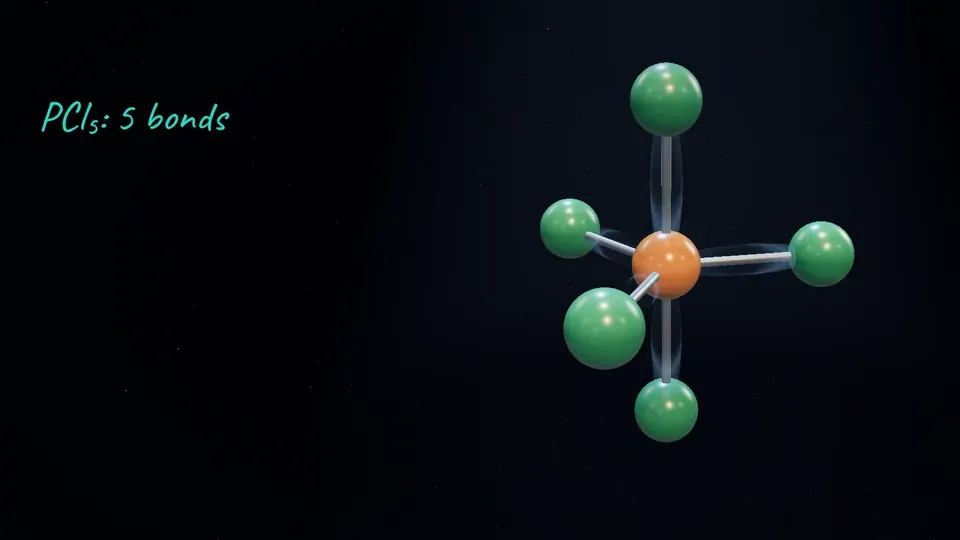
Now let’s go past four, to five and six directions. In phosphorus pentachloride, phosphorus has five bonds and no lone pairs, and those five spots are not all alike. The two on the ends, called axial, each have three neighbors only ninety degrees away, while the three around the middle, called equatorial, each have only two.
In sulfur tetrafluoride, one of those five spots holds a lone pair instead of a bond. Drag the lone pair to the spot where it has the most room.
Put two lone pairs around the middle, like chlorine trifluoride, and the three fluorines make a letter T, called T-shaped. Put in three, like xenon difluoride, and the two fluorines end up in a straight line, linear again, even though xenon has three lone pairs. Six with no lone pairs is sulfur hexafluoride, octahedral. Trade one bond for a lone pair, like iodine pentafluoride, and you get a square pyramid.
With two, like xenon tetrafluoride, the lone pairs sit opposite each other, and the four fluorines make a flat square, called square planar. And that’s every shape you need for the AP exam, eleven of them, all built from just five frames and a few lone pairs.
Each row is a number of directions, and each column adds a lone pair. So if you can count those two things, you can find any shape here without memorizing a wall of pictures. Four directions with one lone pair is trigonal pyramidal, like ammonia.
Polar or not
Shapes also answer one more question, whether a whole molecule is polar. Each polar bond gets an arrow pointing toward the atom that pulls the shared electrons harder, like these two toward the oxygens. In carbon dioxide they pull in exactly opposite directions and cancel, so the molecule is nonpolar, even though both of its bonds are polar.
Water’s two arrows both lean toward the oxygen, so they add up to one overall pull, and water is polar. In boron trifluoride, three equal arrows in a flat triangle cancel, and so do methane’s four, once you see them in three dimensions. Even xenon tetrafluoride, with two lone pairs, is nonpolar, because its arrows pull in opposite pairs. But swap one of methane’s hydrogens for a chlorine, and the balance is gone, so chloromethane is polar.
So a molecule is polar when it has polar bonds in a shape that doesn’t let them cancel. Here’s the Lewis structure of sulfur dioxide, one of the gases that pour out of volcanoes. The rest is yours, from counting its directions right through to whether it’s polar. Which description fits sulfur dioxide?
Single, double, triple
Now let’s go back to that bond in your eye, the one drawn as just two little lines, and look inside it. Here’s the simplest molecule with a double bond like that, ethene. Every bond has one part right on the line between the two atoms, where their orbitals overlap head-on. That part is the sigma bond.
A double bond adds a second overlap. Two p orbitals sit side by side and overlap above and below the line. You can see two halves, but they make one bond, the pi bond. A single bond is just one sigma. A double bond is one sigma plus one pi.
Ethyne has a triple bond between its two carbons. How many sigma bonds and how many pi bonds make it up? More shared bonds pull the two carbons closer. The single bond is about a hundred and fifty-four picometers long. The double is about a hundred and thirty-four, and the triple about a hundred and twenty.
On average it takes about three hundred forty-five kilojoules per mole to break a carbon–carbon single bond. It takes six hundred eleven for a double and eight hundred thirty-seven for a triple. The number of bonds between two atoms is the bond order. A higher bond order makes a bond shorter and stronger.
But a double bond is less than twice as strong as a single. The pi overlap off to the sides is weaker than the sigma overlap on the line. Atom size matters too. Hydrogen fluoride and hydrogen chloride both have single bonds. Chlorine is the bigger atom, so its bond is longer, about a hundred and twenty-seven picometers against about ninety-two.
Now let’s twist. One end of ethane spins right around, because turning around the line doesn’t change the sigma overlap at all. But watch what happens when I twist ethene. The two p orbitals start turning away from each other, and the pi overlap starts to come apart. Take the dial and keep twisting until the pi overlap is completely gone.
So the pi bond works like a lock, and that lock lets one formula make two molecules. Here’s one-two-dichloroethene with both chlorines on one side, called cis, and with them on opposite sides, called trans. Turn the whole cis molecule any way you like, and it never becomes the trans one, so they’re two different molecules with the same bonds, called geometric isomers, and only the cis one is polar.
On paper they look like this. The exam loves to ask you to count sigma and pi bonds. How many sigma bonds are in one molecule of one-two-dichloroethene?
On the AP exam
Let’s finish with a real question from the 2025 AP exam. It showed formaldehyde, H two C O, and asked for the hybridization of its carbon atom. What’s the hybridization of the carbon? The people who graded it reported that a common mistake was counting the four pairs and writing s p three, so count directions, not pairs.
Reading retinal
Now let’s return to the molecule inside your eye. This time, you can read it, just like any other molecule. Pick any carbon along the chain, like this one. It has three directions, so it’s s p two, with angles near a hundred and twenty degrees, and that’s why the chain runs in a zig-zag that’s nearly flat. Over in the ring, this carbon has four directions, so it’s s p three, a little tetrahedron.
Go carbon by carbon, and you’ll find eleven s p two carbons running from the ring along the chain, and nine s p three carbons in the ring and the little methyl groups. And here’s our bond, carbon eleven to carbon twelve, a sigma bond and a pi bond, holding the chain in its bent cis shape, because the pi bond won’t let it twist.
Light gives the molecule enough energy to let go of the weaker pi overlap for an instant. The sigma bond holds on while the end turns, and the pi bond forms again in the straight trans shape. The protein changes shape and starts the signal. The full story of how light does that takes more chemistry than one lesson. But the lock is the pi bond you twisted yourself.
So every star you see tonight reaches you through a pi bond that holds in the dark and lets go in the light. And now, from a flat drawing, you can count the directions around any atom, and the shape, the angles, the hybridization and the polarity all follow. Next time, we’ll see how those shapes decide the way molecules stick to each other.