
Topic 2.5 key terms
- Lewis diagram
- A drawing of a molecule or ion that accounts for every valence electron: shared pairs as lines (bonds) and unshared pairs as dots (lone pairs). It shows how electrons are assigned to bonds or atoms, not where they physically are, and not the molecule's shape.
- valence electrons
- The outer electrons an atom brings to bonding. For main-group atoms, the last digit of the group number (helium, with 2, is the exception): H 1, C 4, N 5, O 6, F 7.
- electron budget
- The total number of valence electrons a Lewis diagram must show: the sum over all atoms, minus one per + charge or plus one per − charge. Every electron is used exactly once.
- bonding pair
- A pair of electrons shared between two atoms, drawn as a line. It counts once in the molecule's total but for both atoms when you check each atom's count.
- lone pair
- A pair of valence electrons on one atom that is not shared in a bond, drawn as two dots (e.g. the two lone pairs on oxygen in water).
- double and triple bonds
- Two or three shared pairs between the same two atoms (C=O in CO₂, N≡N in N₂), made when a central atom is short of eight by moving a neighbor's lone pair into the bond.
- octet rule
- The pattern that C, N, O and F in stable molecules are surrounded by eight valence electrons (hydrogen by two). A description of stable structures, with known exceptions.
- incomplete and expanded octets
- Exceptions: boron is commonly drawn with six (BF₃); central atoms from period 3 and below can be drawn with more than eight when leftover electrons go on them (Xe in XeF₂ has ten). C, N, O and F never exceed eight.
Transcript
2,557 words · 10 parts
The banana sniffer
It’s six in the morning in Bremerhaven, a port on Germany’s North Sea coast, and the man walking along those refrigerated containers has one of the strangest jobs in the world. He sniffs bananas. Axel Krüger is Chiquita’s chief quality inspector, and people really do call him the banana sniffer. Every week his team checks nearly fifteen million green bananas, fresh off a three-week trip from Central America, hunting for the few that have started to ripen early.
Because a banana that starts to ripen gives off a gas, and that gas tells the bananas around it to ripen too, so one early banana can set off its neighbors, and they set off theirs. And the funny thing is that a few days later, in sealed rooms like this one, people pump in that same gas on purpose, so a whole room of bananas turns yellow right on schedule.
The gas is invisible, so let’s shrink down into the air between those bananas and go find it. Most of what’s floating in here is ordinary air, but every so often one of these drifts past. It’s called ethylene, and each molecule is just six atoms, two carbons and four hydrogens. Those six atoms hold together by sharing twelve outer electrons, and a Lewis diagram is a drawing that shows which of them are shared between atoms and which belong to just one.
By the end of this lesson, you’ll be able to take a formula like this one and draw its Lewis diagram from scratch, and prove why these two carbons have to share two pairs of electrons instead of one. And then you’ll finish a molecule straight off the 2025 AP exam, one that glows in the dark.
Dots, pairs and lines
So let’s start with the smallest molecule there is, two hydrogen atoms and just two electrons. In a Lewis diagram, every atom gets its symbol, with one dot around it for each valence electron, the outer electrons that do the bonding.
Hydrogen has one valence electron, so it gets one dot, and for the main-group elements, helium aside, the last digit of the group number tells you the rest, so carbon in group fourteen gets four, nitrogen five, oxygen six and fluorine seven. Notice the dots go one per side before they pair up, which is why oxygen shows two pairs and two single electrons.
Now watch what happens when two hydrogen atoms meet. Each one brings its single electron, and the two electrons settle in between the atoms as one pair that both of them share. That shared pair is a covalent bond, and since two dots between every pair of atoms gets messy, we draw the pair as a line, so a line always means two shared electrons.
This is the spot where almost everybody gets tripped up, so let’s count really carefully. The whole molecule has two electrons, because only two ever showed up, but if you stand on either hydrogen and look around, you see both of them, because the pair belongs to both atoms at once.
So a shared pair counts once in the molecule’s total, but it counts for each atom it sits between when you check that atom, and keeping those two counts straight is most of this lesson. Let’s make sure that’s solid. In a hydrogen molecule, how many electrons does the whole molecule have, and how many does each hydrogen have around it?
When chemists looked at thousands of stable molecules, they noticed that hydrogen ends up surrounded by two electrons, while carbon, nitrogen, oxygen and fluorine almost always end up surrounded by eight, and that’s called the octet rule. People sometimes say atoms want eight, but atoms don’t want anything; it’s just what stable molecules of these elements look like, and you’ll meet a few that break the pattern. On the AP exam, a Lewis diagram question can be worth two points.
One is for the right total number of electrons, and one is for a valid diagram, with the right count around every atom. Those are the two checks we’ll run on every drawing today.
The routine: water
So let’s write down the routine, because it’s the same five steps for every molecule you’ll draw in this course. First, count up all the valence electrons, which is your budget. Second, connect the atoms with single bonds. Third, give the outer atoms their full counts with lone pairs, which are the pairs that aren’t shared.
Fourth, put anything left over on the central atom. And fifth, if the central atom is still short, take a lone pair from a neighbor and turn it into another bond. Let’s try it on water, which fills that ripening room’s humid air. Two hydrogens bring one electron each and oxygen brings six, so the budget is eight, and every one of them has to show up in the drawing.
Each hydrogen can only make one bond, so the hydrogens go on the outside and oxygen goes in the middle, and those two bonds use four electrons, which leaves four. The hydrogens are already done, because each one has its two, so step four says the four leftover electrons go on the oxygen.
Here’s that water molecule in the room’s air, two bonds in place and four leftover electrons waiting in the dish. The four leftover electrons are waiting in the dish. Drag them to where they belong.
Now both checks. Two bonds and two lone pairs make eight electrons, exactly the budget, and standing on the oxygen you see two bonds and two lone pairs, eight, while each hydrogen has its two.
Those lone pairs are real electrons sitting on the oxygen. Leaving them out of a drawing is one of the most common ways to lose points on a Lewis diagram. And notice the flat drawing only records which atoms are connected and which electrons are shared and which are lone pairs; the real shape in space is a lesson of its own.
Short of eight: carbon dioxide
Water worked on the first try, but carbon dioxide, which those bananas breathe out and so do you, is where step five earns its place. Carbon brings four and each oxygen brings six, so the budget is sixteen.
The atom there’s only one of usually goes in the middle, so we connect O, C, O with two single bonds, which uses four electrons and leaves twelve. Step three fills the outer atoms first, so each oxygen gets three lone pairs, six electrons on each side, and that spends all twelve.
Now check the carbon. It has two single bonds and nothing else, so it’s surrounded by only four electrons, and it needs eight. The tempting fix is to draw four more dots on the carbon, but that puts twenty electrons on the page, and carbon dioxide only has sixteen to give, so it fails the very first check. So instead we use step five. And this time, you’re going to do it.
Here’s carbon dioxide in the room’s air, carbon’s ring stuck at four and the dish empty. Fix the carbon without adding a single electron. Look at what happened. The carbon now sits between two double bonds, which puts eight electrons around it, each oxygen still has eight, because the pair it moved still counts for it, and the total is still sixteen, because we didn’t add anything, we just moved it.
That move is the heart of this whole lesson, so I want to say it one more time, slowly. When the central atom comes up short, you don’t add electrons; you take a lone pair that’s already there and share it, and since a shared pair counts for both atoms, the neighbor loses nothing and the center gains two.
Here are two wrong drawings of carbon dioxide. The first uses exactly sixteen electrons, but carbon only has four around it. The second gives carbon eight, but it has twenty electrons and leaves each oxygen with ten, so always run both checks, because each one catches what the other misses.
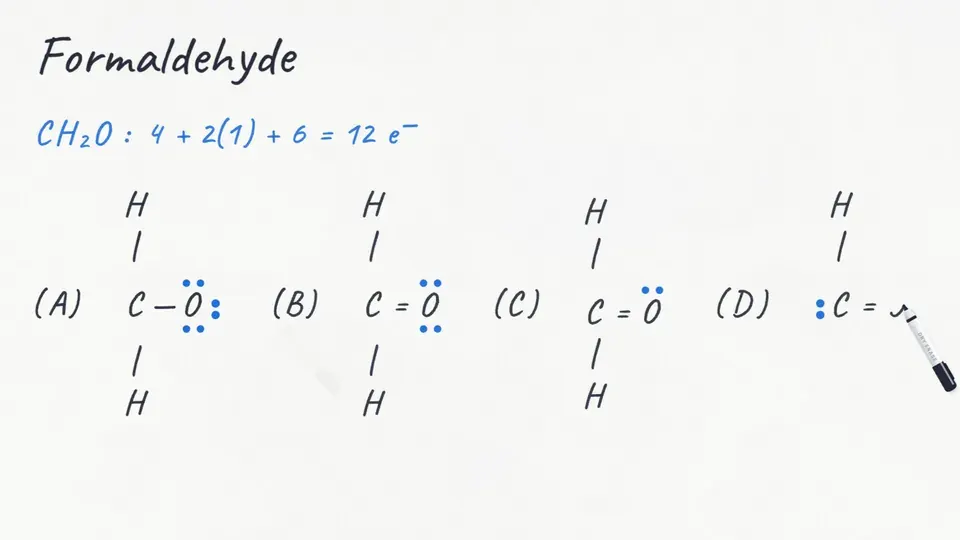
Now you try one. This is formaldehyde, C H two O, which has twelve valence electrons, and four students drew it four different ways. Only one of these four diagrams passes both checks. Which one? Formaldehyde needed exactly the move we made with carbon dioxide, one lone pair from the oxygen becoming a second bond to the carbon.
Ten electrons, two atoms
Back in the room’s air, the most common molecule by far is nitrogen, N two, about four out of every five molecules floating around in there, and in the air you’re breathing right now. Each nitrogen brings five electrons, so there are ten in all, and if we join them with one bond and split the other eight evenly as lone pairs, each nitrogen ends up surrounded by only six.
Two nitrogen atoms, ten electrons, and each atom needs eight around it. How many pairs do you think they’ll have to share? Step five again, one lone pair from each nitrogen, and the bond goes from single to double to triple. Now count around the left nitrogen, and the six shared electrons in the triple bond plus its own lone pair make eight. The right nitrogen has the same six shared electrons plus its own lone pair, so it’s eight again.
And the whole molecule has six in the bond and four in the two lone pairs, which is ten, exactly the budget. Two atoms both reach eight with only ten electrons between them, because six of those electrons belong to both atoms at the same time.
Charged species
You’ll also draw ions, and the only thing that changes is the budget, because a charge means the atoms gained or lost electrons. Take ammonium, N H four plus, which is in a lot of fertilizers. Nitrogen brings five and four hydrogens bring four, which makes nine, and the plus sign means one electron is missing, so we subtract one and the budget is eight.
Four nitrogen–hydrogen bonds use all eight, so nitrogen has no lone pair, and the whole ion goes in square brackets with the charge outside. And if four bonds on nitrogen looks like breaking a rule, count it: four bonds is eight electrons, and the rule counts electrons, not bonds. Hydroxide, O H minus, goes the other way, with six from oxygen, one from hydrogen, and one extra for the minus charge, eight again, which gives one bond and three lone pairs on the oxygen.
The mistake I see most is getting the sign backward. A plus charge means the ion has fewer electrons than its atoms brought, so you subtract, and a minus charge means it has more, so you add.
Hydronium, H three O plus, is the ion that makes an acid’s solution acidic. How many valence electrons does it have to work with?
When eight isn’t the rule
I promised you a few molecules that break the octet rule. There are two kinds worth knowing. Boron trifluoride has twenty-four valence electrons. Three bonds, plus three lone pairs on each fluorine, spend all twenty-four. Boron ends up with six.
Step five would borrow a lone pair from a fluorine. That gives one double bond, and boron reaches eight. Chemists don’t draw it that way. Boron is a center you leave at six, and next lesson’s formal charge shows why.
The other kind goes past eight. In xenon difluoride, xenon is a noble gas with eight valence electrons and each fluorine brings seven, so the budget is twenty-two. Two bonds use four, three lone pairs on each fluorine use twelve more, and that leaves six. Those six can’t just vanish, so step four puts them on the central atom as three lone pairs, and now xenon is surrounded by ten electrons.
Atoms from the third row and below, like phosphorus, sulfur, chlorine and xenon, can end up with more than eight in a Lewis diagram, but carbon, nitrogen, oxygen and fluorine never do. Think about rows. Which of these central atoms can end up with more than eight electrons around it?
The ripening gas
Now you have everything you need to keep the promise from the start, so let’s draw ethylene, the ripening gas. Two carbons bring four each and four hydrogens bring one each, so the budget is twelve. The hydrogens can only make one bond each, so they go on the outside, two on each carbon, and the carbons connect to each other. That’s five single bonds, ten electrons, which leaves exactly two.
Here’s that skeleton back in the ripening room’s air, ten electrons in its five bonds and the last two waiting in the dish. Two electrons left, and both carbons are sitting at six. Where do they go?
So here’s the proof I promised you. Each carbon has two bonds to hydrogen, which is four electrons, plus the double bond, four more, so eight. Each hydrogen has its two, and the drawing uses all twelve electrons exactly once. Twelve electrons just aren’t enough for both carbons to reach eight unless they share two pairs.
The drawing can’t tell you how a banana responds to this gas, which is biology, but it is the molecule’s blueprint, and you built it from nothing but its formula. Six atoms and twelve electrons, and a whole room of fruit turns yellow.
On the AP exam: the glowing element
Hamburg, 1669. An alchemist named Hennig Brand was trying to make gold, and for reasons that made sense to him at the time, he decided the secret might be hiding in urine. So he collected an enormous amount, let it sit and boiled it down, and what he got wasn’t gold. It was a white, waxy substance that glowed in the dark, a new element, phosphorus, which means light-bearer.
The glow comes from phosphorus reacting with oxygen in the air, and the phosphorus itself is made of molecules of four atoms, P four, with every atom bonded to the other three. And that exact molecule was on the 2025 AP exam, which drew all four phosphorus atoms and all six bonds and asked students to add the electrons that were missing. Add the electrons it’s missing. To reach the atom in the back, spin the molecule around. Watch each phosphorus’s ring close at eight, and the total come to twenty.
On paper it goes like this. Four phosphorus atoms bring five electrons each, twenty in all, and the six bonds already use twelve, so eight are missing, which is four lone pairs, one on each phosphorus.
And this is the line that earns the point. The scoring guide looked for exactly that, two lone-pair electrons on every phosphorus, so a student who copied the bonds perfectly but left off those dots didn’t get it. Check any one atom and you’ll see why it works, because three bonds and one lone pair make eight.
The routine, kept
That’s the whole routine on ethylene. Step one, count the budget of valence electrons. Step two, connect the atoms with single bonds. Step three, fill the outer atoms. Step four, put the leftovers on the center.
Step five, share a lone pair if the center comes up short, unless it’s boron. Then check twice, once for the total and once around every atom. Sometimes the routine hands you two different drawings that both pass every check. Ozone is one of them. What to do about that is where the next lesson picks up.