
Topic 2.6 key terms
- resonance
- When two or more valid Lewis diagrams can be drawn for the same arrangement of atoms, the real molecule or ion is a single blend of them (the resonance hybrid), not a switch between them.
- resonance hybrid
- The real structure that the resonance diagrams describe together; in ozone each O–O bond is one and a half bonds, so both bonds are the same length.
- delocalized electrons
- Bonding electrons spread over more than two atoms, which is what resonance diagrams describe.
- formal charge
- Valence electrons − nonbonding electrons − ½ bonding electrons for an atom in a Lewis diagram; a bookkeeping tool for choosing between diagrams, not a measured charge. The formal charges add up to the species' charge.
- octet rule
- Carbon, nitrogen, oxygen and fluorine have at most eight electrons around them in a Lewis diagram; the best diagram gives them octets before minimizing formal charges.
- odd-electron species
- A molecule with an odd number of valence electrons (NO: 11, NO₂: 17); no Lewis diagram can give every atom an octet, a limitation of the model.
Transcript
2,183 words · 8 parts
A molecule’s portrait
In 2009, in a lab on the shore of Lake Zurich, a team of scientists at IBM made a picture. It ended up in newspapers all over the world. Their microscope sat inside this steel chamber, with nearly all the air pumped out, cooled with liquid helium to minus two hundred sixty-eight degrees Celsius, colder than the surface of Pluto.
And the clever part was hiding at the very tip of the needle, where they’d stuck one single molecule of carbon monoxide, just two atoms, a carbon and an oxygen, with the oxygen pointing down like a fingertip. Then they slid that molecule back and forth across another molecule, line by line, feeling every bump, the way you’d read Braille with your fingertip, and out came this, a map of every tiny push the tip felt, made without any light at all.
That’s pentacene, a molecule built from five rings of carbon atoms, and you’re looking at a portrait of one molecule, taken by another molecule. Now, here’s how we’d draw pentacene in chemistry class, with every bond a single line or a double line. But look at the picture, and there’s no pattern of singles and doubles anywhere in it, just rings. So which one is telling the truth, our drawing, or the picture?
By the end of this lesson, you’ll know exactly when one drawing of a molecule isn’t enough. And you’ll know what chemists do about it, and you’ll use a little electron bookkeeping to crack a puzzle hiding right here on the microscope’s tip, in the two atoms that took this picture. So let’s start with a molecule that has just three atoms, and there’s a whole layer of it floating about twenty-five kilometers over your head right now.
One molecule, two drawings
This is the stratosphere at sunrise, and spread all through it is ozone, three oxygen atoms stuck together, which soaks up most of the sun’s harshest ultraviolet light before it reaches the ground. If you gathered up all the ozone above one spot and squeezed it to the pressure we feel at sea level, it would make a layer only about three millimeters thick, two pennies stacked up. So let’s take just one of those molecules. We’re going to draw its Lewis diagram, one step at a time.
Each oxygen brings six valence electrons, so three of them give us eighteen electrons to place. Two single bonds use four, lone pairs fill the two outer oxygens, and the last two electrons go on the middle one.
But the middle oxygen only has six, so we turn one of the outer lone pairs into a second bond. Take that pair from the left oxygen, and the double bond is on the left. Now take it from the right oxygen instead. The double bond is on the right.
Both drawings follow every rule, and they’re mirror images, so neither one is better. So which one is ozone? Two equally good drawings like this are a classic setup on the AP exam, so let’s see what the real molecule tells us.
A double bond is shorter than a single bond, so if ozone really looked like drawing A, one bond would be short and the other one long. Suppose we could measure ozone’s two bonds. What do you think we’d find?
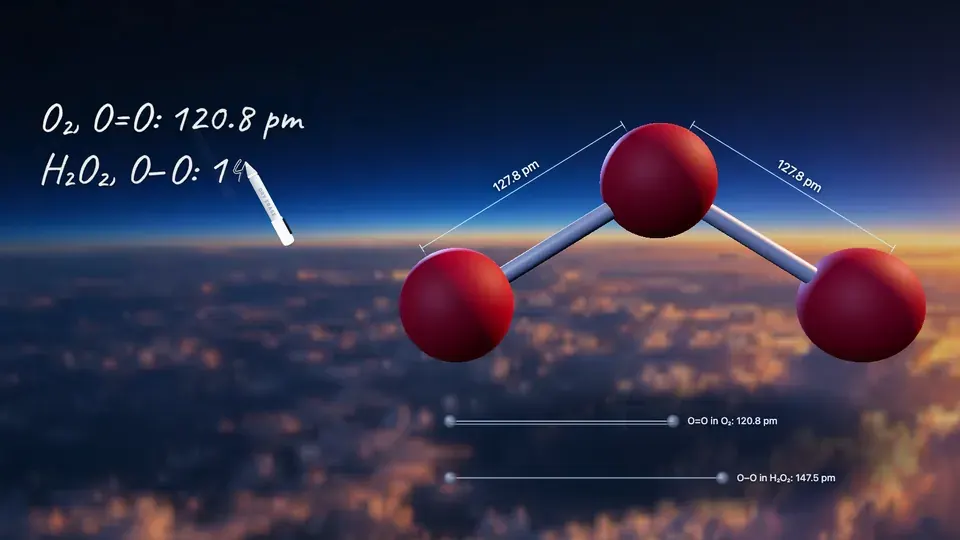
Grab the caliper and measure both of ozone’s bonds yourself. A real double bond between two oxygens is a hundred twenty point eight picometers, a real single bond is a hundred forty-seven point five, and ozone’s two bonds sit in between, identical. So the left drawing gets the bonds wrong one way, and the right drawing gets them wrong the other way. And while we switch between them, the molecule itself doesn’t change one bit.
Chemists draw both with a double-headed arrow between them, and the real molecule is a blend of the two drawings, which we call resonance. In the blend, the electrons of that extra bond spread over both bonds, and chemists call that delocalized, so each bond is one and a half bonds, which is why both are the same length, between a double and a single.
The most common mistake is to picture ozone flipping back and forth between the drawings, and it never does. A mule is a cross between a horse and a donkey. But it isn’t a horse on Monday and a donkey on Tuesday, it’s a mule all the time. And ozone is a blend all the time. The whole explanation fits in one sentence, the electrons are delocalized, ozone is a resonance hybrid, and each bond is between a single and a double.
Three drawings, one ion
Let’s do a harder one together, the nitrate ion, N O three minus, the ion in fertilizer and in the black powder that launches fireworks. Nitrogen brings five valence electrons, the oxygens bring eighteen, the minus sign adds one more, so we have twenty-four. Three single bonds use six, filling the three oxygens uses the other eighteen, and that leaves nitrogen with only six.
So one oxygen has to make a double bond with nitrogen, and the question is which one. Here I’ve put it on the top oxygen. If I move a pair from the lower-left oxygen into its bond and push one pair of the old double bond back onto the top oxygen, I get a second drawing, and nitrogen still has eight. Now you make the third drawing of nitrate. All it takes is moving one pair of electrons.
Don’t draw two double bonds at once, because that puts ten electrons around nitrogen, and nitrogen, like carbon and oxygen, never holds more than eight. So nitrate has three equally good drawings, the real ion is a blend of all three, each nitrogen–oxygen bond is one and a third bonds, and when they’re measured, all three bonds come out the same length. Carbonate, C O three two minus, works the same way, with twenty-four electrons and three equal drawings, and we’ll meet it again in a coral reef.
Formal charge
So far, every molecule had drawings that were all equally good. But many molecules can be drawn in ways that really are different. Then we need to pick the best one, using a tool called formal charge.
Pretend every bond is cut exactly in half, so each atom keeps its own nonbonding electrons, the lone pairs and any unpaired one, plus one electron from every bond, and compare that with the valence electrons it brought. So the formal charge is the valence electrons, minus the nonbonding electrons, minus half the bonding electrons, and since every bond line holds two electrons, half the bonding electrons is just the number of lines.
Let’s do ozone. The single-bonded oxygen has six lone-pair electrons and one bond, so six minus six minus one, minus one. The middle oxygen has two lone-pair electrons and three bonds, so six minus two minus three, plus one, and the double-bonded oxygen gets six minus four minus two, zero.
They add up to zero, the charge of the whole molecule, and that check always works, so do it every time. Keep in mind that formal charge is bookkeeping, a way of tracking electrons. It isn’t a charge you could measure on that atom, and that will matter at the end of the lesson. What’s the formal charge on the nitrogen in nitrate?
Now let’s choose between drawings that really are different, using three rules in order. First, carbon, nitrogen and oxygen get an octet, never more. Second, keep formal charges as close to zero as you can. Third, a negative formal charge belongs on the more electronegative atom.
Here are two drawings of carbon dioxide, one with two double bonds, one with a triple bond and a single bond. Both have sixteen electrons and octets everywhere, so rule one can’t decide. In the first, every formal charge is zero. In the second, the triple-bonded oxygen has two lone-pair electrons and three bonds, so what’s its formal charge?
Six minus two minus three, so plus one, and the single-bonded oxygen comes out minus one. So the all-zero drawing wins, and the measurements agree, because carbon dioxide’s two bonds are identical, a hundred sixteen point two picometers.
Now you try one. This is nitrous oxide, N two O, laughing gas, the same gas that’s in whipped-cream chargers. Here are three drawings, with the atoms in the order nitrogen, nitrogen, oxygen, all with sixteen electrons and octets, so work out the formal charges and pick the best one. Look closely at these three drawings of N two O. Which one is the best?
When the model breaks
Every molecule so far had an even number of electrons. This is nitric oxide, N O, which your blood vessels use as a signal, and five plus six makes eleven valence electrons. Eleven can’t be split into pairs, so the best drawing has a double bond, two lone pairs on oxygen, and one pair plus one lonely electron on nitrogen, which leaves nitrogen with seven.
Nitrogen dioxide, the brown gas in smog, has seventeen, so it has the same problem, and no drawing of either molecule can give every atom an octet. These molecules are real and important, so the problem is the Lewis model, which has limits, and an odd number of electrons is where they show. Look at these four formulas. Which one can’t give every atom an octet?
On the AP exam: the ocean’s carbon
This is the reef at Heron Island, on Australia’s Great Barrier Reef, and the corals here build their skeletons out of calcium carbonate. Inside the skeleton, the carbonate ions are flat little triangles, and their three carbon–oxygen bonds come out essentially the same length, exactly what three equally good drawings predict.
Out in the water, most of the ocean’s dissolved carbon is in a different ion, bicarbonate, H C O three minus, and this exact ion was on the 2016 AP exam. The question said two of its carbon–oxygen bonds are the same length, the third is longer, and the hydrogen is on one oxygen, and asked for Lewis diagrams that fit. Now look at bicarbonate. Tap the two bonds that share the double bond.
Let’s draw it with twenty-four electrons, one from hydrogen, four from carbon, eighteen from the oxygens and one for the charge, keep the hydrogen on its oxygen, and put the double bond on either of the other two, which gives two drawings. The scoring guide gave one point for a correct Lewis structure, and a second point for showing resonance with both drawings.
Look at this double-headed arrow between the two drawings. It’s the line that earns the second point. Check the formal charges in the left drawing. Only the single-bonded oxygen without a hydrogen gets a minus one. That adds up to the ion’s charge, minus one.
What if the hydrogen’s oxygen took the double bond instead? Its three oxygens would come out plus one, minus one and minus one. The left drawing has zero, zero and minus one. That’s three charges instead of one, so this drawing loses.
The tip’s secret
Now let’s go back to the microscope, and the molecule on the end of its tip, carbon monoxide, with four plus six, ten valence electrons. Most people first try a double bond, with two lone pairs on oxygen and one on carbon, and every formal charge comes out zero, which looks perfect.
But count around the carbon, and it only has six electrons, so the first rule says no. Turning one of the oxygen’s lone pairs into a third bond fixes it, and now both atoms have a full octet.
Cut the three bonds in carbon monoxide and give each atom its share. So the best drawing of the molecule on the tip is the triple bond, because complete octets matter more than zero formal charges. And look what that does, it puts a plus formal charge on oxygen, which pulls on electrons harder than carbon does. That plus one isn’t a measured charge on the oxygen, it’s bookkeeping, a tool for choosing between drawings and nothing more.
The portrait, explained
So, back to our question. Pentacene can be drawn six different ways, with the double bonds shuffled around the rings, and the real molecule is a blend of all six at once. Bonds that are double in more of the drawings come out a little shorter and, in pictures like this, a little brighter, so the picture was telling the truth, and it takes all six of our drawings to match it. So when a molecule can be drawn more than one equally good way, use resonance, and remember it’s still one molecule.
When the drawings are different, octets and then formal charges pick the best one. And when the electron count is odd, expect the model to come up short. And if you ever switch from one resonance drawing to another and wonder what changed, it’s never the molecule, and it’s never the number of electrons, it’s only our drawing. Next time we’ll figure out why ozone is bent while carbon dioxide is perfectly straight, and these drawings are exactly where that answer starts.