
Topic 2.2 key terms
- internuclear distance
- The distance between the centers (nuclei) of two bonded atoms or ions, usually in picometers (1 pm = 10⁻¹² m).
- potential energy curve
- A graph of the potential energy of two atoms against their internuclear distance: zero when they are far apart, a minimum at the bond length, a steep rise when they are pushed too close.
- bond length
- The equilibrium internuclear distance: the distance at the minimum of the potential energy curve (H₂: 74 pm).
- bond energy
- The energy required to separate bonded atoms: the depth of the well, from the minimum up to zero (H₂: 436 kJ/mol). Breaking a bond always takes energy in.
- bond order
- The number of shared electron pairs between two atoms (1 single, 2 double, 3 triple). Between the same two kinds of atoms, a higher bond order means a shorter bond and a larger bond energy.
- Coulomb's law
- The attraction between opposite charges grows with the charges and falls with the square of the distance between their centers: F ∝ Q₁Q₂/r².
Transcript
2,321 words · 8 parts
The lightning capital
This is the southwest corner of Lake Maracaibo, in Venezuela, late at night, and if you were sitting on the porch of one of these houses on stilts, you’d see the sky doing this for hours. When NASA used a satellite to count lightning over most of the planet for sixteen years, no place came out ahead of this lake, with about two hundred thirty flashes on every square kilometer, every year, from storms on almost three hundred nights a year.
Every one of those bolts heats the air it passes through to around fifty thousand degrees Fahrenheit, five times hotter than the surface of the Sun, and that heat does something to the air that’s surprisingly hard to do. So let’s stop time, right in the middle of one bolt. Then let’s fly inside it. We’re shrinking past the raindrops and the specks of dust, down past anything a classroom microscope could show you, until the air turns into what it really is, molecules tumbling through mostly empty space.
About four out of every five of these molecules are nitrogen, two nitrogen atoms stuck together, and the air you’re breathing right now has exactly the same molecules in it. Your body needs nitrogen atoms to build every protein and every strand of DNA, and yet it can’t use a single one of the nitrogen atoms you breathe in, because the two atoms in each molecule hold on to each other so tightly.
But here comes the heat from the bolt, and every molecule starts shaking harder and harder. The oxygen molecules give way first, while the nitrogen holds on, and holds on, until finally even nitrogen gets torn apart. By the end of this lesson, you’ll be able to draw the one graph that explains everything we just watched. You’ll read off it exactly how far apart two bonded atoms sit, and how much energy it takes to pull them apart.
And I want you to hang on to one thing you saw, because an oxygen atom is almost the same size as a nitrogen atom, so why did the oxygen fall apart first, while nitrogen took almost twice as much energy to break? To figure that out, let’s start with the simplest pair of atoms there is, two hydrogen atoms, and bring them together very slowly.
Two atoms, one curve
Here are two hydrogen atoms, far apart, each one just a proton with an electron around it, and out here they don’t feel each other at all, so we’ll call the energy of the pair zero. This graph keeps track of them, with the distance between the two nuclei along the bottom, in picometers, and the potential energy of the pair up the side, the energy the pair stores because of where its atoms sit.
Now watch what happens as I slowly push them together. Each nucleus starts pulling on the other atom’s electron, so the pair settles into lower and lower energy, and the curve drops below zero. But push them past a certain point and the two nuclei get so close that they shove each other away, because they’re both positive, and the energy shoots straight up this wall.
So there’s an attraction between each nucleus and the electrons shared between them, and a repulsion between the two nuclei, and right at the bottom of the curve, those two balance exactly. That’s the most stable spot for the pair, with the nuclei seventy-four picometers apart, measured from the center of one nucleus to the center of the other, and even down here the atoms keep jiggling back and forth around that distance.
Okay, I’m going to hand these atoms over to you. Grab one of them, and move it to the distance where this pair is the most stable.
That distance at the bottom is called the bond length. And how deep the valley goes is called the bond energy. Graphs like this are some of the AP exam’s favorite things to hand you. And by the end of today, you’ll be able to read both numbers off one, and even draw a new curve yourself.
Reading the well
Let’s put that same curve on the board and read it carefully. Along the bottom is the internuclear distance, the distance between the two nuclei, and up the side is the potential energy, in kilojoules per mole. Out on the right the atoms are far apart, and that’s our zero line, so every bonded pair sits somewhere below it, which is why the bottom of the curve is a negative number.
The first reading is how far over the bottom sits, so drop straight down from the lowest point, and you land on seventy-four picometers, the bond length of H-two. The second reading is how deep the valley goes, from the bottom all the way up to zero, four hundred thirty-six kilojoules per mole, and that’s the bond energy, the energy it takes to pull a mole of these molecules apart into separate atoms.
And this is where a lot of people slip up. The number at the bottom is negative four thirty-six, so it’s tempting to call the bond energy negative. But climbing from the bottom up to zero takes energy, zero minus negative four thirty-six, which is positive four hundred thirty-six.
That means breaking a bond never releases energy. It always takes energy in, the way pulling two magnets apart takes effort from your hands. It’s forming a bond that gives energy back out, which is why the lightning had to pay for every bond it broke.
This is the curve for hydrogen chloride. What’s its bond length, and how much energy does it take to pull the two atoms apart?
Shorter and stronger
Let’s go back to the atoms and swap in two carbons, the pair at the center of an ethane molecule, held together by one shared pair of electrons, a single bond. Its curve bottoms out at a hundred fifty-four picometers, three hundred forty-five kilojoules per mole below zero. So here’s a question for you. What do you think happens to this valley if the two carbons share three pairs of electrons instead of one?
Take a second to think about it. Then drag the bottom of the triple-bond curve to wherever you think it should go. So every time we add a shared pair, the valley moves to the left and gets deeper, because more electrons between the nuclei pull them closer together and hold them more tightly.
Side by side, every extra shared pair makes the bond shorter, from a hundred fifty-four picometers down to a hundred twenty, and stronger, from three hundred forty-five kilojoules per mole up to eight hundred thirty-seven. The number of shared pairs is called the bond order, and the rule is that a higher bond order means a shorter bond with a larger bond energy.
It’s tempting to think a triple bond is exactly three times as strong as a single bond, but three times three forty-five is over a thousand, and the real triple bond is eight hundred thirty-seven. So the rule gives you the direction. For the size, you still need real data.
The other thing that sets a bond’s length is the size of the atoms. Chlorine and iodine both make single bonds with themselves, but iodine has two more occupied electron shells, so its nuclei can’t get as close.
The chlorine bond is a hundred ninety-nine picometers long, with a bond energy of two hundred forty-three. The iodine bond stretches to two hundred sixty-seven. Its shared pair sits farther from both nuclei, so it’s weaker, only a hundred fifty. So when two bonds have the same bond order and someone asks you why one is longer, the answer is size, because more electron shells keep the two nuclei farther apart.
Why nitrogen holds on
Now we can go back to the puzzle from the storm. These three curves are hydrogen, nitrogen and oxygen, but I’ve hidden which is which, so you’ll need both rules, the size of the atoms and the bond order.
Which curve belongs to which molecule? And that’s the answer to the storm’s puzzle. Oxygen falls apart first because its double bond is only four hundred ninety-eight kilojoules per mole deep, while nitrogen’s triple bond is nine hundred forty-six, almost twice as deep.
Let’s go back into the storm and feel the difference. To pull an oxygen molecule apart, the energy we put in has to reach four hundred ninety-eight kilojoules per mole, but nitrogen just keeps hanging on, past five hundred, past seven hundred, until it finally lets go at nine hundred forty-six. Those numbers are per mole, though, and every single break happens to one molecule, so how much energy does it take to break just one?
Starting from nine hundred forty-six kilojoules per mole, I multiply by a thousand joules per kilojoule, then divide by Avogadro’s number, one mole over six point oh two two times ten to the twenty-third molecules. Kilojoules cancel, moles cancel, and we’re left with joules per molecule. Grab the calculator and work it out. How many joules does it take to break one N-two molecule?
Ions and Coulomb’s law
Lightning isn’t the only arc like that. In a steel mill, engineers make their own between three giant graphite rods and a heap of scrap steel, hotter than three thousand degrees Celsius, to melt it. Then they pour the steel into a huge bucket called a ladle at about sixteen hundred degrees, which raises a great question, because what do you make a bucket out of when it has to hold liquid steel?
Steelmakers line the inside with bricks made mostly of magnesium oxide, an ionic compound of Mg-two-plus and O-two-minus ions, which doesn’t melt until about twenty-eight hundred degrees. Table salt is an ionic compound too, but it melts at eight hundred and one degrees, so a salt-lined ladle would melt away the moment the steel went in. So let’s dive into one brick and look at one magnesium ion next to one oxide ion, two hundred eleven picometers apart, center to center.
The attraction between two ions follows Coulomb’s law, so it gets stronger with the charge on each ion, and weaker with the square of the distance between their centers. Let’s first compare sodium chloride with potassium chloride, where only one thing changes. The charges are plus one and minus one in both, but a potassium ion is bigger, so its center sits three hundred fifteen picometers from the chloride’s instead of two hundred eighty-two.
The distance gets squared, so the closer pair wins by three fifteen over two eighty-two, squared, about one point two five, and the ions in sodium chloride pull about twenty-five percent harder. Now let’s do magnesium oxide against sodium chloride together, where both things change. The charges go from one times one to two times two, which makes the pull four times stronger by itself.
The ions are smaller too, two hundred eleven picometers apart instead of two eighty-two. So that four gets multiplied by two eighty-two over two eleven, squared, about one point eight, which comes to about seven times stronger, and on an energy graph that shows up as a well that sits closer in and goes much deeper.
Now you get to build one, so pick a positive ion and a negative ion. Then try to make the pair with the strongest attraction you can. Here’s one with some new ions. Which pair attracts each other most strongly?
On the AP exam
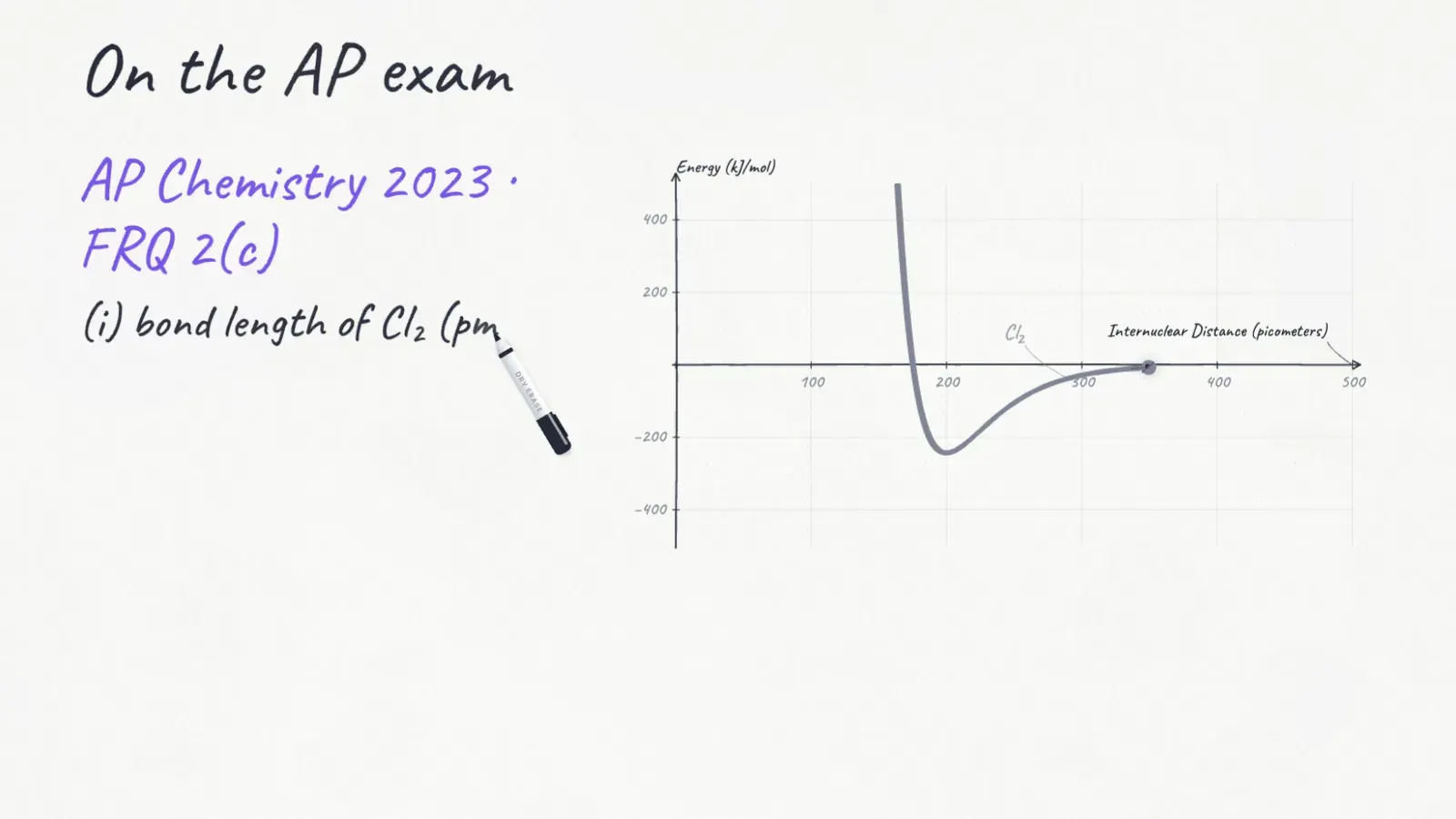
Let’s finish with a real question from the 2023 AP Chemistry exam. Students got this potential energy curve for chlorine, Cl-two, and were first asked for its bond length, which is two hundred picometers, straight down from the lowest point, and that’s one point. Then they were told an average aluminum-chlorine bond is two hundred twenty picometers long, with a bond energy of four hundred twenty-five kilojoules per mole, and asked to draw its curve on the same graph.
Notice something odd. The aluminum-chlorine bond is longer than chlorine’s, yet much stronger, four twenty-five against about two forty-three. Aluminum is a bigger atom than chlorine, so the bond is longer. But chlorine pulls on the shared pair much harder than aluminum does. That makes the bond polar, and its partial charges add an extra Coulomb pull.
Go ahead and draw it. Drag the bottom of the aluminum-chlorine curve to where it belongs. And here’s how that drawing earns its two points on the scoring guide. One point for a minimum at two hundred twenty picometers, and one for a minimum at negative four twenty-five that flattens toward zero by the right edge of the graph.
It’s negative at the bottom, even though the bond energy they gave you was positive. Use the bond-order rule for atoms that are alike, the same atoms or atoms about the same size, like nitrogen and oxygen in the storm. Aluminum and chlorine aren’t alike. Their bond is polar, and that extra pull makes it stronger.
What the storm knows
Let’s go back to the storm one more time. When lightning tears nitrogen apart, some of the loose atoms join up with oxygen, and the rain washes those nitrogen compounds down into the lake and the soil, where plants can finally use them. Lightning does this for about five million tonnes of nitrogen a year. A bolt carries enough energy to climb out of one of the deepest wells in chemistry.
So now you can read the storm. Where the bottom of a curve sits tells you how far apart the atoms are. And how deep it goes tells you the energy it takes to pull them apart.
More shared pairs make a bond shorter and stronger, and bigger atoms make it longer. And for ions, bigger charges and smaller ions make the pull stronger. Next time, we’ll stack about a billion billion of those ions into a crystal. Then we’ll see what holds a whole grain of salt together.