
Topic 2.1 key terms
- electronegativity
- How strongly an atom in a bond attracts the electrons it shares (Pauling scale, no units). It increases across a period and decreases down a group; fluorine (3.98) is the highest.
- nonpolar covalent bond
- A bond in which two atoms of equal or similar electronegativity share a pair of electrons almost evenly, e.g. H–H, Cl–Cl and (effectively) C–H.
- polar covalent bond
- A shared pair held unevenly because the atoms differ in electronegativity; the more electronegative atom becomes partly negative (δ-), the other partly positive (δ+).
- partial charge (δ+, δ−)
- A charge smaller than a full electron's charge on an atom in a polar bond. The molecule stays whole and neutral overall; a partial charge is not an ion.
- bond dipole
- The separation of partial charges along one bond, drawn as an arrow toward the δ- end with a crossed tail at δ+. In single bonds, a bigger Δχ gives a bigger bond dipole.
- ionic bonding
- The attraction between positive and negative ions in an extended array; typical of a metal combined with a nonmetal. Ions attract every opposite neighbor, not one partner.
- metallic bonding
- Positive metal ions (cores) held together by a sea of delocalized valence electrons that are not associated with any single atom.
Transcript
2,618 words · 8 parts
A hose on a live wire
That power line is live right now, carrying hundreds of thousands of volts, and the man in that helicopter is spraying it with water, on purpose. Every instinct you have says water and electricity don’t mix. But power companies really do this, washing the glass on live lines from the ground and from helicopters, with the power still on.
And this crew isn’t afraid of the water in that tank, because they’ve purified it until it barely carries any current at all. What they’re afraid of is this thin white crust on the glass.
It’s sea salt, blown off the ocean and left on the glass by the fog, and on a dry day it does nothing at all. But on a foggy night the dew soaks into it, and a thin film of salty water on the glass starts carrying current across it, until the whole string flashes over. And the strange part is that the fog is water, and the jet is water. So how does a thin crust of salt turn harmless water into something that carries current across glass that’s holding back hundreds of thousands of volts?
By the end of this lesson, you’ll be able to look at every material on this tower, the metal cable, the glass, the salt and the water in that tank, and explain from what their electrons are doing why some of them carry current and some don’t, and why this crew would never fill that tank from the ocean below. And it all comes down to something very small, two atoms and a pair of electrons that both of them are pulling on.
Who pulls harder?
This is a hydrogen molecule, two hydrogen atoms holding on to each other, and the glue is that glowing cloud in the middle. It’s a pair of electrons, and both nuclei pull on it at once, so neither atom owns those electrons, and that shared pair is what holds the two atoms together. That’s a covalent bond.
Two fluorine atoms do exactly the same thing, and because they’re identical, the pair sits right in the middle again. But what happens when the two atoms aren’t the same? The shared pair slides over toward the fluorine, because fluorine pulls on electrons much harder than hydrogen does.
Chemists call that pull electronegativity. It’s how strongly an atom in a bond pulls on the electrons it shares, and the scale everybody uses, the Pauling scale, is just a number with no units. If we read across the second row of the periodic table, from lithium to fluorine, the numbers climb the whole way, from about one up to almost four.
And going down a column, from fluorine to chlorine to bromine to iodine, the numbers drop. So fluorine, up in the top right corner, is the hardest puller of them all, and hydrogen sits in the middle at two point two. The periodic table you get on the AP exam doesn’t list these numbers, so what you really need is the trend, and the reason behind it. So why should fluorine pull harder than oxygen, right next door? Let’s put the two atoms side by side and look inside them.
Both atoms keep their bonding electrons in the same shell, the second one, with the same two inner electrons underneath. Fluorine has nine protons and oxygen has eight, so once those two inner electrons cancel two of them, fluorine pulls with a charge of plus seven and oxygen with only plus six. Now fluorine against chlorine. Chlorine has more protons, seventeen of them, but its extra shell of eight inner electrons cancels out those extra protons, so it’s plus seven too, and its bonding electrons sit a shell farther out, where the pull is weaker.
That’s Coulomb’s law, the same one from unit one. The force grows with the charges, and it shrinks with the square of the distance, so across a row the growing charge wins, and down a column the growing distance wins. And this is a classic AP exam question. If they ask why fluorine is more electronegative than chlorine, saying it’s in the top right corner only describes the trend, and the answer that earns the point says fluorine’s bonding electrons sit in a shell closer to the nucleus.
Okay, now I want you to try one. Between oxygen and sulfur, which atom pulls harder on electrons it shares, and why? Now let’s watch what that difference in pull does to the pair of electrons two atoms share.
Sharing, evenly and not
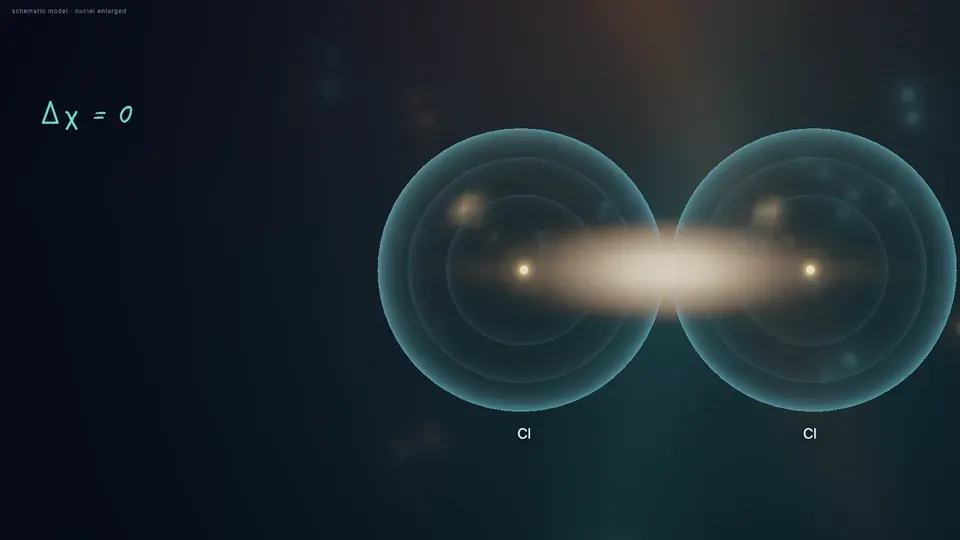
When two identical atoms share a pair, like two chlorines, the pull is perfectly even, so the sharing is even too, and we call that a nonpolar covalent bond. Now let’s swap one of those chlorines for a hydrogen. Chlorine pulls harder, so the shared pair spends more of its time near the chlorine, which leaves the chlorine end a little negative and the hydrogen end a little positive.
Only a little, though, because the electrons are still shared. So we write a small Greek delta for a partial charge, delta minus on the chlorine and delta plus on the hydrogen, and we call this a polar covalent bond.
Let’s do that one properly on the board. Hydrogen’s electronegativity is two point two oh, and chlorine’s is three point one six, so the difference between them is zero point nine six. That difference isn’t zero, so the sharing is uneven, and the atom with the higher electronegativity, chlorine, picks up the partial negative charge. Chemists draw it with an arrow pointing toward the negative end, with a little cross on the tail at the positive end.
And notice that the molecule didn’t break apart, and nobody took an electron away, so it’s still one molecule sharing one pair, just unevenly. Now let’s try carbon and hydrogen, the bond that’s all over candle wax and gasoline. Carbon is two point five five and hydrogen is two point two oh, so the difference is zero point three five.
So carbon pulls a little harder, and the sharing isn’t perfectly even. Does that make the bond polar? Before I tell you, I want you to show me where you think that shared pair really sits.
Grab the shared pair and drag it to where you think it really sits in a carbon–hydrogen bond. So nonpolar really means the two electronegativities are close enough that the sharing comes out nearly even, and carbon and hydrogen are close enough, even though carbon pulls a tiny bit harder.
Now let’s see what happens as the difference grows. Iodine is two point six six and hydrogen is two point two oh, so hydrogen iodide has a difference of about one half, hydrogen bromide about three quarters, hydrogen chloride almost one, and hydrogen fluoride almost one point eight.
The bigger the difference, the farther the shared pair shifts, and the bigger the bond’s dipole. And when chemists measure these four molecules in the lab, their dipoles, in units called debyes, line up in exactly the same order.
Now try one on your own, with these three electronegativities on the board. Which of these two single bonds is more polar, and which atom in it carries the partial negative charge? Hold on to that idea, that the atom that pulls harder ends up partly negative, because water’s bonds work the same way.
Why the purified water is safe
Let’s go back to the coast and that jet of water, because now we can actually see what’s inside it. Every drop is made of water molecules, and every one of them has two oxygen–hydrogen bonds, with a difference of about one point two between them, so those bonds are polar.
The oxygen end is partly negative, and the hydrogen ends are partly positive, but add up the whole molecule and the charges cancel to zero. Every water molecule is neutral and stays in one piece, and that’s why the purified water in that tank barely conducts.
So what if this crew filled their tank from the ocean down there? What would carry the charge down the jet? Fill the tank with seawater, and the jet fills up with sodium ions and chloride ions, real charged particles that drift along the stream and carry current straight back toward the helicopter.
To carry a current, you need charged particles that can actually travel through the water, and a partial charge can’t leave the molecule it belongs to. So a partial charge is not an ion. A chlorine atom with a delta minus is still part of its molecule, sharing a pair of electrons, while a chloride ion is a separate particle with a full negative charge, free to wander off. That’s why the crew purifies the water in that tank, so there are almost no ions in it to carry the charge, and as it blasts the salt off the glass, it carries the danger away with it.
From sharing to ions
So how far can the shared pair go? Let’s take two made-up atoms and turn up the difference between them. As the difference grows, the pair slides farther and farther toward the stronger atom, until at the very end it’s sitting almost entirely on one side. At that point one atom has basically handed over an electron, so these aren’t partial charges anymore, they’re ions. And ions don’t pair off into molecules, because each one attracts every opposite charge around it, which is how you build a crystal like salt.
Here’s the whole picture on one line, from a difference of zero up past two. Two hydrogens sit at zero, carbon and hydrogen near zero, hydrogen chloride near one, hydrogen fluoride near one point eight, and sodium chloride above two. And there’s no wall anywhere on this line. Every polar bond has a little ionic character, and the farther right you go, the more ionic it gets, which is why chemists call this a continuum.
You may have seen a rule that says any difference bigger than one point seven means the bond is ionic. Let’s test it on hydrogen fluoride, at one point seven eight. Hydrogen fluoride is made of separate H F molecules, and it boils at about twenty degrees Celsius, so on a warm day it’s a gas. An ionic compound like salt behaves nothing like that, since it doesn’t even melt until eight hundred and one degrees, so the rule gets H F wrong, and it’s a polar covalent compound.
A better rule of thumb is that a metal bonded to a nonmetal is usually ionic, and two nonmetals bonded together are covalent. But when a number and a substance disagree, the substance wins, because the way it behaves is the best evidence of its bonding.
Here’s a solid that melts at eight hundred and one degrees, and it only conducts electricity once it’s melted. What’s carrying the charge in the melt? And that’s exactly what’s happening on the glass of that tower.
A dry salt crust is a crystal of ions locked in place, so it can’t carry any current at all, but when the dew soaks in, it pulls the ions out of the crystal and sets them free to move, and now the film on the glass carries current, and that’s how the flashover from the beginning got started.
Electrons that belong to no one
Now look at the cable itself, which is aluminum. An aluminum atom next to another aluminum atom gives a difference of zero, the same as in hydrogen. So is this cable just a pile of tiny aluminum molecules, each one sharing a pair like H two?
To see why not, let me show you one of the strangest experiments anyone has done with a metal. In 2010, a team from Rice, Sandia and Brown put two gold wires inside an electron microscope, wires just three to ten nanometers across, so thin that only about ten to thirty-five atoms fit across them. They simply brought the two ends together, with no heat and no glue, so go ahead and do it yourself, and watch the place where they meet.
That can only happen because of what metal atoms do with their outer electrons. In a metal, those electrons spread out through the whole piece as a sea that belongs to no one atom, and that sea holds all the positive cores together. So when two clean pieces of gold touch, the electron sea just flows across the gap, and there’s nothing left to mark where one piece ends and the other one begins.
Compare that with two hydrogen molecules running into each other. Each pair of electrons belongs to its own two nuclei, so they just bounce off. And the weld held. When the researchers pulled on the wire, it broke somewhere else, and they snapped and rewelded one wire eleven times, and its electrical readings barely changed.
On the AP exam, this is how you draw a metal, identical positive cores sitting in a sea of electrons. Hydrogen and gold both have a difference of zero, but one makes separate little molecules, and the other makes one big piece held together by delocalized electrons. So the difference in electronegativity can’t tell those two apart on its own, and that’s why you also have to ask how the substance actually behaves.
On the AP exam
Let’s do the kind of question the AP exam loves. A chemist has three solid samples and tests each one, whether it conducts as a solid, whether it conducts once it’s melted, and what its melting point is. Let’s take sample B first. The claim is that B is ionic, and the evidence is that it doesn’t conduct as a solid but does once it melts.
But the sentence that earns the point is the next one. In the solid, B’s ions are locked in place, and in the liquid they’re free to move and carry charge. Always name the particle that moves, because without it, your claim is just a label. Sample C never conducts and melts at only eighty degrees, so it’s made of neutral molecules, with nothing charged to move.
Now you finish it. Which sentence earns the point for claiming that sample A has metallic bonding? So every answer like this one names the particle that moves, and says why it can or can’t move.
Tell the crew
So let’s go back to the coast, where the sun’s going down and the crew is almost done. At the start I promised you’d be able to explain every material on this tower, so let’s find out.
Find the material on this tower whose electrons belong to the whole piece, and then find the one that only carries charge once it gets wet. The glass is mostly silicon and oxygen, joined into one big covalent network, and its electrons stay put in the bonds and atoms they belong to, so nothing can carry the charge through it. And the purified water is made of polar molecules that are neutral overall, so it barely conducts at all.
So if you remember one thing from today, make it this. Atoms pull on shared electrons with different strengths, and the difference decides where those electrons sit. If they’re shared evenly, it’s a nonpolar covalent bond, and if they’re shared unevenly, with partial charges, it’s polar covalent. If one atom pulls them over far enough to make ions, it’s ionic, and if they spread through a whole piece of metal, it’s metallic. And when you’re not sure, look at how the substance behaves.
The crew is heading home, and the glass is clean for another season. Next time, we’ll zoom in on a single bond and ask how far apart two bonded atoms really sit, and why they don’t just fall into each other.