
Topic 1.8 key terms
- valence electrons
- The outermost electrons of an atom (sodium has one, chlorine seven). Their interactions with nuclei decide how an element reacts and bonds.
- core electrons
- The inner electrons. They sit between the nucleus and the valence electrons and shield them from most of the nuclear charge.
- ionization energy
- The energy needed to remove an electron from an atom or ion in the gas phase, in kJ/mol. A large jump between successive values marks the end of the valence electrons.
- cation
- An ion with a net positive charge. A monatomic cation forms when an atom loses electrons and keeps its nucleus, e.g. Na⁺ (11 protons, 10 electrons).
- anion
- An ion with a net negative charge. A monatomic anion forms when an atom gains electrons, e.g. Cl⁻ (17 protons, 18 electrons); polyatomic anions such as OH⁻ also exist.
- typical charge
- The usual charge of a main-group ion in ionic compounds, predicted by its column: group 1 +1, group 2 +2, aluminum +3, group 15 −3, group 16 −2, group 17 −1.
- analogous compounds
- Compounds with the same formula pattern made by elements in the same column, e.g. LiCl, NaCl, KCl or MgO, CaO, SrO.
- ionic bond
- The electrostatic attraction between oppositely charged ions. In NaCl each Na⁺ is attracted to all six neighbouring Cl⁻, not to one partner.
- formula unit
- The smallest whole-number ratio of ions in an ionic compound, e.g. NaCl (1 : 1), CaF₂ (1 : 2), Al₂O₃ (2 : 3). Not a molecule.
- Coulomb explosion
- A break-up driven by the repulsion of like charges. In the 2015 alkali-metal experiments, surface atoms lost their valence electrons and the positive ions left behind pushed the drop apart.
Transcript
2,439 words · 9 parts
Ten tons off a cliff
In January 1947, the United States government had about ten tons of sodium metal left over from the war, and no railroad would agree to carry it. So they hauled it out here, to Lenore Lake in eastern Washington, a lake the newsreel’s narrator called devoid of fish, and they rolled it off a cliff.
Barrel after barrel bounced down the rocks and into the water, and then the lake started to explode. A newsreel crew was there, and it filmed the whole thing. For generations the explanation was that the metal reacts with water and makes hydrogen gas, and the heat sets the hydrogen on fire. The fireballs really are hydrogen burning, but the beginning happens far too fast for anyone to see.
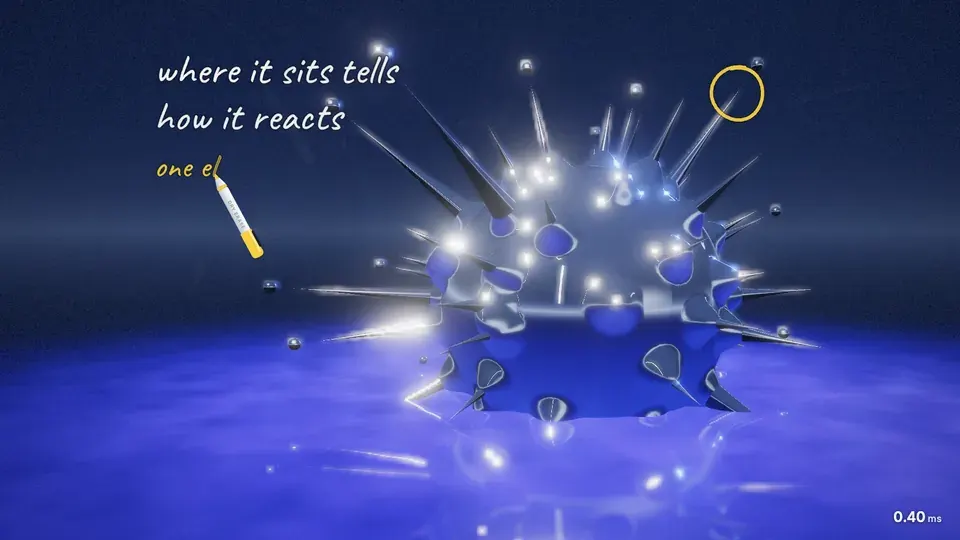
Then in 2015, chemists in Prague and Germany filmed beads of liquid sodium–potassium metal hitting water with a high-speed camera, and one of them, Phil Mason, admitted he’d been doing this explosion for years without understanding it. In the first half a thousandth of a second, before anything catches fire, the metal shoots out spikes and the water around it turns deep blue.
Zoom into the surface and you’ll find sodium and potassium atoms, each with a single electron way out on its outer edge. When the water touches it, every surface atom throws that electron into the water in a few trillionths of a second, and those loose electrons are the blue. What’s left at the surface is a layer of positive metal ions, and like charges push each other away, so the drop tears itself open, in what chemists call a Coulomb explosion.
By the end of this lesson, an element’s spot on the periodic table will tell you how it reacts. You’ll see why sodium gives up just one electron, and you’ll write formulas for compounds you’ve never seen. So let’s start with that one electron, because the whole story is hiding in why sodium lets go of it so easily.
The one electron
Here’s a single sodium atom, hugely enlarged, with eleven protons in its nucleus and eleven electrons around it. Two electrons sit in the first shell and eight in the second. Just one sits all by itself, out in the third. Those ten inner ones are core electrons, and the lonely outer one is the valence electron, the kind that decides how an atom reacts.
On paper that’s two, then eight, then one, which in the configurations from topic 1.5 is a neon core plus three s one. So why is it so easy to lose? Coulomb’s law says the pull between charges drops off fast with distance, and the valence electron is the farthest one out, which is exactly the argument the AP exam wants when you explain this.
The ten core electrons also sit in between and cancel most of the nucleus’s charge, so in the simple shell picture, that outer electron feels the pull of about one proton instead of eleven. Let’s feel the difference. Grab the outer electron and pull it off the atom. Then see whether you can take a second one.
Chemists call that tug ionization energy, which you met in topic 1.5, the energy it takes to pull an electron off an atom. For sodium the first electron costs about four hundred ninety-six kilojoules per mole, and the second costs four thousand five hundred sixty-two, more than nine times as much. That jump is why sodium is N A plus in its ordinary compounds. You’ll never find N A two plus there. Its second electron would have to come out of the core.
Magnesium has two valence electrons, so its jump comes one step later, after seven hundred thirty-eight and fourteen fifty-one, at seven thousand seven hundred thirty-three, which means it gives up two and becomes M G two plus. This picture, a list of ionization energies with one giant jump, is a classic AP question, asking what ion the element forms, or which element it even is.
Here are the first four ionization energies of a mystery element X, in kilojoules per mole. Which ion does X most likely form?
When sodium became an ion its nucleus didn’t change, so it still has eleven protons and it’s still sodium, it just has ten electrons now, and eleven pluses with ten minuses leave a charge of plus one. So losing a negative electron leaves a positive ion, which is worth saying twice because it trips so many people up.
The family
Sodium isn’t alone, because the whole first column works this way, lithium, sodium, potassium, rubidium and cesium. Each row down adds a whole new shell, so the valence electron sits farther out, with more core electrons in between. So it gets easier to pull off, from five hundred twenty kilojoules per mole for lithium down to three seventy-six for cesium.
Let’s see whether that matters, and drop each one into water. Lithium floats and fizzes, skating around pretty calmly. Sodium gets hot enough to melt into a silver ball that races across the surface. Potassium catches fire the moment it lands, with a pale purple flame. Rubidium sits right below potassium, so before we drop it, make a prediction.
And cesium, at the bottom, goes off almost instantly. They look so different, but every one does the same chemistry, handing its valence electron to the water and becoming a plus one ion, and making hydrogen gas and hydroxide.
So their compounds share formulas, lithium hydroxide, sodium hydroxide, potassium hydroxide, and the same goes for their chlorides and oxides, which is what chemists mean by analogous compounds in one column. Melting point and heat also shape how violent each one looks, but the loosely held valence electron is why they react at all.
That 2015 drop hides a nice test of this, because sodium and potassium melted together don’t form an ionic compound, they just mix into a liquid metal, since neither can pull electrons off the other. Ions form when one element holds its valence electrons loosely and the other pulls hard, so let’s go meet an atom that pulls.
The other side of the table
This is chlorine, with seventeen protons, the same ten-electron core as sodium, two and eight, and seven valence electrons in the third shell. In the simple shell picture, those seven feel the pull of about seven protons through the core. That grip is strong enough to pull in one more electron. That makes it a chloride ion, with seventeen protons and eighteen electrons, the same electron count as argon next door.
Let’s put sodium’s family next to chlorine’s. Those metals get more reactive going down, as you saw in the water. Going down any column, the outer shell sits farther out. The nucleus grips its outer electrons more weakly.
A giver reacts by letting go of an electron, so a weak grip helps it. A halogen reacts by grabbing one, so it needs a strong grip. Think about that grip. Which halogen reacts most violently with sodium?
The halogens get more reactive going up, the opposite of sodium’s family. The noble gases already have full shells. Pulling an electron off costs a huge amount, and an extra one would have to start a new shell, far from the nucleus. They don’t form simple ions in ordinary compounds. Nobody has ever made a stable compound of neon.
Put it all together on the periodic table, and you get a map of charges. Sodium’s column makes plus one, magnesium’s makes plus two, and aluminum makes plus three. On the other side, oxygen has six valence electrons. It gains two to reach neon’s eight, so it becomes two minus.
Nitrogen has five valence electrons, so it gains three, for three minus. The halogens need just one more, for one minus, and the noble gases stay at zero. The middle block is different. Transition metals can take more than one charge, so a problem will tell you which one.
You’ll hear people say that atoms want eight electrons. I’d cross that one out, because atoms don’t want anything. Why do ions land on noble-gas counts? Pulling off a core electron costs a fortune, and an electron in a new shell barely feels the nucleus. Lithium plus keeps just two electrons, helium’s count, nowhere near eight.
Here’s the electron configuration of an atom, and its outer shell is the place to start. Which ion does this atom typically form in ionic compounds?
Salt
Now let’s put a giver and a taker in one jar. This pale green gas is chlorine, poisonous enough that armies used it as a weapon in World War One. Now watch the jar. In goes a hot bead of sodium. That white powder on the glass is sodium chloride, table salt, made from an explosive metal and a poisonous gas.
Each sodium hands its valence electron to a chlorine atom, so sodium becomes N A plus and shrinks, and chlorine becomes C L minus and swells. And people often get this part wrong, because the ions don’t pair off, they pull on every opposite charge around them and lock into a crystal.
In 2021, a team in Tokyo filmed this inside a carbon tube thousands of times thinner than a human hair, where a jittery clump of ions suddenly snapped into a tiny cube. Let’s look inside a crystal like that and pick out one sodium ion. Click a sodium ion, then click each chloride ion touching it. How many are there?
So the bond in salt is the pull between each ion and all the opposite charges around it, the whole crystal at once, and the electron handoff only gave the ions their charges. Then why do we write N A C L and not N A C L six? Because each chloride touches six sodiums too, so a block made of complete cells has one sodium for every chloride. The formula is a ratio, one to one, the formula unit from topic 1.3, and that’s how the charges cancel, one plus for every minus. That’s why a grain of salt has no overall charge, even though it’s packed with charged particles.
Make the charges cancel
That’s all you need to write formulas like these, so find each ion’s charge from the table, then use just enough of each ion to make the charges add to zero. Take magnesium chloride, where magnesium in column two becomes M G two plus, and chlorine in column seventeen becomes C L minus.
One magnesium brings plus two, but one chloride only cancels minus one, so I need a second chloride. That gives M G C L two, and the check is plus two, plus two times negative one, which is zero.
Let’s do aluminum and oxygen together. Aluminum, with three valence electrons, loses all three and becomes a three plus ion, and oxygen gains two to become a two minus ion. Plus three and minus two don’t cancel one for one, so we need a number both three and two go into, and the smallest is six.
Try it before I write it in, and work out how many aluminum ions make plus six and how many oxide ions make minus six. Two aluminum ions make plus six and three oxide ions make minus six, so the formula is A L two O three.
You’ve probably seen aluminum oxide without knowing it, because a ruby is aluminum oxide with a trace of chromium, and a blue sapphire is aluminum oxide with a little iron and titanium. One trap comes from the crisscross shortcut, where each ion’s charge becomes the other ion’s subscript, because for magnesium oxide it gives you M G two O two, but a formula has to be the smallest whole-number ratio, so it’s M G O.
Grow your own
Now it’s your turn to build. When your ions add up to zero, a crystal grows. Calcium is in column two and fluorine is a halogen. Put calcium ions and fluoride ions in the dish until the charge comes out to zero.
This is fluorite, which often grows in violet cubes like these, and it’s the mineral that gave fluorescence its name. Now I’ll swap calcium for strontium, right below it, and since the charge stays plus two, the ratio stays one to two, strontium fluoride, the same formula shape. Here’s one on your own, with magnesium and nitrogen, and this time I haven’t written the charges for you.
Now build the compound of magnesium and nitrogen. Make the charge come out to zero. And the aluminum oxide from the board, two aluminum ions and three oxide ions, grows a sapphire. Every one of these crystals is a ratio of ions whose charges add to zero. You can read each ratio right off the periodic table.
How the AP exam asks it
The AP exam loves to test the column idea by swapping in a neighbor, like this. Sodium and oxygen form sodium oxide. What’s the formula of the compound potassium and sulfur form?
They also like to hand you a picture, so say a student draws calcium chloride like this, four calcium ions and four chloride ions. Each calcium ion is plus two and each chloride is minus one, so this drawing has eight positive charges and only four negative ones. The sentence that earns the point says each calcium ion is plus two and each chloride is minus one, so calcium chloride needs two chlorides for every calcium for the charges to add up to zero.
On the 2023 AP exam, a student’s particle drawing of dissolved strontium hydroxide had the wrong ratio of ions, and saying it needs one strontium ion for every two hydroxide ions is what earned the point. So we fix the drawing by adding four more chloride ions, and now it really is a sample of calcium chloride.
Back to the lake
So back to Lenore Lake, where you can now explain what happened to ten tons of sodium. Every sodium atom gave up its one valence electron, the hydrogen burned off in those fireballs, and the sodium ended up dissolved in the lake as N A plus, alongside hydroxide ions. And if they’d rolled cesium off that cliff instead, you’d know what to expect, because it sits three rows down the same column, so it makes the same plus one ion and the same kinds of compounds, only with an even more violent reaction.
That’s what the periodic table gives you once you can read it, because an element’s spot predicts its typical ion charge, and those charges let you write the formulas of common ionic compounds. And the lake the newsreel called devoid of fish? Today, Lenore Lake is a popular place to go trout fishing.