
Topic 1.5 key terms
- nucleus
- The tiny, positively charged center of an atom, made of protons (+1 each) and neutrons (no charge).
- atomic number (Z)
- The number of protons in the nucleus; it identifies the element. A neutral atom has Z electrons.
- ion
- An atom with a net charge: charge = protons − electrons. Cations (+) have lost electrons; anions (−) have gained them.
- Coulomb's law
- The force between two charges is proportional to the product of the charges and inversely proportional to the square of the distance: F ∝ q₁q₂/r².
- shell (energy level)
- A group of orbitals with the same shell number, n = 1, 2, 3, …; higher shells are higher in energy and extend farther from the nucleus.
- subshell
- A part of a shell: s (1 orbital, 2 e⁻), p (3 orbitals, 6 e⁻), d (5 orbitals, 10 e⁻), f (7 orbitals, 14 e⁻).
- orbital
- A region where an electron is likely to be found (not a path); each holds at most two electrons, with opposite spins.
- Aufbau principle
- In the ground state, electrons fill the lowest-energy subshells first; the periodic table read in order gives the filling order.
- ground-state electron configuration
- The lowest-energy arrangement of an atom's or ion's electrons in subshells, e.g. O: 1s² 2s² 2p⁴.
- noble-gas notation
- A shorthand that writes the preceding noble gas's configuration in brackets: Na = [Ne] 3s¹.
- core electrons
- In a main-group atom, the inner electrons below the outermost shell (Na: the 10 of [Ne]; Xe: [Kr] plus 4d¹⁰, 46 electrons).
- valence electrons
- In a main-group atom, the electrons in the outermost (highest) shell (Na: 3s¹; Xe: 5s² 5p⁶). Transition-metal d electrons can also take part in bonding.
- ionization energy
- The energy required to remove an electron from a gaseous atom or ion (always positive); e.g. Na 496 kJ/mol.
- shielding and effective nuclear charge
- Inner electrons reduce the nuclear charge an outer electron feels; the charge it effectively feels is the effective nuclear charge.
Transcript
2,539 words · 8 parts
Dawn: the engine that strips xenon
This dark, cratered world is Ceres, a dwarf planet out in the asteroid belt, and those two bright spots are patches of salt catching the sunlight. In March 2015, NASA’s Dawn spacecraft slipped into orbit around Ceres, and since it had already spent more than a year circling the giant asteroid Vesta, it became the first spacecraft ever to orbit two worlds beyond Earth. And it did all that with an engine that pushes about as hard as a single sheet of paper resting on your hand.
That sounds useless, but Dawn kept pushing for almost six years in all, and it added up to a record change in velocity, about forty-one thousand kilometers per hour. The secret is in this chamber, which is full of xenon gas, and when one of these racing electrons slams into a xenon atom hard enough, it knocks one of that atom’s own electrons right off.
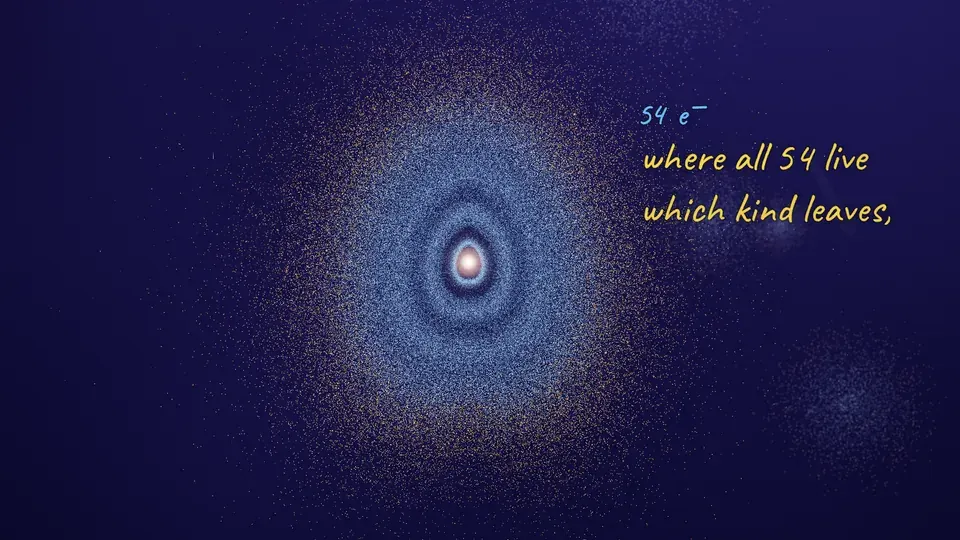
What’s left is a xenon atom with a positive charge, and the grids at the back fling those charged atoms out up to ten times faster than an ordinary rocket’s exhaust, and that’s the push. Now look at just one of those xenon atoms, because it has fifty-four electrons, and the engine takes exactly one.
By the end of this lesson, you’ll be able to write down where all fifty-four of those electrons live, and then point to the kind of electron this engine knocks off and explain why it’s that kind and not a deeper one. Fifty-four is a lot of electrons to keep track of, so let’s start by looking at what an atom is actually made of.
What an atom is made of
Right at the center of every atom sits the nucleus, a tight little cluster of protons, which carry a positive charge, and neutrons, which carry no charge at all. And it is tiny, because if this atom were blown up to the size of a football stadium, its nucleus would be about the size of a pea on the fifty-yard line, and almost all of the atom’s size comes from its electrons. Each electron carries a negative charge exactly as strong as a proton’s positive one, so a xenon atom, with the fifty-four protons that make it xenon, needs fifty-four electrons to be neutral.
Let’s keep score on the board. The fifty-four is xenon’s atomic number, straight from the periodic table, and this one is xenon-one-thirty-two, the most common kind, with a hundred and thirty-two protons and neutrons in its nucleus, so the neutrons are the rest, seventy-eight. And a neutral atom has as many electrons as protons.
Now the engine knocks one electron off, and the protons don’t change, so it’s still xenon, but it has fifty-four positive charges and only fifty-three negative ones, and that leftover plus one is the charge we write on the symbol. An atom with a charge like that is called an ion. So the charge is protons minus electrons, and if you flip that around, the number of electrons is the protons minus the charge.
Let’s do one together, because counting the electrons in an ion is a classic quick question on the AP exam. A chloride ion is chlorine, so it has seventeen protons, and its charge is minus one, so how many electrons does it have? Seventeen minus negative one is eighteen, so it has one extra electron, which makes sense, because a negative ion is one that picked up electrons.
And watch out for the big decimal on chlorine’s square of the periodic table, because thirty-five point four five is the average mass of its atoms, and it tells you nothing about the electrons, which always start from the atomic number. Now you try one. How many electrons does one calcium ion, C a two plus, have?
The pull: Coulomb’s law
So what keeps all those electrons from just drifting away? The positive nucleus and the negative electrons attract each other, and that pull is behind almost everything we’ll do from here on. The rule for that pull is called Coulomb’s law, and it says the force between two charges is proportional to the two charges multiplied together, divided by the distance between them squared.
Watch the arrow as the electron moves twice as far away, because doubling the distance makes the distance squared four times bigger, so the pull drops to a quarter of what it was. Three times as far and the pull drops to a ninth, which is why a little extra distance inside an atom costs an electron a lot of grip. Charge works the other way, so if we double the charge on the nucleus and keep the distance the same, the pull doubles.
Let’s do it the way you’d write it on a test. When the electron moves from r to two r, I’ll put the new force over the old one. Dividing by the old force flips its fraction upside down, so its r squared ends up on top, and since the charges are the same on top and bottom, they cancel.
That leaves r squared over two r, all squared, which is r squared over four r squared, so the new force is exactly one quarter of the old one, just like the arrow showed us. And this is how Coulomb’s law usually shows up on the AP exam, as a comparison, where they change a charge or a distance and ask whether the attraction gets stronger or weaker, and why.
Now drag the electron out to where the nucleus pulls on it only a quarter as hard as it does right now. This next one is a little harder, because the charge on the nucleus doubles and the electron also moves twice as far away, so what happens to the force?
Shells, subshells and orbitals
So the nucleus holds nearby electrons tightly and electrons farther out loosely, and quantum mechanics tells us they can’t have just any energy, so they settle into layers called shells, or energy levels, numbered one, two, three, going outward. Shell one holds a single cloud, shaped like a ball. That cloud is an orbital, the region where you’re likely to find an electron. One orbital holds two electrons, at most.
It isn’t a track the electron races around, like a planet around the sun. The cloud is a map of where the electron is likely to be. Orbitals with the same shape, in the same shell, make up a subshell. Shells hold subshells, and subshells hold orbitals.
Every shell has an s subshell, starting with one s, this ball. It’s one orbital, so it holds two electrons. From shell two on, each shell also has a p subshell, starting with two p. That’s three dumbbell-shaped orbitals, so it holds six electrons.
Shell three adds a d subshell, starting with three d: five orbitals, ten electrons. Shell four adds an f subshell, starting with four f: seven orbitals, fourteen electrons. Let’s collect the four subshells in one table. Each orbital holds two electrons, so the max is always double the orbitals.
Your turn. How many orbitals does shell two hold? To build an atom’s ground state, its lowest-energy arrangement, we fill the lowest-energy subshells first, and that’s called the Aufbau principle, from the German word for building up. Let’s build oxygen, which has eight electrons, drawing one box for each orbital, so two go into one s, and they pair up with opposite spins, which is what the up and down arrows mean, and then two more fill two s.
That leaves four electrons for two p, and electrons in the same subshell spread out one per orbital before any of them pair up, so the first three go in on their own and only the fourth one doubles up. Written as a configuration, that’s one s two, two s two, two p four, and a quick check is that the little superscripts add up to eight, oxygen’s number of electrons.
The periodic table writes it for you
Now, you could memorize that filling order, but you don’t have to, because the periodic table already has it built in. Look at the table’s shape, two columns wide on the left, six on the right, ten in the middle and fourteen along the bottom, and those are exactly the numbers of electrons an s, p, d and f subshell can hold.
So to write any configuration, you walk across the table in order, and for sodium that’s one s two in row one, then two s two and two p six in row two, and one step into row three’s s block, three s one. Everything before that last step is just neon’s configuration, the noble gas at the end of row two, so we can write sodium as neon in brackets, followed by three s one. The ten electrons inside those brackets are core electrons, tucked in close to the nucleus, and the one electron out in the highest shell is sodium’s valence electron, which is the one that does sodium’s chemistry.
Let’s do chlorine together. It’s in row three, so we start from neon, take the two s steps, then five steps into the p block, which gives us neon, three s two, three p five, and seven valence electrons. For the chloride ion we add one more electron, which fills three p up to six, so it has the same arrangement as argon, but it’s still chlorine, because it still has seventeen protons.
Now you find one. Tap the element whose configuration is neon, three s two, three p four. Which of these species has the configuration one s two, two s two, two p six?
Into the d block: manganese and its ion
Row four is where it gets interesting, because potassium and calcium put their electrons into four s, and then we hit the ten-wide middle block, and those are three d electrons, one shell lower than the row. So the d block always runs one shell behind its row, three d in row four, four d in row five, and that four d is going to matter when we get back to xenon.
So manganese, element twenty-five, starts from argon, takes four s two, and then five steps into the d block, which gives argon, four s two, three d five. You’ll also see it written with the three d first, in order of shells, and that’s exactly the same atom, with the same electrons in the same subshells.
Now, when manganese loses two electrons to become M n two plus, which two leave? It’s really tempting to take them off the end of what you wrote, from three d, and that’s the mistake a lot of students make. The electrons that leave first are the ones in the highest shell, the four s electrons, which spend more of their time farther from the nucleus, so M n two plus is argon, three d five.
This exact question was on the 2023 AP exam, which gave you manganese and asked which subshell loses electrons first when it forms an ion, and the answer that earned the point was four s. The order you write the subshells in doesn’t decide which electrons leave, the shell does. Iron is argon, four s two, three d six. What’s the ground-state configuration of the iron two plus ion?
How hard is it to pull one off?
So let’s actually pull some electrons off, starting with sodium. When I drag its one three s electron away, the meter shows the energy that takes for a whole mole of sodium atoms, four hundred ninety-six kilojoules, and that number is sodium’s first ionization energy. Now let’s take a second electron from the sodium ion, which has to come out of two p, and look at that meter, it climbs to about forty-six hundred kilojoules, roughly nine times as much.
Coulomb’s law explains the jump. The three s electron is far out in shell three, and the ten core electrons sit between it and the nucleus and cancel out much of the nucleus’s pull, which we call shielding. A two p electron is in shell two, much closer in, with only the two one s electrons in a shell beneath it, so it’s far less shielded.
The charge it effectively feels from the nucleus, which we call the effective nuclear charge, is far bigger, and that’s why it costs nine times as much. So whenever you compare two electrons, ask how far each one sits from the nucleus and how many electrons sit in between, because those two things set the pull, and the pull sets the price.
Here are the measured ionization energies, and every one of them is energy we have to put in, because pulling an electron away from a nucleus that attracts it always costs energy. So you might hear that sodium wants to lose its electron to get a full shell, but the meter just showed that it takes almost five hundred kilojoules per mole, and nothing in Coulomb’s law wants anything.
Let’s compare potassium with sodium together. Potassium has more protons, but eight more core electrons shield them, and its valence electron sits farther out, in shell four, so it’s easier to remove, four hundred nineteen kilojoules against sodium’s four ninety-six. Magnesium’s first ionization energy is higher than sodium’s. Which explanation is best?
Back to Dawn
Now we’re ready for xenon, and if we walk the table all the way to element fifty-four, we pass through eleven subshells. One s two, two s two, two p six, three s two, three p six, four s two, then three d ten, one shell behind, four p six, five s two, four d ten, and five p six.
But starting from krypton, the noble gas just before it, it’s just krypton, four d ten, five s two, five p six. Let’s check the count together, krypton’s thirty-six, plus ten, plus two, plus six, which makes fifty-four. And notice that the core is bigger than the bracket, because those ten four d electrons sit in shell four, inside shell five, so xenon has forty-six core electrons and eight valence electrons.
Let’s go back inside the engine, where our xenon atom is waiting, opened up, with all eleven of its subshells lit. Now you be the engine. Tap the subshell where it’s cheapest to knock an electron out.
And just for fun, look what it would take to pull out one of the two one s electrons, right down next to the nucleus, because the bar flies off the screen, at almost three thousand times the energy. So the engine takes a five p electron, the most loosely held of all fifty-four, and leaves behind X e plus, still fifty-four protons, now with fifty-three electrons. And that positive charge is exactly what the grids need, because now the ion feels their electric pull, and they fling it out the back.
Every bit of push from Dawn’s ion engines started just like that, with one five p electron leaving one xenon atom, billions of billions of times every second, all paid for with sunlight from those wings. So now you can write where all fifty-four of xenon’s electrons live and say why the engine takes a five p electron, and in the next lesson we’ll measure the energies of those electrons, subshell by subshell, with a technique called photoelectron spectroscopy.