
Topic 1.6 key terms
- photoelectron spectroscopy (PES)
- An experiment that shines light of known energy on atoms, measures the kinetic energies of the electrons it knocks out, and uses them to find how much energy it takes to remove electrons from each subshell.
- binding energy
- The energy needed to remove an electron from its subshell. On a PES spectrum it sets the peak's position; AP spectra show it in MJ/mol, increasing to the left.
- photoelectron
- An electron knocked out of an atom by a photon. Its kinetic energy = photon energy − binding energy.
- kinetic energy (of a photoelectron)
- The energy of motion the escaping electron keeps: what is left of the photon's energy after the binding energy is paid.
- photoelectron spectrum
- A graph of the escaping electrons: one peak per occupied subshell. Position = energy to remove an electron from that subshell; relative height = (ideally) the number of electrons in it.
- subshell
- A group of electrons within a shell with one energy (1s, 2s, 2p, 3s…). PES shows each occupied subshell as its own peak: neon has two shells but three peaks.
- Coulomb's law
- The attraction between the nucleus and an electron grows with the nuclear charge and weakens with distance (F ∝ q₁q₂/r²); it explains why peaks sit where they do.
- isoelectronic
- Having the same number of electrons, such as Ne, Na⁺ and Mg²⁺ (10 each): same peak heights, but more protons push every peak to a higher binding energy.
Transcript
2,146 words · 10 parts
First light
That pale line across the hills behind Stanford University is two miles long and dead straight, and the freeway crossing it, Interstate two-eighty, runs right over the top of it. About thirty feet underground it’s a tunnel, and in its last kilometer, bunches of electrons race faster and faster until they’re moving at more than ninety-nine point nine nine nine nine percent of the speed of light.
At the end, a hall full of magnets makes them wiggle and throw off X-rays, and when this X-ray laser switched on in 2009, its flashes were more than a billion times brighter than any X-ray source before. That October, its very first experiment aimed those flashes at a tiny puff of neon, the gas that glows in neon signs.
Every flash knocks electrons clean out of the atoms, and detectors catch them and measure how fast each one is flying. Nobody can look inside an atom and see its electrons, but if you catch the ones that fly out and measure their energies, you can work out what was inside, and that’s called photoelectron spectroscopy.
By the end of this lesson, you’ll be able to read the electrons flying out of an atom you’ve never seen. You’ll tell me which element it is and how its electrons are arranged, right down to the ones its nucleus grips hardest. So let’s slow way down and follow one flash into one neon atom.
One electron, one receipt
Here’s one neon atom, ten protons in a tiny nucleus and ten electrons in clouds that show where each one is likely to be. Last lesson you learned how these ten electrons are arranged, but let’s pretend we don’t, because today we’ll work it out from the escaping electrons alone.
To see what an X-ray does, I’ll draw the atom as a well. The deeper an electron sits, the more energy it takes to haul it up over the rim and set it free. Our X-ray photon carries a thousand electron volts, a tiny unit of energy sized for single electrons, and it hits one of the outer electrons. That electron barely has to climb, so it shoots out with about nine hundred seventy-eight electron volts, almost everything the X-ray brought.
Now watch the very same kind of X-ray hit one of the two electrons at the bottom of the well. They sit right next to the nucleus. This one crawls out with only about a hundred thirty electron volts, so where did the rest of the energy go? Let’s find out. Grab the X-ray dial, turn it down, and find the lowest energy that still frees those slow, deep electrons.
The energy it takes to pull an electron out is called its binding energy, and it tells you how tightly the atom holds that electron, which is why every spectrum on the AP exam uses it as the axis. So the X-ray brought a thousand, the electron spent eight hundred seventy getting out, and it kept the hundred thirty that was left.
A spectrum is born
A real measurement does this over and over with fresh neon atoms, and every escaping electron flies down a tube to a detector that clocks its energy. Look, they pile up at just three energies, as if neon has only three kinds of electrons. Subtract each energy from the thousand the X-ray brought, and the graph shows binding energy, how hard each electron was to remove.
Binding energy gets bigger to the left. That’s how chemists draw it, and this kind of graph is a classic setup on the AP exam. It’s a photoelectron spectrum, drawn the idealized way, where each peak’s height matches how many electrons are in that group, and it holds two clues, where each peak sits and how tall it is.
The receipt, in ink
Let’s write the receipt down. The photon’s energy equals the binding energy plus the kinetic energy, the energy of motion the electron flies off with. We pick the photon energy and measure the kinetic energy, so I’ll get binding energy alone by subtracting kinetic energy from both sides.
For the slow electron, a thousand point zero minus a hundred twenty-nine point eight is eight hundred seventy point two electron volts, right where your dial said. Let’s do one together. The middle pile flew out with nine hundred fifty-one point five electron volts, so what was their binding energy? A thousand point zero minus nine fifty-one point five leaves forty-eight point five electron volts, so the atom holds these much more loosely.
Now you try the last pile. Those electrons flew out with nine hundred seventy-eight point four electron volts, so what’s their binding energy, in electron volts?
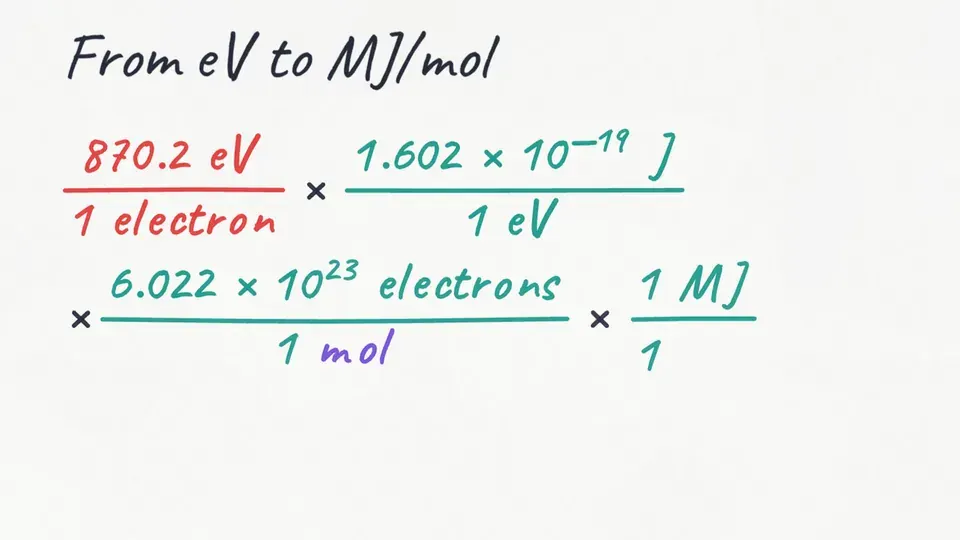
On the AP exam these energies usually come in megajoules per mole, so let’s convert eight seventy point two and watch the units cancel. One electron volt is one point six oh two times ten to the negative nineteen joules, a mole of electrons is six point oh two two times ten to the twenty-third of them, and a megajoule is a million joules.
The electron volts cancel each other, then the joules, then the electrons, and what’s left is megajoules per mole. That’s eighty-three point nine five megajoules per mole of electrons, which a spectrum rounds to eighty-four.
Two shells, three peaks
Let’s walk into neon’s spectrum, where every peak is a pillar of light on a floor that measures binding energy, tied by a thread to the part of the atom its electrons came from. The farther left a pillar stands, the harder its electrons are to remove, and its height counts the electrons.
Let’s test the simple shell picture. If neon had two electrons in its first shell and eight in its second, all with one energy, we’d see just two peaks, one four times taller than the other.
But the real spectrum has three, so the second shell’s eight electrons don’t share one energy, and the atom holds two of them tighter than the other six. That’s the evidence for subshells, a two s subshell with two electrons and a two p subshell with six, which is why the two p peak is three times as tall.
The AP exam draws the same spectrum on paper. Binding energy runs along the bottom, in megajoules per mole. The axis works like the floor in the hall. Read it from the right. One, ten, a hundred, a thousand.
Each step left is ten times more energy. Now put neon’s three peaks on it. A peak’s position is the energy to remove one electron from that subshell. The one s peak stands just under a hundred, at eighty-four. The two p peak stands a little over one, at two point oh eight.
Eighty-four divided by two point oh eight is about forty. Pulling out a one s electron takes about forty times the energy of a two p. A peak’s height is the number of electrons in that subshell, two, two and six. Read left to right and you’ve written the configuration, one s two, two s two, two p six, ten electrons, and if it’s neutral, ten protons, which means neon.
The classic mistake is thinking the tallest peak holds its electrons hardest, but height only counts electrons, and position tells you the energy. A student’s model gives all eight of neon’s second-shell electrons the same energy. Which feature of the spectrum shows the model doesn’t fit?
Read any spectrum
Let’s read one together, drawn the AP way, with four peaks this time, and I’ll start at the left, where the nucleus holds its electrons hardest. The far-left peak is two tall, so one s two, the next is two, so two s two, and the tall one is six, two p six, just like neon so far.
But there’s one more peak way out on the right, half as tall as the two s peak, so how many electrons is that, and in which subshell? It’s one electron in the next subshell, three s, the easiest electron in the whole atom to remove. That’s eleven electrons, so if the atom is neutral, it has eleven protons, and it’s sodium. Here’s a neutral atom you haven’t seen, with five peaks. Which configuration matches it?
One more proton
Back in the hall, here’s sodium, eleven protons in the nucleus and that lonely three s electron on the right. Now I’ll add one proton, and one electron to keep it neutral, which turns sodium into magnesium.
You predict first. Drag the ghost pillar to where magnesium’s three s peak will stand, and set its height. So one more proton and one more electron changed two different things, the position, from the extra pull, and the height, from the extra electron, and the AP exam asks about both.
This is Coulomb’s law from the last lesson, where the attraction gets stronger when the nucleus has more charge and weaker when the electron is farther away. Sodium has eleven protons and magnesium has twelve, but both keep the same ten inner electrons below the third shell, two plus two plus six. So magnesium’s nucleus pulls harder on its three s electrons, and the binding energy climbs from about point five to about point seven four.
Now an ion. Here’s neon, ten protons and ten electrons, and here’s a sodium ion, eleven protons, but it lost its three s electron, so it also has ten. The heights don’t change, because both have the same ten electrons in the same subshells, but every pillar slides left, because eleven protons pull harder on those ten electrons than ten protons do.
Removing a two p electron from the sodium ion takes about four point five six megajoules per mole, more than twice neon’s. So heights alone can’t tell you which nucleus the electrons belong to, and you need the positions too. These two spectra have the same heights, but every peak in Y sits at a higher binding energy. Which pair could have made them?
The sentence that earns the point
Now let’s see how the AP exam asks about this. Here’s a question shaped just like a real one. Part A asks you to mark the peak for the electrons closest to the nucleus on average, and that’s the one s, the farthest left.
To justify it, I’d write that the one s electrons are, on average, closest to the nucleus, so their attraction to the eleven protons is strongest, and that means it takes the most energy to remove one. This is the sentence that earns the point, because it links distance to attraction, and attraction to the energy needed to remove the electron. An answer like “it’s on the left because it’s the first subshell” only describes the graph, so it earns nothing.
Part B wants the complete configuration, one s two, two s two, two p six, three s one, so write every subshell instead of the noble-gas shortcut. Part C asks you to draw magnesium’s three s peak. You already did that in the hall, a little to the left and twice as tall, and each of those earns its own point.
If they ask why it moved, you could write that magnesium is to the right of sodium on the table, or that magnesium has one more proton with the same inner electrons, so which would you write? The first is true, but it’s just a place on the periodic table, while the second names the extra proton and the same inner electrons, which is the reasoning graders want.
Promise kept
Let’s go back to SLAC and keep my promise with a mystery gas. It holds its deepest electrons so tightly that a thousand electron volts can’t free them, so we turn the X-rays up to five thousand. Here’s everything that flies out, five peaks, from a neutral atom. So read it the way you’ve read every spectrum today. Which element is it?
And look how far left argon’s one s peak sits, about three hundred ten megajoules per mole, because eighteen protons grip those two innermost electrons hardest of all. And it’s no exotic gas, because about one percent of the air you’re breathing right now is argon. You started not knowing how anyone could see inside an atom, and now you can name one from nothing but the electrons it throws off.
And chemists still do exactly this. In June 2026, a team at Brown University used electrons knocked out of boron clusters to find evidence that eighty boron atoms can snap into a hollow ball, shaped like a soccer ball.
What to keep
A peak’s position is the energy it takes to remove its electrons, and Coulomb’s law explains it with nuclear charge and distance. A peak’s height is how many electrons are in that subshell. Read the peaks left to right for the configuration, check whether it’s neutral or an ion, and you can name the element. Next lesson, these same ideas explain the patterns across the periodic table.