
Topic 1.2 key terms
- isotopes
- Atoms of the same element (same number of protons) with different numbers of neutrons, so different masses.
- mass number
- Protons + neutrons in a nucleus: a whole-number count (37 for chlorine-37).
- isotopic mass
- The actual mass of one atom of an isotope in amu (34.969 amu for chlorine-35).
- mass spectrometer
- An instrument that turns atoms into ions, separates the ions by mass-to-charge ratio, and counts them (the lesson's model uses a magnet).
- mass spectrum
- A graph of mass (m/z) against relative abundance: one peak for each isotope of the element.
- relative abundance
- The share of an element's atoms that are one isotope, as a percent (summing to 100) or relative to the tallest peak (= 100).
- m/z
- Mass divided by charge. For the singly charged (+1) ions in AP spectra, m/z equals the isotope's mass in amu.
- average atomic mass
- The weighted average of the isotopic masses, each multiplied by its fractional abundance: the value on the periodic table.
Transcript
2,435 words · 10 parts
A rock with a return address
This is a field of blue ice in Antarctica called Elephant Moraine, and more than forty years ago, a team of meteorite hunters found that black rock lying right out in the open. From the outside it’s just a lump of black crust, about eight kilograms of it, and nobody who picked it up had any idea that it had come from another planet. Inside, though, it has little pockets of black glass, and that glass trapped a tiny bit of gas from wherever this rock started out, including some argon.
Argon atoms don’t all weigh the same, and if we color the lighter ones blue, you can see how rare they are in here. In 1983, two scientists heated chips of this rock to let that gas out and ran it through a mass spectrometer, a machine that sorts atoms by their mass, and they compared its argon with the argon in the air we breathe.
The heavy argon-forty towers over everything, so let’s blow the little peaks up three hundred times, and in our air the argon-thirty-six rises right up level with the giant. But in the rock, it barely gets off the ice.
That lopsided argon looked nothing like the air on Earth, and a lot like the air the Viking landers had measured on Mars. Then NASA’s Curiosity rover, on Mars since 2012, sniffed the Martian air with its own mass spectrometer, and the argon matched, so this black rock really is a piece of Mars that got knocked into space and fell to Earth.
By the end of this lesson, you’ll be able to read the kind of graph that traced this rock to Mars, and tell which versions of an element a sample holds and how common each one is. And you’ll find out why the number the periodic table prints for chlorine is the mass of a chlorine atom that doesn’t exist. But first, what does it even mean for argon to come in different weights? Let’s zoom all the way into a pair of argon atoms from inside that rock.
Same element, different atoms
Here are two argon atoms from that gas, and each one has exactly eighteen protons, because eighteen protons is what makes an atom argon. The difference is in the neutrons, so this one carries eighteen neutrons, for thirty-six particles in its nucleus, and this one carries twenty-two, which makes forty.
Atoms of the same element with different numbers of neutrons are called isotopes, so these two are argon-thirty-six and argon-forty. And neither one is the real argon with the other one a strange copy, because both are perfectly normal argon atoms with the same chemistry, and one is just a little heavier.
Chemists write an isotope with its mass number up top, which counts the protons and neutrons together, and the number of protons down at the bottom. Chlorine is the element we’ll use for most of today, and its lighter isotope, chlorine-thirty-five, has seventeen protons and eighteen neutrons. Its heavier isotope is chlorine-thirty-seven, which still has seventeen protons, because anything with seventeen protons is chlorine.
So how many neutrons are in an atom of chlorine-thirty-seven? This came up on the real exam in 2025, when students had to explain how a magnesium-twenty-five atom differs from a magnesium-twenty-six atom, and one mistake the graders saw was students calling twenty-six the number of neutrons.
The last column is the isotopic mass, the actual mass of one atom of each isotope, and notice it isn’t a whole number, so one chlorine-thirty-five atom weighs thirty-four point nine six nine atomic mass units, a little less than thirty-five. Keep those two straight, because thirty-five is a count of particles, while thirty-four point nine six nine amu is a real mass, and that’s what we calculate with.
Inside the sorter
So how do you sort atoms that differ by just a couple of neutrons? Let’s take apart a mass spectrometer, the kind with a magnet inside, because it does four jobs in a row. It knocks an electron off each atom, flings the charged atoms forward, bends their path with a magnet, and counts them at the far end.
Let’s ride along with one chlorine atom, and right here a beam of fast electrons slams into it and knocks one of its electrons clean off. Now it’s a chlorine ion with a charge of plus one, so the electric plates can fling it forward and the magnet can steer it. Before we turn on the whole beam, think about which ions you’d expect the magnet to bend more sharply, the lighter chlorine-thirty-five or the heavier chlorine-thirty-seven.
And there they go, the lighter ions curve on a tighter arc and the heavier ones swing wider, so one beam of chlorine splits into two. A heavier ion carries more momentum, so the same magnet can’t turn it as sharply, the way a bowling ball is harder to steer than a tennis ball.
At the far end there’s a narrow slit with a detector behind it, and every ion that makes it through the slit adds one count. As the machine slowly turns up the magnet, each beam sweeps across the slit, and the chlorine-thirty-five peak climbs about three times higher than the other one. That’s because about three out of every four chlorine atoms are chlorine-thirty-five, and the machine simply counted them.
Now you run the machine, so turn the magnet’s dial slowly from low to high and record chlorine’s whole spectrum yourself. Let’s pull that graph out of the machine and look at it properly, because reading it is exactly what the AP exam asks you to do.
Reading the graph
Here’s the same spectrum, with mass along the bottom in atomic mass units and relative abundance up the side, and each peak stands for one isotope. Where a peak sits tells you which isotope it is, because its position is that isotope’s mass, so these two are chlorine-thirty-five and chlorine-thirty-seven. How tall a peak stands tells you how common that isotope is, and on this scale the heights are percents of all the atoms, seventy-five point seven six and twenty-four point two four.
And a taller peak never means a heavier atom, it only means more atoms, which is why the tallest peak here belongs to the lighter isotope. You’ll sometimes see this axis labeled m over z, but for ions with a charge of plus one, that’s just the mass. Some spectra set the tallest peak to a hundred and scale the others against it, and on that scale chlorine-thirty-seven reads thirty-two point zero.
Those two heights don’t add up to a hundred, so before you use them, divide each one by their total, and thirty-two over a hundred thirty-two brings us right back to about twenty-four percent. And the big peak works the same way, a hundred over a hundred thirty-two is about seventy-six percent, so its hundred never meant that every chlorine atom is chlorine-thirty-five.
Copper has two isotopes too, and this spectrum uses the tallest-peak scale, so copper-sixty-three reads a hundred and copper-sixty-five reads forty-four point six. So what percent of all copper atoms are copper-sixty-five? Give it to me to the nearest tenth of a percent.
The number on the periodic table
Now let’s go after that number on the periodic table, so we’re back out on the ice, with a glass beam marked off in atomic mass units, sitting on a pivot. A hundred chlorine atoms fall onto it, each one landing at its own mass, so seventy-six stack up at chlorine-thirty-five and twenty-four at chlorine-thirty-seven.
The pivot starts exactly halfway between them, at about thirty-six, and when we let go, the beam tips straight toward the big pile. So the balance point has to sit somewhere closer to chlorine-thirty-five, but where exactly?
Now I want you to find it, so drag the pivot along the beam until natural chlorine sits perfectly level. Now look at what sits right above the pivot, because there’s nothing there at all, and no chlorine atom anywhere has a mass of thirty-five point four five.
The big pile sits about three times closer to the pivot than the small one, and that’s exactly balanced by having about three times as many atoms. And that balance point, thirty-five point four five, is the number your periodic table prints under chlorine. So how do we land on thirty-five point four five without a glass beam? We turn the beam into a calculation, and it’s the one you’ll write on the AP exam.
Take the hundred atoms on the beam. Seventy-six of them weigh about thirty-five amu, and twenty-four weigh about thirty-seven. An average is the total mass divided by the number of atoms. The total mass is seventy-six times thirty-five, plus twenty-four times thirty-seven. That comes to three thousand five hundred forty-eight amu.
Divide by the hundred atoms, and the average is thirty-five point four eight amu, close to the beam’s thirty-five point four five. Now divide each piece by the hundred instead. Seventy-six over a hundred is zero point seven six. Twenty-four over a hundred is zero point two four.
Zero point seven six is just seventy-six percent. That’s why a percent becomes a decimal before you multiply. Dividing by the hundred atoms is already part of the average. The rule: multiply each isotope’s mass by its fraction, then add. This Greek letter, sigma, means add them all up.
Real chlorine follows the same rule. Seventy-five point seven six percent of its atoms weigh thirty-four point nine six nine amu. The other twenty-four point two four percent weigh thirty-six point nine six six.
Each percent becomes a decimal, and a calculator does the multiplying. That gives twenty-six point four nine amu and eight point nine six one amu. Together that’s thirty-five point four five amu, right where the beam balanced. And if you slide a little fulcrum under the spectrum itself, it balances at thirty-five point four five too, because the spectrum and the beam are the same picture.
So never write that a chlorine atom has a mass of thirty-five point four five amu, because that’s the average of the whole mix, and the atoms in that mix weigh about thirty-five or about thirty-seven amu. It’s also chlorine’s molar mass from last lesson, because a mole of chlorine atoms is this same natural mix, so a mole of them weighs thirty-five point four five grams.
Magnesium, together
Magnesium has three isotopes, so its spectrum has three peaks, at twenty-four, twenty-five and twenty-six, and magnesium-twenty-four is by far the most common. Let’s set it up together, each isotope’s mass times its fraction, starting with twenty-three point nine eight five times zero point seven eight nine nine. That first term gives eighteen point nine five, and the second one’s easy, because ten percent of twenty-four point nine eight six is two point four nine nine.
Now you work out the third term, twenty-five point nine eight three times zero point one one zero one, and round it to three decimal places. Add all three and we get twenty-four point three one amu, sitting right next to the big peak, exactly where a balance point should be. Your AP periodic table prints twenty-four point three zero, the same to the tenths place, and when a problem hands you isotope data, the answer you calculate from that data is the one that earns the point.
Bromine, on your own
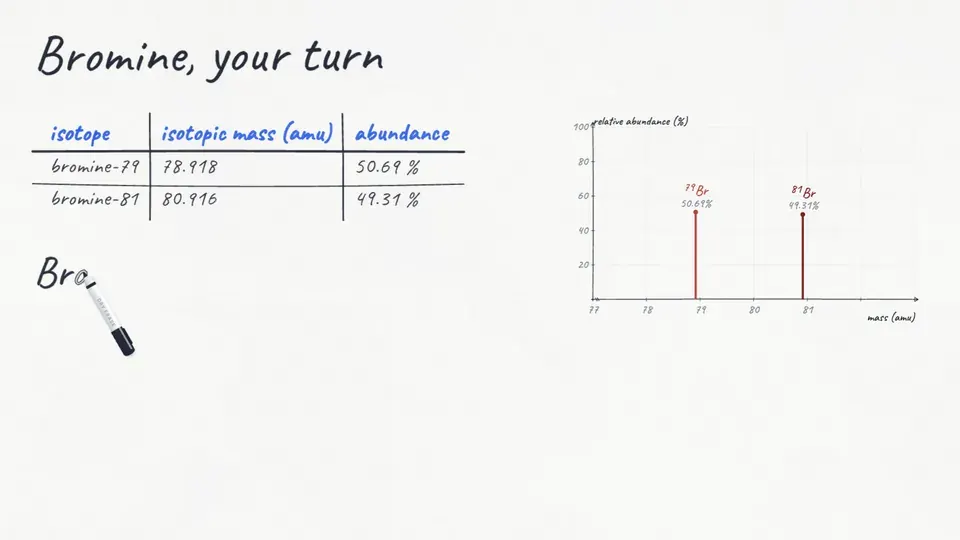
Bromine is a fun one, because its two isotopes are almost fifty-fifty, with bromine-seventy-nine just a hair more common than bromine-eighty-one. Here are the real masses and abundances, and this time the whole calculation is yours.
Use the table to work out bromine’s average atomic mass, and give it to me to two decimal places. Notice it lands just below the halfway point between the two masses, because bromine-seventy-nine is a little more common, and the balance always leans toward the bigger pile.
Boron runs it backwards
The AP exam also likes to run this backwards, so here’s boron, with the pivot pinned at its average atomic mass, ten point eight one, and two piles that start out equal. With equal piles the beam tips toward boron-ten, because the pivot sits so much closer to eleven than to ten, so think about which isotope must be the common one. Let the piles shift until it balances, and boron-eleven ends up with about four times as many atoms, because the pivot sits about four times closer to it.
On paper you’d call the boron-ten fraction x, and since the two fractions add up to one, boron-eleven’s is one minus x, so solving gives x of about zero point two zero, twenty percent boron-ten and eighty percent boron-eleven. So in boron the heavier isotope is the common one, while in chlorine it was the lighter one, which is why you always read the abundances from the data instead of guessing from the mass.
The 2025 AP question
Here’s a real question from the 2025 AP exam, a magnesium spectrum with only the magnesium-twenty-four line drawn, at seventy-nine percent, and the prompt says the other two isotopes are about equally common. The graders noticed that some students drew their lines as tall as the one already there, and others misread the grid lines, so take your time with this one.
Drag the magnesium-twenty-five and magnesium-twenty-six lines up to the heights you think they should have. The scoring guide accepted any lines between ten and eleven, so what really mattered was knowing that a spectrum’s percents add up to a hundred.
The second part asked what difference in atomic structure makes magnesium-twenty-six heavier than magnesium-twenty-five, and these are the answers the graders saw that earned nothing. And this is the sentence that earns the point, an atom of magnesium-twenty-six has one more neutron than an atom of magnesium-twenty-five, because isotopes of one element always share the same number of protons.
Back to the ice
Which brings us back to the ice, where you can read the evidence yourself, with two argon samples, one from our air and one from the rock, and no labels. Use the magnifier on the small peaks, and then pick the one that came from Mars.
Both samples are argon with their peaks in exactly the same places, but the heights are completely different, and that difference is how one graph traced a rock back to another planet. So a peak’s position tells you which isotope it is, its height tells you how many, and the average atomic mass is where the whole spectrum balances. Next time we’ll use those average masses to figure out how much of a compound’s mass comes from each element, which is how chemists work out a formula from scratch.