
Topic 1.4 key terms
- pure substance
- A sample whose particles are all of one type: atoms, molecules, or formula units of a single kind (H₂O, NaCl). It can contain more than one element.
- mixture
- A sample containing two or more types of particles (two or more substances) whose relative proportions can vary, like pond brine or sylvinite.
- formula unit
- The simplest ratio of ions in an ionic compound such as NaCl (1 Na⁺ : 1 Cl⁻); a counting unit, not a molecule.
- percent by mass
- (mass of the part ÷ mass of the whole sample) × 100 %.
- elemental analysis
- Measuring how much of an element a sample contains; with the formulas of the possible substances it gives the composition of a mixture and its purity.
- purity
- The mass percent of the desired substance in a sample. A measured elemental percent that differs from the pure substance's value shows an impurity is present.
Transcript
2,269 words · 8 parts
The ponds you can see from space
Astronauts on the space station have photographed this spot in Chile’s Atacama Desert, and honestly, it doesn’t look like it should be real. In the middle of a white salt flat, somebody seems to have painted rectangles of turquoise and green and yellow, and every one of them is a pond. Down on the ground it gets even stranger, because there are flamingos out here, more than two kilometers above sea level, wading in lagoons that mirror the volcanoes.
Those ponds are full of brine pumped up from under the salt, a mixture of water, ordinary salt, and smaller amounts of potassium, magnesium and lithium salts. For more than a year the desert sun evaporates the water, pond after pond, until the last ones turn this thick yellow-green, loaded with lithium.
That lithium ends up in a salt called lithium carbonate. It goes into batteries, so maybe the battery in your phone started out right here. But battery makers want that powder at least ninety-nine and a half percent pure, and nobody can see purity. That’s where you come in. A lab hands you one number, the grams of a single element in a sample, and you work out what’s really in the mixture.
In the end, you’re the one who decides. Does this batch go into a battery? Or does it get sent back? So let’s go down into one of these ponds, because at the level of the particles, this is what a mixture actually looks like.
One kind of particle
Everything here is either a water molecule or an ion, so there are sodium ions, chloride ions, a few lithium ions, and water molecules everywhere in between. A chemist decides whether something is a mixture by asking one question about its particles, which is how many different kinds are in there.
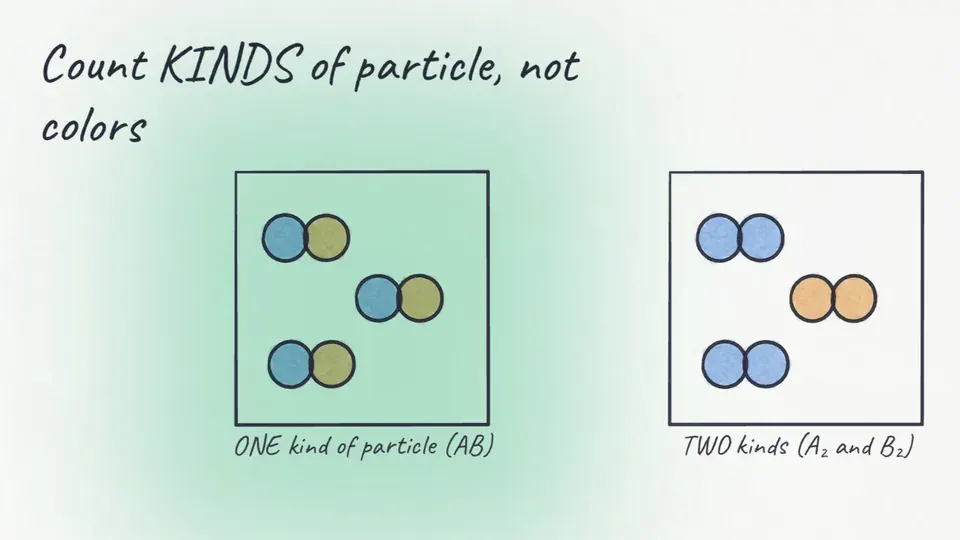
If every particle is the same kind, the same atom or molecule or formula unit, it’s a pure substance, and if there are two or more kinds, it’s a mixture, and that pond has at least five. A lot of people count elements instead, and that’s a trap. Water has two elements, hydrogen and oxygen, but every molecule in pure water is the same H two O molecule, so pure water is a pure substance.
This is a classic AP question, by the way, where they show you boxes of particles like these and ask which is a mixture, and this one has two colors but only one kind of particle, so you count kinds of particles, never colors. Mixtures can also change their proportions, which a pure substance can’t, and these ponds were built to do exactly that.
Evaporate pond one by dragging the sun across the sky, and keep going until salt crystals start to grow on the floor. And those crystals are sodium chloride, which has two kinds of ion locked together in one fixed one-to-one ratio, so the crystal is a single pure substance, counted in formula units of sodium chloride. So if there’s one sentence to keep from today, it’s that the formula fixes what’s inside each substance, and the mixture decides how much of each substance there is.
Let’s lock in that sorting rule. Here are four samples from the salt flat. Drag each sample into the tray where it belongs. If you want to look inside one first, just tap it.
A number that never moves
Now let’s put numbers on it. Percent by mass is the mass of one part divided by the mass of the whole thing, times a hundred. My favorite example is a gold medal from the Paris Olympics, which weighed five hundred twenty-nine grams with only six grams of gold, so a gold medal is about one percent gold.
For a pure substance, those percents never move. Sodium chloride is always one sodium for every chlorine, so its molar mass is twenty-two point nine nine plus thirty-five point four five, fifty-eight point four four grams per mole.
That makes it always about thirty-nine percent sodium and sixty-one percent chlorine by mass, from your salt shaker or from these ponds. A mixture gets no fixed number like that, so pond one and the last pond hold the same kinds of particle but a different percent chlorine.
Elemental analysis can also count atoms. Say a lab finds point three nine three four grams of sodium and point six oh six six grams of chlorine in a one gram crystal from pond one. Dividing each mass by its molar mass gives the same number of moles of each, so there’s exactly one sodium for every chlorine, which is the formula NaCl, even though the masses aren’t equal.
Now you try it. Say a lab makes a pure salt from the brine in the last ponds, and one gram of it has point one six three seven grams of lithium and point eight three six three grams of chlorine. How many moles of chlorine are there for every mole of lithium?
And this is where most mistakes in this topic come from, so let’s slow down. A lab analysis involves three different masses, the whole sample, one substance inside it, and one element inside that substance. In a crust sample that’s partly sodium chloride and partly sand, those are three different numbers, and today’s whole skill is moving between them without mixing them up.
Working backward from one element
You’ll see this kind of problem all through the unit, so watch closely. I’ll do this first one all the way through. A two point five oh oh gram sample of pond-one crust contains only sodium chloride and sand, and the lab finds point six oh oh oh grams of sodium. What percent of the sample is sodium chloride?
First I want the fact that links sodium to sodium chloride, and it’s hiding in the word sand. The sand here is pure quartz, silicon dioxide, with no sodium at all, so every gram of that sodium is sitting inside sodium chloride. So the tempting answer, point six over two point five, gives twenty-four percent, and that’s the percent sodium in the sample, not the percent sodium chloride. Instead I’ll turn the point six oh oh oh grams of sodium into moles, dividing by sodium’s molar mass, twenty-two point nine nine, and the grams of sodium cancel.
The formula is the bridge to sodium chloride, because one sodium per formula unit means one mole of sodium gives one mole of sodium chloride, and then its molar mass, fifty-eight point four four, turns moles into grams. That’s one point five two five two grams of sodium chloride, keeping an extra digit for now, and out of the whole two and a half gram sample, that’s sixty-one point oh one percent, with four significant figures because every measurement had four.
And it passes the sanity check, because the sodium chloride weighs more than the sodium inside it and less than the whole sample, and the leftover point nine seven five grams is the sand. Inside the crystal you can see exactly what we did, because we grew the sodium into the whole sodium chloride using the formula, and the sand fills in the rest.
Which way the number moves
Now let’s flip the question around, because often the lab isn’t measuring how much of something there is, it’s checking whether a sample is pure at all. Say salt from a later pond is supposed to be pure sodium chloride, and the analysis comes back seventy-three percent chlorine by mass. Pure sodium chloride is only about sixty-one percent chlorine, so this sample has more chlorine than pure salt could ever have, which means something in there is even richer in chlorine than sodium chloride is.
The two suspects in these ponds are potassium chloride and lithium chloride, each with one chlorine per formula unit. Potassium is heavy, thirty-nine point one oh, so chlorine is only about forty-seven and a half percent of potassium chloride. But lithium is so light, only six point nine four, that chlorine is about eighty-four percent of lithium chloride.
Here are all three salts on one line, by percent chlorine, and our sample has to land on seventy-three. Pick an impurity and add it to the salt until your sample reads seventy-three percent chlorine.
On a free-response question you’d write it as one sentence, with the measurement, seventy-three percent chlorine, the comparison with pure sodium chloride, and the conclusion, that lithium chloride could raise it and potassium chloride couldn’t. And notice this kills a really common idea, that an impurity always makes a percentage go down, because an impurity can push the number either way, depending on its formula.
Two salts, one chlorine
A few ponds down the line, a different crust grows, called sylvinite, and up close it’s two salts tangled together, sodium chloride and potassium chloride, with no fixed recipe, because it’s a mixture. Farmers use the potassium chloride as fertilizer, so somebody needs to know how much of this crust is potassium chloride. Here’s a ten point oh oh gram sample, and the lab says it contains five point seven oh oh grams of chlorine. How much of it is potassium chloride?
The crust trick, growing the element into one salt, fails here. It divides by sodium chloride’s share of chlorine, as if all the chlorine sat in sodium chloride. But both of these salts carry chlorine. The lab’s chlorine comes from two places. Chlorine from the sodium chloride, plus chlorine from the potassium chloride, makes five point seven oh oh grams.
Before any algebra, I want you to find the answer with your own hands. Drag the boundary between the two salts until their chlorine adds up to five point seven oh oh grams.
Now let’s turn what your hands did into algebra, with easy numbers first. Round sodium chloride to sixty percent chlorine, and potassium chloride all the way to fifty. Say the same ten grams held five and a half grams of chlorine. Call the sodium chloride x grams. The potassium chloride is the rest, ten minus x.
The chlorine in each salt is its percent times its grams. Point six x, plus point five times ten minus x, equals five and a half. Multiply out the bracket. That gives five, minus point five x.
Collect the x terms. Point six x minus point five x leaves point one x. Take five from both sides. Point one x equals point five. Divide by point one, and x is five grams of sodium chloride.
That leaves five grams of potassium chloride, half and half. Check it. Three grams of chlorine plus two and a half gives five and a half. Now the real sample. Again, x is the grams of sodium chloride, and ten minus x is the potassium chloride.
Swap in the real percents from before, sixty point six six and forty-seven point five five. Point six oh six six x, plus point four seven five five times ten minus x, equals five point seven oh oh.
Your turn. Make the same moves with the calculator, and give the grams of potassium chloride to three significant figures. Plug the answer back in. Four point three seven two plus one point three two eight gives five point seven oh oh grams, the chlorine the lab found. Make that check a habit.
Battery grade
Now let’s go back to the very end of the line. Out here the brine has turned yellow, and it’s about six percent lithium. At a plant near the coast, sodium carbonate turns the lithium into lithium carbonate, so a little sodium carbonate, which has no lithium at all, can end up in the powder.
Here’s a two point oh oh oh gram sample of the powder, and the lab finds point three seven two oh grams of lithium. Battery makers want at least ninety-nine and a half percent lithium carbonate, so is this good enough? It’s the same move as the pond-one crust, with one twist hiding in the formula, and this one’s all yours. Using the numbers on the board, work out what percent of this batch is the compound battery makers want, to three significant figures.
Forget that two and you’d get almost four grams of lithium carbonate from a two gram sample, which is impossible, so the sanity check catches it in five seconds. Your call. Does this sample meet the battery-grade spec?
And this is the sentence that earns the point on the AP exam, so I’ll write it all out. Every word counts here. The sample is ninety-nine point oh percent lithium carbonate by mass, below the ninety-nine and a half percent spec, so it isn’t battery grade, as long as the impurity has no lithium in it. That last part matters, because if the impurity had lithium too, the lithium the lab measured would be coming from two places, like the chlorine in the sylvinite, and you’d need to know what the impurity is and add up both contributions.
And that’s the promise from the start. You took one number from a lab, the grams of lithium, and decided whether this powder can go into a battery, which is exactly the job of the quality lab at the end of this line.
What to keep
Here’s the whole lesson on one board. A pure substance has one kind of particle, and a mixture has more than one, an element’s mass turns into a substance’s mass through the formula, and you judge purity by comparing with the pure substance’s percent. The formula fixes what’s inside each substance and the mixture decides how much of each there is, and every problem in this topic is some version of keeping those two ideas straight.