
Topic 1.7 key terms
- periodicity
- The repeating pattern of properties across the periodic table, explained by repeating patterns of outer-electron configurations.
- valence electrons
- The electrons in the outermost occupied shell; atoms in one column share the same valence pattern (ns¹ for group 1).
- core electrons
- The electrons other than the valence electrons; they shield the valence electrons from the nucleus. In sodium, the ten core electrons are arranged like neon.
- Coulomb's law
- The attraction between opposite charges grows with the charges and falls with the square of the distance: F ∝ q₁q₂/r².
- shielding
- Inner electrons reduce the nuclear charge felt by the outer electrons.
- effective nuclear charge
- The net positive charge an outer electron feels: the nuclear charge reduced by shielding (roughly protons minus core electrons).
- atomic radius
- A measure of an atom's size (here, covalent radius in pm): smaller across a period, larger down a group.
- isoelectronic
- Species with the same number of electrons (O²⁻, F⁻, Na⁺, Mg²⁺, Al³⁺ all have 10); more protons means a smaller species.
- first ionization energy
- The energy needed to remove one electron from a gas-phase atom: X(g) → X⁺(g) + e⁻. Generally higher across a period, lower down a group.
- successive ionization energies
- The energies to remove electrons one at a time; a large jump marks the first core electron, so it counts the valence electrons.
- electron affinity
- The energy released when a gas-phase atom gains an electron: X(g) + e⁻ → X⁻(g). Cl releases more than F.
- electronegativity
- How strongly an atom in a bond attracts the shared electrons (Pauling scale, no units); fluorine is highest, 3.98.
Transcript
2,239 words · 10 parts
The disappearing spoon
Say a friend hands you a glass of hot tea and a shiny spoon, so you give it a stir. And it melts, right there in the tea, leaving a stub in your fingers and a silver puddle at the bottom of the glass. That’s gallium, a real metal that melts at about thirty degrees Celsius, cooler than the inside of your mouth.
The strangest thing about it, though, is that a chemist here in St. Petersburg described it in 1871, four years before anyone had ever seen it. Dmitri Mendeleev had lined up the known elements by the weight of their atoms and by how they behaved, and the same behavior kept coming back, like a repeating pattern. Where the pattern broke he left a hole, and from the hole under aluminum he predicted an atomic weight near sixty-eight, a density near five point nine, and a low melting point.
In 1875 a French chemist saw a violet line in the light from a zinc ore that no known element gives off, and he named his new element gallium, after the Latin name for France. When the French chemist measured its density at four point seven, Mendeleev, who’d never seen a grain of it, wrote and suggested he measure it again. He purified his sample and got five point nine.
And Mendeleev did that without knowing electrons existed. We know about them, so by the end of this lesson you’ll be able to look at an element’s place on the table and predict how big its atoms are, how tightly they hold their electrons, and even a number nobody’s given you, and then explain why, which he couldn’t. Why it melts in your tea is a story for another day, so let’s start where Mendeleev did and ask why the table repeats.
Why the table repeats
That pattern means the elements in one column behave like relatives. Lithium, sodium and potassium are soft metals that react so readily with air and water that chemists keep them sealed away from both, the halogens are colorful and harsh, and the noble gases hardly react at all. Mendeleev could only see the behavior, but we can see why, because the atoms in a column share the same pattern of outer electrons.
Lithium, sodium and potassium are each a noble-gas core plus one electron in a new, partly filled shell, two s one, three s one and four s one, the same lone s electron every time. The halogens are one electron short of filling their outer s and p subshells, so fluorine and chlorine both end in s two p five.
And the noble gases have completely filled outer subshells, from helium’s tiny one s two to two s two p six for neon and three s two p six for argon. We call the inner electrons core electrons and the outer ones valence electrons, and almost every trend today comes down to how hard the nucleus pulls on those valence electrons. Careful, though, because sodium and potassium don’t have the same configuration. Potassium has a whole extra shell inside, and that shell is about to matter.
One law runs the table
You met the rule behind that pull in topic 1.5. Coulomb’s law says the attraction gets stronger with bigger charges and much weaker with distance, so doubling the distance cuts the pull to a quarter. And that’s what the AP exam tests here. Writing that an atom is smaller because it’s farther right only says where it sits, and the point goes to the answer that explains why, with protons, shells and distance.
So let’s go down onto the frozen river, where I’ve set up a sodium atom blown up about ten billion times. Its nucleus has eleven protons, and packed around it are ten core electrons. They sit between the nucleus and the one valence electron, screening out most of its pull, and we call that shielding.
Eleven protons minus ten shielding electrons means the outer electron feels a pull of roughly plus one, which is a rough version of what chemists call the effective nuclear charge. Chlorine has seventeen protons behind the same ten core electrons, so its outer electrons feel roughly plus seven, and the cloud gets pulled in tight. That’s the whole lesson in one picture. More protons behind the same shield pull harder, and a new shell farther out gets pulled less.
Which atom is bigger?
Here are sodium and magnesium under veils of exactly the same size, and magnesium has one more proton and one more electron than sodium. Which one do you think is bigger? Tap the one you’d bet on.
Let’s write down why, in three steps that work for every trend today. Where are the outer electrons? Both atoms are in period three, so both are in the third shell, behind the same ten core electrons. Why would one pull harder? Magnesium has twelve protons behind that shield instead of eleven, so its outer electrons feel roughly plus two instead of plus one.
So the stronger pull on the same shell draws magnesium’s cloud in, and it’s the smaller atom. Now try sodium against potassium, and think about the first step before I write it. Potassium’s outer electron is in the fourth shell, a whole shell farther out. Its eighteen core electrons shield its nineteen protons, so it feels about the same plus one from farther away, and that weaker pull makes potassium the bigger atom.
Across a row, the protons pile up behind the same shield and the atoms shrink, all the way to chlorine at about a hundred picometers. Down a column, each new shell makes the atoms bigger. Those are the two arrows everybody memorizes, and now each one has its reason next to it, more protons behind the same shield across a row, and a new shell farther out down a column. Now you try one with two nonmetals, sulfur with sixteen protons and chlorine with seventeen. Which atom is bigger, and why?
Losing and gaining
Now let’s take sodium’s outer electron away. It was the only electron in the third shell, so the whole shell goes with it, and the sodium ion is much smaller than the atom. Chlorine picks up an electron instead, and its cloud swells a little, because the same seventeen protons now hold eighteen electrons that push on each other.
So in table salt the sizes flip, and sodium, the big atom, becomes the small ion, while chloride becomes the big one. The AP exam loves isoelectronic species, ones with the same number of electrons, like these five ions, which all have exactly ten. Only the proton count changes, from eight in oxide up to thirteen in the aluminum ion. More protons squeeze the same ten electrons, so oxide is the biggest and the aluminum ion is the smallest.
So the charge alone doesn’t tell you, because oxide is two-minus and it’s the biggest of the five. Count the electrons first, and when they match, more protons means smaller. These four ions all have eighteen electrons, the same number as an argon atom. Which one is the biggest?
The price of an electron
Pulling an electron off a lone gas-phase atom always costs energy, and the cost of the first one is the first ionization energy, about four ninety-six kilojoules per mole for sodium. A stronger pull makes a smaller atom and a higher price, so ionization energy runs opposite to size.
To see that across the whole table, I’ve built a mountain range where the height at each element, from hydrogen to barium, is its first ionization energy. Helium is the highest summit on the whole range, because its two electrons sit right next to the nucleus with no inner electrons shielding them. Then the ridge drops off a cliff at lithium, whose outer electron starts a new shell, climbs as protons pile up behind the same shield to neon, and drops again at sodium.
Pull back, and the whole table is in the shape of these mountains. Every row after the first starts in an alkali-metal valley and climbs to a noble-gas summit, and each summit stands a little lower than the last. Each new row puts the outer electrons farther out, so helium’s first ionization energy is about twice xenon’s, the same xenon the ion engine strips in topic 1.5, and even a noble gas gives up an electron if you pay enough.
Where the ridge dips
Now look closely at period three, because the climb from sodium to argon isn’t perfectly smooth. The ridge breaks its own rule twice in this row. Tap both places where it dips.
Magnesium’s outer electrons are a pair in three s, but aluminum’s last electron sits alone in three p. A three-p electron is higher in energy and partly shielded by the three-s pair, so it’s cheaper to remove, even though aluminum has one more proton.
Now let’s do phosphorus and sulfur together. Phosphorus has three electrons in three p, one in each orbital, so where does sulfur’s fourth one have to go? It has to pair up in an orbital that already has an electron, and the two repel each other, so that one is easier to remove. That repulsion is the reason that earns credit, more than saying a half-filled subshell is stable.
Let’s go back to the river and take magnesium apart, one electron at a time. Pull magnesium’s electrons off one at a time and watch the price. Stop when it gets ridiculous.
Divide the third by the second, seventy-seven thirty-three kilojoules per mole over fourteen fifty-one, and the kilojoules per mole cancel, leaving about five point three, so that third electron costs more than five times as much. The big jump always comes right after the last valence electron, so a list of ionization energies tells you how many valence electrons an atom has. Here are the first four ionization energies of a mystery element, in kilojoules per mole. Which group is it in?
Grabbing and sharing
Electron affinity goes the other way, the energy a lone gas-phase atom releases when it gains an electron. So instead of paying to pull an electron off, for most atoms you get energy back when one arrives.
The halogens release a lot, since the new electron lands in a shell that feels roughly plus seven. You’d expect fluorine at the top to win, but chlorine releases more, about three forty-nine kilojoules per mole to fluorine’s three twenty-eight. Fluorine’s outer shell is so small and crowded that its seven electrons shove the newcomer, and that repulsion eats into the energy released.
Electronegativity is a different question, how hard an atom pulls on electrons it shares in a bond, and between two hydrogens the pair sits right in the middle. With chlorine the pair slides toward chlorine, and with fluorine it slides even farther, because fluorine’s small size and big effective charge give it the strongest pull of all.
So ionization energy is the price of pulling an electron off a lone atom, electron affinity is the energy a lone atom gives back when it gains one, and electronegativity is a tug on a shared pair in a bond, a different question entirely. That’s how fluorine loses electron affinity to chlorine, three twenty-eight kilojoules per mole to three forty-nine, and still wins electronegativity, three point nine eight to three point one six, because the two numbers answer different questions. Chlorine releases more energy than fluorine when it gains an electron. Which explanation fits?
Mendeleev’s move
Now let’s do what Mendeleev did. I’ve hidden krypton’s summit in the clouds, and all we know are the noble gases above and below it, argon and xenon. A good first guess is the midpoint, fifteen twenty-one plus eleven seventy over two, about thirteen forty-six, and the measured value is thirteen fifty-one, so we’re off by less than half a percent.
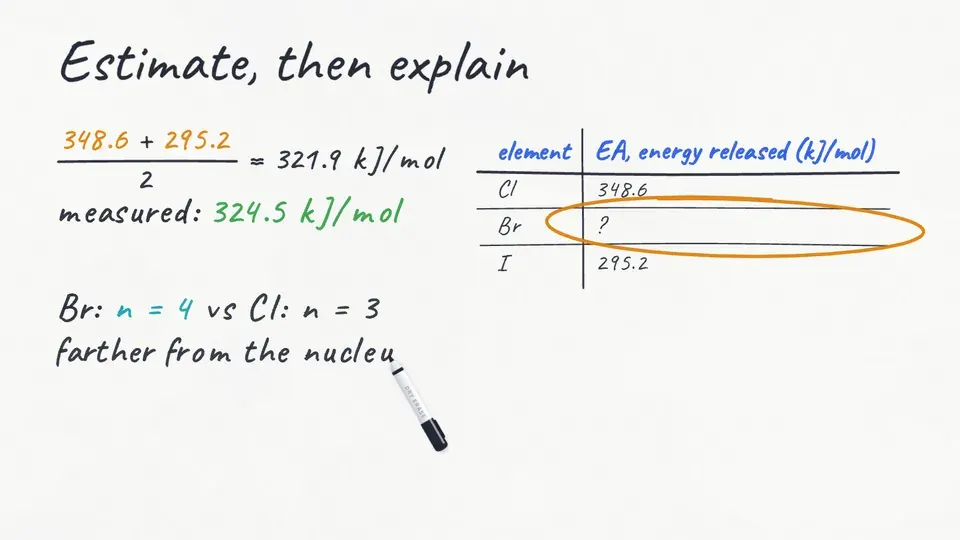
Let’s do bromine’s electron affinity together, between chlorine at about three forty-nine and iodine at about two ninety-five, so let’s take the midpoint. It’s about three twenty-two, and the measured value is three twenty-four point five, close but not exact, because the steps down a column aren’t perfectly even.
On the exam the number is only half the answer, and this is the sentence that earns the point. Bromine’s valence electrons are in a higher shell than chlorine’s, farther from the nucleus and more shielded, so they feel a weaker Coulombic attraction. That’s almost exactly how the 2024 AP exam scored a question about why silver atoms are bigger than copper atoms.
Bromine’s card
So let’s finish the job. Back in the hall, I’ve emptied bromine’s cell, and you can see chlorine above it and iodine below it with their measured values. Set bromine’s radius and its first ionization energy, then lock it in. And gallium went from an empty square in 1871 to the gallium nitride that makes the blue light in most white LED bulbs, maybe the one lighting your room right now.
If you remember one thing, make it three questions. Where is the outer electron, how hard does the nucleus pull on it, and what does that pull do to the property you’re asked about? So across a row, more protons behind the same shield pull harder, which makes the atom smaller and raises its ionization energy and electronegativity, and down a column, each new shell farther out does the opposite. Next time we’ll see what all of this means for how elements react, and why sodium and chlorine end up as salt.