
Topic 1.1 key terms
- mole
- The SI unit for amount of substance: one mole contains 6.022 × 10²³ specified particles (atoms, molecules or formula units).
- Avogadro's number
- Nₐ = 6.022 × 10²³ mol⁻¹ (AP equation sheet), the number of particles in one mole. It converts between moles and particles.
- formula unit
- The smallest whole-number ratio of ions in an ionic compound, e.g. one Na⁺ with one Cl⁻ in NaCl. Ionic compounds are counted in formula units, not molecules.
- atomic mass unit (amu)
- A unit for the mass of single particles (also written u). 6.022 × 10²³ amu is almost exactly 1 g, so one particle's mass in amu equals one mole's mass in grams.
- molar mass
- The mass of one mole of a substance, in g/mol. Numerically equal to the average mass of one particle in amu; found by adding the atomic masses in the formula.
- dimensional analysis
- Solving a problem with a chain of conversion factors arranged so the units cancel, leaving the unit you want (factor-label method).
Transcript
2,564 words · 8 parts
The Hope Diamond
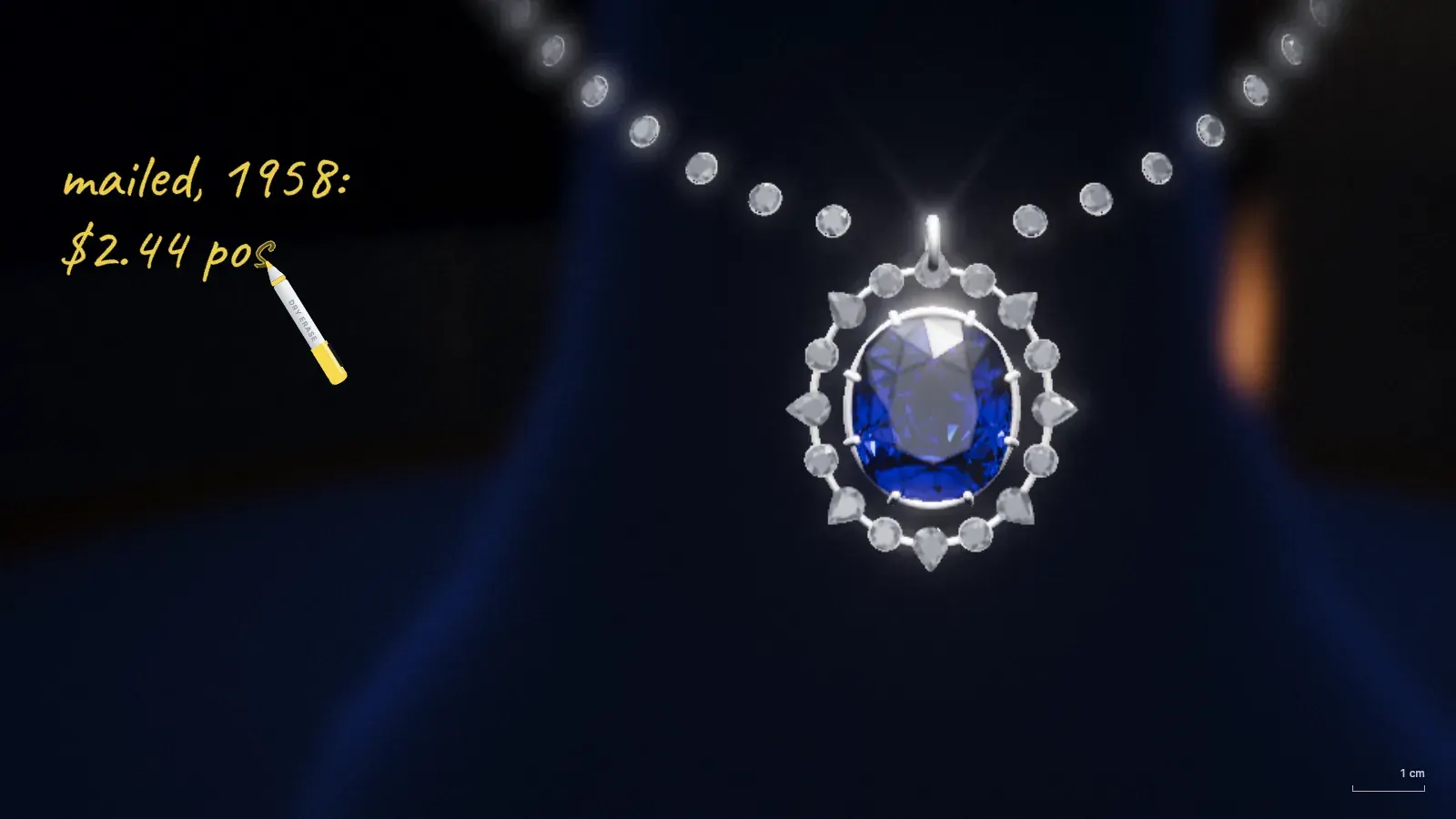
This is the Hope Diamond, and it’s probably the most famous diamond in the world. It sits in the Smithsonian’s natural history museum in Washington, turning slowly inside its own glass vault. And my favorite thing about it is how it got there. In 1958 its owner, a jeweler named Harry Winston, gave it to the museum, and he sent it by mail, in a plain brown paper package, for two dollars and forty-four cents in postage, plus insurance.
Like every diamond, it’s made almost entirely of carbon atoms, locked together into one enormous crystal, and today we’re going to count them. So let’s go in, past the facets, deeper and deeper, until the blue light gives way to the atoms themselves, every carbon atom holding on to four neighbors, in a pattern that keeps going in every direction.
Let’s start counting. One, two, three, four, and you can already feel the problem, because there are a lot of them. If all eight billion people on Earth helped, and each of us counted one atom every second, day and night, without ever stopping, we’d need almost two million years to finish this one diamond. But the museum already knows one number about this diamond, its weight, which is forty-five point five two carats.
And by the end of this lesson, you’ll be able to take that one number and count every single carbon atom inside the Hope Diamond, without ever touching it. Then we’re going to settle a bet. Which has more atoms in it, this little diamond, or all the gold on the mirror of the biggest telescope anyone has ever launched into space? Before we answer either one, let’s start with something a lot easier to count than atoms, a bag of coins at the bank.
Counting by weighing
When a bank gets a bag of nickels, nobody counts them one by one. They put the bag on a scale, and the scale does the counting. Every nickel is made to weigh five grams, and let’s say this whole bag weighs two thousand grams. So we take the two thousand grams and multiply by one nickel for every five grams, the grams cancel, and we’re left with four hundred nickels.
That’s the whole trick, because once you know the mass of one thing, a scale turns into a counter. And this exact move, turning a measured mass into a number of particles, shows up again and again on the AP exam, so we’re going to get really good at it today.
So why don’t chemists just weigh atoms the way the bank weighs nickels? Because atoms are absurdly light. One carbon atom has a mass so small that you’d write twenty-two zeros after the decimal point before you even reach its first real digit. That’s about two times ten to the negative twenty-third of a gram, far too little for any balance in a chemistry lab to notice.
So chemists count in bundles, the way egg farmers and paper companies do. Eggs come by the dozen, which means twelve, and paper comes by the ream, which is five hundred sheets. And chemists count particles by the mole, which is six point oh two two times ten to the twenty-third of them.
That number is called Avogadro’s number, and the AP equation sheet writes it as six point oh two two times ten to the twenty-third per mole, the number of particles in every single mole. A mole works for anything you can count, so a mole of carbon is that many carbon atoms, and a mole of water is that many water molecules.
Table salt is different, because it’s one giant crystal with a sodium for every chlorine and no separate molecules at all, so a mole of salt is that many formula units, one sodium and one chlorine each. So a good chemist always says what they’re counting, because a mole of water molecules actually holds two moles of hydrogen atoms.
Twelve amu, twelve grams
Now, counting by weighing has a catch. A dozen eggs and a dozen watermelons are the same number of things, but they obviously don’t weigh the same. Atoms work the same way. Chemists weigh single atoms in a tiny unit called the atomic mass unit, or amu, which is about the mass of a single proton, and carbon atoms have an average mass of twelve point oh one amu.
A gold atom comes in at almost a hundred ninety-seven amu, so it’s more than sixteen times heavier than a carbon atom. And this is where the size of the mole starts to make sense. If carbon atoms average twelve point oh one amu each, then a whole mole of carbon atoms has a mass of twelve point oh one grams, the very same number, just in grams. And gold works the same way, almost a hundred ninety-seven on both scales.
That’s no coincidence, because chemists chose the size of the mole so that six point oh two two times ten to the twenty-third amu add up to almost exactly one gram. So a whole mole of carbon atoms is twelve point oh one amu, added up Avogadro’s number of times, and every Avogadro’s number of amu makes one gram, so the whole mole comes to twelve point oh one grams.
So whatever one particle weighs in amu, on average, a mole of those particles weighs that same number in grams, and that’s the bridge between single atoms and things you can put on a scale. We call that number of grams per mole the molar mass, and you can read it right off the periodic table, so carbon’s molar mass is twelve point oh one grams per mole.
For a compound, we just add up its atoms. Water has two hydrogens at one point oh oh eight each, plus one oxygen at sixteen point oh oh, so a mole of water molecules has a mass of eighteen point oh two grams. Table salt works the same way, one sodium plus one chlorine gives fifty-eight point four four grams for every mole of formula units.
There’s one trap to deal with right now. A lot of students write that water’s molar mass is eighteen point oh two grams, but it’s eighteen point oh two grams per mole, and that per mole is what lets it turn grams into moles.
Let’s check that this idea really landed. Copper atoms have an average mass of sixty-three point five five amu, so what’s the mass of one whole mole of copper atoms?
So let’s go back to the Hope Diamond. What does a mole of carbon actually look like? Next to the Hope I’ve put a clear copy made of pure carbon, with exactly the same mass, and its readout shows its grams, carats and moles.
So now I want you to take the controls. Drag the ghost diamond until it holds exactly one mole of carbon atoms, and watch how big it gets next to the Hope.
And that already tells us something. The Hope Diamond is smaller than one mole of carbon, so it holds fewer than six point oh two two times ten to the twenty-third atoms, and now let’s find out exactly how many.
Counting the Hope
Before we calculate, let’s put everything onto one map, with mass in grams on the left, moles in the middle, and the number of particles on the right. To get from grams to moles we divide by the molar mass, and to get from moles to particles we multiply by Avogadro’s number, and going the other way, we just undo each step. The AP equation sheet writes that first step as n equals m over M.
Okay, let’s count the Hope Diamond. We start from the one number the museum gave us, forty-five point five two carats. A carat is a jeweler’s unit, exactly two tenths of a gram, so I multiply by point two oh oh grams per carat, with carats on the bottom so they cancel, and that gives nine point one oh four grams of carbon.
Next stop is moles. Carbon’s molar mass is twelve point oh one grams per mole, but I want grams to cancel, so I flip it over and put the grams on the bottom, and the grams cancel.
Then Avogadro’s number turns moles into atoms, with moles on the bottom so the moles cancel, and atoms are the only unit left. Into the calculator, and we get four point five six five times ten to the twenty-third carbon atoms, about four hundred fifty-six sextillion atoms in one diamond. I kept four significant figures, because the carats, the molar mass and Avogadro’s number all have four, and the carat conversion is exact.
And the middle step gave us point seven five eight oh moles, a little less than one, which is exactly what the ghost diamond told us. We treated the diamond as pure carbon, and it’s almost entirely carbon, with a tiny trace of boron that gives it that blue color, so our count is a very good estimate.
So that’s how many atoms are in there, every one of them just like this one. And we found that number with one measurement and three steps.
The bet: Webb’s gold
So, now for the bet. This is the James Webb Space Telescope, a million and a half kilometers from Earth, and its mirror is six and a half meters across, built from eighteen hexagons of a light metal called beryllium. Every one of those hexagons has a coating of real gold, because gold reflects infrared light almost perfectly, and infrared is exactly the light Webb was built to see.
So how much gold is on there? If you could peel off every bit of it and roll it into a ball, NASA calculates it would come to forty-eight point two five grams, about the mass of a golf ball. And because gold is so dense, the ball itself would only be about the size of a marble.
The coating is only a hundred nanometers thick, just a few hundred layers of gold atoms. So here’s the bet. On one side, Webb’s forty-eight grams of gold, and on the other, the Hope Diamond’s nine grams of carbon. Take a guess. Which one do you think has more atoms?
Let’s work it out together, starting with the gold, and the first stop on our map is moles. So how many moles of gold atoms is that? Use gold’s molar mass, and give me four significant figures.
Now Avogadro’s number turns moles of gold into gold atoms, and we get one point four seven five times ten to the twenty-third gold atoms. Now put them side by side. The Hope has four point five six five times ten to the twenty-third atoms, and Webb’s gold has one point four seven five, so the little diamond has about three times as many atoms.
How can nine grams beat forty-eight? A gold atom has a mass of almost a hundred ninety-seven amu, while a carbon atom averages only about twelve, so every gold atom is about sixteen times heavier.
So each gram of gold holds sixteen times fewer atoms than a gram of carbon, which is why five times more gold still loses, about three to one. That’s the bank’s trick all over again, because a count is the total mass divided by the mass of one, so heavier atoms mean fewer of them in every gram.
Let’s see if you can make it a fair fight. Grow this clear diamond until it has exactly as many atoms as all of Webb’s gold. So the bet goes to the diamond. A sample’s mass only tells you how many particles it holds once you know what those particles are.
Atoms inside molecules
Now let’s count something closer to home. All the blood in an adult’s body holds only about four grams of glucose, the sugar your cells burn for energy, roughly a teaspoon. Let’s go in, past the red blood cells, into the watery plasma between them, where glucose molecules are tumbling around among the water. Here’s one glucose molecule, and if we pull it apart, it’s made of six carbon atoms, twelve hydrogen atoms and six oxygen atoms, which is why its formula is C six H twelve O six.
Go ahead and tap each hydrogen atom in this molecule, and count them as you go. So one molecule brings twelve hydrogens, two bring twenty-four, three bring thirty-six, and a mole of glucose molecules brings twelve moles of hydrogen atoms. Glucose’s molar mass adds up all twenty-four atoms, six carbons, twelve hydrogens and six oxygens, for a hundred eighty point one six grams per mole.
Now try this one completely on your own. How many hydrogen atoms are in four point oh oh grams of glucose, to three significant figures? That third factor is the easy one to forget, because Avogadro’s number counts whatever the mole is made of, here glucose molecules, so we needed one more step to reach the atoms inside them.
On the AP exam
Let’s finish with a real question from the 2024 AP exam, because it uses exactly this idea. Silver tarnishes when a thin black layer of silver sulfide, A g two S, forms on its surface, and in this question a student weighs a tarnished piece of sterling silver before and after removing the tarnish.
Before, the sample has a mass of four hundred nine point two one grams, and after, three hundred ninety-eight point nine four grams, and the question asks for the moles of silver atoms removed with the tarnish. Which setup gives the moles of silver atoms that were removed?
The first point is just the mass of tarnish that came off, four hundred nine point two one minus three hundred ninety-eight point nine four, which is ten point two seven grams of silver sulfide. Then we divide by the molar mass of silver sulfide, which gives point oh four one four four moles of silver sulfide, and I’ll keep every digit in the calculator for the next step.
Every formula unit of silver sulfide has two silver atoms in it, just like every glucose molecule had twelve hydrogens, so I multiply by two moles of silver for every mole of silver sulfide. And this is the line that earns the second point, because multiplying by two gives point oh eight two eight nine moles of silver atoms. If you stopped at moles of silver sulfide, you’d earn the first point and miss the second, so whenever a question asks about atoms of one element inside a compound, look for that subscript.
Every atom in the Hope
So let’s go back inside the Hope Diamond, and this time we know the number, four point five six five times ten to the twenty-third carbon atoms. We never touched it, and we never counted a single atom. We just took its mass, divided by the mass of a mole, and multiplied by the number of atoms in a mole.
So if you remember one thing, make it this map, grams to moles with the molar mass, moles to particles with Avogadro’s number, and always say exactly what you’re counting. And here’s a question to take with you. Why is carbon’s molar mass twelve point oh one, and not exactly twelve? The answer is hiding inside the atoms themselves, and it’s where we’re going next.