
Topic 1.3 key terms
- molecule
- A separate particle of two or more atoms bonded together; a molecular substance's formula (H₂O, C₆H₁₂O₆) counts the atoms in one molecule.
- formula unit
- The simplest ratio of atoms or ions in an extended structure, counted out once: one FeS₂ formula unit is 1 Fe + 2 S; one NaCl formula unit is 1 Na⁺ + 1 Cl⁻.
- percent by mass
- The mass of one element in a compound divided by the mass of the whole compound, times 100 %, using the subscripts: %S in FeS₂ = 2(32.06)/119.97 × 100 % = 53.45 %.
- law of definite proportions
- In any pure sample of a compound, the ratio of the masses of its elements is always the same, whatever the sample's size or source.
- empirical formula
- The chemical formula that lists the lowest whole-number ratio of atoms of the elements in a compound (CH₂O for glucose).
- molecular formula
- The actual numbers of atoms in one molecule; a whole-number multiple n of the empirical formula, with n = molar mass ÷ empirical formula mass.
Transcript
2,462 words · 9 parts
The cubes nobody cut
There’s a hillside in northern Spain, just outside a tiny village, where you can dig perfect metallic cubes straight out of the ground. Brush away a little of the gray stone. Now look what’s underneath. Those mirror faces are flat and the edges are so sharp they look like they came off a machine, and nobody cut this cube. It grew like this, all by itself, inside the rock, and this whole slope is full of them, some smaller than a grain of rice and some as big as your fist.
It’s called pyrite, and it’s built from just two elements, iron and sulfur, but you can’t tell by looking at it how many of each it has, one iron for every sulfur, or two for every three, or some other recipe entirely. By the end of this lesson, you’ll take a crystal like this and find the grams of iron and sulfur inside it. From those two numbers alone, you’ll work out its recipe of atoms. And you’ll never even see an atom.
And you’ll understand why every one of these cubes, from the tiniest speck to the biggest one on this hill, has exactly the same recipe. So let’s get a lot closer to one of them. And I mean a lot closer.
Inside the cube
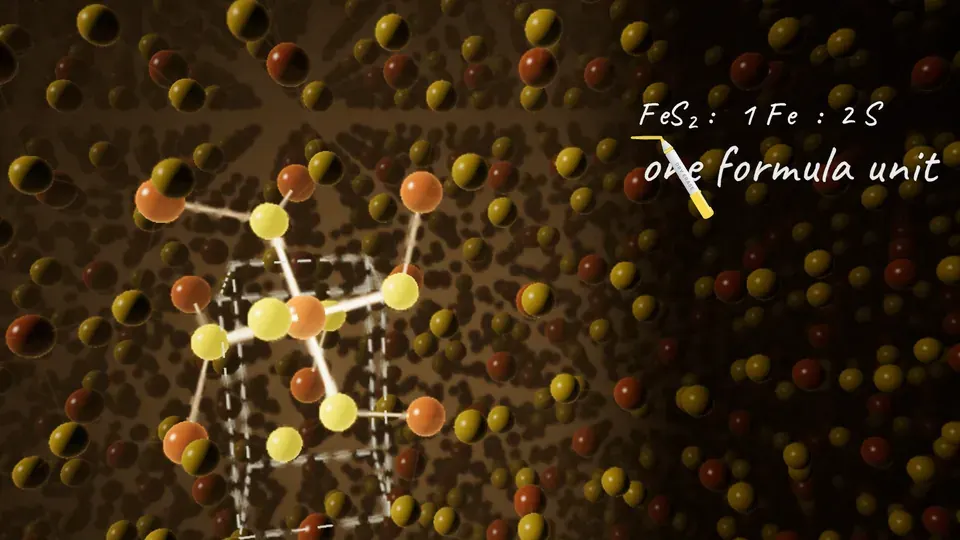
We’re going down through that mirror face, past the grooves on its surface, past anything an ordinary microscope could show you, all the way down to the atoms. So this is the inside of the cube, iron atoms in orange and sulfur in yellow, repeating in every direction for billions of trillions of atoms.
Pick any one iron atom, like this one, and look at what’s around it. It’s sitting in the middle of six sulfur atoms, and every one of those sulfurs is also touching two more irons. So which two sulfurs belong to this iron? If the formula is F E S two, there ought to be one little iron-and-two-sulfur molecule in here that you could pull out on its own.
Grab any iron atom you like and try to pull one iron-and-two-sulfur molecule out of the crystal. So in a crystal like this, F E S two doesn’t describe a molecule at all. It describes a ratio, one iron for every two sulfur atoms, and when we count out one iron and two sulfurs like this, we call it one formula unit.
Now let’s surface again. The morning dew has left a droplet of water on the cube. Inside the drop, every water molecule is its own separate unit, two hydrogens holding onto one oxygen, tumbling past its neighbors without belonging to them. So these substances show two kinds of structure, separate molecules like water, where the formula tells you what’s in one molecule, and giant connected networks like pyrite, where the formula tells you the ratio.
Water, carbon dioxide and sugar are made of molecules, while table salt and quartz are networks like pyrite, so N A C L just means sodium and chloride ions in a one-to-one ratio. So if you ever catch yourself writing one N A C L molecule, on a test or on the AP exam, cross it out and write one formula unit of N A C L, because there’s no separate molecule of salt inside a salt crystal.
Counting isn’t weighing
Back in the crystal, two out of every three atoms are sulfur. That ought to tell us something about where the cube’s mass comes from. Take a guess first. What percentage of pyrite’s mass do you think is sulfur?
Here’s one formula unit on the scale. An iron atom has an average mass of fifty-five point eight five atomic mass units and a sulfur atom only about thirty-two, so the two sulfurs together come to sixty-four point one two, which is barely more than the one iron.
So let’s work out the real number the way you’d write it on a test. On average, one formula unit weighs fifty-five point eight five plus two times thirty-two point oh six, which is one hundred nineteen point nine seven atomic mass units altogether. The sulfur’s share is sixty-four point one two out of one hundred nineteen point nine seven, and if we divide and multiply by a hundred, we get fifty-three point four five percent, so sulfur is a little more than half of the mass, nowhere near two-thirds, and iron is the other forty-six point five five percent.
The same move works for any compound, and since molar masses in grams per mole are the very same numbers, it’s the element’s molar mass times its subscript, over the molar mass of the whole compound, times a hundred. And this exact setup is a classic AP question, where one wrong answer to watch for is the number you’d get by counting atoms instead of weighing them.
Let’s do water together. Two of its three atoms are hydrogen, so counting would say two-thirds, but what do you get when you weigh it? Two hydrogens make two point oh one six out of eighteen point oh two, only eleven point one nine percent, so two-thirds of the atoms carry just over a tenth of the mass, because hydrogen is the lightest atom there is. Now you try one with table salt, which has one chloride ion for every sodium ion, so what percentage of its mass is chlorine?
Every cube, the same recipe
Back on the hillside, here’s a small cube, one centimeter on each side, and it weighs about five grams. If a lab analyzed it, and it’s pure pyrite, it would find two point three three six grams of iron and two point six eight two grams of sulfur, which is forty-six point five five percent iron, exactly what we just worked out from one formula unit.
Now take the biggest cube on this slope, ten centimeters across and about five kilograms. It has a thousand times more of everything, and the percentage doesn’t budge, still forty-six point five five percent iron. Pick any two cubes you like, big or small, and split them. See if you can find one that breaks the pattern.
This is the law of definite proportions. In any pure sample of a compound, the masses of its elements are always in the same ratio, whether the sample is a speck or a boulder, and whether it came out of a mine or out of a lab.
Look at the first row, where two point three three six grams of iron out of five point oh one eight grams of pyrite, times a hundred, is forty-six point five five percent, and every other row lands on exactly the same number. A French chemist named Joseph Proust made that case in the seventeen-nineties, working in Spain, by analyzing copper carbonate from his lab and from the ground, and two of the compounds iron makes with sulfur.
One of them is pyrite, and the other is F E S, and pure F E S has its own fixed recipe, sixty-three point five three percent iron, so the same two elements can make different compounds, each with a recipe that never changes. So if a question ever suggests that a bigger sample has a bigger percentage of something, cross it out, because the grams grow and the percent stays put.
Run it backwards
Okay, now for the promise. Pretend nobody told us the formula, and all a lab hands us is a crushed six-gram sample with two point seven nine three grams of iron and three point two oh seven grams of sulfur in it. You might want to compare those two masses directly, which gets you almost one to one, and that’s wrong, because masses don’t count atoms.
To turn grams into a count, we divide by the molar mass, the same move from lesson one point one, so let’s do iron first. The grams of iron cancel, and we’re left with zero point oh five oh oh one moles of iron atoms. Sulfur works the same way, three point two oh seven grams divided by thirty-two point oh six grams per mole, which is zero point one oh oh oh moles of sulfur atoms.
Now we divide both by the smaller one. Iron comes out to one and sulfur to two point oh oh oh, two sulfur atoms for every iron atom, so the formula is F E S two. A formula we get this way has a name, the empirical formula, and it means the lowest whole-number ratio of atoms in a compound. Lowest means divided down as far as it goes, so if your numbers came out two to four, you’d still write F E S two.
And the reason it works is that a mole of iron atoms and a mole of sulfur atoms hold the same number of atoms, so once everything’s in moles, comparing moles is the same thing as comparing atoms. So there it is, the recipe of a cube nobody cut, worked out from just two masses, and you never had to see a single atom.
Half an atom?
That routine works on any compound, so let’s take it somewhere very different, a gorge in Western Australia whose walls are full of iron. These stripes are about two and a half billion years old. One explanation is that oxygen made by microbes in the ancient ocean combined with iron dissolved in the seawater, and the iron oxides settled to the bottom, layer after layer. The iron in these bands sits mostly in two different compounds, and both of them are made of nothing but iron and oxygen.
Geologists have a quick way to tell them apart. Drag the magnet along the wall and find a band that it sticks to. The dark bands grab the magnet because they’re rich in magnetite, and the red ones let it hang because their iron is mostly hematite, two different compounds from the same two elements. Pure hematite is sixty-nine point nine four percent iron and thirty point oh six percent oxygen by mass, so let’s work out its formula together.
With percentages, imagine exactly a hundred grams of the stuff, so the percents turn straight into grams, sixty-nine point nine four grams of iron and thirty point oh six grams of oxygen. Dividing each by its molar mass gives one point two five two moles of iron and one point eight seven nine moles of oxygen, and you already know the next step from the pyrite.
We divide both by the smaller number, and we get one for iron and one point five for oxygen, and now we have a problem, because a compound can’t contain half an atom. So what formula do these numbers really point to?
The fix is to multiply every number by the same whole number, so one and one point five, times two, becomes two and three, and the formula is F E two O three. Point five means multiply by two, point three-three or point six-seven means multiply by three, point two-five or point seven-five means multiply by four, and you always multiply every element, never just the one that’s misbehaving.
Now the dark bands are all yours. Pure magnetite is seventy-two point three six percent iron and twenty-seven point six four percent oxygen, so what’s its empirical formula? So the iron in the red bands is mostly F E two O three and in the dark ones it’s mostly F E three O four, two fixed recipes from the same two elements, stacked up for two and a half billion years.
Same recipe, different molecules
There’s one more thing an empirical formula can’t tell you, and it matters a lot when a substance is made of molecules. Here are three of them. This is formaldehyde, which biology labs use to preserve specimens, this is acetic acid, the molecule that makes vinegar sour, and this is glucose, the sugar that’s in your blood right now. Divide each one down as far as it goes and every one of them lands on the same ratio, C H two O, which means all three have exactly the same percent composition, so weighing their elements could never tell them apart.
The formula that tells you what’s actually in one molecule is called the molecular formula, and it’s always a whole-number multiple of the empirical formula. To find that multiple you need the molar mass. Glucose is one hundred eighty point one six grams per mole and one C H two O adds up to thirty point oh three, so dividing gives six, and glucose is C six H twelve O six.
Let’s see if you can do the next one. A compound has the empirical formula C H two O and a molar mass of sixty point oh five grams per mole, so what’s its molecular formula?
The question the AP exam asked
Let’s finish with a real question from the twenty twenty-three AP Chemistry exam, because it’s exactly what we’ve been doing, just in a lab instead of a hillside. A student put a piece of manganese into hydrochloric acid, which turned it into a manganese chloride with an unknown formula, then heated the beaker until only the dry solid was left.
The manganese was already in the beaker before the reaction, so everything the beaker gained after that has to be chlorine, which means the chlorine’s mass is sixty-two point six seven three minus sixty-one point two six two, or one point four one one grams. Now you turn those one point four one one grams of chlorine into moles. The molar mass of chlorine is right there on the board.
The question gives zero point oh one nine nine moles of manganese, and zero point oh three nine eight oh divided by that is two point oh oh, two chlorines for every manganese, so the formula is M N C L two. And this line right here, the mole ratio, is the one that earns the point on the exam, because the ratio is your evidence, and a formula written without it looks like a guess.
What a formula knows
So a formula tells you what’s in one molecule or the ratio in a network, every pure sample of a compound has the same mass percentages, and to go from masses to a formula you divide by molar mass and find the lowest whole-number ratio.
And back in Navajún, the sun’s going down on a slope full of cubes that nobody cut. You started this lesson not knowing their recipe, and now you could weigh the iron and the sulfur in any one of them and prove it’s F E S two. Everything today assumed a pure sample, though, and real rocks almost never are, so next time we’ll find out what these numbers can tell us when a sample is a mixture.