
Topic 2.4 key terms
- metallic bonding
- The attraction between an array of positive metal cores and the sea of delocalized valence electrons around them. It acts in every direction, so layers of cores can shift without breaking the bonding.
- sea of electrons
- The model of a metal's valence electrons as delocalized: they are not tied to any one atom and move through the whole sample. They carry electric current.
- delocalized electrons
- Electrons that belong to the whole piece of metal rather than to one atom or one bond.
- positive metal core
- A metal atom without its valence electrons: the nucleus plus the inner electrons. In solid magnesium each core is Mg²⁺.
- malleable
- Able to be hammered or pressed into sheets without breaking. Metals are malleable because their layers can slide while the electron sea keeps holding the cores.
- ductile
- Able to be drawn into a wire without breaking, for the same reason metals are malleable.
- alloy
- A mixture of a metal with at least one other element that keeps metallic properties, e.g. steel (Fe with C) or brass (Cu with Zn).
- interstitial alloy
- An alloy in which atoms of a much smaller radius fill the spaces (interstices) between the larger host atoms, and every host atom stays on its site. Example: carbon in iron (steel).
- substitutional alloy
- An alloy of atoms with comparable radii, in which atoms of one element take the place of host atoms in the lattice. Example: zinc for copper in brass; copper for silver in sterling silver.
- atomic radius
- A measure of an atom's size, in picometers (1 pm = 10⁻¹² m). Comparing the radii of two metals' atoms predicts which kind of alloy they form.
Transcript
2,430 words · 8 parts
One wire at a time
In 1935, two steel towers stood on opposite sides of the Golden Gate, the windy strait where San Francisco Bay meets the Pacific, and the bridge that would join them needed something to hang from. It would hang from two cables, each almost a meter thick and about twelve thousand tons, far too heavy to lift into the sky, so the builders spun them right there in the air, one wire at a time.
A wheel like this one carried a wire about as thick as a pencil from one shore, up over both towers and down to the other side, then turned around and came back for another, back and forth for six months. They kept going until each cable held twenty-seven thousand, five hundred seventy-two wires, packed side by side. If you laid all the wire from both cables end to end, it would wrap around the Earth more than three times.
Every one of those wires is steel, and steel is mostly iron, which is a little strange, because pure iron is surprisingly soft. And a big part of what makes this wire strong enough to hold up a bridge is just a pinch of carbon. That’s less than one percent of its mass.
So what is that carbon actually doing in there? Let’s go and look, all the way down, past the surface of one wire and into the steel itself, until we can see its atoms. There they are, rows and rows of iron, bathed in a glow we’re going to explain in a minute, and every so often, tucked in between them, a much smaller atom of carbon.
By the end of this lesson, you’ll be able to zoom into a wire like this and draw what’s holding its atoms together, show exactly where that carbon goes, and explain why such a tiny pinch makes iron so much harder to bend. And then we’ll do the same thing for brass. Its extra atoms end up somewhere completely different. So let’s start with the iron itself, before anybody adds anything, and figure out what’s holding a piece of metal together in the first place.
What holds a metal together
You already know two ways atoms hold on to each other. In salt, positive and negative ions attract each other, and in a molecule like water, two atoms share a pair of electrons. Metals do something different, because they hold their outer electrons so loosely. We saw that with ionization energy, and a few lessons ago we called those electrons delocalized, so today let’s build that model, the one you’ll need on the AP exam, and put it to work.
Let’s build a piece of magnesium. Each magnesium atom has two valence electrons, and in a solid chunk every atom lets go of both of them, into one shared pool that spreads through the whole piece. What’s left behind at each spot is a positive core, a magnesium two-plus ion, and all around the cores is this crowd of loose electrons that chemists call a sea of electrons.
Let’s count, because a good model always adds up. Nine cores at plus two each makes plus eighteen, and eighteen electrons makes minus eighteen, so the whole piece is neutral, even though it’s absolutely full of charges.
Delocalized just means that no electron belongs to any one atom. Each electron belongs to the whole piece of metal, and the attraction between all those positive cores and all those negative electrons is what we call metallic bonding.
Here’s a drawing students make all the time, a metal drawn like salt, with positive and negative ions taking turns. There are no negative ions in a metal at all, and the only negative things in there are the electrons in the sea.
Here’s the same idea inside our wire. Each sphere is an iron core, the nucleus plus its inner electrons, and its valence electrons have joined the glow that fills every gap. Now let’s connect a battery across this piece of wire and see what moves. The battery’s on. Click one of the particles that’s actually carrying the current through the wire.
That drift is an electric current, and it’s why every metal conducts electricity as a solid. The charge carriers are already loose, so all a battery has to do is give the whole sea a nudge in one direction.
Bend, don’t break
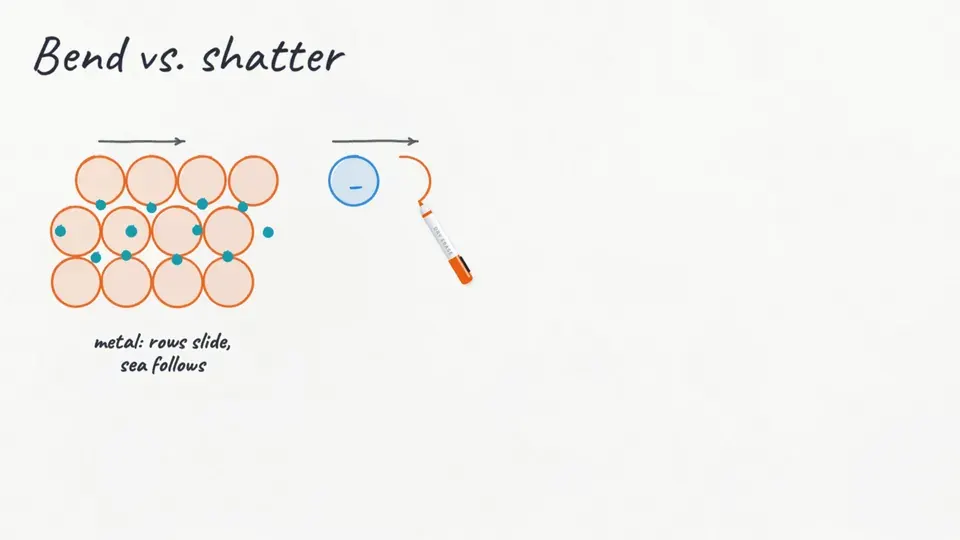
Now, making a wire like the ones in that bridge stretches the steel enormously, and it never cracks. Try that with a crystal of salt and it shatters on the very first pull, so why doesn’t the metal? Let’s push on the iron. I’ll slide the top half of the block to the right. The rows slide right over each other, one atom over, and the sea of electrons flows along with them.
Every core is still surrounded by electrons, so nothing has come apart. The metal didn’t break, it just changed shape, and that’s what makes metals malleable, so you can hammer them into sheets, and ductile, so you can pull them into wire. Now let’s give salt the same push. As soon as the top layer slides one ion over, every positive ion is suddenly facing another positive ion and every negative faces a negative, and the repulsion splits the crystal right along that line.
That’s the whole difference. In salt, each ion’s attraction depends on exactly who its neighbors are, but in a metal the sea doesn’t care where the cores sit, so you can rearrange them and the bonding comes right along.
On paper it looks like this. A metal row slides and the sea comes with it, while one shift in an ionic solid puts like charges face to face. And here’s one thing worth getting straight. When a wire bends, the iron atoms themselves don’t bend or stretch; each atom stays exactly the same, and what changes is their arrangement.
Picking the right particle drawing of a metal is a classic AP question. They’ll show you a few pictures like these. Only one of them is a metal. Which of these drawings represents solid magnesium?
A pinch of carbon
So if iron’s rows slide this easily, how does that wire hold up a bridge? That’s where the carbon comes in, and the first thing to notice is its size. An iron atom’s radius is about a hundred fifty-six picometers, and carbon’s is sixty-seven, less than half.
Now look at the gaps in the iron, these little hollows where four atoms meet. An atom as small as carbon can fit right inside one. Turn this iron into steel. Drag carbon atoms into the iron, and see where they’ll go.
What you just made is an alloy, a metal mixed with at least one other element, and this kind is called an interstitial alloy. An interstice is a gap, so in an interstitial alloy much smaller atoms fill the gaps between the bigger ones, and none of the bigger atoms gets replaced.
Now let’s push on the steel the same way. The rows try to slide and they catch, because each carbon sits right in the path and squeezes its neighbors out of line, so it takes a much bigger push to move anything. That’s why steel is so much harder than pure iron. The sea of electrons is still there, so steel still conducts and it still holds together, but the rows can’t slide nearly as easily, so the metal resists being bent out of shape.
Now let’s check our drawing. The wire is point eight one percent carbon by mass, so how many iron atoms are there for every carbon? The answer surprised me. With a percent by mass, it helps to imagine exactly a hundred grams. Then point eight one grams is carbon, and the other ninety-nine point two grams is almost all iron, with a little manganese and silicon mixed in, so we’ll treat it all as iron, which barely changes the answer.
To turn grams of carbon into moles, I put carbon’s molar mass in upside down, one mole over twelve point oh one grams, so the grams cancel, and I’m left with about point oh six seven four moles of carbon. Same move for the iron. Ninety-nine point two grams times one mole over fifty-five point eight five grams gives about one point seven seven six moles of iron.
And now the ratio. One point seven seven six divided by point oh six seven four is about twenty-six, so there’s roughly one carbon atom for every twenty-six iron atoms. Does that make sense? A carbon atom weighs less than a quarter of an iron atom. Every gram of carbon holds over four times as many atoms as a gram of iron.
Carbon’s share of the atoms is its moles over all the moles. Put in our two mole numbers. It comes to point oh three seven. That’s about three point seven percent of the atoms, more than four times its share of the mass. We keep two significant figures in that twenty-six, because point eight one has only two.
So when we draw steel, the carbon goes in only a few of the gaps. On an exam you’d draw a grid of big iron circles, a few small carbon circles in the gaps, and a key.
And here’s the version that loses the point, with carbon drawn in place of an iron atom and a hole where the iron should be. In steel every iron stays, and the carbon only fills the gaps. In the real wire, much of the carbon gathers into thin plates of a compound called iron carbide, but the model you’ll use on the exam puts the carbon in the gaps between iron atoms, and that model explains why steel resists bending.
Brass
Now let’s go somewhere warmer. This sheet of brass is about half a millimeter thick, and it’s about to become the bell of a trumpet. It’s rolled into a cone, joined at the seam, hammered over a steel form and spun on a lathe until it flares out, an enormous amount of bending, and it never cracks.
Brass is copper with zinc mixed in, seventy percent copper and thirty percent zinc by mass for a bell like this. So what are the zinc atoms doing in there? Are they hiding in the gaps, like the carbon in steel? Here’s copper, and here’s zinc. Copper’s radius is a hundred forty-five picometers and zinc’s is a hundred forty-two, so they’re almost exactly the same size.
So watch what happens if I try to push a zinc atom into one of the gaps. It’s far too big. The neighbors bulge out around it, and then it pops right back out. Now you try it. Put zinc atoms into this copper, and find the move that actually works.
That’s a substitutional alloy, where the atoms are about the same size and one kind simply takes the other’s place in the arrangement. Zinc in copper, which is brass, is the classic example. And it still bends. Copper slides easily, and brass catches a little more because each zinc nudges its row slightly out of line, but it still slides, so brass is harder than copper and still easy to hammer into a trumpet.
And the sea is still here. With the battery on, the electrons drift right through the brass just like they did in pure metal, which is why brass conducts electricity. Mixing in a second metal doesn’t take the sea away.
Let’s count the atoms again, and this time you’re going to finish it. Imagine a hundred grams of this brass, so seventy grams of copper and thirty grams of zinc. Seventy grams of copper times one mole over sixty-three point five five grams gives about one point one oh moles of copper. Now you do the zinc, thirty grams divided by zinc’s molar mass of sixty-five point three eight. Then work out what fraction of all the atoms are zinc.
About how many of every hundred atoms in this brass are zinc? Notice how different that is from steel. Copper and zinc weigh almost the same per mole, so their share of the atoms nearly matches their share of the mass, but carbon is so light that a tiny mass percent turns into a much bigger share of the atoms.
The AP exam’s silver
Here’s something the AP exam actually asked, in 2024. Sterling silver, the kind used for jewelry, is ninety-two and a half percent silver by mass, and the rest is usually copper. The exam gave you two numbers, silver’s atomic radius of a hundred sixty-five picometers and copper’s of a hundred forty-five, and asked why sterling silver is better classified as a substitutional alloy than an interstitial one.
So here’s silver, and here’s copper. Copper is the smaller one, and you get to decide where it goes. Put the copper atoms where they belong in sterling silver. Now, let’s put what you just did into words. So, on the exam, what’s the best explanation you could write?
Both at once
Let’s try one more, the spoon in your kitchen drawer. A lot of stainless steel is iron with about eighteen percent chromium and eight percent nickel by mass, plus a trace of carbon, and here are their sizes.
Which model fits stainless steel? So don’t think of interstitial and substitutional as labels for a whole alloy. They describe where each kind of atom goes, and that comes down to size.
Back to the bridge
Let’s put the whole picture in one place. A metal is positive cores in a sea of shared electrons, which is why it conducts and why it bends instead of shattering. When the added atoms are much smaller, they tuck into the gaps between the host atoms, and that’s an interstitial alloy, like carbon in steel.
When they’re about the same size, they take a host atom’s place, and that’s a substitutional alloy, like zinc in brass or copper in sterling silver. Either way, the misfit atoms get in the way when the rows try to slide, so the alloy is harder to bend, and the sea is still there, so it still conducts.
So now you can draw what’s inside every one of those wires. It’s iron cores in a sea of electrons with about one carbon for every twenty-six irons overall, and in your model those carbons sit in the gaps, pinning the rows in place. And the next time you see this bridge, you’ll know it’s hanging from eighty thousand miles of iron that a pinch of carbon helped make strong enough for the job.