
Topic 2.3 key terms
- ionic solid
- A solid made of cations and anions held together by the attractions between opposite charges, arranged in a repeating 3-D pattern (for example NaCl).
- Coulomb's law
- The force between two charged particles is proportional to the product of their charges divided by the square of the distance between their centers: F ∝ q₁q₂/r².
- periodic 3-D array
- The repeating arrangement of ions in an ionic crystal. Each ion's nearest neighbors are opposite charges (maximum attraction) and like charges are kept farther away (minimum repulsion).
- particulate model
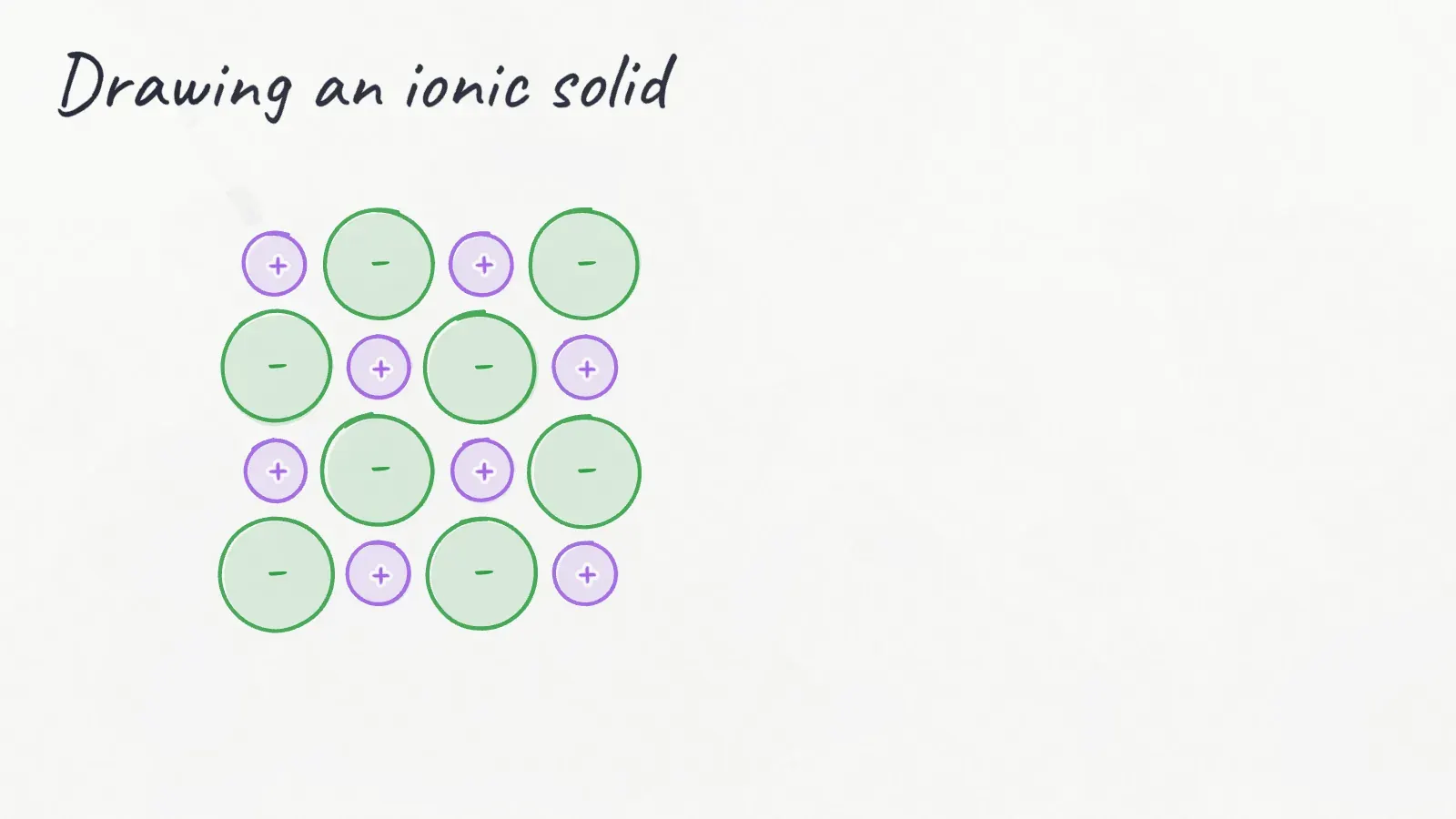
- A drawing of the particles in a substance. For an ionic solid: ions labeled with charges, sizes from the key, opposite charges as nearest neighbors, counts matching the formula, a slice of a 3-D array.
- formula unit
- The ratio of ions in an ionic compound, such as one Na⁺ for every Cl⁻ in NaCl. An ionic solid contains no separate molecules.
- brittle
- Breaking rather than bending. Shifting a layer of an ionic crystal by one ion brings like charges face to face, and their repulsions split the crystal along a plane.
- lattice enthalpy
- The enthalpy change for separating a solid ionic crystal into its gaseous ions; it takes energy, so it is positive. Stronger Coulombic attractions between the ions mean a greater lattice enthalpy.
Transcript
2,367 words · 9 parts
A wheel inside the salt
Right now you’re riding a Ferris wheel, and you’re doing it about a hundred and twenty meters underground. This is the Rudolf Mine at Salina Turda in Romania, and the walls around you and the ceiling forty-two meters above the floor are solid salt, sodium chloride, the same stuff you sprinkle on French fries.
Long after the mining stopped, this hall became a place to ride a wheel, play mini-golf and go bowling. And look up at the ceiling, because those white icicles are salt too, and they’re still growing, about two centimeters a year, as salty water seeps down through the rock and leaves its salt behind.
And that’s what makes this place so strange, because the salt holds together well enough that miners hollowed out a hall taller than a ten-story building. But take one clear crystal of the very same salt, rest a blade on it, and give it a single tap. It doesn’t dent, and it doesn’t bend, it splits apart along a face so flat that it shines like a mirror.
So which is it, is salt strong enough to hold up a hall like this, or does it fall apart at one tap? It’s both, and the reason is hiding in how its particles line up. By the end of this lesson, you’ll be able to draw what’s inside this salt, ion by ion, the way the AP exam wants it, and use that drawing to explain both halves of this puzzle, why salt holds together so well and why one small shove splits it clean in two.
So let’s fly up to the tip of one of those stalactites, where new salt is landing right now, and find out what it’s actually made of. Down at this scale, all of that salt turns out to be made of just two kinds of particles, sodium ions and chloride ions.
What’s in the salt
Here they are on the board, a sodium ion, with a charge of plus one, and a chloride ion, with a charge of minus one. And notice they aren’t the same size, because the chloride ion’s radius is about a hundred and eighty-one picometers, while the sodium ion’s is only about a hundred and two. That’s because sodium lost its whole outer shell to become an ion, while chlorine kept all three shells and gained an extra electron.
And with plus one and minus one, salt has exactly one sodium ion for every chloride ion, which is all the formula N A C L means. And that’s already enough for a classic AP question, where they show you an ionic solid drawn with two sizes of circles and ask which circles are which ions, and all you need are the charges and the sizes, never the name of a crystal structure.
To see how a whole crowd of these ions should arrange itself, we need Coulomb’s law from topic one point five. Opposite charges pull together and like charges push apart, and the force grows with the two charges multiplied together on top. It shrinks with the distance squared on the bottom, so the closer two ions get, the harder they pull or push, and half the distance means four times the force, because two squared is four.
So how should a huge crowd of sodium and chloride ions arrange itself to hold together as well as it possibly can? One idea is to put all the sodium ions on one side, and all the chloride ions on the other side. Coulomb’s law rules that out, because every sodium ion would sit jammed against other positive ions, all pushing apart, and the only opposite charges close enough to pull hard would sit along the one line where the groups meet.
Another idea is little pairs, one sodium stuck to one chloride, like a bag of tiny magnets. We’ll test the pairs idea soon, but instead of guessing, let’s go back inside that stalactite and let the ions show us.
Grow the crystal
Here’s the tip of that stalactite, with a drop of salty water hanging off it, and this is exactly where new salt joins the crystal. As the water evaporates, the sodium and chloride ions it was carrying settle onto the surface, and at two centimeters a year, if this tip grew as one single crystal, that would be about two new layers of ions every second.
Here are the forces on one sodium ion in the surface, a gold thread for every pull and a blue one for every push, and the brighter the thread, the stronger the force. Its closest neighbors are chloride ions, so the strongest threads are gold, and the pushes from other sodium ions are fainter, because those ions sit farther away.
This surface still has six empty spots for your three sodium ions and three chloride ions, and the bar on the right adds up the potential energy of every pair of ions in this patch, so the lower it sits, the more stable the layer. Drag the loose ions into the empty spots, so this layer holds together as well as it can. And watch the threads as you go.
The layer’s finished, so let’s start the next one, with one more sodium ion hovering above the surface. Try to set this sodium ion down right on top of another sodium ion, and then let go and see whether it stays.
So each new layer sits shifted from the one below, sodium over chloride and chloride over sodium, which means the pattern alternates up and down as well as side to side, and layer after layer, the same rule builds the crystal in all three directions. Now let’s pick one sodium ion deep inside and look at everything around it.
The six ions closest to it are all chloride ions, above and below, left and right, in front and behind, each one two hundred eighty-two picometers away, and every one of them pulls on it. But it isn’t surrounded only by chloride ions, and this is the part people usually miss, because twelve sodium ions are nearby too, pushing on it, just from farther away, about three hundred ninety-nine picometers, so each push is weaker than each pull.
And that’s the whole reason behind this arrangement, because every ion’s closest neighbors are opposite charges, so the pulls are as strong as they can be, while the like charges sit farther off, so the pushes stay as weak as they can be. So which of those six chloride ions is this sodium’s partner? None of them, since all six pull on it equally, so there are no little salt molecules in here, and the pairs idea is out.
And the pattern doesn’t stop, it repeats in every direction, so a single grain of salt just one millimeter across holds about forty-five billion billion ions, all in this one arrangement. A drawing on paper can’t hold a whole three-dimensional crystal, so the usual picture is one flat slice, a checkerboard of plus and minus ions, which is really one layer of a pattern that keeps going.
Draw it the AP way
Here’s that slice on the board, the answer for that empty third box, and let’s go through what makes it a correct model, because these are exactly the things an AP grader checks. First, it’s made of ions, and every one has its charge written on it. Second, the sizes come from the key, so the chloride ions are drawn almost twice as wide as the sodium ions.
Third, and this is the big one, every ion’s nearest neighbors have the opposite charge, the rule the forces chose for us inside the stalactite. Fourth, the counts match the formula, with eight sodium ions and eight chloride ions in this patch, the same one-to-one ratio as the whole crystal, so the charges add up to zero.
And fifth, it’s only a slice, so the edges stop where the paper does, while the real crystal keeps going in all three directions. The whole crystal has zero charge, but every single ion in it still carries its own charge, and those charges are what hold it together.
Now here are three drawings that lose points, starting with a really common one, separate little sodium chloride pairs, and we saw that every ion feels the pull of all its neighbors, so this one’s out. The second one alternates perfectly, but it draws the sodium ions bigger than the chloride ions, which is backwards. And the third has two chloride ions right next to each other, an easy mistake to miss and an easy point to lose.
Let’s try magnesium oxide, with magnesium ions of plus two and oxide ions of minus two, where the oxide ion is almost twice as big. Which of these four drawings is a correct particulate model of solid magnesium oxide? Those rules work for every ionic solid, so let’s take them back inside the crystal and see what happens when we change one ion.
Same charges, closer together
Here’s sodium chloride again, and this time we’ll swap in a different positive ion, keeping the charges exactly the same. Lithium ions are plus one too, but they’re smaller, seventy-six picometers instead of a hundred and two, so in lithium chloride the centers of neighboring ions sit closer together, about two hundred fifty-seven picometers apart instead of two hundred eighty-two. Think of it as lithium chloride beside sodium chloride, two different compounds, and with the same charges and a shorter distance, Coulomb’s law says every pull gets stronger. Let’s work out how much.
For each salt, the distance between the centers is just the two radii added together, two fifty-seven picometers for lithium chloride and two eighty-three for sodium chloride, within one picometer of the two eighty-two we saw inside the stalactite. To compare the forces, I’ll divide one Coulomb’s law by the other, and since both salts have charges of plus one and minus one, the charges cancel, leaving only the distances. Dividing by one over two eighty-three squared flips it to the top, so we get two eighty-three over two fifty-seven, all squared.
Grab the calculator and work out that ratio, two eighty-three over two fifty-seven, squared, to two decimal places. That’s just one pair of ions, and a real crystal adds up an enormous number of pulls and pushes, but the direction is clear, since a smaller ion with the same charge sits closer and pulls harder.
Twice as many
Now one where the charges don’t match, calcium fluoride, with calcium ions of plus two and fluoride ions of minus one, and here the fluoride ion is the bigger one. To come out neutral, every calcium ion needs two fluoride ions, so a correct drawing shows twice as many fluorides as calciums, and it can’t be a simple checkerboard anymore. This one’s all yours, and each drawing is meant to show every ion in a sample, so check the charges, the counts and the neighbors.
Which of these drawings correctly represents solid calcium fluoride? Now you can draw any of these, so let’s go back to the crystal from the beginning and finally solve the puzzle we started with.
Why salt splits
Here it is, back in one piece, sitting in the hall where we left it. Inside it is the pattern you just built, every ion surrounded by opposite charges. Light up every pull between nearest neighbors at once and you can see why salt holds together so well, because opposite charges pull on every ion from every direction, and to tear salt apart you’d have to fight all of those pulls at once.
So let’s do what the blade did, and push the top half of the crystal sideways, along this plane. A small nudge doesn’t do much, because the ions across the plane still mostly face opposite charges, so the pulls drag the top half back into place. Now you try it. Grab the top half of the crystal, slide it over by one whole ion, and watch what ends up facing what.
That’s the other half of the puzzle, because the same arrangement that makes every pull as strong as it can be also means that sliding one layer by a single ion lines up like charges all along a flat plane. And that’s why the crystal from the beginning came apart along a perfectly flat face, because it split between two flat layers of ions.
A real crack usually starts at a tiny flaw, but like charges lining up is why salt can’t just bend out of the way, and it’s the explanation the AP exam expects. So salt holds together and shatters for the same reason, its arrangement, and if you hit copper the same way, it just dents, which is a story for next time.
On the AP exam
Here’s a question adapted from the 2016 AP Chemistry exam, and you’ve already done everything it asks. One part shows a piece of a lithium chloride crystal and asks you to label the ions, and the point only comes if you get both. A lithium ion has just one shell of electrons left while a chloride ion has three, so the small circles are the lithium ions and the big ones are the chloride ions.
Another part asks which salt, lithium chloride or sodium chloride, has the greater lattice enthalpy, the energy it takes to pull the solid apart into separate gaseous ions. Which of these justifications would earn the point? And that’s both parts of a real AP question, so let’s go back to Turda one last time.
Back on the wheel
From up here, you can explain this whole place. The salt in these walls is sodium and chloride ions in a repeating three-dimensional pattern, where every ion’s closest neighbors are opposite charges, while the like charges are kept farther away, and that’s why salt holds together well enough to carve a hall like this out of it.
And if you shift one layer by a single ion, like charges end up facing each other all along a flat plane, and that’s why a crystal of it splits clean in two. Next time, we’ll take a hammer to a metal instead, and find out why it bends where salt would break.