
Topic 4.7 key terms
- acid–base reaction
- A reaction in which one or more protons (H+) transfer from one species to another.
- oxidation number
- A bookkeeping charge assigned to each atom: elements alone are 0, a one-atom ion has its charge, and the numbers in a species add up to its overall charge.
- oxidation–reduction (redox) reaction
- A reaction in which electrons transfer from the species oxidized (its oxidation number goes up) to the species reduced (its oxidation number goes down).
- combustion
- A redox reaction of a substance with oxygen gas. Complete combustion of a hydrocarbon gives carbon dioxide and water.
- precipitation reaction
- A reaction in which ions in solution come together to form an insoluble (or sparingly soluble) ionic solid. All sodium, potassium, ammonium and nitrate salts are soluble.
- spectator ion
- An ion present in the solution before and after a reaction that takes no part in it (for example K+ and NO3- when AgBr precipitates).
Transcript
1,400 words · 5 parts
Types of reactions: acid–base, a proton moves
Here’s the reaction we used to measure the acid in the stop bath, acetic acid plus hydroxide, and now we’re going to slow it way down and look at what actually happens inside it, which is what tells you what kind of reaction it is. Watch this one hydrogen on the acid molecule. It lets go of its oxygen and jumps across to the hydroxide, and it leaves its electron behind, so what actually moves is a bare hydrogen nucleus, a single proton.
The acid becomes acetate and the hydroxide becomes water, and that’s what an acid-base reaction is, one or more protons moving from one particle to another. Your turn, so grab the hydrogen that actually moves and hand it to the hydroxide.
Here’s the same reaction on the board, with the proton circled, hopping from the acetic acid over to the hydroxide. And a base doesn’t even need hydroxide. When ammonia meets a hydronium ion, a proton hops from the hydronium onto the ammonia, giving ammonium and water, so that’s acid-base too, because a proton moved.
Now you can see why the stop bath works, because its acid hands protons to the hydroxide the developer needs. But the black parts of that giant picture came from a different kind of reaction.
Redox: electrons move
So, back to the hangar… where the picture is only halfway up. Before I tell you, take a guess. What do you think the black parts of this picture actually are?
Let’s follow one runway stripe down into the fabric, past the threads and into the layer of gelatin, until you can see the crystals themselves. Emulsions like this are packed with tiny crystals of silver halides, like silver bromide, and wherever light hit one, the developer turns it into a black tangle of silver metal, while the rest stay pale.
Let’s go inside one of those crystals. It’s built from silver ions and bromide ions, each one still carrying its charge, and this little cluster at the corner is a few silver atoms that the light made.
Now a developer molecule arrives, and it hands over two electrons, one to each of these silver ions, and every silver ion that gets an electron turns into a neutral silver atom and joins the cluster. Chemists keep track of this with oxidation numbers. A silver ion’s oxidation number is plus one, a silver atom’s is zero, so silver went from plus one to zero, because it gained an electron.
A reaction where electrons move from one particle to another is an oxidation-reduction reaction, or redox for short. The one that loses electrons is oxidized, here the developer, and the one that gains them is reduced, here the silver. So the electrons always travel from the one being oxidized to the one being reduced, and if you need a way to remember which is which, try oil rig, oxidation is loss, reduction is gain.
Now you be the developer, so give these silver ions their electrons and watch their oxidation numbers. The developer also hands two protons to hydroxide as it works, which is why it needs a basic solution, but we call this reaction redox, because silver’s oxidation number changed.
Oxidation numbers and combustion
So how do you work out an oxidation number? An element on its own, like silver metal or oxygen gas, is zero, and a one-atom ion has its own charge, so a silver ion is plus one.
In any molecule or ion, the oxidation numbers add up to its overall charge, and hydrogen is almost always plus one, while oxygen is almost always minus two. Polyatomic ions are where people slip, because it’s tempting to give sulfur sulfate’s minus two, but that minus two belongs to the whole ion. Four oxygens at minus two make minus eight, and the total is minus two, so sulfur is plus six.
Let’s try one together. When you drop zinc metal into a solution of copper ions, it comes out coated with copper, and using our first two rules, zinc goes from zero to plus two while copper goes from plus two to zero. Zinc’s number went up because it lost two electrons, so zinc is oxidized, and copper’s went down because it gained those electrons, so copper is reduced, which means the two electrons travel from the zinc to the copper ion.
Hangar one fifteen used to house F eighteen fighter jets, and a jet engine runs on combustion, a fuel reacting with oxygen gas. Let’s start with the simplest fuel there is, methane. In methane, four hydrogens at plus one make carbon minus four, in carbon dioxide, two oxygens at minus two make carbon plus four, and oxygen goes from zero in oxygen gas to minus two.
So carbon lost electrons and oxygen gained them, which makes combustion a redox reaction, and when a fuel made of only carbon and hydrogen burns completely, the products are always carbon dioxide and water. Now here’s how the AP exam asks about it, in a free-response question from the course guide. Sulfur burns in oxygen to make sulfur dioxide, and the question says, justify that this is a redox reaction.
To answer that you need oxidation numbers, so what’s the oxidation number of sulfur in sulfur dioxide? So this is the sentence that earns the point, sulfur goes from zero to plus four, and oxygen goes from zero to minus two, and you need all four of those numbers, because just saying it burns doesn’t earn anything.
Precipitation: ions build a solid
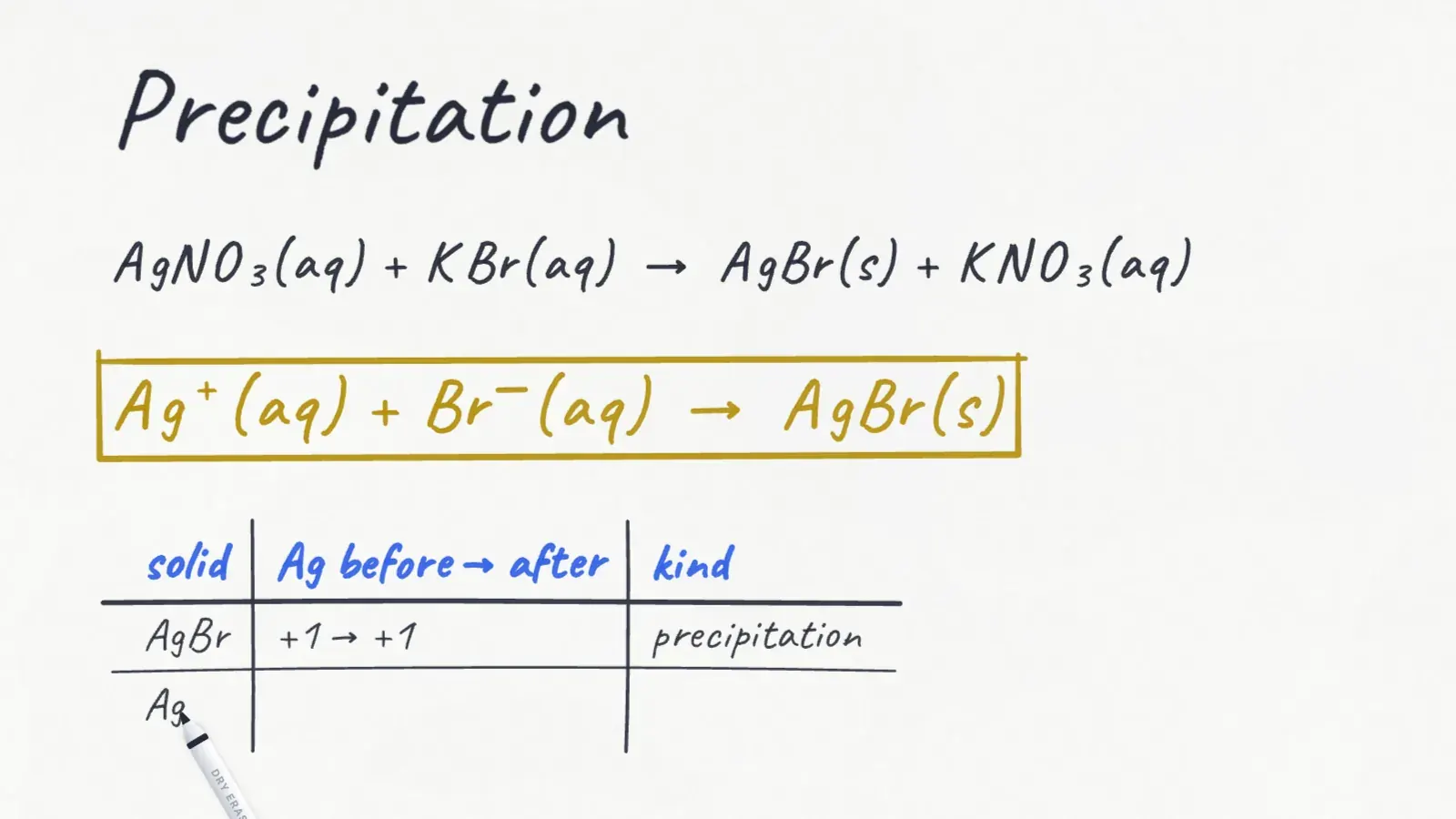
Back to our photograph, because before anything got developed, somebody had to make those silver bromide crystals, and they do it by mixing two clear solutions, silver nitrate and potassium bromide. In the water, every ion swims on its own, wrapped in water molecules, but when a silver ion meets a bromide ion, they shed their water and lock together, and a solid crystal grows right out of the solution.
The potassium ions and the nitrate ions never join it. They keep drifting around, because they were dissolved before and they’re still dissolved now. When dissolved ions come together into a solid that barely dissolves, we call it a precipitation reaction, and nobody gained or lost an electron, because silver is still plus one and bromide is still minus one.
To tell which product is the solid, the AP exam expects one rule, that every sodium, potassium, ammonium and nitrate salt dissolves, so the solid has to be silver bromide. Anything beyond that, the question tells you.
Here are three animations of this same mixing, and only one gets it right, so which one is it? So here are two solids made from the same silver, silver bromide, where the silver is still plus one, and silver metal, where it’s zero.
On paper, the precipitation looks like this, and when we leave out the spectators, we’re left with silver ion plus bromide ion making solid silver bromide. Both of these reactions make a solid, but only the one where silver’s oxidation number changes is redox, and that’s the difference that matters.
Which kind of reaction?
So whenever you meet a reaction, you can ask it three questions, in this order. First, if any oxidation number changed, it’s redox, even if a proton moved too, like in the developer, if not, and a proton moved from one particle to another, it’s acid-base, and if dissolved ions came together into a solid, it’s precipitation.
Now try those three questions on this one. Then tell me, what kind of reaction is it? And a titration can run on any of these three kinds of reaction, as long as it goes all the way with a known ratio, like vitamin C measured with iodine, which is redox.
So let’s go back to the hangar and that giant photograph one more time, and see it the right way around, the airfield in daylight. Its crystals came from silver and bromide ions locking into a solid, so that’s precipitation, its image came from silver ions taking electrons from the developer, so that’s redox, and in an ordinary darkroom, the stop bath that ends the developing hands protons to hydroxide, so that’s acid-base.
And if anyone ever hands you a bath and asks how much acid is in it, you can find out with a buret, a color change, and the coefficients of one balanced equation. Not bad for a building with a hole in its wall.