
Topic 5.7 key terms
- elementary step
- One molecular event (a collision, or one molecule falling apart), exactly as written; its rate law follows from its molecularity.
- reaction mechanism
- The sequence of elementary steps by which a reaction occurs; the steps must add up to the overall balanced equation.
- intermediate
- A species produced in one step and consumed in a later step; present only while the reaction runs, never in the overall equation.
- catalyst
- A species present at the start, consumed in one step and regenerated in a later step, so it does not appear in the overall equation.
Transcript
1,539 words · 3 parts
Reaction mechanisms: the “gas attack”, Los Angeles 1943
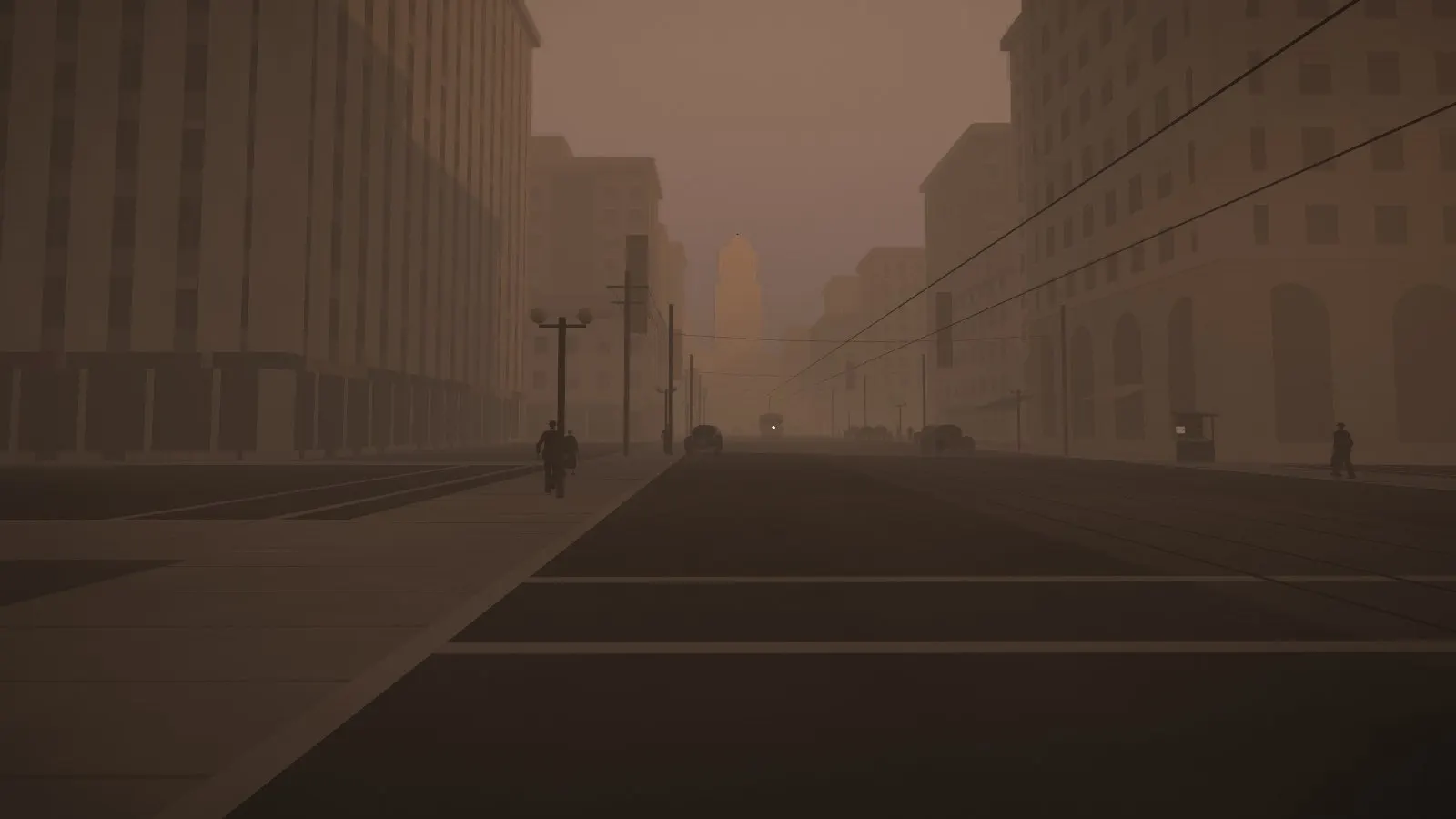
On the morning of July twenty-sixth, nineteen forty-three, a dark, smoky cloud came down over downtown Los Angeles, so thick that people couldn’t see three blocks down the street. Their eyes burned and their throats stung, and because the country was in the middle of a world war, a lot of people thought the city was under a gas attack.
The next morning, the Los Angeles Times ran this headline, and you can tell nobody was sure what they were dealing with, because they put gas attack in quotation marks. The city found a suspect fast, a gas company plant on Aliso Street that made butadiene, which goes into synthetic rubber, and it made a nice simple story, where one chimney makes one cloud.
If that plant really was making the cloud, what should happen when they shut it down? So under public pressure they shut the plant down, and the stacks went quiet, and the smog kept right on coming back.
Hold on to that moment, because the city had a story about the cloud, the story got tested, and the sky said no. The cloud wasn’t coming out of any one chimney. The worst of it was forming right there in the air, in steps nobody could see. It took a Caltech chemist named Arie Haagen-Smit, who’d been studying the chemicals that give pineapples their flavor, to work that out, and he published it in nineteen fifty-two.
So let’s go down into that haze and look at the air itself. It’s mostly nitrogen and oxygen, the way air always is, but in with them are two gases I want you to meet. City smog often looks brown, and part of that brown is a gas called nitrogen dioxide, N O two. Hot engines and furnaces mostly make its cousin, nitric oxide, N O, and nitric oxide is colorless, so the brown gets made out here in the air, after the gas leaves the pipe.
By the end of this lesson, you’ll be able to do what the city couldn’t do that summer, which is take a story about steps you can’t see and put it on trial. You’ll check whether a story like that adds up, find its slowest step, and use it to predict how fast the whole reaction goes, even when that slow step comes second, behind a fast one.
And then we’ll put one real suspect on trial, a reaction that turns this colorless gas brown. The air over a city runs hundreds of reactions at once, so we’ll do what chemists do and start smaller, with one reaction between two gases that were both in that air, nitrogen dioxide and carbon monoxide.
One reaction, two steps
So here we are, inside a container of those two gases, and that brown glow all around us is the nitrogen dioxide. The overall reaction is easy to write down, a nitrogen dioxide and a carbon monoxide making nitric oxide and carbon dioxide, so somewhere along the way one oxygen atom has to move from the nitrogen over to the carbon.
The simplest story you could tell is that it all happens in one collision, where the two molecules bump into each other and the oxygen hops straight across. But chemists who measured this reaction at ordinary temperatures found that story doesn’t fit, so they proposed a route with two steps, and checking a proposed route like this is exactly what the AP exam asks you to do.
In the first step, two nitrogen dioxides collide, and most of the time they just bounce off each other, until one collision finally works and an oxygen hops from one to the other. That makes N O three and N O, and I’ve painted the oxygen that moved gold so we can follow it.
Then the N O three runs into a carbon monoxide, and the gold oxygen jumps again, this time onto the carbon, so we get carbon dioxide, and a nitrogen dioxide back. Each of those two moves is called an elementary step, because it happens exactly the way it’s written, in one single event, which here is a collision, though sometimes it’s just one molecule falling apart, and the whole sequence of steps is the reaction’s mechanism.
Let’s write it out. Here’s the overall reaction, which tells us where it starts and where it ends, but nothing about how it gets there, and under it, the two steps of the route, first two nitrogen dioxides making N O three and N O, and then N O three and carbon monoxide making nitrogen dioxide and carbon dioxide.
If this route is real, then its two steps have to add up to the overall reaction, so let’s add them. Everything on the left of either step goes on the left, and the same for the right.
Now look, there’s an N O three on the right and an N O three on the left, so those cancel. There’s nitrogen dioxide on both sides too, but be careful here, because there are two on the left and only one on the right, so only one of them cancels, and one is still left over on the left.
What’s left is N O two plus C O making N O plus C O two, which is exactly the overall reaction, so the steps add up. And canceling is only bookkeeping. Nothing actually disappears, because if you count the atoms you get one carbon, one nitrogen and three oxygens on each side. And adding up the steps and canceling, exactly like this, is how those AP mechanism questions start, and in twenty nineteen one of the free-response questions used reactions of this same brown gas.
Let’s watch that canceling with the actual molecules. Here are both steps, built out of real molecules, and when we add them, the two N O threes melt away, and then one pair of nitrogen dioxides.
That N O three has a name. It’s called an intermediate, because the first step makes it and the second step uses it up, so it only exists while the reaction is actually running. Before the reaction starts there isn’t any, and once it’s over there isn’t any, and that’s why you’ll never see an intermediate in the overall equation.
I’m going to run the reaction in slow motion, over and over. Tap the intermediate while it’s there. So reactants are there at the start and get used up, products show up and stay, and an intermediate lives only in the middle.
Made and used, or used and given back
There’s a fourth kind of player, and to see it we need a different reaction. Hydrogen peroxide slowly falls apart into water and oxygen, and if you’ve ever seen the foam they call elephant toothpaste, you’ve seen it go fast, with help from iodide ions. Here’s the mechanism chemists give for it. In the first step, a hydrogen peroxide hands one of its oxygens to an iodide ion, which makes water and I O minus.
In the second step, the I O minus meets another hydrogen peroxide, and out come water, oxygen and an iodide ion. Add the two steps the same way as before, with everything from both left sides on the left and everything from both right sides on the right, and the iodide cancels, and so does I O minus, leaving two hydrogen peroxides making two waters and one oxygen. In this mechanism, which one is the catalyst, and which one is the intermediate?
Let’s watch an iodide do it. It grabs an oxygen from a hydrogen peroxide and becomes I O minus, then hands that oxygen on to a second peroxide, and it’s right back where it started, ready to go again.
That’s what a catalyst does. It’s there at the start, it takes part, and it’s given back, while I O minus is just like our N O three, made in one step and used up in the next.
So now we’ve got four kinds of players, and the difference between them is all about when each one is around, and the catalyst is the only one that’s there before, during and after. Now here’s a mistake I see all the time. Someone looks back at the nitrogen dioxide mechanism, sees N O two on both sides, and calls it a catalyst. But two N O twos went in and only one came back, so the reaction still uses one up, and that makes it a reactant.
So how would a chemist know the N O three story is the true one? Adding up is only the first test, because you can usually invent more than one set of steps that adds up to the same overall reaction. One of the best kinds of evidence is to catch the intermediate in the act, to find N O three in the container while the reaction is running. If you find it, that supports the two-step story. It doesn’t prove it, since some other route might make N O three too, but it’s real evidence.
Here’s a situation like that. Two mechanisms both add up, only Mechanism 1 makes a species called X, and chemists detect X while the reaction is running. What’s the strongest thing they can say?