
Topic 5.12 key terms
- implicit relation
- An equation in x and y, like x² + xy + y² = 3, that describes a curve without solving for y. The whole curve may fail the vertical line test, yet near most points it is the graph of a function.
- critical point (implicit relation)
- A point on the curve where dy/dx = 0 or dy/dx does not exist.
- horizontal tangent
- Where the numerator of dy/dx is 0 and the denominator is not, at a point that is actually on the curve: dy/dx = 0 there.
- vertical tangent
- Where the denominator of dy/dx is 0 and the numerator is not, at a point on the curve: dy/dx does not exist and the tangent line is x = a.
- implicit second derivative
- Found by differentiating the first-derivative equation again; it may contain x, y and dy/dx, and that is a finished answer.
- concave down / concave up
- Where d²y/dx² < 0 the slope is decreasing (concave down); where d²y/dx² > 0 it is increasing (concave up).
- second derivative test
- If dy/dx = 0 and d²y/dx² < 0 at a point, the curve has a relative maximum there; if dy/dx = 0 and d²y/dx² > 0, a relative minimum.
Transcript
2,556 words · 7 parts
The loop in the groove
This is the tip of a record needle, a polished diamond riding a groove about as wide as a human hair, and right now it’s playing one single note. On a stereo record, each wall of this little V carries the sound for a different speaker. The left one is on this wall, and the right one is on that one.
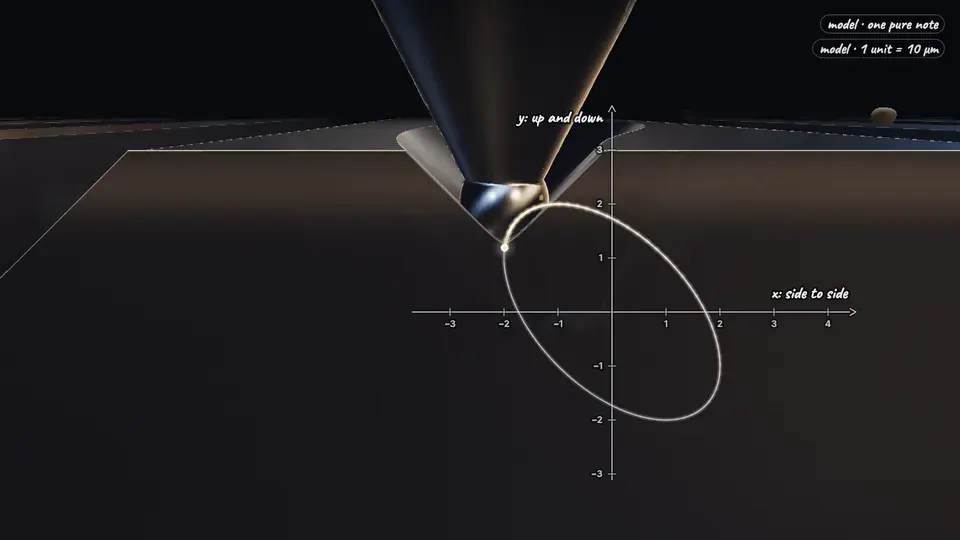
When the two speakers get different sounds, the needle doesn’t only wiggle from side to side, it bobs up and down too. Play one pure note on both sides, a bit louder on one side and a quarter of a wave out of step. Then the tip traces this tilted loop once for every wave of the sound, and as long as the note holds, the little diamond keeps skating around it.
Now watch what happens when that loop gets bigger. The higher it climbs, the shallower the groove gets, and if the top climbs too far, the needle ramps right up and out, and the record skips. Mastering engineers watch for this every time they cut a record. The two numbers they care about are how high this loop lifts the needle, and how far it throws it to each side. A groove that swings too wide crowds the groove next door.
By the end of this lesson, you’ll be able to take the equation of a loop like this one and find both of those exactly. You won’t even have to solve it for y. A loop fails the vertical line test, so one x can give us two different heights, and the tools we learned for finding a highest point were all built for functions. Let’s start on a loop where we already know the answers, and build the method there.
One x, two slopes
If you were with us for implicit differentiation, you’ve seen this table before. It’s perfectly round, five feet from the center to the rail, so with x and y in feet, the rail is the circle x squared plus y squared equals twenty-five. Draw the line x equals three across the table, and it hits the rail twice, at three comma four and at three comma negative four, which is exactly why the whole circle isn’t the graph of a function.
Let me ask you something about those two points. What’s the slope of this rail at x equals three? Let’s bring this onto the board. We’ll see where those two numbers come from.
You already know how to get them. We differentiate both sides with respect to x, and because y changes with x, the y squared turns into two y times dy dx, by the chain rule. Then we solve for dy dx, and we get negative x over y.
At three comma four that’s negative three fourths, and at three comma negative four it’s positive three fourths. The formula needs both coordinates, and that’s how it tells the two points apart. Calculus still works on a curve like this for a simple reason. Zoom in on a little piece around three comma four, and that piece passes the vertical line test.
Near that point the circle is just its top half, y equals the square root of twenty-five minus x squared. Near a smooth point where the tangent isn’t vertical, the curve gives just one y for each nearby x, so we can use derivatives there to tell where it rises or falls, how it bends, and whether it has a maximum.
Flat, and straight up
To find the flat points and the straight-up points, we look at the two parts of this fraction. A fraction is zero when its top is zero and its bottom isn’t, and it doesn’t exist when its bottom is zero. The slope is zero when the numerator, negative x, is zero, and that means x equals zero.
But x equals zero is only half a point. We have to go back to the circle itself to see where on the curve that happens, so zero squared plus y squared is twenty-five, and y is five or negative five. At both of those points the denominator is five or negative five, not zero, so the slope there really is zero. The top and the bottom of the circle have horizontal tangents, which is exactly what your eye expects.
Now let’s look for a vertical tangent. The slope stops existing when the denominator, y, is zero, and on the circle that means x squared is twenty-five, so x is five or negative five. The numerator there is negative five or five, not zero, so we’d be dividing a real number by zero, and the tangent line stands straight up. Those are vertical tangents, the lines x equals five and x equals negative five.
These four points have a name. We call a point on the curve where dy dx is zero or doesn’t exist a critical point, the same idea you met for functions, and it’s where we look for a flat tangent, a vertical tangent, or a maximum or minimum.
In between, the sign tells the rest of the story. On the top half y is positive, so the slope is positive left of center and negative right of it. The rail climbs to the top, then falls.
Before P moves, make a guess. As P slides down the rail from three comma four to five comma zero, what do you think happens to the slope? As P slides down the rail toward five comma zero, the slope gets more and more negative, steeper and steeper, and right at the side it isn’t a number at all. Look at the rail, though, it’s perfectly smooth.
The slope is undefined here because the tangent line is vertical, not because the curve breaks or has a corner. A vertical line just doesn’t have a number for its slope.
Which way does it bend?
Before we compute anything, look at just the top half of the circle. Which way do you think it bends? To prove it, we need the second derivative, so let’s differentiate again. I’ll write y prime for dy dx to save ink, and we’ll start from the line we already had, two x plus two y times y prime equals zero.
The two x gives us two. The two y times y prime is a product of two things that both change with x, so it takes the product rule: y prime times y prime, plus y times y double prime. This is where it’s easy to slip. If I write just two y times y double prime, I’ve treated the first y like a constant, but that y changes too, and its change is the missing y prime squared.
Now the whole line reads two, plus two y prime squared, plus two y y double prime, equals zero. Solving for y double prime gives negative the quantity one plus y prime squared, all over y.
Notice this still has y and y prime in it, and that’s completely fine. A second derivative you get this way can involve x, y and dy dx, and on the exam that counts as a finished answer.
Now look at the top of that fraction. One plus a square is always positive, and the minus sign in front flips it, so y double prime always has the opposite sign from y. On the top half y is positive, so the curve is concave down. On the bottom half it’s concave up, all from one formula.
At the top point, zero comma five, y prime is zero and y double prime is negative one fifth. Near the top the circle is just a function, so the second derivative test works there, and a flat tangent where the curve is concave down is a relative maximum. Now I’d like you to use this formula yourself. Find y double prime at the point three comma negative four, rounded to three decimal places.
The tilted loop
Now let’s go back to the needle, because we’re ready for the real thing. Across the groove, with x measuring side to side and y measuring up and down, this loop is x squared plus x y plus y squared equals three. That x y in the middle is what tilts the loop. It’s also why you can’t just glance at it and say where the top is.
Before we do any algebra, I want your eye on it. Drag the probe to the highest point of the loop, where its tangent line is perfectly flat. We’ll use the same steps as the circle. Get dy dx, set its numerator equal to zero, and then go back to the curve to find the actual points.
Differentiating x squared gives two x. The x y in the middle is a product, so the product rule gives y plus x times y prime. The y squared gives two y y prime, and it all equals zero, because three is a constant. Gather the y prime terms on one side, factor out the y prime, and divide, and we get y prime equals negative the quantity two x plus y, over x plus two y.
For the flat points, the numerator two x plus y has to be zero, so y equals negative two x. That’s not a point yet, it’s a whole line of candidates, and only the places where that line meets the loop count. We put y equals negative two x into the curve’s equation. That’s x squared minus two x squared plus four x squared, which is three x squared, equals three, so x is one or negative one.
When x is negative one, y is two, and when x is one, y is negative two. The denominator at those points is three and negative three, not zero, so these really are the flat points, the top at negative one comma two and the bottom at one comma negative two.
That’s exactly where we found it by eye. The top is one unit to the left of center and two units up, which in our model is twenty micrometers above where the needle rests. Now you find the sides. The loop’s rightmost point is where the tangent stands straight up, so what’s its x-coordinate?
We found a flat point, but a flat tangent on its own doesn’t prove a maximum. The curve y equals x cubed is flat at the origin and keeps right on climbing, so we need the second derivative too.
Let’s differentiate the line two x plus y plus x y prime plus two y y prime equals zero one more time. Two x gives two, and y gives y prime. The x y prime is a product, so it gives y prime plus x y double prime. The two y y prime gives two y prime squared plus two y y double prime, just like on the circle.
We only need the second derivative at this one point, and we already know x, y and y prime there. So let’s plug them in right now. x is negative one, y is two, and y prime is zero, so every y prime term simply disappears. What’s left is two, minus y double prime, plus four y double prime, equals zero. That makes three y double prime negative two, so y double prime is negative two thirds.
The bottom point, one comma negative two, works the same way. Put it into that same differentiated line and find y double prime there, rounded to three decimal places.
Now let’s write the sentence an AP grader is looking for. I’ll write the second derivative as d two y d x squared, which is the same thing as y double prime. At negative one comma two, dy dx is zero, and the second derivative is negative two thirds, which is less than zero, so by the second derivative test the curve has a relative maximum at negative one comma two.
The flat slope and the negative second derivative are the evidence, and naming the test makes your reasoning clear to whoever is grading it. Now pick the sentence that states both derivative conditions and the relative minimum they prove at one comma negative two.
The flat spot that isn’t there
There’s one more trap, and it has cost students real points on recent AP exams. Take the curve x y equals y squared plus one. Differentiating, the x y gives y plus x y prime, and the right side gives two y y prime. Gather the y primes on one side and factor, so y equals y prime times two y minus x. Divide, and y prime equals y over two y minus x.
Where does this curve have a horizontal tangent? The picture agrees. Follow the lower arm on the right as it hugs the x-axis. It gets flatter and flatter but never touches the axis, so its slope gets closer and closer to zero without ever getting there.
This is exactly how the exam asks it. Setting the numerator to zero only gives you candidates. You have to put them back into the curve before you can claim a single point.
Every turn of the loop
Let’s go back to the groove. It’s time to finish what we promised at the start. Here are four pins, two for flat points and two for points where the tangent stands straight up. Put each one where it belongs on the needle’s loop.
It bends just like the circle did. The arc over the top, above the line through the side pins, is concave down, and the arc along the bottom is concave up, so the top really is a relative maximum, just like we proved.
Now look at what that means for the needle. It swings two units, twenty micrometers, to each side, and the top lifts it two units too. The surface is only three units up, so at that instant there’s just ten micrometers of groove left. That’s much less than the twenty-five micrometers or so that engineers like to keep.
Now you decide how loud this note can get. Using the top we found, drag the loudness up until the top of the loop just touches the surface, without letting the needle jump out.
A real engineer wants far more room than that. At the loudness we started with, there’s only ten micrometers of groove left, so let’s fix it. This slider sends more and more of the deep bass to both walls equally. Slide it until at least twenty-five micrometers of groove are left.
That slider is a real tool, called an elliptical equalizer. It sends the deep bass to both walls equally, which is exactly how engineers keep loops like this one from lifting the needle. Look at what you can do now. You found all four tangent points on this loop and checked every one in its equation, and you proved where its maximum and minimum are.
and if the top and the bottom of dy dx are ever both zero, you know to look at the curve itself. Those are the tools you’ll bring to the next implicit curve. All without ever solving for y. The next time you hear a record, you’ll know there’s a tiny diamond in there tracing loops like the one you just mapped, and you’ll know exactly how to find how high they go.