
Topic 5.7 key terms
- concave up
- The graph of is concave up on an open interval where is increasing; it bends like a cup, whether it rises or falls.
- concave down
- The graph of is concave down on an open interval where is decreasing; it bends like a cap.
- second derivative
- , the derivative of : how fast the slope changes. on an interval means concave up there; means concave down. For height in meters against time in seconds, is in m/s².
- point of inflection
- A point on the graph where is continuous and the concavity changes. Candidates are where or is undefined; the sign of must actually change.
- second derivative test
- If and , has a relative maximum at ; if and , a relative minimum. If or does not exist, the test is inconclusive.
- inconclusive
- The second derivative test gives no answer when : the point may be a maximum (), a minimum () or neither (). Use the first derivative test.
- one critical point on an interval
- If is continuous on an interval and has exactly one critical point there, and it is a relative extremum, then it is the absolute extremum of on that interval.
Transcript
1,333 words · 4 parts
Eyes closed
Now we can answer the question from the start. Both of these level moments are critical points of the height, because h prime is zero at each one. At the bottom of the trench the graph is concave up, a cup, and a flat spot at the bottom of a cup can only be a low point. Over the hill it’s a cap, so that flat spot is a high point. Your body was doing the same thing, because the seat’s push told it the sign of h double prime.
We call this the second derivative test. If f prime of c is zero and f double prime of c is negative, f has a relative maximum at c. If f double prime of c is positive instead, f has a relative minimum at c. If f double prime of c is zero, or doesn’t exist, the test tells you nothing, and we’ll see in a minute why that matters.
Back to our cubic. Its derivative, three times x minus one times x minus three, is zero at one and three, so those are the two critical points. At x equals one, p double prime is negative six, so p has a relative maximum of eight. At x equals three it’s positive six, so p has a relative minimum of four. That fits the graph, since p of zero is four and p of two is six, both lower than eight.
The full-credit sentence on the exam puts both facts together. Since p prime of one equals zero and p double prime of one equals negative six, p has a relative maximum at x equals one. Both facts matter. At x equals four, p double prime is twelve, but p prime is nine, so the graph isn’t even level there, and there’s no minimum at all.
Let’s see if you can spot the full-credit answer. This function has a relative maximum at x equals negative one, and four students wrote four justifications, so which one earns the point?
When the test goes quiet
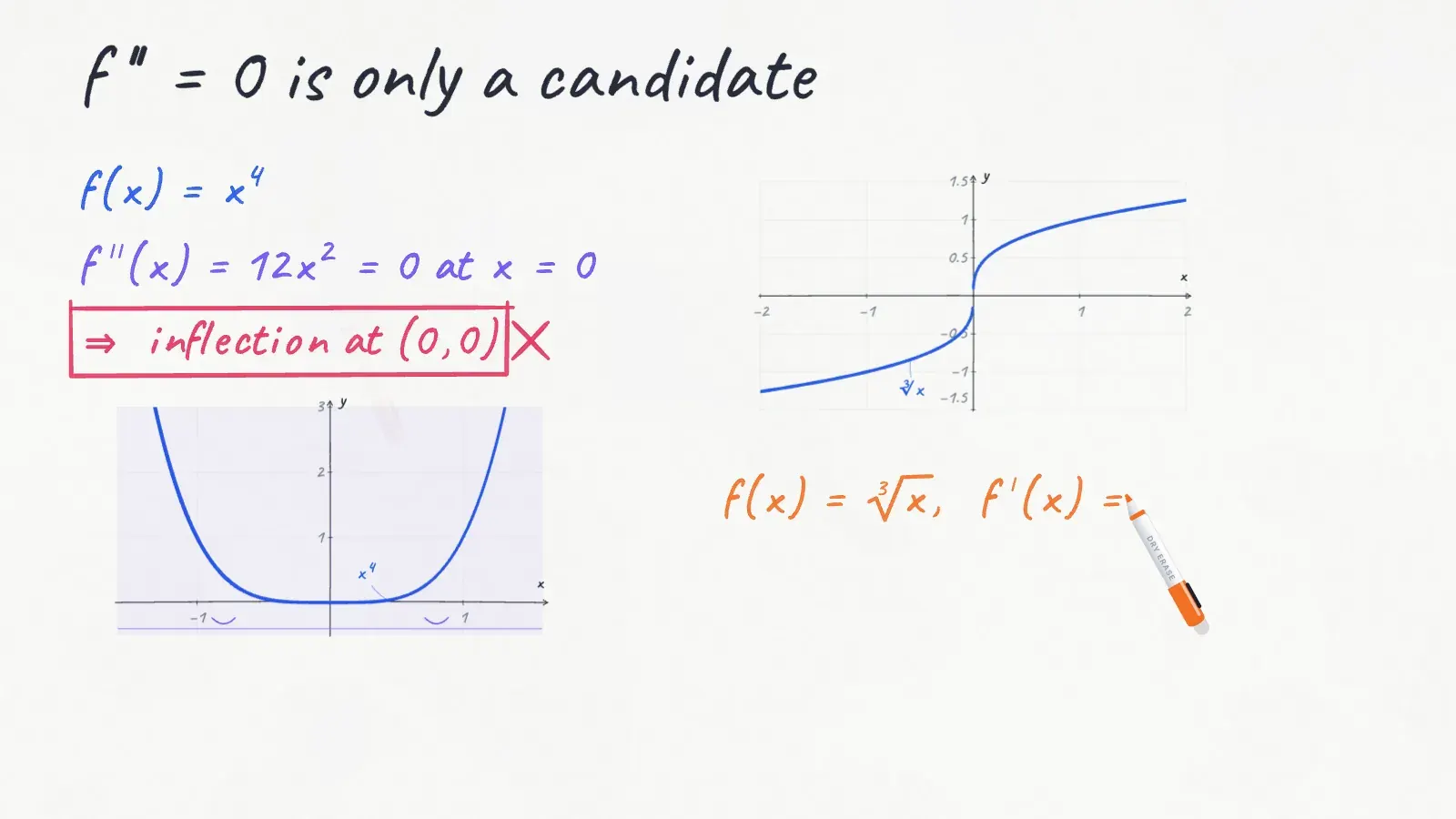
Now let’s see what happens when the test has nothing to say. Each of these sculptures has a channel shaped like a graph, with a heavy steel ball resting at its flat spot. Their shapes are x to the fourth, negative x to the fourth and x cubed. At the flat spot, all three have a first derivative of zero and a second derivative of zero too.
The second derivative test looks at those readings and shrugs, since zero is neither positive nor negative. What does inconclusive actually tell us about x equals zero? Nothing about the point itself, only that this test can’t decide, so each one could still be a peak, a valley or neither, and we’ll have to look closer. Give each ball a little nudge, left or right, and watch what it does.
The ball in the x to the fourth bowl keeps rolling back, so that’s a minimum. The dome’s ball rolls away either way, so that’s a maximum. The x cubed ball is the sneaky one. Push it uphill and it comes back and runs straight off the low side, and push it downhill and it’s just gone. That spot is neither, only a ledge on the way down.
Now you build one. Use the sliders on the first sculpture to make a curve where the second derivative test is silent, but the ball still comes back when you nudge it. The readings were the same and the answers weren’t, so we need a test that looks at both sides of the point. We already have one, the first derivative test.
For x to the fourth, f prime is four x cubed, negative on the left and positive on the right, so it’s a minimum. For negative x to the fourth the signs flip, so it’s a maximum. For x cubed, f prime is three x squared, positive on both sides, so the function keeps rising right through zero and there’s no extremum.
When the test comes back inconclusive, say so and switch tests. For x to the fourth, you’d write that f prime changes from negative to positive at zero, so f has a relative minimum there.
One valley, nowhere lower
One more question about our cubic. Its relative maximum is eight, but by x equals five the graph is already up at twenty-four, so a relative maximum is only the top of its own hill.
Sometimes, though, a relative extremum has to be the absolute one. If a function is continuous on an interval with only one critical point, and that point is a relative minimum, nothing on the interval is lower. To dip below that valley somewhere else, the graph would first have to turn around, and turning around takes another critical point. Our cubic shows it the other way up, because it turned around at three and then climbed past its peak of eight.
Take f of x equals x plus four over x for positive x. Its derivative is one minus four over x squared, and that’s zero when x squared is four. That gives x equals two or negative two, and only two is in our interval, because x has to be positive. The second derivative, eight over x cubed, is one there, so it’s a relative minimum. f is continuous for every positive x and this is its only critical point, so f of two, which is four, is the absolute minimum.
That checks out, since f of one and f of four are both five. Just make sure the critical point really is an extremum first, because x cubed has only one critical point and no extremum at all.
This time you do the whole thing yourself. Find the absolute minimum value of w of x equals x squared plus sixteen over x for positive x, and type the value, not the x.
The blind ride
Let’s keep the promise from the start. It’s night now, you’re back in the front seat, so close your eyes again, and this time you get a second gauge. Your body can’t feel whether you’re level, so the new gauge shows how fast you’re rising or falling, and that’s h prime. The old one shows the seat’s upward push, so whether it reads above or below one tells us the sign of h double prime.
The climb rate just hit zero, so we’re level. The seat is pushing with almost three times your weight, which means h double prime is positive, and this is the bottom of a valley.
Here comes the next level moment, and this one’s your call. The seat is barely pushing, about a fifth of your weight, so what kind of moment is this? A valley and a peak go by, and now we’re falling again.
Right here the climb rate touches zero one more time, and the seat is pushing with exactly your weight, so h double prime is zero. What can you say about this moment?
It was negative before, it touches zero, and it’s negative again after, so we were falling, leveled off for an instant, and kept falling. Open your eyes. That was a double dip, a ledge in the middle of a drop, neither a peak nor a valley, just like the ledge in the sculpture garden.
Let’s put it together. A graph is concave up where its derivative is increasing, and a positive second derivative guarantees that. A point of inflection is where that concavity changes. At a level moment a negative second derivative means a peak and a positive one means a valley, and when it’s zero you switch to the first derivative test.
You just told peaks from valleys without looking, and now you can prove it the way the AP exam asks, with the slope and the second derivative in the same sentence. Next time we’ll turn this around and read the shape of a function straight from the graphs of its derivatives, one of the exam’s favorite questions.