
Topic 5.2 key terms
- absolute (global) maximum
- The greatest value a function takes on its whole interval (or domain). It can happen at more than one input, and on a closed interval it can be at an endpoint.
- relative (local) maximum
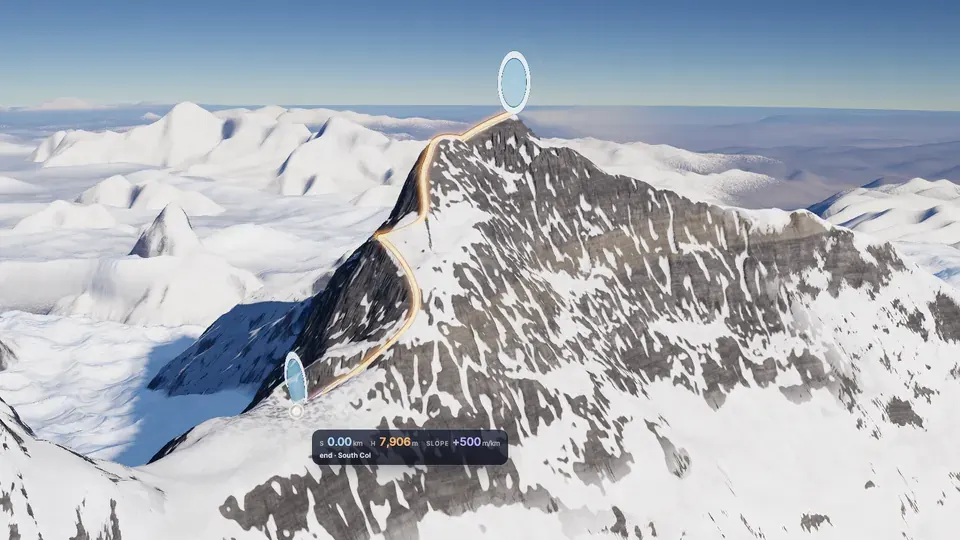
- A value that is at least as large as every value of at inputs near (in some open interval around ). A relative maximum can lose to a higher point elsewhere, like Everest's South Summit.
- value vs location
- The maximum VALUE is an output, ; its LOCATION is the input . Answer the one the question asks for (or give the point ).
- Extreme Value Theorem
- If is continuous on the closed interval , then has at least one maximum value and at least one minimum value on . If a condition fails there is no guarantee, but extrema may still exist.
- critical point
- A point on the graph of where or does not exist ( must be defined). Every relative extremum is at a critical point, but not every critical point is an extremum ( at ).
- candidates test
- For a continuous on : find the critical points inside the interval, evaluate at them and at both endpoints, and compare. The largest value is the absolute maximum and the smallest is the absolute minimum.
Transcript
1,306 words · 4 parts
The false summit
On the twenty-sixth of May, 1953, two British climbers, Charles Evans and Tom Bourdillon, were working their way up the southeast ridge of Mount Everest. At about one in the afternoon they reached the top of a dome of snow at eight thousand seven hundred forty-nine meters. That was higher than anyone had ever been known to climb, and higher than K2, the second-highest mountain on Earth.
But they weren’t on top of Everest. The ridge kept going, dipping down and climbing again to the real summit, about a hundred meters higher. They were standing on the South Summit, a false summit, and with the day getting late and Evans’s oxygen set failing, they turned back. Three days later, Edmund Hillary and Tenzing Norgay climbed right past that dome and stood on the real summit.
A false summit like that raises a real question. A route has infinitely many points on it, so you could never check every single one, and yet you’d still like to know for sure which one is the highest.
By the end of this lesson, you’ll be able to find the highest and the lowest points on any route like this one by checking just a handful of spots, and you’ll be able to prove that nobody will ever find a higher one. Let’s start with the words, because this one ridge already has two different kinds of highest point.
Two kinds of highest
Go back to the South Summit for a second. Compared with everything nearby it really is the top, since every step off it goes downhill, and that makes it a relative maximum, or a local maximum. Compare it with the whole route, though, and it loses, because the summit is about a hundred meters higher. The summit is the absolute maximum, the highest point anywhere on the route.
The lowest point of this route is where it starts, at the South Col, the saddle at seven thousand nine hundred six meters where climbers camp before the final push. Let’s put the route on the board, where its height becomes h of s, and s is how far along the route you are, measured horizontally, in kilometers.
An absolute maximum, which the exam also calls a global maximum, is the greatest value the function takes anywhere on the interval, and for our route it’s at the summit. A relative maximum is a point in the middle of the interval that’s at least as high as the points right around it, like the South Summit.
There are really two answers hiding in the word maximum. The maximum value is about eight thousand eight hundred forty-nine meters, a height, and it happens at s equals two, a location. Exam questions are picky about which one they want. The minimum works the same way, with a value of seven thousand nine hundred six meters at the location s equals zero.
Let’s practice reading this on the kind of graph the exam uses, a function on a closed interval with four labeled points. Which of these four points is a relative maximum but not the absolute maximum?
Is there always a highest point?
Up to now we’ve assumed the route even has a highest point, and that depends on these two gates. Both are closed rings, which means the South Col and the summit are part of the route. Now imagine a rule that lets you climb as close to the summit as you like but never lets you stand on it.
With the summit off limits, see if you can find the highest point the route still has, by dragging the probe as close to the top as you can. The heights get as close to the summit’s height as you like, but no point on the route ever reaches it. Whatever point you pick, there’s higher ground ahead, so this route has no highest point at all. Close the gate again, and the summit is back, and so is the maximum.
That gate is exactly what a famous theorem is about. The Extreme Value Theorem says that if f is continuous on a closed interval from a to b, then f has at least one maximum value and at least one minimum value on that interval. There are two conditions, and each one does a job. Continuous means the graph has no breaks, and closed means both endpoints are included, like our two closed gates.
Drop the closed interval and you get our off-limits summit. Take f of x equals x from zero up to one, but leave out one itself, and the values climb toward one without ever reaching it, so there’s no maximum. Keep the interval closed but break the graph, and the same thing happens. This function, call it q, follows x all the way up and then drops to zero right at the end, so again the values creep toward one and never get there.
Be careful with the logic, though, because the theorem only makes a promise. Both of those graphs still had a lowest point, zero, without any promise. x squared on the open interval from negative one to one has a minimum too, zero, even though the theorem doesn’t apply. Breaking a condition takes away the promise, but it doesn’t take away the minimum.
On the exam this theorem shows up as a reason, so learn the sentence. Since f is continuous on the closed interval, the Extreme Value Theorem guarantees that f has an absolute maximum and an absolute minimum there. Which one of these does the Extreme Value Theorem guarantee has an absolute maximum?
Where a winner can hide
We know a winner exists. The next question is where it could be hiding, and the slope of the route is going to tell us. Climb the route with a slope meter. At a spot in the middle of the route where the slope is positive, one small step forward takes you higher, so that spot can’t be the highest.
Where the slope is negative, one small step back takes you higher, so that spot can’t win either. That leaves only two kinds of places in the middle of a route where the highest point could hide. One is a spot where the slope is zero, like the top of the South Summit.
The other is a spot with no single slope at all, like this sharp notch just past it, where the ridge comes in going down and leaves going straight back up. Then there are the two ends. Right at the summit the route is still climbing, and the summit wins anyway, because there’s no step up when the route is over.
Keep an eye on one more spot, a ledge called the Balcony. The slope is zero there too, but the route keeps climbing on both sides, so it’s flat for a moment without being a top or a bottom.
Flat spots and sharp spots get a name. A critical point of f is an input c where f prime of c equals zero or f prime of c doesn’t exist, as long as f itself is defined at c. On a graph, f prime fails to exist at a corner like this one. The slope from the left is negative one and the slope from the right is positive one, so no single tangent line fits.
Our slope meter just proved the big fact. Every relative maximum or minimum in the middle of an interval happens at a critical point, because anywhere else, the slope tells you which way to step to get higher or lower.
Take f of x equals x cubed, whose slope at zero is zero, so zero is a critical point. What kind of point do you think it is? The rule only runs one way, so every critical point is a place to check, not a guaranteed winner.