
Topic 9.3 key terms
- Gibbs free energy change (ΔG°)
- The standard free energy change of a process; ΔG° < 0 means the process is thermodynamically favored under standard conditions.
- thermodynamically favored
- Describes a process with ΔG° < 0. It says which way a process tends to go, not how fast; it replaces the older word "spontaneous".
- standard state
- Gases at 1 atm (or 1 bar), solutions at 1 M, solids and liquids pure. The temperature is stated separately (tables usually use 298 K).
- standard free energy of formation (ΔG°f)
- ΔG° for forming one mole of a substance from its elements in their standard states; zero for an element in its standard state.
- ΔG° = ΔH° − TΔS°
- Relates ΔG° to the enthalpy change, the entropy change and the absolute temperature; put ΔH° and TΔS° in the same energy unit.
- crossover temperature
- The temperature where ΔG° = 0 and a process switches between favored and not favored: T = ΔH°/ΔS°.
Transcript
2,173 words · 5 parts
Gibbs free energy: is burning favored?
This is the Giant Forest, high in California’s Sierra Nevada, in September of 2021, and that haze hanging between the trees is smoke. That giant trunk belongs to the General Sherman tree, the largest tree on Earth, and the tiny people at the bottom are firefighters wrapping it in a heat-reflecting, aluminum-foil fabric, which makes it look like the world’s biggest plate of leftovers.
It’s about eighty-four meters tall and eleven meters across at the base, and it’s about twenty-two hundred years old, which means it was already growing right here before the Roman Empire even existed. A week earlier, a lightning storm had started fires in the park. By the middle of September, they were burning toward this grove.
Here’s what bothers a chemist about this picture. The biggest ingredient in wood is cellulose, and cellulose can react with the oxygen in the air to make carbon dioxide and water, and chemically, that reaction is strongly favored.
This tree has been standing in air that’s about twenty-one percent oxygen for twenty-two hundred years, and it still hasn’t burned up. Before we do any chemistry, a question. This tree hasn’t burned up in twenty-two hundred years. What do you think that tells us?
And here’s the part that makes it urgent. In 2020 and 2021, wildfires killed thousands of giant sequoias, more than one in every ten of the big ones left on Earth. So what has kept this tree from burning up for twenty-two hundred years, and what exactly were those firefighters fighting?
By the end of this lesson, you’ll prove that this wood is favored to burn. All it takes is a table of numbers and a little arithmetic. And it holds at any temperature this forest will ever see.
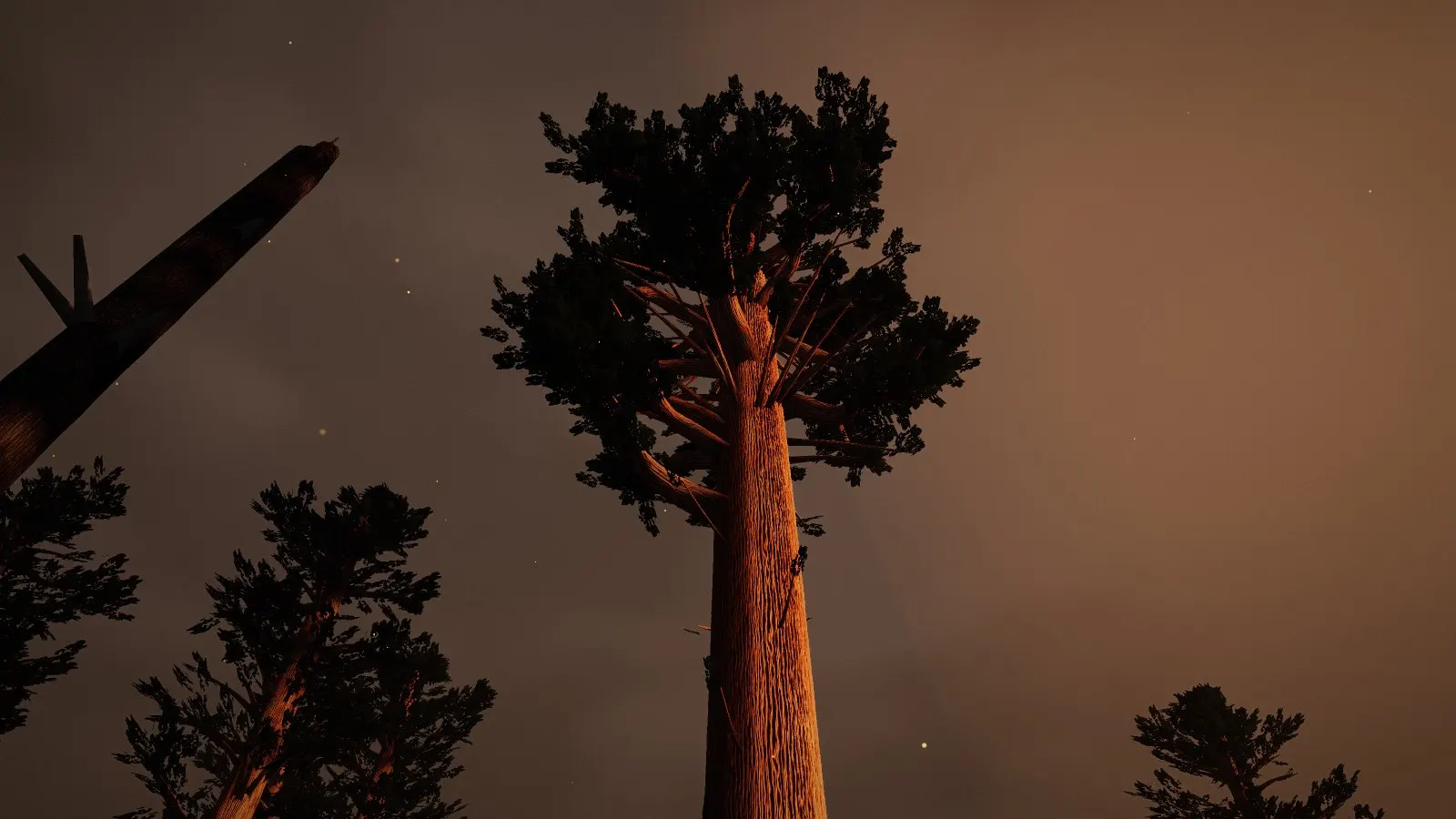
Then you’ll explain why it’s still standing anyway. That second part, a reaction that’s favored but isn’t happening, is a classic AP question, so you’ll walk away knowing the exact sentence that earns the point. Before we start, grab the view and look straight up this thing, because it really is that big. Now let’s figure out what ‘favored’ actually means. It doesn’t mean what it sounds like.
What “favored” means
Chemists have one number that tells you whether a process is favored, and it’s called the change in Gibbs free energy, written delta G. It’s named for Josiah Willard Gibbs, who worked it out in the 1870s.
For now, the only thing you need to read from it is its sign. If delta G is negative, the process is thermodynamically favored, which means that, left to itself, it tends to run toward the products, and if delta G is positive, it isn’t favored. Then it’s the reverse direction that is.
A lot of books still call a negative delta G ‘spontaneous,’ and you can see the problem with that word, because it sounds like sudden, and our tree has been ‘spontaneous’ for twenty-two hundred years without doing a thing. That’s why on the AP exam you’ll see thermodynamically favored instead, which tells you which way a process is headed without promising anything about when.
That little circle matters too. We read it ‘delta G naught,’ and it means every substance is in its standard state, so every gas is at one atmosphere, every dissolved substance is at one mole per liter, and every solid and liquid is pure.
Notice there’s no temperature on that list, so we always state it separately, and most tables, including the ones on the AP exam, are for two ninety-eight kelvin, which is twenty-five degrees Celsius. Now let’s go get the actual number for this tree. To do that, we’ll shrink down. All the way down, into the wood itself.
How badly does wood want to burn?
Let’s fly in. Right through the bark, into the pale wood underneath, and keep going, past the long hollow cells that wood is built from, and into the walls of those cells, until we reach the threads they’re woven from. These are cellulose chains, thousands of ring-shaped sugar units linked end to end, and every one of those units has the same formula, C six H ten O five, so when we write the reaction we count in repeat units, because the chain itself can be any length.
And drifting past them is the other reactant, oxygen from the air. If one repeat unit reacts completely with six oxygen molecules, it ends up as six carbon dioxides and five waters. Real burning gets there through a lot of messy steps. So think of this as a picture of the start and the finish. It’s not the road in between.
Here’s that reaction written properly for one mole of repeat units, with liquid water, because liquid is water’s standard state at twenty-five degrees Celsius. To get delta G naught, we use a table of standard free energies of formation. Here it is.
Each entry is the delta G for making one mole of that substance from its elements, and for cellulose it’s negative six eighty-six point six kilojoules per mole of repeat units. Oxygen’s entry is zero, because oxygen gas is already an element in its standard state, so there’s nothing to form, and every element in its standard state gets a zero.
The rule is the same products-minus-reactants bookkeeping you used for enthalpy: add up the products, each one multiplied by its coefficient, and subtract the reactants, counted the same way. So the products are six carbon dioxides at negative three ninety-four point four and five waters at negative two thirty-seven point one, and the reactants are one cellulose unit at negative six eighty-six point six and six oxygens at zero.
The products add up to negative thirty-five fifty-one point nine, and subtracting negative six eighty-six point six means adding it back, which leaves negative twenty-eight sixty-five point three kilojoules for every mole of repeat units, which is about a hundred and sixty-two grams of cellulose. That’s a big negative number, so burning wood is strongly favored, exactly as we suspected, and the table just proved it.
But this tree didn’t come from nowhere. It spent twenty-two hundred years building all this cellulose out of carbon dioxide from the air and water from the soil, which is the exact reverse of the reaction we just did. So what’s delta G naught for building one mole of repeat units out of carbon dioxide and liquid water?
Now try one on your own. When a fire is starved of oxygen, some of the carbon only gets as far as carbon monoxide, and later that carbon monoxide can burn the rest of the way to carbon dioxide.
Use the table to find delta G naught for two carbon monoxides plus one oxygen going to two carbon dioxides, in kilojoules. So the table hands us the number. But it doesn’t tell us why burning is favored. There’s a second road to the very same number that does.
When heat isn’t the whole story
Here’s the other road, and it might be the most useful equation in this whole unit: delta G equals delta H minus T times delta S. Delta H is the enthalpy change, the heat a process gives off or takes in, and delta S is the entropy change, how much more spread out the matter and energy end up. Giving off heat pushes delta G down, and so does spreading out, because a positive delta S gets multiplied by T and then subtracted.
And T is the temperature in kelvin, never Celsius. For our cellulose reaction, the same products-minus-reactants bookkeeping on enthalpy and entropy tables gives a delta H of negative twenty-eight hundred point one kilojoules and a delta S of positive two hundred eighteen point four joules per kelvin. The units don’t match yet, because delta H is in kilojoules and delta S is in joules, so before anything else we divide delta S by a thousand, which gives point two one eight four kilojoules per kelvin.
Now we substitute: negative twenty-eight hundred point one, minus two ninety-eight kelvin times point two one eight four kilojoules per kelvin, and the kelvins cancel, so what’s left is kilojoules. Two ninety-eight times point two one eight four is about sixty-five point one, so we get negative twenty-eight hundred point one minus sixty-five point one, which is negative twenty-eight sixty-five point two kilojoules, the same answer the formation table gave us, to within a few tenths, from a completely different set of data.
And now we can see why it’s favored. Burning gives off a huge amount of heat, and the entropy goes up. So both terms help. If every favored process gave off heat like this, we’d never need the second term, but two very ordinary processes break that rule.
Here’s the first one. Sodium nitrate is a salt, and when you stir it into water it dissolves easily, and the water gets noticeably colder while it does. Getting colder means the salt is pulling heat in from the water, so it’s endothermic, with a delta H of plus twenty point four kilojoules per mole, which fights against dissolving, and yet it dissolves anyway.
The reason is entropy. In the crystal, the sodium and nitrate ions are locked into a neat repeating pattern, and once they dissolve they’re spread all through the water, with far more ways to be arranged, so delta S is positive, plus eighty-eight point nine joules per mole per kelvin.
So, is dissolving sodium nitrate favored at two ninety-eight kelvin? Work out delta G naught in kilojoules per mole. For the second one, we come back to the Giant Forest. It’s winter now. This whole grove is buried in snow.
Here’s a pool of meltwater at the foot of a boulder. The thermometer reads ten degrees above freezing. Let’s watch it decide whether to freeze. Freezing gives off heat, because water molecules settle into a full set of hydrogen bonds as they lock into the crystal, so delta H is negative, which helps, but those molecules go from tumbling around freely to sitting in fixed places in a lattice, so delta S is negative, and that hurts.
Temperature multiplies the entropy term, so if we warm it up, the entropy penalty grows and the ice melts away, and right at zero degrees Celsius the two terms cancel, delta G is zero, and ice and water just sit there together. Freezing gives back six point oh one kilojoules per mole, and its delta S is negative twenty-two joules per mole per kelvin.
At minus ten degrees, which is two sixty-three kelvin, the entropy penalty is only five point seven nine kilojoules per mole, so delta G is negative point two two kilojoules per mole, and it’s zero at zero and plus point two two at plus ten. Now you be the weather. Drag the thermometer to any temperature where freezing is favored.
So for freezing, enthalpy helps, entropy hurts, and the temperature decides who wins. Burning wood, building wood, dissolving salt and freezing water: that’s four processes with four different combinations of signs, and they’re about to fill a table.
Four cases and the crossover temperature
Let’s build that table. Each row is one combination of signs, delta H first and then delta S, and we can fill in every one of them just by thinking about the equation. Start with a negative delta H and a positive delta S. Both terms push delta G down, so it’s negative at every temperature, and that’s burning wood, which you can call favored without doing a single calculation.
Flip both signs, and both terms push delta G up, so it’s positive at every temperature, and that’s building wood, which is never favored on its own. The other two rows are a tug-of-war. With both signs positive, enthalpy opposes and entropy helps, and the entropy term grows with temperature, so it’s favored once it’s hot enough, like our sodium nitrate. And when both are negative, enthalpy helps and entropy hurts, so the process is favored only when it’s cold enough to keep the entropy penalty small, which is freezing water.
The temperature where a tug-of-war process switches is its crossover temperature, and we can estimate it, treating delta H and delta S as constant, because that’s where delta G is zero. Set delta H minus T delta S equal to zero, and T equals delta H divided by delta S.
For freezing, that’s negative six point oh one kilojoules per mole divided by negative point oh two two oh kilojoules per mole per kelvin, which is two seventy-three kelvin, or zero degrees Celsius, right where water freezes, and that’s no surprise, because that delta S was worked out from water’s freezing point in the first place. Now you find one. Boiling is liquid water turning into water vapor, and it sits in the tug-of-war row where delta H and delta S are both positive.
Find the temperature, in kelvin, where delta G naught is zero for liquid water turning into vapor. And that’s everything we need from delta G naught for now, which means that for our tree, the verdict is in.