
Topic 9.4 key terms
- activation energy (Eₐ)
- The energy colliding particles need to reach the top of the barrier between reactants and products; it controls how fast a reaction can go.
- kinetic control
- A thermodynamically favored process that does not proceed at a measurable rate, usually because of a high activation energy. It is not equilibrium.
Transcript
1,210 words · 3 parts
Favored, but not happening: kinetic control
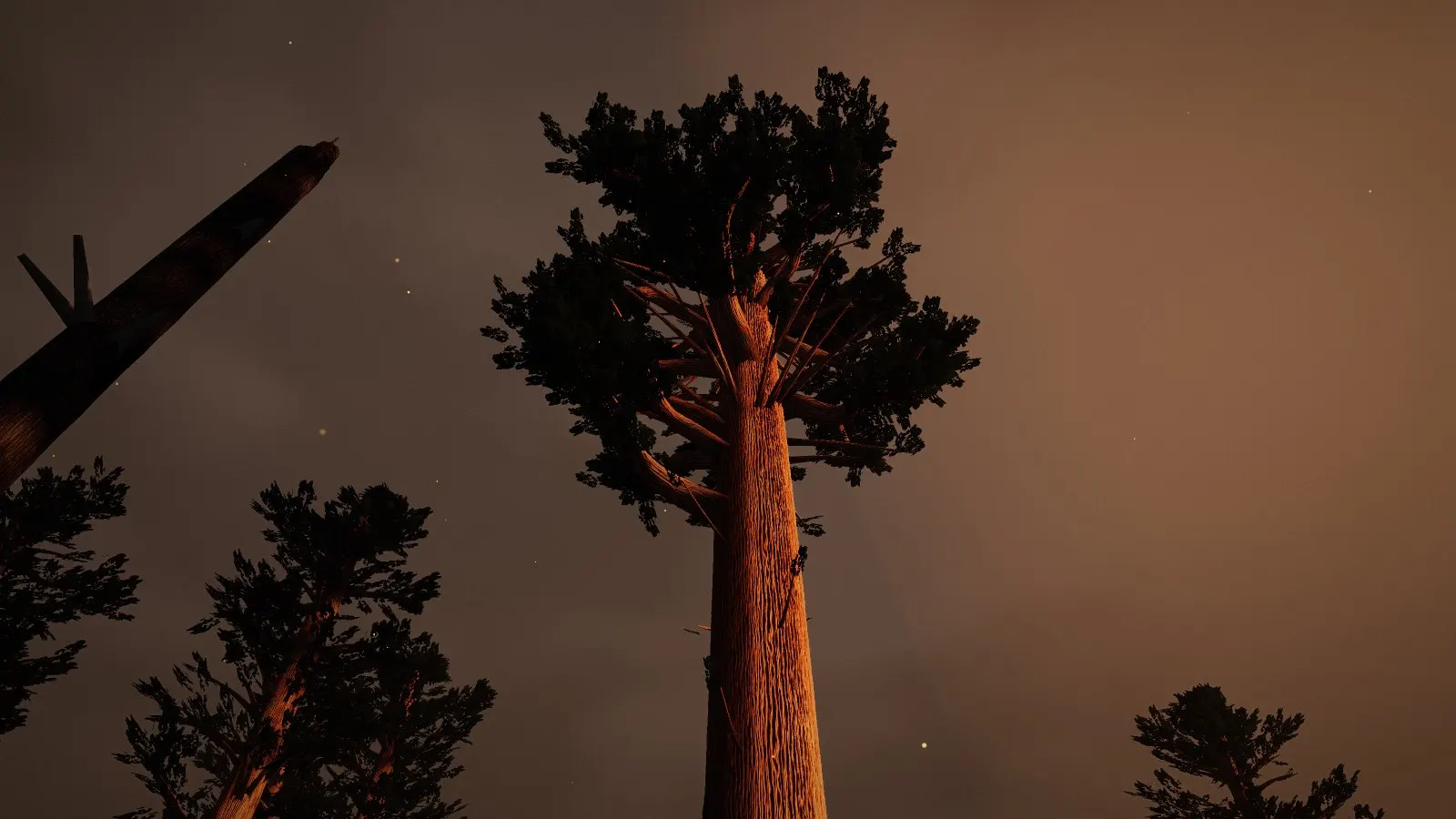
So we’ve now proven twice that burning this wood is favored, and that it’s favored at every temperature this forest will ever see. And the tree is still standing. Delta G told us which way the reaction is headed, but it never said a single word about how fast it gets there. And it isn’t just this tree. The paper in your notebook and the cotton in your shirt are cellulose too, sitting in air right now, favored to burn and not burning, and plenty of favored reactions are just as slow.
To see why, we need a picture you met back in Unit 5, the energy profile. Here’s wood plus oxygen up on the left, and carbon dioxide and water sitting far lower on the right, because the reaction releases a lot of energy. But between them sits this hump. To get from one side to the other, the molecules first have to climb it.
The height of that climb is the activation energy, the energy colliding molecules need to reach the top, where the old bonds are half broken and the new ones are half made. At the temperature of a September morning, almost no collision between oxygen and cellulose carries enough energy to get over the top, so they start up the hill and slide back down, again and again.
Here’s a whole crowd of them at forest temperature, with a curve showing how their energies are spread out, and look past the orange activation-energy line, where the sliver with enough energy is so thin you can’t even see it. That doesn’t make the rate exactly zero, it just makes it far too small to measure, and when a reaction is favored but doesn’t happen at a measurable rate, chemists say it’s under kinetic control.
Now, there’s a trap here. When nothing is changing, it’s tempting to say the system must be at equilibrium, so let’s look at two systems side by side. On the left is a real equilibrium with a low hump, where molecules cross in both directions all the time and at exactly the same rate, so the amounts stay steady even though everything is moving.
On the right is our wood and oxygen, and its amounts stay steady too, but only because crossings are far too rare to see in either direction. That system is stuck, and calling it equilibrium would be wrong.
Now imagine a sealed flask of freshly mixed reactants for a strongly favored reaction, and after a whole year no products have measurably formed. What’s the best conclusion? So what does it take to actually start a fire? Let’s find out.
Grab the thermometer and turn up the heat until reactions start happening. That’s why a fire keeps itself going once it starts. The same favored reaction that sat still for twenty-two hundred years is now supplying its own energy to get over the hump, and all it needed was enough heat to begin.
What the firefighters were fighting
Think back to September of 2021. At the bottom of this tree, that’s exactly what the firefighters were trying to prevent. Picture the base of the tree as the fire came into the grove, burning through dead branches and needles down the slope and sending heat and flying embers toward the trunk.
This heat view is a model of where that heat goes, and hotter things glow brighter. That old fire scar is a spot where the bark is missing, so the bare wood soaks up the fire’s radiant heat and starts warming toward the point where its molecules can get over the hump, And an ember lodged in the scar? It does the same thing, up close.
Now close the gap in the foil. The shiny aluminum reflects most of that radiant heat away and keeps embers from settling into the scars, so the wood underneath stays cool, and its molecules stay on the near side of the hump. The tree had protection of its own, bark up to forty-six centimeters thick that insulates the living wood, and the crews had cleared burnable material from around its base.
And a fire set on purpose made a big difference too, because a prescribed burn near the tree in 2019 left so little fuel that the 2021 fire stopped spreading before it got there. Not one of those things changed the delta G we calculated by a single kilojoule, and burning stayed strongly favored. Every one of them worked by keeping heat away from the wood, so its molecules never got enough energy to get over the hump.
So, in the language of this lesson, what did the foil wrap actually change? And kinetic control isn’t only about fire. Let’s go back to our pool in the snow, because water has its own version of this.
Here’s a bottle of very clean water. It’s been sitting in the snow on a night that’s eight degrees below zero. And it’s still completely liquid. We worked out that freezing is favored below zero, so which statement about this water is true?
So let’s give it one. When the water hits this chunk of ice, the crystal that’s already there gives the molecules something to lock onto, and look at that, it freezes the instant it lands, And look, the ice builds a little tower. It grows right up toward the bottle.
Down at the level of the molecules, the liquid kept trying to start a crystal. Each time, it fell apart, until the ice gave it a ready-made surface to build on. Delta G never changed, the water just got a path, and that’s the same idea as the tree. Now let’s put this all together. Here’s the answer the AP exam is looking for.
The sentence that earns the point
Here’s how this shows up on the exam. Cellulose combustion has a delta G naught of negative twenty-eight sixty-five kilojoules at two ninety-eight kelvin, yet wood doesn’t burst into flame at room temperature, so explain why. A full-credit answer makes two moves. The first move is thermodynamics, so you write that the reaction is thermodynamically favored because delta G naught is negative.
The second move is kinetics, so you add that its activation energy is large, which means that at two ninety-eight kelvin very few collisions have enough energy to get over the barrier, and the rate is far too slow to observe, so the reaction is under kinetic control. This is the sentence that earns the point. Notice that it never says the reaction is impossible, and it never says it’s at equilibrium, because it says favored, and slow, and it says why.
So here’s the answer to the question we started with. This tree has been favored to burn every day of its twenty-two hundred years, with a delta G you can now calculate two different ways, and it’s still here because that reaction is stuck behind a high activation energy.
Burning wood is favored no matter what anyone does, so those firefighters fought the one thing they could, the heat that would have carried the wood over the hump. In the next lesson we’ll see that delta G naught knows even more than which way a reaction goes, because it also tells you how far toward products a reaction’s equilibrium lies.