
Topic 9.1 key terms
- entropy (S)
- A measure of how spread out the particles of a substance and their energy are: the more ways the particles and their energy can be arranged, the higher the entropy.
- phase and entropy
- For the same substance and amount, S(solid) < S(liquid) ≪ S(gas); melting and boiling increase entropy (ice melting does so even though the liquid takes up less volume).
- moles of gas
- For a reaction, entropy generally increases when the products have more moles of gas than the reactants, and decreases when they have fewer. Only (g) species count; a tie decides nothing.
- temperature and entropy
- Heating broadens the distribution of the particles’ kinetic energies (same area), so the energy is more dispersed and the entropy increases.
Transcript
1,750 words · 3 parts
Entropy: an ice piano goes back to the river
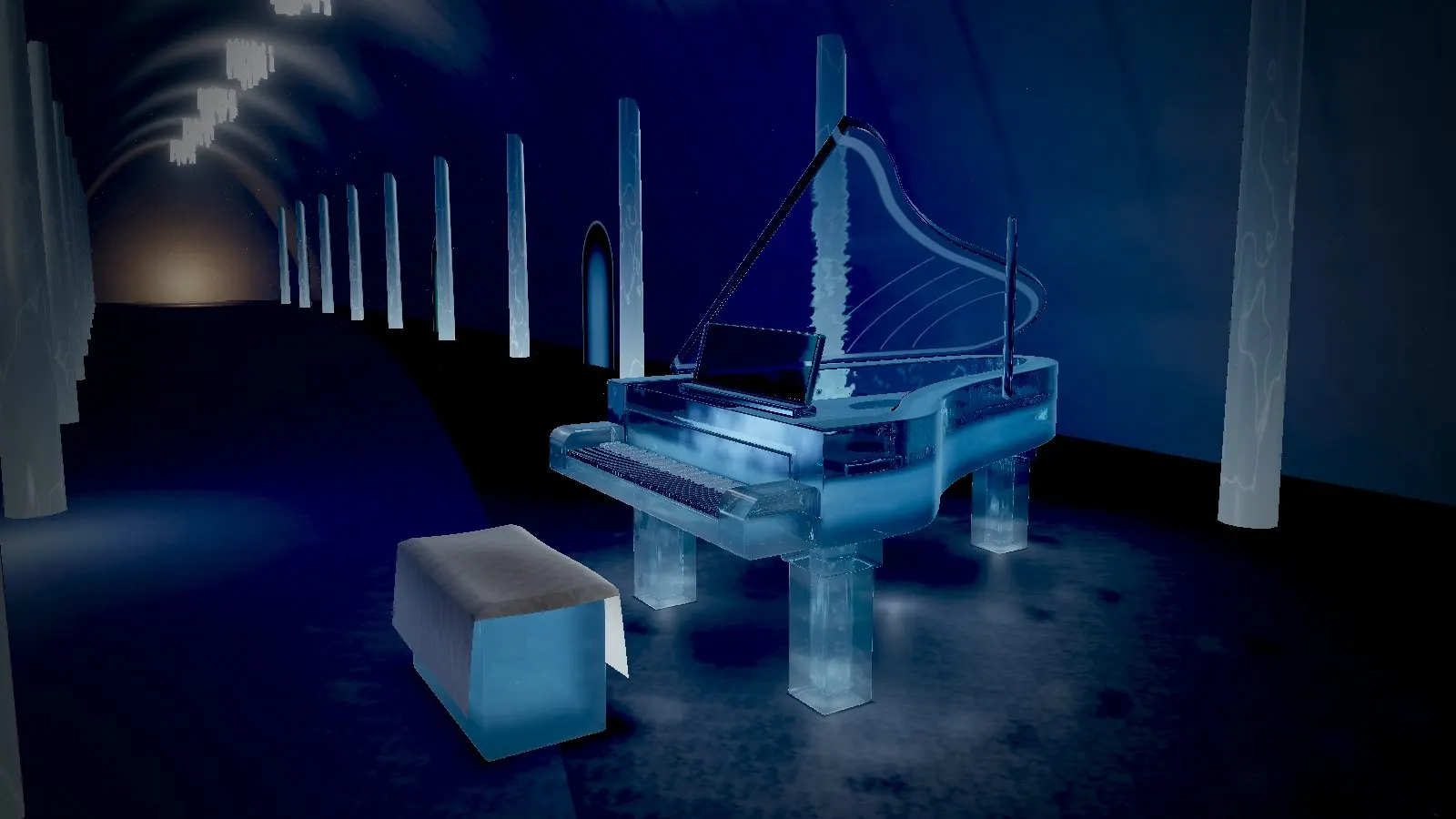
This is a full-size grand piano, and every part of it you can see is made of ice, built to be played all winter long in a room kept at about minus five degrees Celsius. It stood last winter in the Icehotel, in Swedish Lapland, where artists carve a whole hotel out of ice and snow every year, and people really do sleep in it, in sleeping bags on reindeer skins.
All of that ice came out of the river that flows right past the hotel, the Torne, sawn from the frozen river in March, and the hotel says all the ice in the winter building adds up to about ten seconds of the river’s flow. And then spring comes, and the whole winter hotel melts, this piano included, and all of that water runs straight back into the river it came from.
They’ve built it every winter and watched it melt for more than thirty years. In March it was part of a frozen river, by December it was a piano you could play, and by the end of spring it was flowing river again, the same water the whole time.
Every molecule in that piano was a water molecule when it was cut from the river, and it was still a water molecule when it flowed back in, so what actually changed? You already know from Unit 6 that the ice had to soak up heat to melt, so that’s one thing that changed. But something else changed too, and it has a name, entropy, one of the big ideas in all of science.
By the end of this lesson, you’ll be able to explain what changed inside this ice, predict whether entropy goes up or down for any change, and calculate exactly how much it changes, for a reaction and for one kilogram of this piano. Now, let’s take a much closer look, right down inside one of its keys. Let’s zoom in past the bubbles frozen in the ice, all the way down to the water molecules themselves.
In ice, hydrogen bonds hold every water molecule in its own spot among its neighbors, so together they build this open pattern of hexagons, and the most any one molecule can do is shiver in place. You met this picture in Unit 3, and today we’ll ask it a new question, how much freedom these molecules have.
That’s what entropy measures. It’s how spread out the molecules are, and how spread out their energy is, and it comes down to how many different ways there are to arrange them. Locked in a crystal like this, the molecules don’t have many options, so ice has a low entropy. Now I’ll draw an outline around this group, so we can track how much room they take up.
Now you bring the spring. Drag the season handle forward until the ice in this key has completely melted, and keep your eye on what the molecules do.
Now look at the outline around our molecules. After melting, they take up less room than they did as ice, because the open hexagons have collapsed and the molecules pack a little closer, which is exactly why ice floats.
So here’s a puzzle. The water takes up less room than the ice did, so when this key melted, what happened to its entropy? I want to say that one again, because it surprises a lot of people, and on the AP exam this is exactly the kind of reasoning you’ll need. When ice melts, the molecules end up a little closer together, and the entropy still goes up, because what really counts is how freely they can move.
And when that meltwater reaches the river, a few molecules at the surface break away into the air as water vapor, far apart and racing around with almost no neighbors. You can’t actually see water vapor, and the mist over a river is tiny drops of liquid, but vapor molecules have the most freedom of all, so a gas has far more entropy than its liquid. Let’s come back out and write down what we’ve found.
Entropy, which chemists write as a capital S, measures how spread out the particles and their energy are. The more different ways there are to arrange the particles, the higher the entropy. So for the same substance, the solid has the lowest entropy, the liquid has more, and the gas has by far the most, which means melting and boiling both make the entropy go up.
Let’s cross out one trap right away. Entropy isn’t how messy something looks, and it has nothing to do with the piano’s shape, since a plain block made of the same amount of ice, at the same temperature, has exactly the same entropy as the piano.
And explaining the sign of an entropy change with particles is a classic AP question. On the 2024 exam, maleic acid and baking soda reacted and fizzed out carbon dioxide gas, and the question asked you to explain with particles why the entropy goes up. The answer that earned the point said the reaction makes two moles of gas from reactants that weren’t gases, and gas particles are far more spread out than the particles of a liquid or a solution, and a vague answer like it gets more disordered, with nothing about the particles, misses what they’re asking for.
More room, more ways: spreading out a gas
Melting set those molecules free to slide past each other, and a gas takes that freedom much further, so let’s give a gas more room and see what happens to its entropy. Here’s a gas trapped in the left half of a chamber, with a divider down the middle and nothing at all on the other side. Before you pull the divider out, decide what you think will happen to the gas’s entropy, and then pull it out and watch.
The temperature never changed, and neither did the number of molecules, so more room alone means more possible arrangements. But why does a gas spread out like that, and why does it never squeeze itself back into one half? Let’s find out by counting, with a tiny model of just four molecules. For all four molecules to be on the left side, there’s exactly one way to do it.
Three on the left, and one on the right, can happen four different ways. Any one of the four molecules, any one at all, could be the one on the right. And two on each side can happen six different ways, which makes it the biggest column of all. The last two columns mirror the first two, so there are sixteen arrangements in all, and only one has everything on the left, which means even with four molecules, you’d catch them all on the left just one time in sixteen.
With a hundred molecules, the chance of finding them all on the left drops to about one in a million trillion trillion, and any real sample of gas has far more molecules than that. That’s why a gas spreads out and stays spread out, since the spread-out arrangements outnumber the bunched-up ones by such an enormous margin that you would never see it go the other way.
The same counting works for reactions. Here’s sulfur dioxide reacting with oxygen to make sulfur trioxide, and at the start there are nine molecules flying around in this chamber. Watch what happens as they react, because when it’s done, there are only six. Fewer molecules flying around on their own means fewer ways to arrange them, so this time the entropy goes down.
Here’s that reaction, two S O two plus O two goes to two S O three, all gases, and the quick way to predict its entropy change is to count the moles of gas on each side, three on the left, two on the right. Fewer moles of gas in the products usually means the entropy goes down, which we write as a negative delta S, and more usually means it goes up, and only the gases count, because a gas has so much more entropy than a solid, a liquid or a solution.
And notice I keep saying usually, because when the gas moles tie, this shortcut can’t tell you anything, and we’ll come back to that. This reaction comes straight from a sample question the College Board published for this topic, so which statement about its entropy change is right? Now try this one on your own. Which of these four processes has a negative entropy change?