
Topic 8.11 key terms
- pH-sensitive solubility
- A salt's solubility depends on pH when one of its ions is a weak base (CO₃²⁻, F⁻), a weak acid (BH⁺) or OH⁻: reacting that ion away lowers Q below Ksp, so more solid dissolves.
- saturation state Ω
- Ω = Q/Ksp for a mineral such as aragonite (CaCO₃). Ω > 1: the solid can form; Ω < 1: it tends to dissolve. Ksp itself doesn't change with pH.
Transcript
1,106 words · 3 parts
pH and solubility: why acid fights a shell
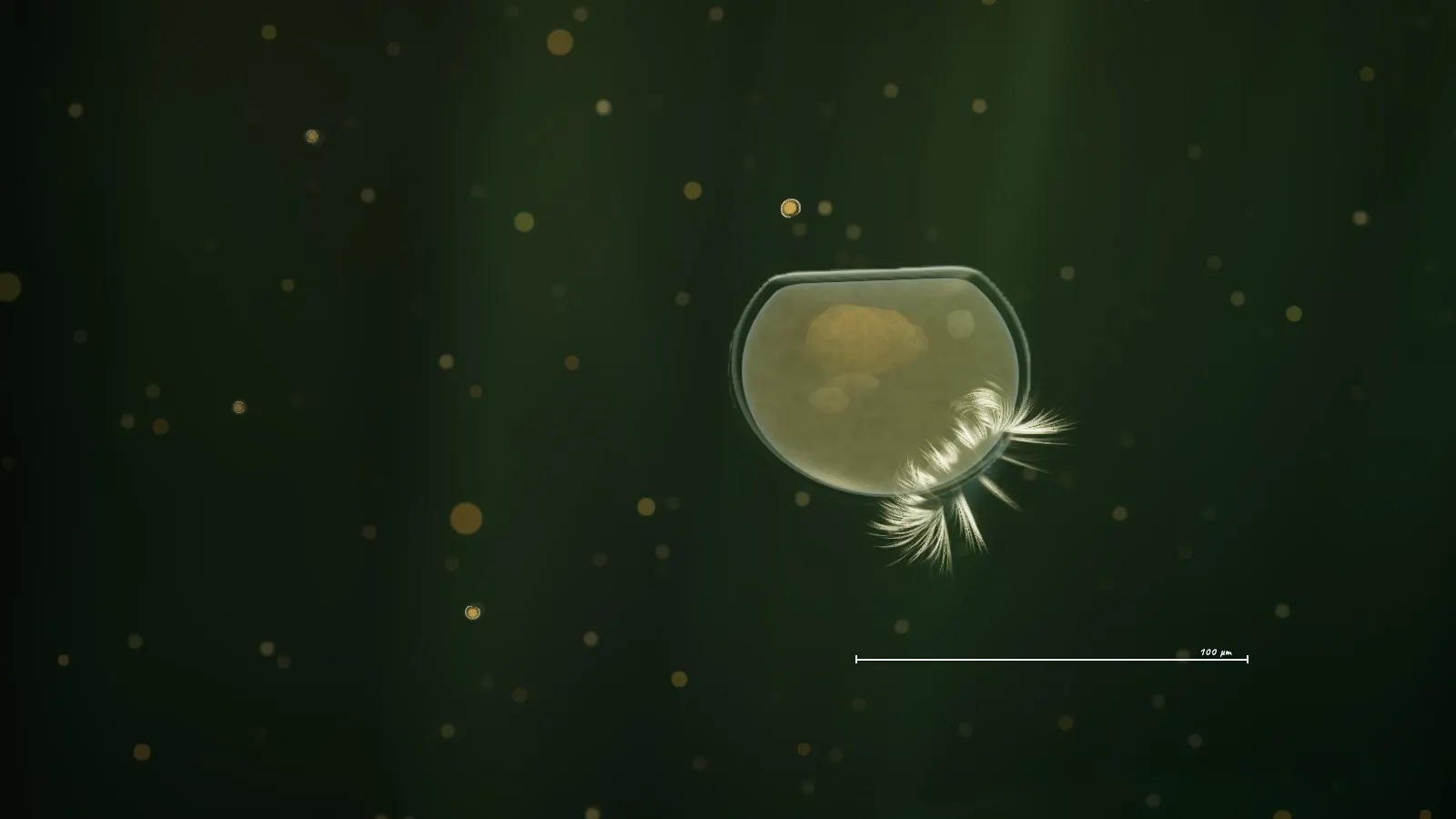
Let’s zoom in on the edge of the shell. This is where our larva is adding new shell right now. Now let’s go all the way down to the ions. What is this shell actually made of?
The shell is calcium carbonate, built from calcium ions, the amber ones, and carbonate ions, the blue triangles, the same flat little triangles you met in the coral at Heron Reef. Just like the giant beams in the Cave of the Crystals, ions leave this edge and land on it all the time, and right now the two rates match.
Here’s the needle from the cave lesson, Q against the gold K s p line. Right now, Q is sitting right on it. Now let’s bring in some acid. We’ll add it to the water around the shell.
Follow this carbonate as it drifts toward an empty spot on the shell, because on the way it runs into a hydronium ion, catches the proton, becomes bicarbonate, and drifts right past the spot it was about to fill, because with that extra proton on it, it doesn’t fit there anymore. It’s the same reaction from the flasks, happening at the edge of a living shell.
So fewer carbonates land while ions keep leaving, and the edge starts losing ground. The calcium in the water goes up as the shell dissolves, but the free carbonate stays low, because the acid turns it into bicarbonate as fast as it shows up. And Q slides below K s p, the signal for a solid to dissolve.
Now you fix it. Turn the pH dial and set this water so the shell edge starts growing again. Let’s write that as two separate equations. That’s the clearest way to explain it on the AP exam.
The first one is calcium carbonate dissolving into calcium ions and carbonate ions, and its K s p is the calcium concentration times the carbonate concentration. The second is the acid reaction, carbonate plus hydronium going to bicarbonate and water, and carbonate shows up in both of them. So when the second reaction pulls carbonate out, Le Chatelier says the first one shifts right to replace it, and more calcium carbonate dissolves. Adding them gives the overall reaction, calcium carbonate plus hydronium going to calcium ions, bicarbonate and water.
This one trips up a lot of people. When acid pulls carbonate out of the water, what happens to the K s p of calcium carbonate?
Ocean scientists track this exact number, Q divided by K s p, and call it the saturation state, omega. An omega of one means Q sits right on the gold line, so when omega drops below one, shell dissolves.
Whiskey Creek found it needed omega above about one point seven just to break even. Carbonate isn’t the only ion acid can grab, though, so let’s find out which salts care about pH and which ones couldn’t care less.
Which salts care about pH?
Back at the bench, here are four solids, each at the bottom of its own saturated solution, calcium carbonate, calcium fluoride, magnesium hydroxide and silver chloride. I’m adding a little nitric acid to all four.
Look at all four for a second. Which one of these solids do you think won’t dissolve any more than it already has? So let’s sort these four out on the board. We’ll take them one ion at a time, and the two weak bases come first.
Carbonate and fluoride are weak bases, conjugate bases of weak acids, so hydronium hands them a proton, and hydroxide reacts with hydronium to make water. Chloride, the conjugate base of a strong acid, gets left alone. So a salt’s solubility depends on pH when one of its ions can react with acid or base, which means it’s a weak base, a weak acid, or hydroxide itself. Acid doesn’t dissolve everything, and silver chloride is your proof.
This next one is from the 2025 AP exam. A saturated solution of magnesium hydroxide has undissolved solid at the bottom, and nitric acid is added to lower the pH. What happens to the amount of undissolved magnesium hydroxide?
It works backwards too. Add sodium hydroxide and you’re adding more of the solid’s own ion, the common-ion effect from the Cave of the Crystals, so the equilibrium shifts left and more solid forms.
The rule also covers ions that are weak acids, so here’s a model salt, B H X, where B H plus can give up a proton, and X minus doesn’t react with anything. Now raise the pH. What happens to the solubility of B H X? And that’s everything you need to run this hatchery’s water yourself, so let’s go back to Netarts Bay.
Running the hatchery
It’s a summer morning on Netarts Bay, the north wind has been blowing for days, and upwelled water is coming in through the intake. But the bay is full of algae, and in sunlight algae pull carbon dioxide out of the water. So imagine you’re running this hatchery. What time of day would you pick to fill the tanks for your newest babies?
But picking the hour only goes so far, and when upwelling goes on for days, even afternoon water falls short, so that’s when the soda ash comes in. This gauge shows omega for the water reaching the babies. The gold band is where the hatchery breaks even.
Here’s the soda ash. Dose the incoming water until it’s good for building shells, and hold it in the gold band. And down at the edge of the shell, ions are landing faster than they leave. The shell is growing again.
So let’s answer the question we started with. A scoop of white powder does two jobs at once. As a buffer, sodium carbonate adds the base partner, so the water can soak up more of the acid coming in from the deep. And for solubility, more carbonate pushes calcium carbonate’s equilibrium toward the solid, the common-ion effect again, so the shell builds instead of dissolving. And a pH meter alone couldn’t tell you either one, because two waters with the same pH can hold very different amounts of buffer and of carbonate.
Since it started buffering its water in 2011, the hatchery has won back between thirty and fifty percent of what it had been losing, which is billions more larvae every year. And every one of those babies gets a fair shot at its first big job. It has one day to build a shell, and now the water lets it. All of that is buffer capacity and solubility at work, and now you can explain every bit of it.