
Topic 8.4 key terms
- neutralization (strong acid + strong base)
- H3O+ + OH- -> 2H2O goes essentially to completion; the pH of the mixture comes from whichever reagent is left over, divided by the total volume.
- buffer
- A solution containing a weak acid and its conjugate base (or a weak base and its conjugate acid) in comparable amounts. Made, for example, by neutralizing only part of a weak acid with a strong base.
- Henderson–Hasselbalch equation
- pH = pKa + [A-][HA], from the Ka expression; used on the amounts LEFT after the strong reagent has reacted.
- conjugate acid–base pair
- Two species that differ by one proton, such as CH3COOH/CH3COO-, NH4+/NH3 or HCO3-/CO3²-.
Transcript
2,188 words · 4 parts
Acid-base reactions and buffers: when an acid meets a base
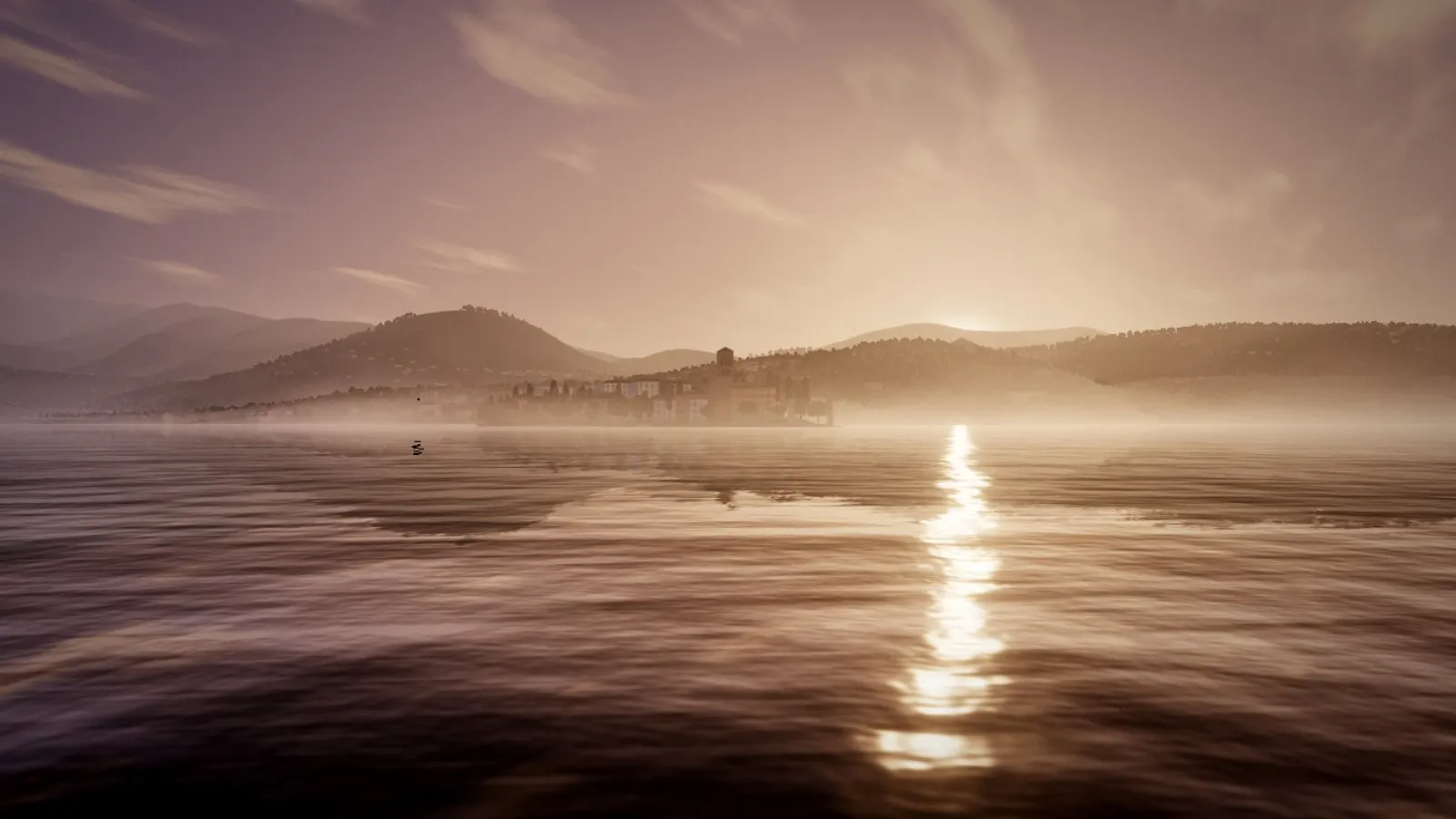
This is Lake Orta, in the north of Italy, at sunrise, one of the most beautiful lakes in the world. That’s the island of San Giulio out in the middle, with a church that’s been standing on it for centuries. But by the 1980s, it had become the largest acidified deep lake in the world. All of its water, from the surface to the bottom a hundred and forty-three meters down, had a pH of about three point nine, and most of the life in it had disappeared.
And the strange part is that nobody poured that acid in. In 1927 a rayon factory at the south end started dumping its waste into the lake, and that waste was full of ammonium. Bacteria in the lake fed on that ammonium, and every time they turned one ammonium ion into nitrate, they let go of two hydrogen ions, so the bacteria were filling the lake with nitric acid.
For a while the lake fought back, because its water carried a little bicarbonate, a weak base that grabs hydrogen ions. But by the 1960s it was all used up, and after that the acid just piled up until the whole lake was about as acidic as orange juice. So in May of 1989, the scientists tried something bold. A boat called the Sant’Angelo started spraying powdered limestone into the lake, and limestone is calcium carbonate, a base.
It kept going for thirteen months, until it had sprayed fourteen thousand eight hundred tonnes of limestone into the water. By the beginning of 1991, the acid in the whole lake was gone, and by 2000 the pH was back to about six point eight, where it had been before the factory came, and people could swim from its beaches again.
To pull that off, those scientists had to answer exactly the questions this lesson is about: what’s left when an acid and a base mix, what the pH is, and how much limestone it takes to neutralize a whole lake. And you’ll learn to read a titration curve, to find out how much acid is in a sample and how strong it is.
The acid those bacteria made was nitric acid, a strong acid, so every one of its molecules has given its proton to water, and a drop of it is full of hydronium ions and nitrate ions. Now let’s pour in sodium hydroxide, a strong base. Every hydroxide that bumps into a hydronium takes its extra proton, and the two of them become two water molecules, while the sodium and nitrate ions just drift around.
We started with twenty-eight hydroniums and added twenty hydroxides, so the hydroxide ran out first, and eight hydroniums are left over, and those eight decide the pH. Each one stands for a huge number of real ions, but the counting works the same way. So this is the idea that runs through the whole lesson, and you’ll hear it a lot. First find what reacted, and then ask what’s left.
Let’s do it with real numbers, in exactly the kind of question the AP exam loves to ask. We mix thirty-five milliliters of point oh eight molar nitric acid with twenty milliliters of point one molar sodium hydroxide, and we want the pH.
The reaction is hydronium plus hydroxide making water, and the first thing I want is moles, because particles react with particles, not milliliters with milliliters. Milliliters times molarity gives millimoles, so that’s two point eight millimoles of hydronium and two millimoles of hydroxide. They react one to one, so the hydroxide uses up two millimoles of hydronium and then it’s gone, leaving point eight millimoles of hydronium.
That leftover acid spreads through all fifty-five milliliters of liquid, which makes it about point oh one four five molar, and the negative log of that is a pH of one point eight four. Two shortcuts look tempting here, and both of them are wrong. You can’t average the two pH values, and you can’t call the mixture neutral just because both are strong.
A strong acid and a strong base only land on exactly seven when their moles are equal, so nothing’s left but water and spectator ions. And when the AP exam hands you two solutions with their volumes and molarities and asks for the pH after mixing, the move that earns the points is the one we just made, moles first and pH last.
Now you try one. This time we mix fifteen milliliters of point one molar nitric acid with twenty-five milliliters of point oh eight molar sodium hydroxide. What’s the pH of the mixture?
Weak acid + strong base: buffers
Nitric acid is strong, but most acids are weak, like the acetic acid in vinegar, and in the sample we’re about to use, only about one molecule in a hundred has given its proton to water. So you might expect it to react only a little with a base, and that’s the surprise, because it reacts almost completely. Hydroxide pulls the proton off acetic acid whether the acid wants to let go or not, and the equilibrium constant is close to two billion, so for every practical purpose it goes all the way.
Here’s twenty milliliters of point one two molar acetic acid, twenty-four molecules in our counting, and almost all of them are still holding on to their protons. Add six milliliters of point one molar sodium hydroxide, which is six hydroxide ions, and each one grabs a proton from an acid molecule, which leaves eighteen acetic acids and six acetates side by side.
A weak acid together with its own conjugate base is called a buffer, a mixture that holds its pH steady when a little acid or base comes in, and we just made one by neutralizing part of the acid. Now keep going to twenty-four milliliters. Every acetic acid has become acetate, with no acid left and no extra hydroxide.
But every so often an acetate pulls a proton off a water molecule and leaves a hydroxide behind. Only about one acetate in ten thousand does it, and that’s enough to make the solution a little basic. Past that, at thirty milliliters, the six extra hydroxides have nothing to react with, so they just stay. So let’s see if you can spot one. Which of these four mixtures is a buffer?
Now let’s put numbers on those three moments, because each one needs a different tool. We start with two point four millimoles of acetic acid. Six milliliters of base adds point six millimoles of hydroxide, leaving one point eight millimoles of acid and point six of acetate.
For a weak acid and its conjugate base, take the negative log of the Ka expression and rearrange it, and you get the Henderson-Hasselbalch equation, pH equals pKa plus the log of base over acid. Both are in one flask, so the volume cancels and millimoles work fine. Acetic acid’s Ka of one point eight times ten to the minus five gives a pKa of four point seven four five, and the log of a third is minus point four seven seven, so the pH is four point two seven.
At twenty-four milliliters it’s all acetate, two point four millimoles of it in forty-four milliliters, about point oh five four five molar, and there’s no acid left to put into Henderson-Hasselbalch, so we ask what acetate does with water. It’s a weak base, with a Kb of Kw over Ka, about five point six times ten to the minus ten.
Solving x squared over point oh five four five equals that gives about five and a half times ten to the minus six molar hydroxide, a pOH of five point two six, and a pH of eight point seven four. So when the acid and the base have exactly used each other up, the solution is basic, without a single drop of extra sodium hydroxide in it.
And at thirty milliliters, point six millimoles of extra hydroxide in fifty milliliters gives a pH of twelve point oh eight, and next to that, acetate’s little bit of hydroxide doesn’t matter. The classic mistake is to put the amounts you poured in straight into Henderson-Hasselbalch, which skips the reaction completely. React first, then use what’s left. Now you try it with the same acid, adding eighteen milliliters of the base this time. What’s the pH?
Weak base + strong acid: liming the lake
Now let’s flip it around, a weak base meeting a strong acid, because that’s exactly what happened in Lake Orta, twice. Before the acid took over, the lake’s bicarbonate was a weak base taking the protons as the bacteria made them, and while there was more bicarbonate than acid, the lake had a buffer, and its pH stayed near seven.
Then the acid used up the last of the bicarbonate, the strong acid was left over, and the pH came straight from the extra hydronium, just like in our very first problem. In 1989 the scientists turned it around, pouring a brand-new weak base into all that strong acid. Let’s follow one grain of that limestone down into the water.
At the grain’s surface, a carbonate ion grabs a proton and becomes bicarbonate, and while there’s plenty of acid around, it grabs a second one and becomes carbonic acid, which falls apart into carbon dioxide and water. So each carbonate soaks up two protons, as long as the acid is in excess.
Here’s a little pocket of the old lake water, with twelve hydronium ions in it. Add limestone, one carbonate ion at a time, until there’s no hydronium left. In the lab, the classic weak base is ammonia. Ammonium, the ion that factory was dumping, is ammonia with one extra proton.
Ammonia’s Kb is one point eight times ten to the minus five, the same number as acetic acid’s Ka. That makes this titration the acetic acid one, flipped over. Each pH is fourteen minus its partner. Six milliliters of acid gives a buffer again: ammonia with some ammonium. Fourteen minus four point two seven is nine point seven three.
Before I fill in the next row, you call it. At the equivalence point, where does the pH land? Acidic. Fourteen minus eight point seven four is five point two six. Past equivalence, the extra hydronium takes over: one point nine two.
Here’s why. At twenty-four milliliters, every ammonia molecule has become ammonium. That’s two point four millimoles in forty-four milliliters: point oh five four five molar. Ammonium is a weak acid. It hands a proton to water and makes hydronium.
For a conjugate pair, Ka times Kb equals Kw. Divide Kw by ammonia’s Kb, and ammonium’s Ka comes out at five point six times ten to the minus ten. Call the hydronium x. Then x squared over point oh five four five equals that Ka, and x comes out at five point five times ten to the minus six molar.
Take the negative log: pH five point two six. Below seven. The flask is acidic, just as the mirror said. Now back to the lake, and the biggest question in this story: how much limestone does it take to neutralize a whole lake? The scientists measured that the liming neutralized a hundred and seventy-three micromoles of acid in every liter, counted as hydrogen ions, and the lake holds about one point three times ten to the twelfth liters.
Multiply them and the liters cancel, about two point two times ten to the eighth moles of hydrogen ion. Each calcium carbonate takes two of those, so that’s one point one times ten to the eighth moles of calcium carbonate. Now you finish it. How many tonnes of calcium carbonate is that?
Weak acid + weak base
So far one partner has always been strong, and a strong partner drags the reaction all the way. When the acid and the base are both weak, the reaction settles at an equilibrium instead, and K tells you which side wins. Mix acetic acid with ammonia and the protons jump from the acetic acid over to the ammonia, and almost all of them stay there.
To see why, compare the two acids in the reaction, acetic acid on the left and ammonium on the right. The K for the whole reaction is the Ka of the acid on the left divided by the Ka of the acid on the right. That’s because you can split it into two steps, acetic acid handing its proton to water and then ammonia taking it back off the hydronium, and that second step is ammonium’s own reaction run backward, so ammonium’s Ka goes on the bottom.
Here that’s one point eight times ten to the minus five over five point six times ten to the minus ten, which is about thirty-two thousand. A big K means the products win, because the proton ends up on the stronger base, and ammonia holds on to a proton far more tightly than acetate does.
Now back to the lake. For years, the factory’s ammonium and the lake’s bicarbonate were sitting in the same water. Using these two Ka values, which side of this equilibrium is favored?