
Topic 8.2 key terms
- strong acid
- An acid that ionizes completely in water: HCl, HBr, HI, HClO₄, HNO₃, and the first proton of H₂SO₄. For a strong monoprotic acid, [H3O+] the acid’s initial concentration (water’s small contribution neglected).
- strong base
- A group 1 or group 2 hydroxide, which dissociates completely: [OH-] = C for group 1, 2C for group 2 (for the dissolved portion).
Transcript
1,221 words · 3 parts
Strong acids and bases: their pH and pOH
The researchers who studied these springs point to strong acids in the water, with iron chemistry pushing the pools even lower, so let’s find out what makes an acid strong, and why a strong acid makes the math so easy. Here’s hydrogen chloride going into water, so let’s follow the first molecule. It hands its proton straight to a water molecule, and what’s left behind is a chloride ion.
Then the next one does the same thing, and the next, until every single molecule has given up its proton. There’s no hydrogen chloride left in the water at all, only hydronium and chloride, and that’s what chemists mean by a strong acid. Six molecules went in, so six hydronium ions came out, one for one.
On paper, hydrochloric acid plus water gives hydronium plus chloride, and this time there’s only a single arrow, because the reaction goes all the way and doesn’t come back. There are six strong acids to know for the AP exam, hydrochloric, hydrobromic, hydroiodic, perchloric, nitric and sulfuric acid.
Sulfuric acid is a special case, because only its first proton comes off completely, so for this kind of calculation we’ll stick with acids that have one proton to give. And let’s cross out one more mix-up, that strong means concentrated. Strong means every molecule gives up its proton, while concentrated means there’s a lot of acid in each liter.
So let’s run the full AP routine on a strong acid, nitric acid at two point five times ten to the minus three molar. Each nitric acid molecule makes one hydronium, so I multiply by one mole of hydronium per mole of nitric acid.
The moles of nitric acid cancel, so the hydronium concentration is the same number, two point five times ten to the minus three molar. That’s between ten to the minus three and ten to the minus two, so the pH should land between two and three, and the calculator gives two point six zero.
The AP exam likes to ask for every species, so let’s list them. There’s as much nitrate as hydronium, and essentially no nitric acid left. And there’s a tiny bit of hydroxide from the water, K w over the hydronium, four point zero times ten to the minus twelve molar, for a pOH of eleven point four zero.
Even in a strong acid the hydroxide never drops all the way to zero, because water’s own equilibrium is still running underneath everything. Now you try one. What’s the pH of zero point zero two zero molar hydrochloric acid?
Strong bases: count the hydroxides
That’s the acid side of the scale, so what about the other side, where hydroxide takes over? Here’s sodium hydroxide going into water, and it doesn’t hand a proton to anything, it just falls apart into a sodium ion and a hydroxide ion, and the oxygen and hydrogen in the hydroxide stay stuck together. Calcium hydroxide falls apart the same way, except each formula unit gives you one calcium ion with a two plus charge and two hydroxide ions to balance it.
Now it’s your turn to use calcium hydroxide and put exactly six hydroxide ions into this water. On paper, sodium hydroxide gives one hydroxide per formula unit, and calcium hydroxide gives two, so I’m circling that two, because it’s the whole trick of this section.
The strong bases you’ll meet are the group one and group two hydroxides, and for group two the hydroxide concentration is double the base concentration, at least for the part that dissolves, because some of them barely dissolve at all. With bases, the most common slip is taking the negative log of the hydroxide and calling it the pH, when it’s really the pOH, so there’s still one more step to get to the pH.
Let’s do one together. A solution is one point five times ten to the minus three molar calcium hydroxide, so how much hydroxide does it hold? Two hydroxides per formula unit, so I multiply by two moles of hydroxide per mole of calcium hydroxide. The calcium hydroxide cancels, and the hydroxide comes out to three point zero times ten to the minus three molar.
If this were an AP free-response question, this is the sentence that earns the point, each formula unit of calcium hydroxide releases two hydroxide ions, so the hydroxide concentration is twice the calcium hydroxide concentration. The negative log of the hydroxide gives a pOH of two point five two, and fourteen minus that is a pH of eleven point four eight. The calcium ion stays at one point five times ten to the minus three molar, and there’s just a trace of hydronium.
Now one all on your own. You dissolve zero point two zero grams of sodium hydroxide in enough water to make five hundred point zero milliliters of solution at twenty-five degrees, so what’s the pH?
Below zero: back to Dallol
So let’s go back to Dallol’s number, and run our powers-of-ten ladder the other way. Before, every step went to more dilute acid, so what happens if we go toward more concentrated acid instead, still treating the pH as just the negative log of the molarity? In that simple model, what concentration of hydrochloric acid would give a pH of exactly zero?
So in our simple model, the zero on that old chart is just the pH of a one-molar strong acid, and anything more acidic than that pushes the pH below zero, which is right where Dallol’s pools are sitting. The same thing happens at the other end, because at twenty-five degrees, in our simple model, a ten-molar sodium hydroxide solution would have a pOH of minus one and a pH of fifteen. At that temperature, the zero-to-fourteen chart only covers everyday solutions, where neither ion gets above one molar.
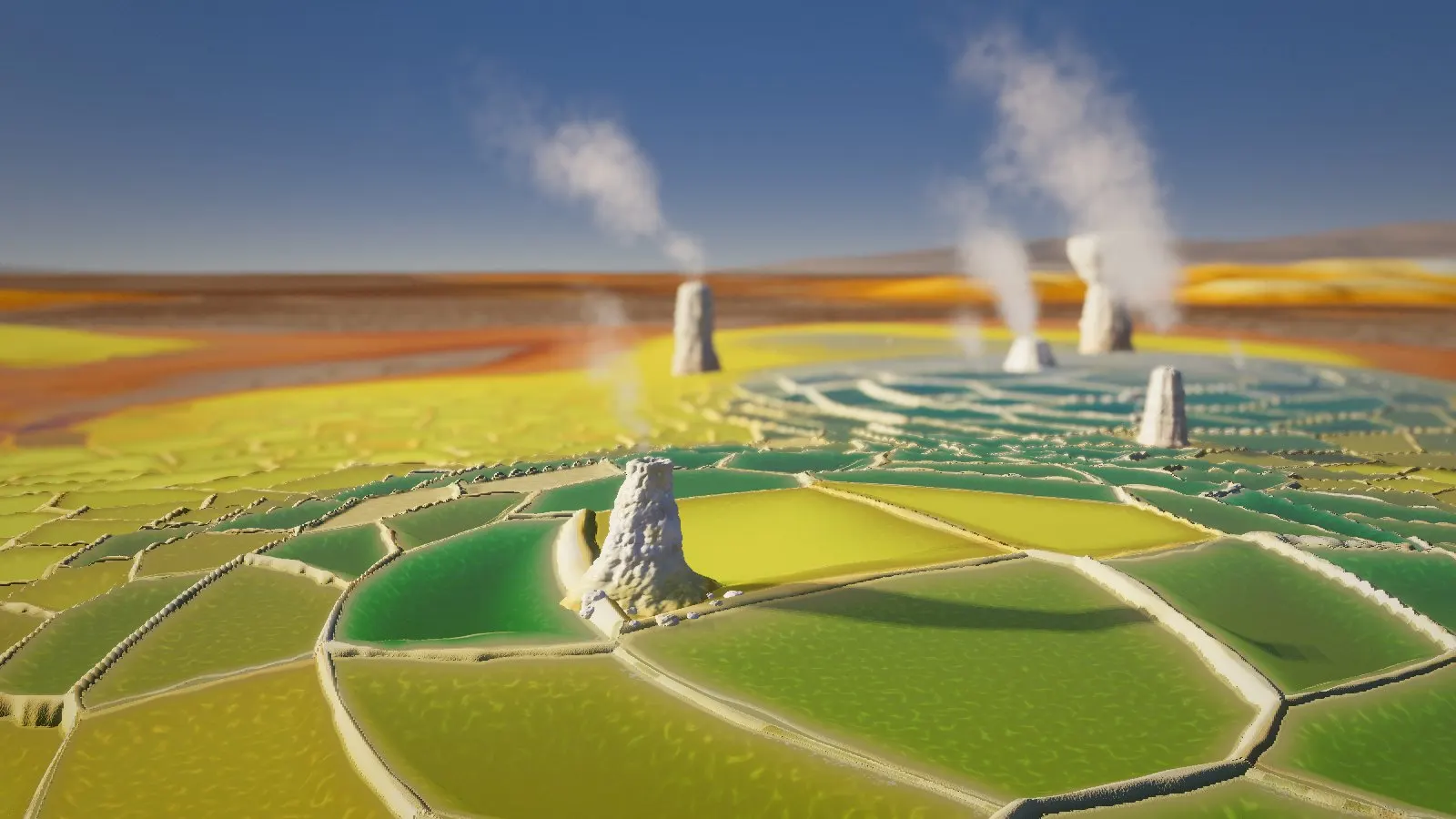
So let’s go back out to Dallol, late in the afternoon now, and this time you get to hold the meter. Dip the probe into the green spring first, then into the yellow pool, and watch the readings. The spring reads about zero point two, close to what researchers reported for these springs, and the yellow pool, where the brine has had time to evaporate and change, reads minus one point six, like the most concentrated brines they measured.
In a brine this hot and this salty, a meter really reads how strongly the hydronium acts, which isn’t quite the same thing as its molarity. So what can we honestly say about that minus one point six?
So here’s the whole lesson in one picture. Every water solution has two ion concentrations linked by K w, and their p values add up to fourteen at twenty-five degrees and something different at other temperatures. And every calculation starts by finding the ion, from water, from a one-proton strong acid one for one, or from a strong base one or two for one, and after that it’s just a log.
And the minus sign at Dallol is that same log at work, with the hydronium acting even more strongly than at pH zero, which is why the meter just kept on going. Every acid we used today gave up its proton from every single molecule, and next time we’ll meet acids where only a few of the molecules let go, which is where the math gets a lot more interesting.