
Topic 8.10 key terms
- buffer capacity
- How much added acid or base a buffer can neutralize before its pH changes significantly. It grows with the amounts of both partners in a given volume.
- acid partner (conjugate acid)
- The weak acid of a buffer pair, such as HCO₃⁻ or HA. It neutralizes added base: HA + OH⁻ → A⁻ + H₂O.
- base partner (conjugate base)
- The weak base of a buffer pair, such as CO₃²⁻ or A⁻. It neutralizes added acid: A⁻ + H₃O⁺ → HA + H₂O.
- same ratio, same pH
- A buffer's pH depends on the ratio [A⁻]/[HA] (pH = pKa + log ratio), so diluting both partners, or concentrating both, leaves the pH about the same while changing the capacity.
- lopsided buffer
- A buffer with more of one partner has more capacity in one direction: more base partner handles added acid; more acid partner handles added base.
Transcript
1,590 words · 3 parts
Buffer capacity: the babies of Whiskey Creek
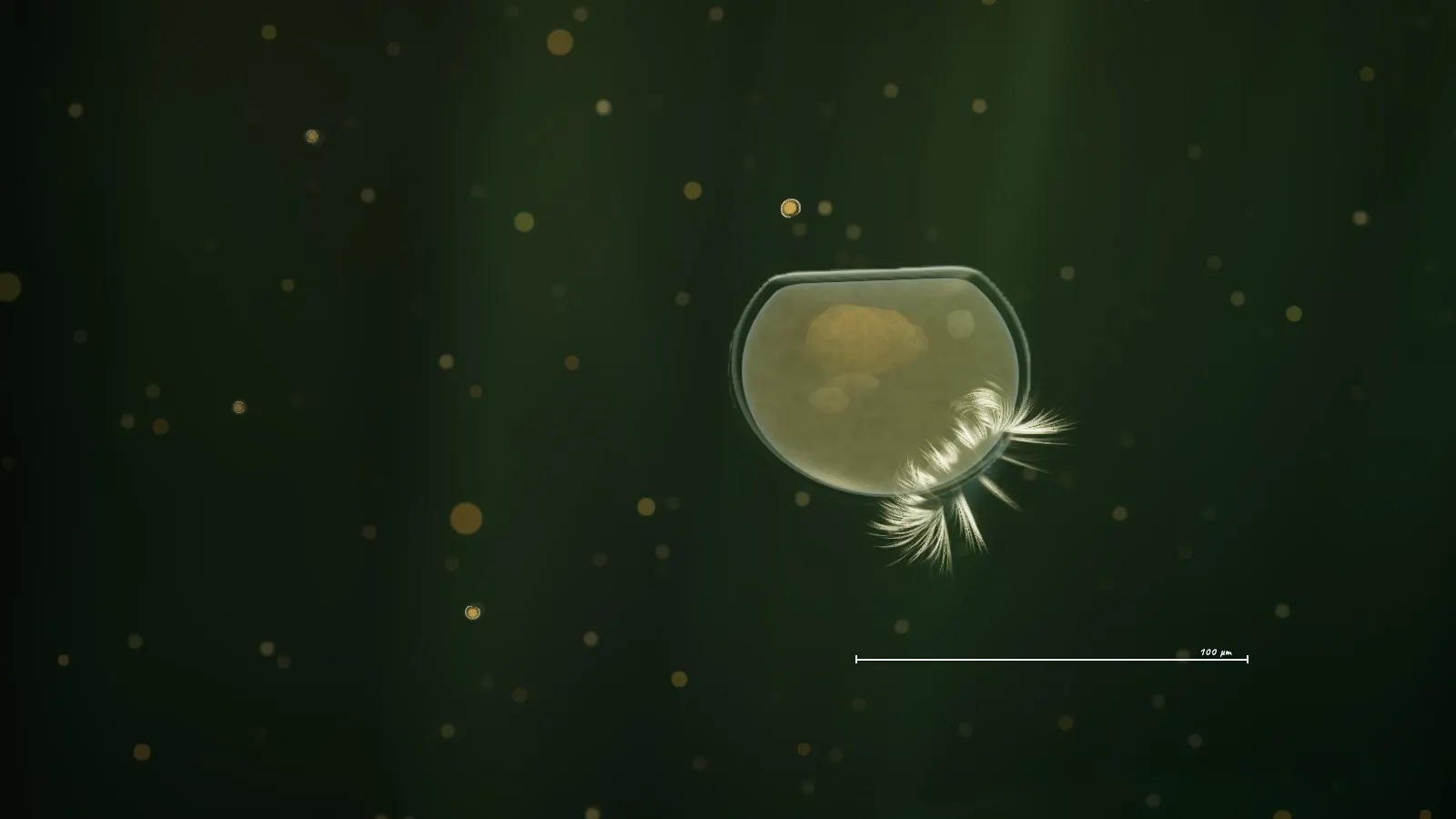
This is a baby oyster, about a day old. It’s smaller than the dot at the end of a sentence. And in its first day of life, it builds itself a shell, straight out of the seawater around it.
Here’s that day sped up. It starts with no shell at all, just a ball of cells with a band of tiny beating hairs, and then a shell of calcium carbonate spreads over it, until in less than a day its body is mostly shell. And it does all of that on the energy packed into its egg. It can’t even eat yet.
This one lives in a tank full of them at Whiskey Creek Shellfish Hatchery, on Netarts Bay in Oregon, which raises billions of baby oysters a year for oyster farms up and down the West Coast. In July 2007 the babies here started dying in enormous numbers, and nobody knew why. The hatchery blamed a bacterium that kills oyster larvae and got rid of it, and the babies kept dying anyway.
By the end of 2008, they’d raised only about a quarter of a normal year’s larvae. That’s billions fewer babies. So they sent their seawater to an ocean chemist at Oregon State, who figured somebody had botched the samples, because the carbon dioxide was ridiculously high. Nobody had botched anything, though, because that really was the water coming in from the bay.
It comes from out here. Every summer, north winds push the Pacific’s surface water away from the coast. Cold water from deep down rises up to take its place, water that’s been away from the surface for decades and has been picking up carbon dioxide the whole time. Upwelling isn’t new. But the ocean has been soaking up the extra carbon dioxide we’ve put in the air, and that makes this deep water more corrosive than it used to be.
When that water reached the hatchery’s pumps, the babies in the tanks just couldn’t build their shells. And the fix that kept this hatchery in business is a white powder, sodium carbonate, sometimes called soda ash, which since 2011 they’ve been measuring into the seawater before it ever reaches the babies. So why does a scoop of that powder work so well? You’ll find out by running this hatchery’s water yourself.
The water around these babies is a buffer. It’s a weak acid and its conjugate base side by side, like the one in that runner’s blood last lesson. But the carbon dioxide in that deep water broke right through it. So today’s question is one the AP exam loves to ask. How much can a buffer actually take?
Let’s run an experiment on the hatchery’s lab bench, after dark. In these two flasks I’ve made the ocean’s own buffer pair, in pure water, so we can see it clearly. The orange ones are bicarbonate, H C O three minus, the acid partner, and the blue ones are carbonate, C O three two minus, the base partner.
They differ by one proton, so a carbonate that catches a proton becomes a bicarbonate, and a bicarbonate that gives one up becomes carbonate. Both flasks hold a hundred milliliters with the partners one to one, but the left one is ten times more concentrated, a tenth of a mole per liter of each partner instead of a hundredth.
And look at the needles. They read almost the same pH, about ten point three. That’s because a buffer’s pH depends on the ratio of its partners, and the ratio is one to one in both. Comparing two buffers with the same ratio but different concentrations is a classic AP setup, so it’s worth slowing down for.
To a pH meter, these look nearly identical. So if I drop the same amount of acid into each one, which needle do you think will move more?
So the two buffers had the same pH but very different abilities to soak up acid. Chemists call that ability buffer capacity, how much acid or base a buffer can neutralize before its pH changes a lot, and a matching pH tells you nothing about it. Bicarbonate can catch a proton too, by the way, but carbonate is the much stronger base, so it grabs the acid first. Let’s put numbers on this.
Same ratio, different capacity
In the left flask, point one liters times point one zero zero moles per liter is point zero one moles, which is ten millimoles, so it has ten millimoles of each partner. The right flask, ten times more dilute, has one millimole of each. Each proton turns one carbonate into one bicarbonate, so carbonate goes down and bicarbonate goes up by the same amount.
After point eight millimoles of acid, the left flask has nine point two millimoles of carbonate and ten point eight of bicarbonate, still close to one to one. The right flask is down to point two millimoles of carbonate against one point eight of bicarbonate, about one carbonate for every nine bicarbonates, which is why its needle fell so far.
So the same ratio gives the same pH, but more of both partners in the same volume gives more capacity, because there are more particles to react with whatever you add. In 2017 the AP exam gave students two buffers made of nitrous acid and nitrite, one about thirty times more concentrated than the other, and asked which one better resists a change in pH when a strong acid or base is added.
The answer that earned the point says the more concentrated buffer wins, because it has a higher concentration of both partners to react with the added acid or base. And the AP exam won’t ask you to calculate those needle readings after the acid goes in. It’ll ask which one changes more, and why.
Now a different buffer. A student accidentally dilutes an acetic acid and acetate buffer with an equal volume of water, then tests fifty milliliters of it against fifty milliliters of the original. What happens to its pH and its capacity? Both of those buffers had their partners one to one, but real buffers often don’t, and that includes the ocean.
Lopsided buffers: which way can it push back?
Here are two new flasks, each with ten millimoles of buffer in total, split two different ways. Flask P has eight millimoles of bicarbonate and two of carbonate, and flask Q is the reverse, two of bicarbonate and eight of carbonate. Their needles don’t match this time, which makes sense, because their ratios are different.
A big dose of acid is coming, the same dose whichever flask gets it, so drag the burette to the flask you think will hold its pH better. Now let’s do the bookkeeping on the board. We’ll put both flasks side by side, so we can compare them.
It’s the same reaction, one carbonate used up for every proton. In Q, eight millimoles of carbonate minus one point five leaves six point five, plenty for another dose. Now you do flask P. It started with two millimoles of carbonate and took the same one point five millimoles of acid, so how much carbonate is left?
Now start over with fresh flasks and add one point five millimoles of base instead, hydroxide, which gets caught by the acid partner, since bicarbonate hands its proton to O H minus and becomes carbonate. This time P has the big reserve, eight millimoles of bicarbonate, and keeps six and a half, while Q drops from two to half a millimole. And this time it’s Q’s pH that moves more, because Q only had two millimoles of bicarbonate to spend.
So a lopsided buffer is stronger in one direction, with more base partner handling added acid and more acid partner handling added base. That clears up a common mistake, which is thinking more acid in a buffer protects it from acid, when it’s the base partner that does the catching. Partners one to one handle both directions equally, which is why chemists often build buffers that way.
So what about the ocean? Seawater’s carbonate pair is lopsided, with about ten bicarbonate ions for every carbonate ion. So use what we just found. Which kind of challenge is the ocean’s carbonate pair better at handling?
Let’s see what that carbon dioxide actually does. Dissolved carbon dioxide makes carbonic acid, which hands a proton to a carbonate, so every C O two that comes in uses up one carbonate and leaves two bicarbonates.
One of them comes from the carbonic acid that gave up its proton. The other is the carbonate that caught it. So by the time the upwelled water reaches the hatchery, much of its small carbonate reserve is already spent. It’s still basic, around pH seven point six at its worst, but it’s lost much of the partner that protects it.
Now you can see half of why the white powder works. Sodium carbonate dissolves into sodium ions and carbonate, so it adds the base partner, tilting the ratio back toward carbonate and adding more buffer overall, which is both of our rules working for the hatchery at once.
It’s a cousin of the limestone they sprayed into Lake Orta, except here the job is keeping a buffer stocked with its base partner. Seawater is salty enough that its numbers differ from our lab flasks, but the logic is the same. But every carbonate that caught a proton stopped being a carbonate, and that matters enormously to our larva, because carbonate is exactly what it builds its shell with.