
Topic 8.6 key terms
- conjugate base
- The species left when an acid donates H⁺; its charge is one unit lower. For a neutral acid HA this is A⁻ (which keeps the electron pair from the broken bond); for NH₄⁺ it is NH₃.
- acid strength from structure
- The more stable the conjugate base (the better it holds its negative charge), the more readily the acid gives up its proton, and the stronger the acid.
- resonance (in a conjugate base)
- Sharing a charge over several atoms in one real structure, the hybrid. Acetate's −1 is spread over two O (−½ each), which makes acetic acid far stronger than ethanol.
- inductive effect
- An electronegative atom (such as Cl on the carbon next to the carboxyl group) pulls electron density through the bonds, spreading a conjugate base's charge further and making the acid stronger: chloroacetic acid (pKa 2.85) vs acetic acid (4.76).
- strong acids
- HCl, HBr, HI, HClO₄, H₂SO₄ (first proton) and HNO₃: they ionize essentially completely in water, and their conjugate bases are very weak bases.
- strong bases
- The Group 1 hydroxides (NaOH, KOH, …) and the heavier Group 2 hydroxides Ca(OH)₂, Sr(OH)₂ and Ba(OH)₂: OH⁻ takes a proton; its conjugate acid, water, is very weak. (Be(OH)₂ and Mg(OH)₂ are not counted.)
- weak bases
- Bases that accept a proton only to a small extent: nitrogen bases such as ammonia (lone pair on N) and carboxylate ions such as acetate.
- pKa
- pKa = - Ka: a property of the acid molecule, one value for each proton it can give up (citric acid has three). A smaller pKa means a stronger acid.
Transcript
1,739 words · 4 parts
Molecular structure of acids and bases: which H leaves?
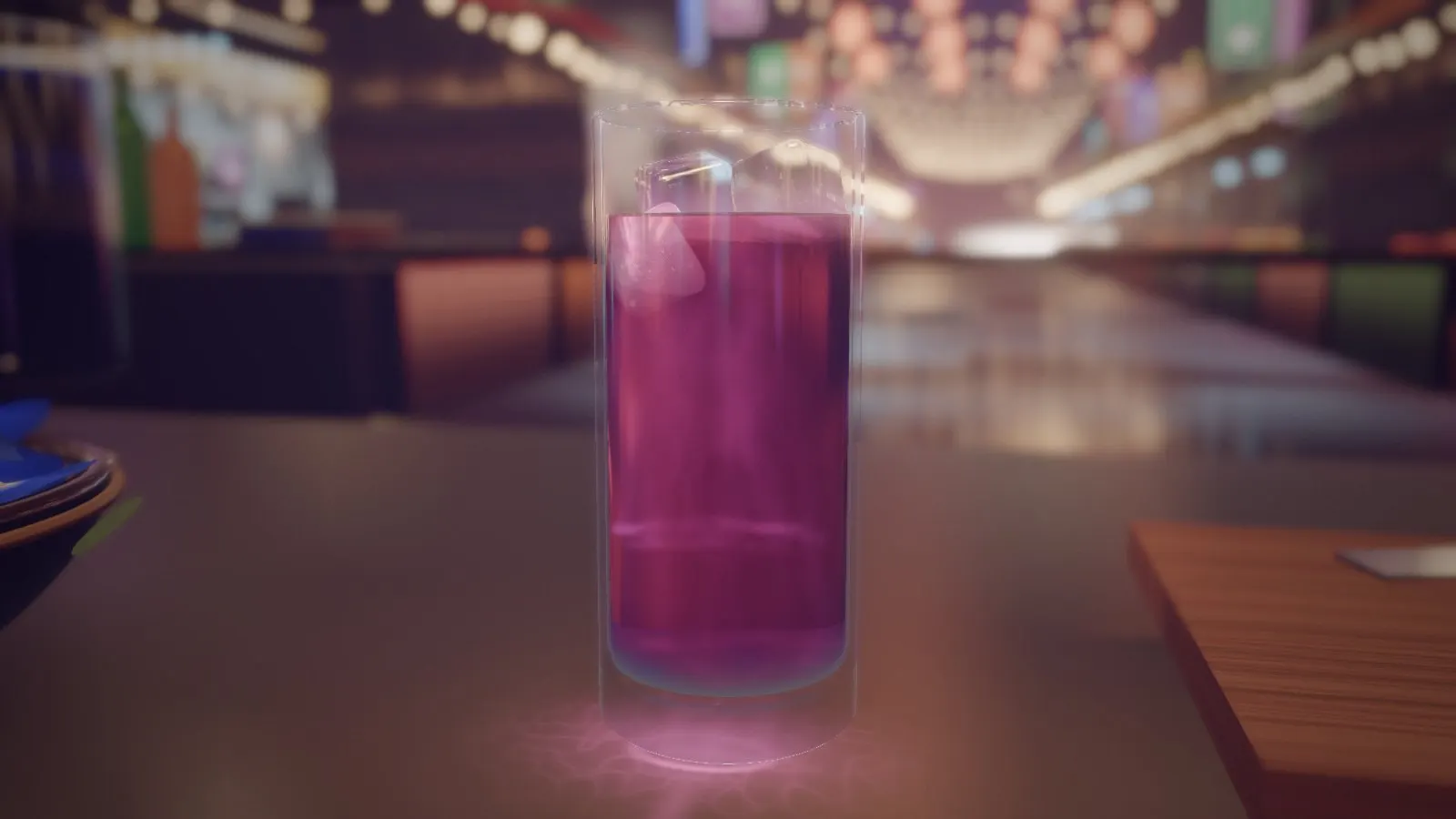
In Thailand, there’s a popular drink called nam anchan manao, and it might be the strangest-looking drink you’ll ever order, because it starts out a deep, glowing blue. The color comes from a flower called the butterfly pea. You steep the petals in hot water, and the tea comes out this color all by itself, with nothing added. And then the vendor squeezes in some lime…
Look at that, and nobody poured in anything pink. Lime juice is pale, the tea was blue, and now the drink is turning pink from the top down, right in front of us. Let’s go way in, down past the ice to where the lime is mixing in. These are the flower’s pigment molecules, the same molecules that made the tea blue a minute ago.
What the lime did was flood the glass with protons, and when one of these molecules picks up a proton, its electrons rearrange just enough that it soaks up a different color of light. With the proton on it looks pink, and with the proton off it looks blue. So there are really two kinds of molecules at work in this glass. The acid in the lime gives protons away. And the pigment shows you, in color, whether it’s holding one.
So, two questions. Which hydrogen can a molecule give away, and how easily? And when you compare the pH with its pKa, which form wins? So let’s start with the lime, because that’s where the protons come from. Lime juice is about pH two, and most of its acid is one molecule, called citric acid.
Count the hydrogens on one citric acid molecule and you get eight, but when citric acid meets water, only three of them can leave. So which three are they, and why those three? Let’s try one. If this hydrogen on a carbon left as H plus, it would leave its bonding electrons behind on the carbon, and carbon holds a negative charge far worse than oxygen does, so in water this proton never really leaves, and it snaps right back.
Now let’s try the hydrogen on this oxygen, at the end of an arm. It hops onto a water molecule, and the negative charge it leaves behind spreads out across both of these oxygens, which is a much more comfortable place for a charge to be, so this is a proton citric acid can really give away.
Let me write that down, because it’s the big idea of this whole topic. An acid, H A, hands its proton to water, and what’s left behind, A minus, is called its conjugate base. The better that conjugate base can hold its negative charge, the more readily the acid lets go, and the stronger the acid.
And notice it has nothing to do with how many hydrogens a molecule has, because five of citric acid’s eight are just along for the ride. The AP exam loves this idea. It’ll show you two structures and ask which is the stronger acid, and the point goes to the student who talks about what’s left behind after the proton leaves.
So now you try it. Tap the hydrogens on citric acid that you think can leave, and the molecule will show you exactly what each one leaves behind.
Resonance: sharing the charge
So why is a carboxyl group so good at this? Let’s look at a smaller molecule with the same group, acetic acid, the acid in vinegar. When the proton leaves, its oxygen keeps the electron pair from the bond, so now that oxygen carries a negative charge. But look at the other oxygen, double-bonded to the same carbon.
We can swing a lone pair from the charged oxygen into its bond and push the double bond’s electrons up onto the other oxygen, and now the charge sits over there instead. Both drawings follow the rules, and neither one tells the whole story on its own. The real acetate ion is one structure in between the two. Both carbon–oxygen bonds are the same length, and each oxygen carries half the charge, all the time, so don’t picture it flipping back and forth between our drawings. That sharing is called resonance.
Now compare ethanol, the alcohol in drinks, which also has an O H. When its proton leaves, the ion that’s left, ethoxide, has its whole charge on one oxygen, and there’s no second oxygen next door to share it. And you can see the difference right here. On acetate, the charge is spread softly over two oxygens, and on ethoxide, it’s one hot spot on a single atom.
And that difference is huge. Acetic acid’s Ka is about one point seven times ten to the negative five, and ethanol’s is around ten to the negative sixteen, more than a hundred billion times smaller, from the same kind of O H bond. And that’s why citric acid’s fourth O H stays put. It sits on the middle carbon, which has no double-bonded oxygen of its own, so its conjugate base would have the same problem as ethoxide. So which of these best explains why acetic acid is a much stronger acid than ethanol?
Electronegativity: a pull through the bonds
Resonance is one way to steady a conjugate base, and there’s a second way that’s even sneakier. Let’s go back to acetic acid, let its proton go, and then leave that oxygen end exactly as it is. Now I’ll swap one hydrogen on the far carbon for a chlorine. Chlorine is very electronegative, so it pulls electron density toward itself through the bonds, and that pull reaches the oxygens and spreads their charge a little further, which makes the conjugate base more stable.
Now you take over. Swap a second hydrogen for a chlorine, and then a third, and watch what happens to the charge on the oxygens each time.
And here’s what chemists measured. Acetic acid’s pKa is four point seven six, one chlorine brings it down to two point eight five, two chlorines to one point four eight, and three to zero point seven. A smaller pKa means a stronger acid, and not one of those chlorines is even touching the O H.
Every unit of pKa is a factor of ten in Ka. This first step drops the pKa by almost two units. That makes chloroacetic acid’s Ka about eighty-one times bigger, from one chlorine on the neighboring carbon.
This kind of comparison was on the AP exam in 2009. Students got Ka values for H O C L and H O B R, two point nine times ten to the negative eight and two point four times ten to the negative nine, and had to say whether H O I, with iodine in place of chlorine, would be a stronger or a weaker acid. See if you can call it before I do.
In all three, the hydrogen sits on an oxygen, so the bond that breaks is the same kind each time, and what changes is the halogen on the far side. Iodine is the least electronegative, so it pulls the least, O I minus is the least stable conjugate base, and H O I is the weakest acid of the three.
Extra oxygens work the same way. In chloric acid, H C L O three, the extra oxygens pull electron density away from the O H, and once the proton leaves, the charge spreads over three oxygens, so chloric acid is far stronger than H O C L, and perchloric acid, with four oxygens, is one of the strong acids.
Strong acids, strong bases and weak bases
Speaking of strong acids, there are six to know by name: hydrochloric, hydrobromic, hydroiodic, perchloric, sulfuric and nitric. In water they give up their protons essentially completely, the first one anyway in sulfuric acid’s case, because their conjugate bases are so stable that they barely pull on a proton at all. Perchlorate and nitrate spread their charge over several oxygens, and chloride, bromide and iodide are big ions that hold one extra electron easily.
But here’s a trap. Fluorine is the most electronegative element of all, so you’d expect H F to be the strongest of these four, and yet in water it’s a weak acid, while H C L, H B R and H I are all strong. When the hydrogen sits right on the halogen, size matters more. Going down the group the atom gets bigger, so the bond gets longer and weaker, from ninety-two picometers in H F to a hundred and sixty-one in H I, and the bigger ion spreads its charge over more space.
So use electronegativity across a row, or for atoms pulling from a distance, and use size going down a group. Which of these statements best explains why hydrochloric acid is a stronger acid than hydrofluoric acid in water?
Structure tells you about bases too. The strong bases are the hydroxides of the group one metals and the heavier group two metals, like sodium hydroxide and calcium hydroxide, where the metal ion is just a spectator and the hydroxide ion grabs a proton to become water.
And water is such a weak acid that it almost never gives that proton back. It’s the same idea as the strong acids, running the other way, because a very strong base has a very weak conjugate acid.
Weak bases take a proton only some of the time. Ammonia’s nitrogen has a lone pair sticking out, and that pair can grab a proton from water to make ammonium. Acetate is a weak base too. It can take a proton back onto one of its oxygens. But its charge is spread out so well that it doesn’t hold on tightly.
So it’s all one seesaw, where the stronger the acid, the weaker its conjugate base. Chloride, from a strong acid, is so weak a base that we ignore it, while acetate and ammonia are weak bases. Which one of these is the strongest base?
Every proton an acid can give up has a number that sums up how badly the structure wants to keep it, its pKa, the negative log of Ka, and the smaller the pKa, the stronger the acid. But a pKa only tells you half the story. The pKa belongs to the molecule and comes from its structure, while the pH belongs to the solution the molecule is sitting in. So to know what a molecule is doing in a solution, we just compare those two numbers.