
Topic 8.1 key terms
- hydronium ion
- H3O+: a water molecule carrying an extra proton. “Hydrogen ion” and H+(aq) mean the same aqueous ion; H3O+ is preferred on the AP Exam.
- The pH of a solution
- pH = −log[H₃O⁺]. Each pH unit is a factor of ten in hydronium; lower pH means more hydronium. The scale does not stop at 0 or 14.
- autoionization of water
- 2H2O(l) <=> H3O+(aq) + OH-(aq): pure water always contains equal, tiny concentrations of both ions.
- Kw, the ion product of water
- Kw = [H₃O⁺][OH⁻] = 1.0 × 10⁻¹⁴ at 25 °C. It changes with temperature (larger when hotter).
- The pOH of a solution
- pOH = −log[OH⁻].
- The pKw of water
- pKw = −log Kw = pH + pOH; 14.00 at 25 °C, 13.26 at 50 °C.
- neutral solution
- [H3O+] = [OH-], so pH = pOH. At 25 °C that is pH 7.00; at other temperatures neutral pH is not 7.
Transcript
2,029 words · 3 parts
Acids and bases: what a pH number counts
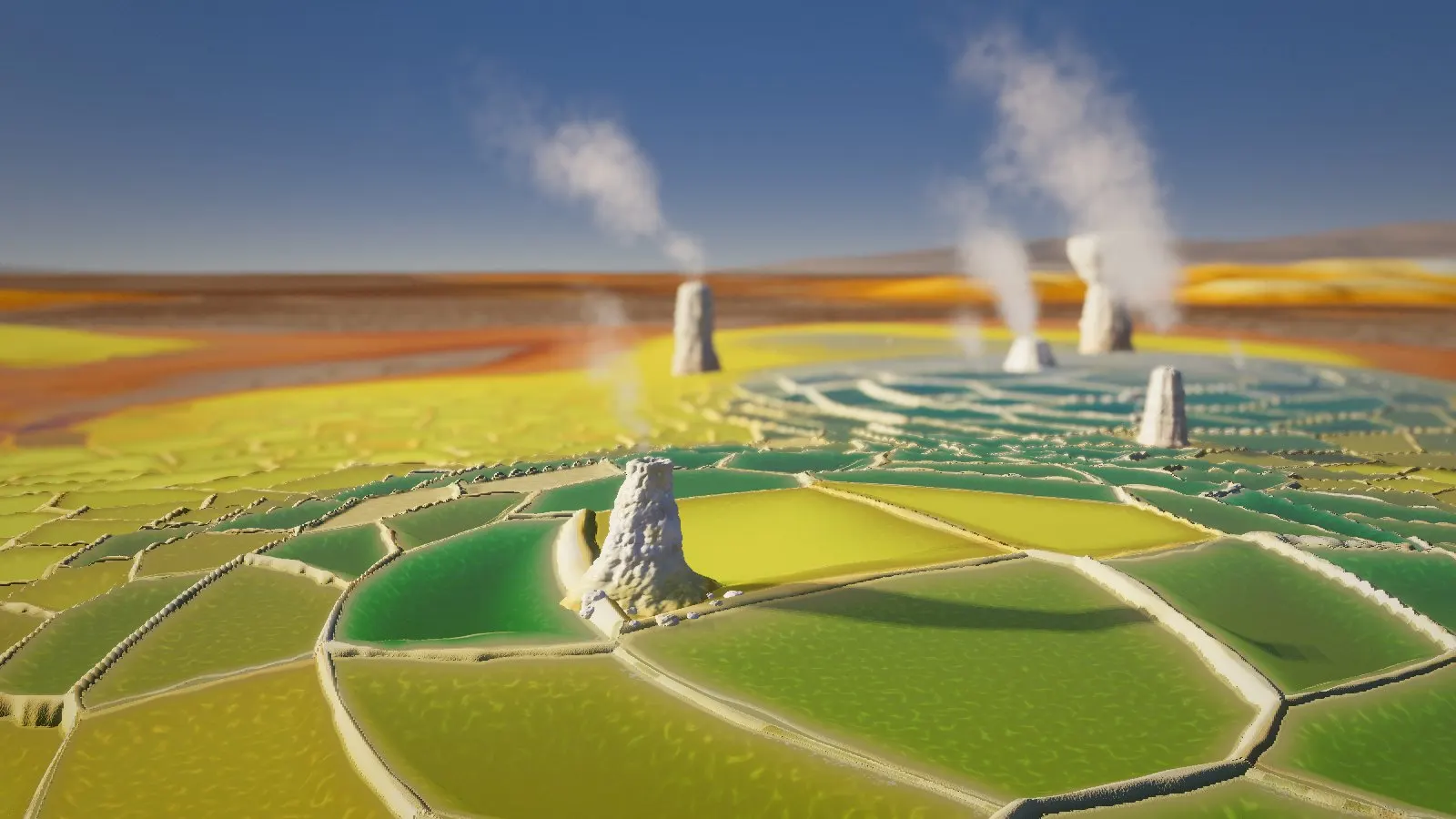
When scientists came out here to study these pools, they dipped pH meters into the yellow ones, and in the most concentrated of them, the number fell past two, past one, past zero, and it just kept going. Minus one point six. This is Dallol, a field of hot springs on a salt dome that rises out of the Danakil Depression, a salt flat about a hundred and twenty meters below sea level, and its pools are some of the most acidic natural water ever measured.
The water bubbles up out of the salt at about a hundred and eight degrees Celsius, which is hotter than a pot boiling on your stove, and it carries so much dissolved salt that it builds these terraces as it flows, and so much iron that the water itself glows green and yellow. You’d never touch this water, because a lot of it is hot enough to scald you before the acid even gets a chance.
Now, if you’ve ever seen a pH chart, it ran from zero up to fourteen, so a reading of minus one point six shouldn’t even fit on it. Either that meter was broken, or the chart you learned left something out, and I think you can guess which one it is. By the end of this lesson, you’ll know exactly what that minus sign is telling you, and you’ll be able to work out how concentrated an acid it would take to drag a pH meter below zero yourself.
To get there, we need to know what a pH meter is actually counting, and in this pool, there’s a crowd of them. Each of these glowing particles is a water molecule carrying one extra proton, called a hydronium ion, and even though this is a simplified picture of a far more complicated brine, the hydronium is the part the meter cares about.
When an acid gives away a hydrogen ion, that’s really just a bare proton, and in water a bare proton grabs onto the nearest water molecule, so the water plus the proton is the hydronium ion, H three O plus. That’s why hydrogen ion and hydronium ion, H plus and H three O plus, all mean the same thing in water, and on the AP exam H three O plus is the preferred way to write it, but H plus earns the credit too.
And pH is just a short way to report how much hydronium is in the water, and it’s defined as the negative log of the hydronium concentration, in moles per liter. Hang on to that little minus sign, because it’s the whole reason Dallol’s reading makes sense.
Let’s see what that log actually does. If there’s a tenth of a mole of hydronium in every liter, that’s ten to the minus one, and the pH is one. A hundredth of a mole is ten to the minus two, so the pH is two, and a thousandth is ten to the minus three, pH three.
Every time the hydronium drops by a factor of ten, the pH goes up by exactly one, so for neat powers of ten like these, the pH is simply the exponent with its minus sign flipped. And notice it runs backwards, because more hydronium gives a smaller pH, so the most acidic water on this table has the lowest number.
It’s really tempting to say that pH two is twice as acidic as pH four, and it’s completely wrong. Two steps on the scale are two factors of ten, so the pH two solution has a hundred times as much hydronium. Comparing two pH values like this is a classic AP question, and the answer is always ten raised to the difference.
Here’s one for you. Solution X has a pH of three and solution Y has a pH of six, so how does the hydronium in X compare with the hydronium in Y?
Real concentrations usually aren’t neat powers of ten, though, so let’s use the calculator on three point two times ten to the minus four molar. Before I touch the calculator I like to guess, and this sits between ten to the minus four and ten to the minus three, so the pH should land between three and four.
On the calculator that’s negative, then log, then three point two times ten to the minus four, close the bracket, and equals. The negative log comes out to three point four nine, right where we guessed.
And when you round a pH, the significant figures in the concentration become decimal places, so two sig figs in three point two give two decimal places in the pH. The three in front of the decimal point only tells you the power of ten, so it doesn’t count as a significant figure. Going the other way is just as quick, because the concentration is ten raised to the negative pH.
So try this one with the calculator. A solution has a pH of two point seven zero, so what’s its hydronium concentration? Now look at pH seven, which is what pure water reads, and it still means ten to the minus seven molar hydronium, so even pure water has some hydronium in it, even though nobody added any acid.
Pure water makes its own ions
Here’s a single drop of pure water, and the meter reads seven point zero, so there’s hydronium in here somewhere. Let’s go inside and look for it, and at first all you see is water molecules, tumbling and tugging on their neighbors. But every so often, two neighbors line up just right, and one of them hands a proton across to the other.
The water that took the proton is now hydronium, and the one that gave it up is left behind as hydroxide, O H minus, so pure water just made both ions at once, out of nothing but itself. Now you make one. Grab the proton on the left-hand water and hand it over to the water next to it.
And just as easily, the two ions can find each other again and turn back into two ordinary waters, and in pure water, splitting apart and pairing back up happen at exactly the same rate, so the concentrations stay constant, and that’s what equilibrium means. So how many of these ions are there? Let’s start on one hydronium ion and keep pulling back, ten times more water at every step, until we’re looking at plain pure water.
In pure water at twenty-five degrees, you’d have to search through about five hundred and fifty million water molecules to find a single hydronium ion, and somewhere in that same crowd, there’s one hydroxide ion to match it. Every hydronium in pure water formed along with its own hydroxide, so the two are always exactly equal, and these pictures make the ions far more common than they really are, just so you can see them.
On paper, two waters make one hydronium and one hydroxide, with a double arrow because it keeps running both ways. Like any equilibrium it has a constant, and water’s gets its own name, K w, which is the hydronium concentration times the hydroxide concentration, with the water itself left out like any pure liquid. At twenty-five degrees Celsius it equals one point zero times ten to the minus fourteen.
In pure water the two concentrations are equal, so call each one x, and x times x has to be ten to the minus fourteen, which makes x one point zero times ten to the minus seven molar for both ions. The negative log of that is seven point zero zero, so pure water has a pH of seven, and if you take the negative log of the hydroxide concentration instead, you get a number called the pOH, which is also seven.
Take the negative log of both sides of K w, and since the log of a product is the sum of the logs, you get a shortcut you’ll use constantly, the pH plus the pOH equals fourteen. That fourteen is called p K w, and it’s only fourteen at twenty-five degrees, so I’m circling that.
That gives us a clean way to sort any solution, by comparing its two ions. More hydronium than hydroxide means acidic and more hydroxide means basic, and when they’re exactly equal, like in pure water, the solution is neutral.
So these four numbers are all connected. K w links the two ions across the top, and the negative log turns each one into its p number. Across the bottom the pH and pOH add up to fourteen, so give me any one of the four and we can find the other three.
Let’s try it with a hydroxide concentration of two point zero times ten to the minus five molar. K w divided by that gives a hydronium concentration of five point zero times ten to the minus ten molar. That’s a pH of nine point three zero, and a pOH of four point seven zero, which add up to fourteen, and since there’s more hydroxide than hydronium, the solution is basic.
Your turn with the calculator. At twenty-five degrees, a solution has a hydronium concentration of four point zero times ten to the minus nine molar, so what’s its pOH? Now, K w and that fourteen both came with a little tag on them, at twenty-five degrees, and the water at Dallol is a whole lot hotter than that.
Neutral isn’t always 7
The springs at Dallol come out of the ground at around a hundred and eight degrees Celsius, and that raises a question that trips up almost everybody the first time they meet it. Forget the acid for a second, and imagine perfectly pure water heated that hot. Would it still have a pH of seven?
Let’s test it on our drop of pure water, starting at twenty-five degrees. Go ahead and turn the heat up yourself, and keep an eye on the ions. As the water heats up, the molecules jostle harder and more of them pull apart into ions, but every new hydronium still comes with its own hydroxide, and the meter has dropped to six point six. The meter says six point six now, so how would you classify this water?
Let’s put numbers on it. At fifty degrees, K w is five point five times ten to the minus fourteen, more than five times bigger than at twenty-five. That makes sense, because pulling water apart into ions absorbs energy, so heating the water pushes the equilibrium toward more ions. The water’s still pure, so the hydronium and hydroxide are still equal, which means x squared equals five point five times ten to the minus fourteen, and the square root gives two point three times ten to the minus seven molar for each ion.
Take the negative log, using the unrounded number, and the pH comes out to six point six three, and so does the pOH, which means that at fifty degrees, the pH and pOH add up to thirteen point two six instead of fourteen. So let’s cross out a rule a lot of people carry around, that a pH below seven means acidic. That only works at twenty-five degrees, and the real test is always which ion there’s more of.
Here’s the neutral pH of pure water at a few temperatures. It’s seven at twenty-five degrees and six point six three at fifty, and by a hundred degrees it’s down to about six point one. So no, pure water as hot as Dallol’s springs wouldn’t read seven, and it still wouldn’t be acidic. This exact idea is one of the sample questions in the official AP Chemistry course description, so let’s try it the way the exam asks it.
At zero degrees, K w for water is one times ten to the minus fifteen, so what’s the pOH of pure water at zero degrees? So water on its own only makes a trickle of hydronium, around ten to the minus seven molar, nowhere near enough to explain a pool that reads below zero, so something else must have loaded that water up with hydronium.