
Topic 7.12 key terms
- ion product (Q)
- The same product of ion concentrations as Ksp, calculated at any moment. Q < Ksp: more solid can dissolve; Q = Ksp: saturated; Q > Ksp: solid precipitates.
- common-ion effect
- A salt is less soluble in a solution that already contains one of its ions; Ksp is unchanged (Le Châtelier's principle, or a Ksp calculation with the common ion in the initial row).
Transcript
1,132 words · 5 parts
Common-ion effect: water that already has the ions
Every ion in every problem so far came out of the crystal itself. But the water in this cave didn’t start out pure, so let’s look at where its ions came from.
In the rock under the cave there’s another calcium sulfate mineral, called anhydrite. It’s gypsum without the water. The cave water was about fifty-four degrees. At that temperature, anhydrite’s Ksp is a little bigger than gypsum’s.
The water kept dissolving anhydrite, adding calcium and sulfate, even after it reached gypsum’s limit. That pushed it just past gypsum’s line, a hair over gypsum’s Ksp. This water already held the crystal’s own ions before a single one came off a beam. So what happens to a crystal’s solubility when the water already contains some of its ions? Let’s test it back in the lab, one ion at a time.
Here are two cells at the same temperature. Each one gets two grams of gypsum. The left one is pure water, and the right one already has zero point one zero zero molar sodium sulfate dissolved in it, so it’s full of sulfate ions, with sodium ions along for the ride. Both cells have the same gypsum at the same temperature. So which one do you think will dissolve more of it?
And look at the gauges, because both needles sit on the very same gold line. In the right-hand cell, the extra sulfate makes the product reach Ksp after only a tiny bit of gypsum dissolves. You can see the same thing with Le Châtelier’s principle from the last lesson, because adding one of the products, sulfate, pushes the dissolving equilibrium back toward the solid. That’s the common-ion effect, and it says that a salt dissolves less in a solution that already contains one of its ions.
How much less? Putting a number on it
So how much less dissolves? Let’s calculate it for that right-hand cell. Before any gypsum dissolves, there’s no calcium, but there’s already zero point one zero zero molar sulfate from the sodium sulfate. Then s moles per liter of gypsum dissolve and add s to each column, so at equilibrium the calcium is s and the sulfate is zero point one zero zero plus s.
That gives six point one times ten to the minus five equals s times the quantity zero point one zero zero plus s. You could solve that as a quadratic. But s is going to be tiny next to zero point one, so I’ll drop it from the sum and check that choice afterward. Then s is six point one times ten to the minus five divided by zero point one zero zero, which is six point one times ten to the minus four molar.
And the check passes, because s is only about six tenths of a percent of zero point one zero zero, well under the five percent we allow. In pure water, s was seven point eight times ten to the minus three, so the sulfate cut the solubility by about thirteen times, and Ksp didn’t change at all, because at the same temperature it stays the same no matter what else is in the water.
Let’s do one together, with calcium fluoride dissolving in zero point zero one zero zero molar sodium fluoride. Before any calcium fluoride dissolves, what’s the fluoride concentration in this solution? Two s is tiny next to point oh one, so we can drop it. That leaves Ksp equal to s times point oh one squared.
Point oh one squared is one times ten to the minus four. Divide, and s is four times ten to the minus seven molar. In pure water, s was two point two times ten to the minus four molar. Now it’s more than five hundred times smaller.
Clear water, solid crystal
Now for the trick I promised at the very start. This cell holds a saturated gypsum solution, perfectly clear, with a seed crystal hanging in it, and it’s sitting at twenty-five degrees with nothing boiling off.
See if you can make more gypsum come out of this clear solution. Pick one of these four bottles and add it to the cell.
Right after the sulfate went in, the ion product, Q, was about fourteen times bigger than Ksp, so the water was holding more than it’s allowed to, and the extra came out as crystal, onto the seed and in a snow of tiny needles. When it settles, look at the calcium. It has dropped from seven point eight times ten to the minus three all the way down to six point one times ten to the minus four.
That’s the same number we calculated for the sulfate cell. Meanwhile the sulfate is way up at about zero point one zero molar, and Ksp is still six point one times ten to the minus five. In a fresh saturated cell, sodium chloride makes no gypsum come out, because neither of its ions is part of gypsum, but calcium chloride does, since calcium is gypsum’s other ion.
The AP version
Now you try one on your own. It’s calcium fluoride again, but this time the sodium fluoride is point oh two molar. What’s the molar solubility of calcium fluoride in this solution?
And now we can finish that 2023 question. Part (c) asks what happens to the hydroxide concentration if the strontium hydroxide dissolves in zero point one zero molar strontium nitrate instead of distilled water.
So what do you think happens to the hydroxide concentration in that solution, compared with distilled water? And now we can finally answer the question this whole lesson started with.
Why the crystals grew
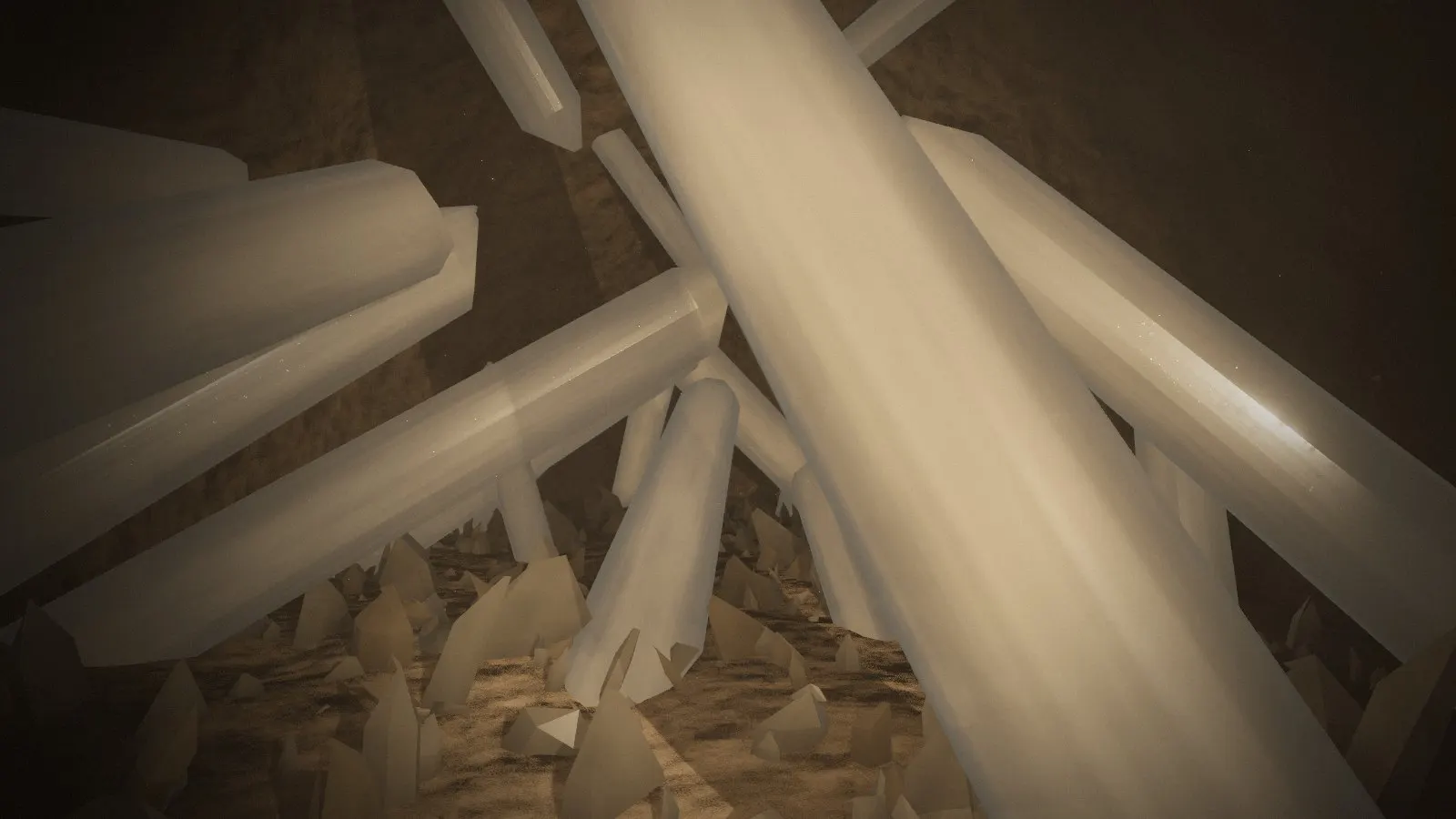
Here are three kinds of water touching a gypsum face, so which one do you think built the crystals in Naica? That’s the water Naica had. Anhydrite’s Ksp sits a little above gypsum’s, so water that keeps dissolving anhydrite stays a hair above gypsum’s line. The crystals couldn’t shrink overall. The tiny extra had nowhere to go except onto the few crystals already there.
When researchers measured how fast these faces grow in Naica’s own water, back in 2011, it was the slowest crystal growth anyone had ever directly measured. And if the water had been far above the limit, new crystals would have started everywhere at once. You’d get a crowd of small ones instead of a few giants.
For years, the mine’s pumps held the water down. That’s the only reason people could ever walk in here, but in 2015 the mine flooded, the company couldn’t pump it out, and that October it shut the mine down, so for now, nobody can get in. So let’s picture them the way they spent almost all of their history, underwater. What built them was a limit that Ksp sets and water that was already carrying the crystal’s own ions, working together for hundreds of thousands of years.