
Topic 7.3 key terms
- reaction quotient, Q
- Products over reactants, each raised to the power of its coefficient in the balanced equation, using concentrations (Qc) or gas partial pressures (Qp) at any moment. Solids and pure liquids are left out.
- equilibrium constant, K
- The value of Q when the reaction is at equilibrium: Kc = Qc and Kp = Qp at equilibrium. For a given reaction it depends on temperature, not on the starting amounts.
- partial pressure
- The pressure one gas in a mixture would exert by itself; Qp and Kp use each gas's own partial pressure, never the total pressure.
- pure solids and liquids in Q
- Left out of Q and K because their concentration does not depend on how much is present (liquid water is about 55 mol/L however much there is); they are omitted, not zero. Aqueous and gaseous species stay in.
Transcript
1,133 words · 4 parts
The reaction quotient Q and the equilibrium constant K
No instrument can count every single reaction in a flask, but a chemist can measure how much of each substance is there, its concentration or, for a gas, its pressure, so we need one number, built from those, that tells us where a reaction stands. Chemists call that number the reaction quotient, Q, and you build it straight from the balanced equation. Products go on top and reactants go on the bottom, so N₂O₄ goes on top and NO₂ goes underneath, each in square brackets, which mean concentration in moles per liter.
Then every coefficient in the equation becomes a power, so the two in front of NO₂ becomes a square. The equation has two NO₂ in it, so NO₂ shows up twice on the bottom, NO₂ times NO₂. Let’s try it on our tube, partway through its fade, where we measure NO₂ at point zero four zero molar and N₂O₄ at point zero three zero molar.
Point zero three zero goes on top, over point zero four zero squared, which is point zero zero one six, and dividing gives eighteen point seven five, or nineteen with two significant figures. On the AP exam, we write Q and K without units, so it’s just nineteen, and dividing by a tiny number should give something bigger than the top, so that checks out.
Now let’s put a meter on the tube that shows Q, starting at our nineteen, and let the reaction keep going. Q climbs, then it slows down, and it stops, right about here. And it stops exactly when the tube reaches equilibrium. That value of Q has its own name, the equilibrium constant, K, so K is just Q at equilibrium. For this reaction at twenty-five degrees, K comes out to about a hundred and sixty, one point six times ten to the second.
Here’s a tube that started from the other side, with pure N₂O₄, and at one moment the NO₂ is point zero one zero molar and the N₂O₄ is point zero four five molar, so find Q, to two significant figures. That’s way above K, and as this tube keeps going, watch Q fall and land on exactly the same K.
Two of these tubes start from opposite sides with the same amount of gas, and the third holds twice as much. The first two end up at the same concentrations and the third somewhere else, but all three land on the same K, because K belongs to the reaction at that temperature. So Q can have any value at any moment, and as a reaction runs, Q heads toward K, until at equilibrium Q equals K.
For gases, we can use each gas’s partial pressure instead. Qp is the pressure of N₂O₄ over the pressure of NO₂ squared, with every pressure in atmospheres. At equilibrium, it’s Kp.
Writing Q for any reaction
Let’s build one together for nitrogen and hydrogen making ammonia, N₂ plus three H₂ makes two NH₃, and before I write anything, think about what goes on top and what power each one gets. Ammonia’s the product, so it goes on top, squared because of its two, and on the bottom we multiply the two reactants, N₂ times H₂ cubed, because of that three.
There are two slips people make here, writing two times NH₃ instead of NH₃ squared, and adding the reactants instead of multiplying them. Every species here is a gas, so we can write the same thing with partial pressures, each gas’s own pressure, never the total pressure of the container.
The AP exam won’t ask you to convert Kc into Kp, but it does expect you to notice which one a question asks for, and write that one. Just be careful, because turning coefficients into powers works for Q and K, not for the rate law of an overall reaction, which has to come from experiments. This reaction was on the 2024 AP exam, so which of these is its Kc expression?
Solids and pure liquids stay out
There’s one more rule, about which substances get into Q at all, so let’s set up two flasks back in the hallway. Both flasks are sealed at twenty-five degrees and both keep some liquid water, one a thin layer and one half full, so which one ends up with more water-vapor pressure above it?
The amount of water made no difference, because more water means more molecules but also more volume, packed just as tightly, so a pure liquid’s concentration doesn’t depend on how much you have, and liquid water is always about fifty-five moles per liter.
A pure solid is the same, because a big crystal and a tiny one are packed exactly alike. The amount can change but the concentration can’t, so we leave solids and pure liquids out of Q.
So for solid silver chloride dissolving, the solid sits out, and Q is just silver ion times chloride ion. Leaving it out doesn’t mean it’s zero; its concentration just never changes, so we don’t need to write it. In ammonia and water, the water is a pure liquid, so it sits out, but the three dissolved species, the aqueous ones, all stay in.
Watch out for carbon reacting with steam, though, where the carbon sits out but the water is a gas, and gases always stay in, so here water goes on the bottom. Here’s one from the 2023 AP exam, where two AlCl₃ molecules join into one Al₂Cl₆, all as gases. They asked for Kp, so we use pressures, with Al₂Cl₆ on top and AlCl₃ squared on the bottom, because of its two, and this is the expression that earns the point.
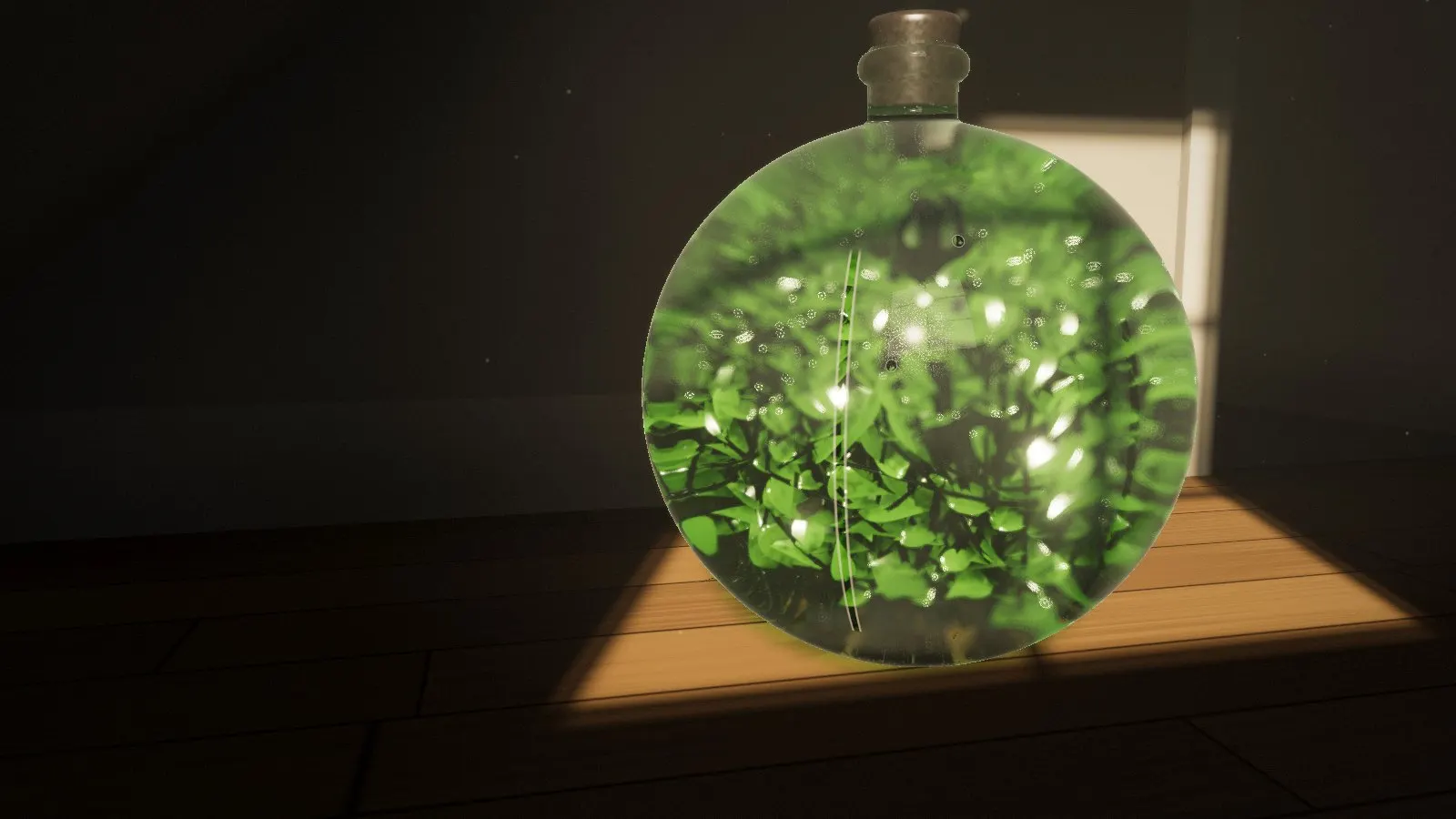
Back to the bottle
Now, finally, we can write the expression for the water in our bottle. We’ll use the flask we set up right next to it. Which expression is Qp for the water in our flask?
At twenty-five degrees, that pressure settles at three point one seven kilopascals. Chemists call it the vapor pressure of water. Kp uses pressures in atmospheres. Three point one seven divided by one hundred one point three is point zero three one three atmospheres. Kp for water at twenty-five degrees is point zero three one three.
So, is this garden at equilibrium? The honest answer has two parts. The garden as a whole isn’t, because sunlight comes in every day and the plant keeps using it to grow. As one expert on the radio panel put it, the only input to this whole process has been solar energy.
Its water is a different story. When everything inside sits at one steady temperature, its evaporation and condensation can come very close to matching, the same dynamic equilibrium our flask showed us, quietly running in both directions. So David Latimer was right that his garden doesn’t do anything you can see, and wrong about everything you can’t.