
Topic 7.2 key terms
- net direction of a reaction
- If the forward rate is greater, there is a net conversion of reactants to products; if the reverse rate is greater, a net conversion of products to reactants; equal rates mean no net change (equilibrium).
Transcript
501 words · 1 parts
Direction of reversible reactions: which way is it going?
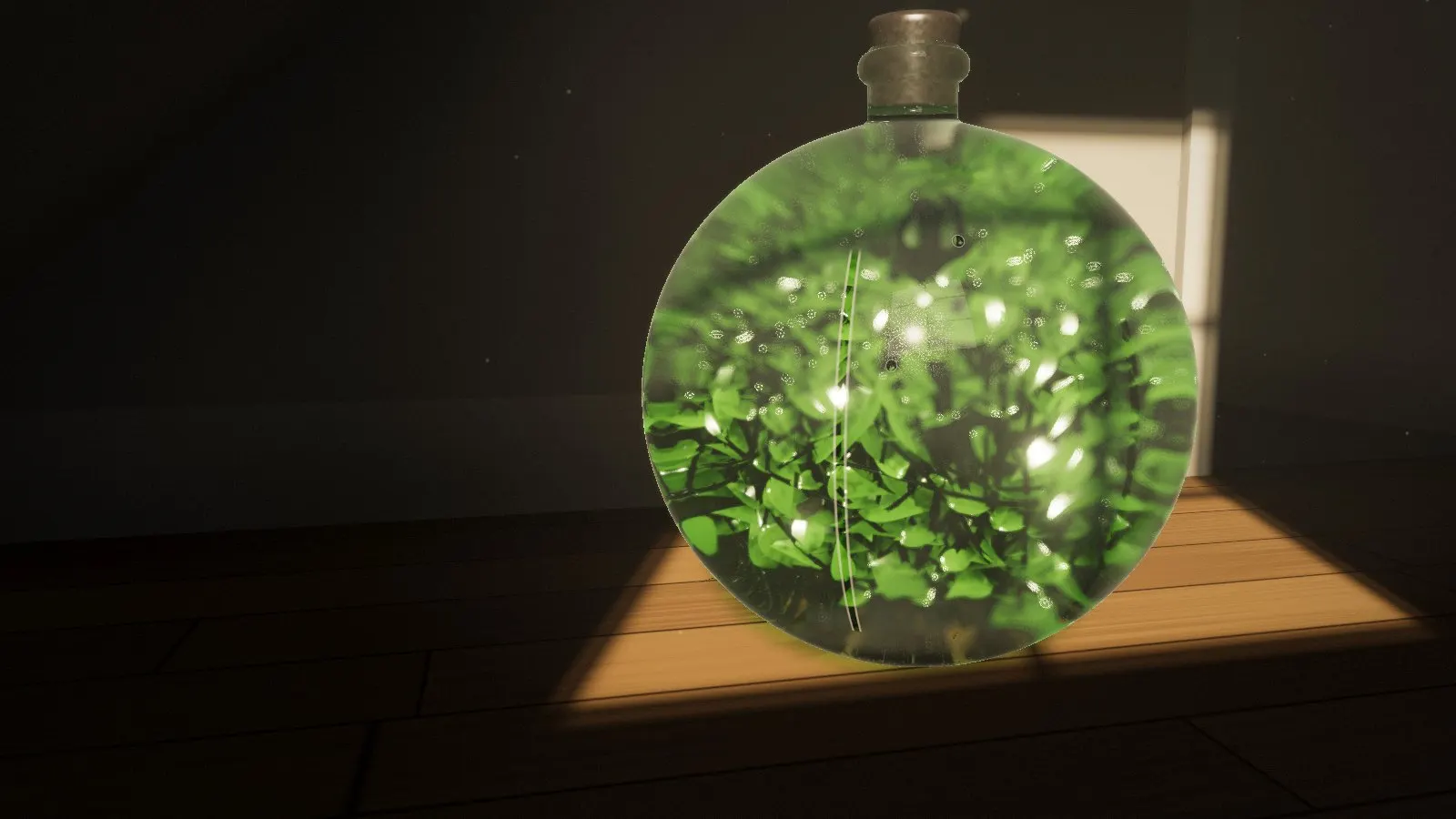
Before a system reaches equilibrium, one rate is bigger than the other, and the bigger one decides which way things go. You can see it in the bottle garden. On a cold night the glass cools down, so water vapor condenses onto it faster than water evaporates from it, and the droplets on the glass grow. When the hallway warms up again, evaporation wins, and the droplets shrink away. Which way the water goes depends on which process is faster right now.
The same rule works for any reversible reaction. Let’s go back into our tube while it’s still fading, and this time I’ll mark every forward event in gold and every reverse event in blue. You can see both kinds of event in here, but pairs form far more often than they split, and the gold ones win by a mile.
Let’s count one short window exactly, and say we see eight forward events and three reverse events. Three of the forward events are undone by the three reverse events, so those cancel out, and that leaves five forward events that weren’t undone. Each forward event makes one N₂O₄, so we gain five N₂O₄ overall. But each forward event uses up two NO₂, so we lose ten NO₂, not five.
That gives us one rule that works for every reversible reaction. If the forward rate is bigger, there’s a net change from reactants to products. If the reverse rate is bigger, there’s a net change from products back to reactants. And if the two rates are equal, there’s no net change at all, and that’s equilibrium. Forward always means left to right, the way we write the equation.
So far in our tube the forward reaction has always won, so let’s see if we can make the reverse reaction win instead. Use the slider to choose how the tube starts, watch the two rate bars, and set it up so the reverse reaction wins at the start, then run it.
Remember where the two curves crossed? Right there, the tube held equal amounts of each gas. The forward rate was still about five times the reverse. The rates decide the direction. The amounts only matter because they set the rates.
Now say a window has three forward events and eight reverse events. Three of each cancel, which leaves five reverse events, and each one splits an N₂O₄, so we lose five N₂O₄ and gain ten NO₂.
The forward reaction never switched off, though; it just happened less often than the reverse. In this window there were twelve forward events and five reverse events, so how many NO₂ molecules did the tube use up, net?
Once the tube reaches equilibrium, a window looks like this, six forward and six reverse, so nothing changes overall, while there are sixteen NO₂ molecules in here and forty-two N₂O₄. Equal rates don’t mean equal amounts. At the crossing, equal amounts didn’t mean equal rates either. Here the rates match with sixteen NO₂ and forty-two N₂O₄.