
Topic 7.7 key terms
- reaction quotient (Q)
- The equilibrium-constant expression filled in with the concentrations (or partial pressures) present at one moment, whether or not the system is at equilibrium.
- Q vs K
- Q < K: net reaction toward products. Q > K: net reaction toward reactants. Q = K: dynamic equilibrium, forward and reverse rates equal, proportions constant.
- dynamic equilibrium
- The state in which the forward and reverse reactions continue at equal rates, so the concentrations of all species stay constant.
- ICE table
- A table of Initial amounts, the Change (from the coefficients, with one unknown x) and the Equilibrium amounts (I + C); the equilibrium row goes into K.
- x (reaction progress)
- How far the reaction went, in mol/L or atm. The concentrations are the equilibrium row (for example 2x for HI), not x itself.
- small-x approximation
- When K is very small, dropping x where it is subtracted from a starting amount; checked afterward by confirming x is under about 5 % of that amount (a rule of thumb).
Transcript
1,985 words · 5 parts
Calculating equilibrium concentrations—two bulbs, one ending
Heidelberg, Germany, in the 1890s. In the university’s chemistry building, a young chemist named Max Bodenstein is setting up an experiment that chemists still teach today. He lights a ring of gas burners under a pot of sulfur, and as the sulfur boils, its hot vapor rises around his little sealed glass bulbs. Boiling sulfur makes a steady oven, because its vapor stays at one temperature, and here that’s four hundred and forty-three degrees Celsius.
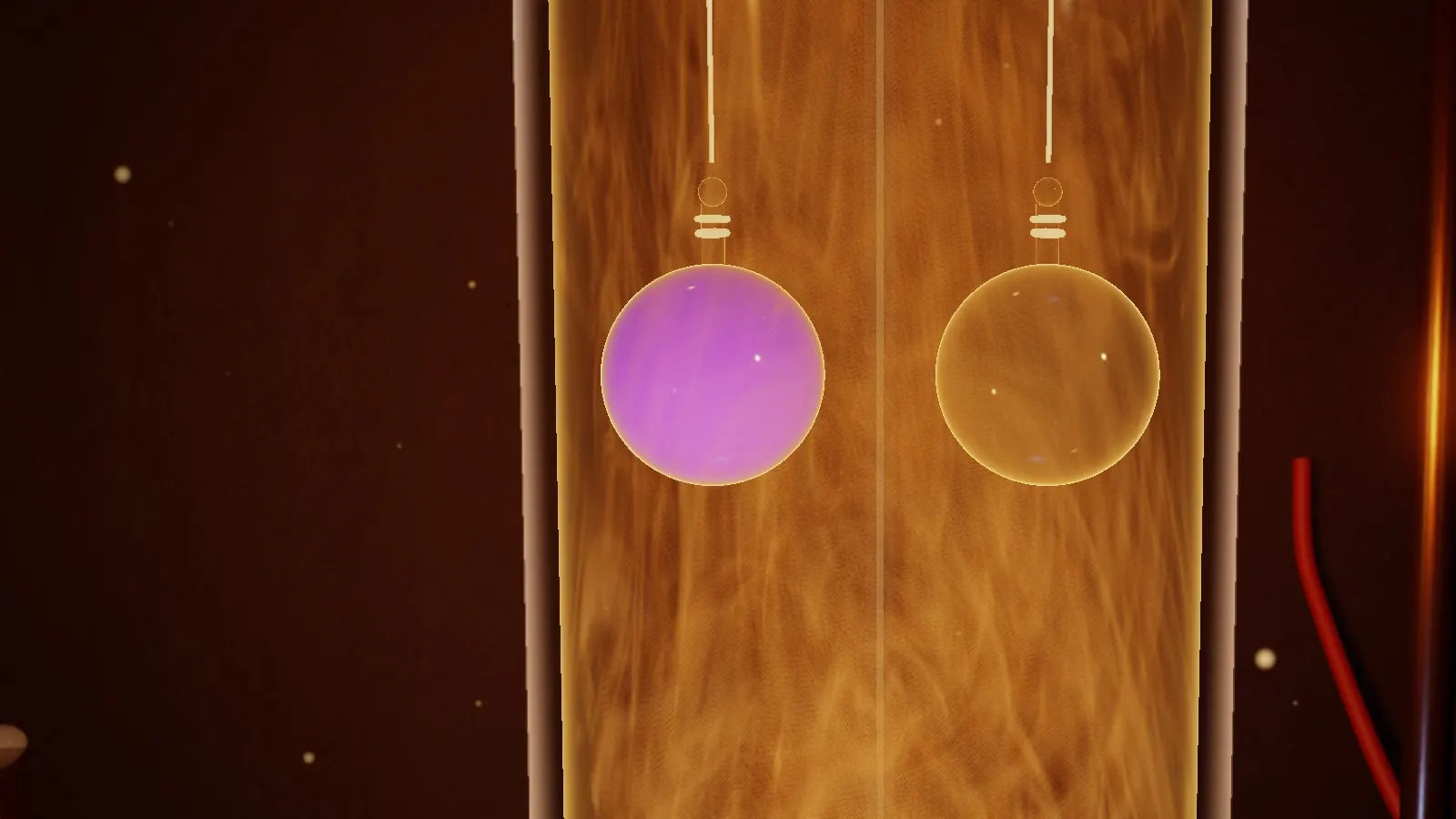
Here’s our version of it, with two bulbs side by side. The bulb on the left holds hydrogen and iodine, and iodine vapor is this deep violet. The bulb on the right holds hydrogen iodide, which is completely colorless.
And we’ve loaded both bulbs with exactly the same atoms, the same amount of hydrogen and the same amount of iodine, just joined up differently. And in a hot bulb like this, hydrogen and iodine react to make hydrogen iodide, and hydrogen iodide falls apart into hydrogen and iodine, both at the same time.
So before we let them cook, I’d like your guess. Once both bulbs stop changing, how will their colors compare? Bodenstein would freeze bulbs like these with a blast of cold carbon dioxide, then open them up and measure exactly what was inside. He ran it from both directions, starting from hydrogen iodide and starting from hydrogen and iodine, and both pointed to the same equilibrium.
Think about how strange that is. Nobody told the clear bulb’s color where to stop, and yet it stopped at exactly the left bulb’s shade. By the end of this lesson, you’ll be able to predict exactly what’s inside bulbs like these, down to the concentration of every gas, before anyone lights a single burner.
And then you’ll draw what’s inside them, molecule by molecule, the way the AP exam asks you to. So let’s put the left bulb back in the heat and go inside, to see what the color can’t show us.
Down here, the molecules with two big violet atoms are iodine, the tiny white pairs are hydrogen, and the ones with one of each are hydrogen iodide. Every amber flash is a hydrogen molecule and an iodine molecule becoming two hydrogen iodides, and every teal flash is that exact same reaction running in reverse.
And this isn’t just history. Hydrogen and iodine in a sealed container is a setup the AP exam really uses, and in 2024 it showed up as a particle drawing you’ll do yourself before we’re done.
Which way, and how far: Q, K and the change row
Let’s rewind the left bulb to when the burners came on. At first there’s no hydrogen iodide, so the only flashes are forward ones, making HI. As hydrogen iodide builds up, teal flashes start, because now there’s HI around to fall apart, so the reverse reaction speeds up while the forward one slows down. Eventually the two kinds of flashes happen equally often, and that’s when the color stops changing. The reactions keep going in both directions at the same rate, so nothing changes overall.
Bodenstein’s measurements put a number on where that happens. For hydrogen plus iodine making two hydrogen iodide, K is HI squared over hydrogen times iodine, and at four hundred forty-three degrees his data give K equals fifty point four.
You build Q the same way, but with whatever concentrations are in the bulb right now, and comparing Q with K tells you which way the bulb will go. If Q is smaller than K, the reaction makes more products until Q catches up to K. If Q is bigger than K, it runs backward and makes reactants until Q comes back down to K. And when Q equals K, it’s at equilibrium, with the forward and reverse reactions at the same rate and the proportions staying put.
The violet bulb starts with no HI, so Q is zero, and zero is less than fifty point four, so it runs forward. That’s the fading violet we watched. Now you try one with the right bulb, which starts as pure hydrogen iodide. Which way will it go?
Now, how far does the left bulb go? To count carefully, let’s lift out a little cube of its gas before it heats up, nine hydrogen molecules and nine iodine. Watch one reaction. One hydrogen and one iodine get used up and two hydrogen iodides appear, so nine, nine and zero becomes eight, eight and two. Here’s that same cube drawn the way the AP exam draws it.
That one event is the reason behind the change row. If the reaction goes forward by an amount we’ll call x, hydrogen drops by x, iodine drops by x, and hydrogen iodide goes up by two x, because the equation says two.
Predicting the violet bulb (worked example)
Let’s predict the violet bulb exactly. Say it starts with zero point zero one zero zero molar hydrogen, the same of iodine, and no hydrogen iodide, and K is fifty point four. I’ll keep track of the steps over here as we go. First, which way does it go? There’s no HI yet, so Q is zero, smaller than K, and it runs forward.
Then the ICE table, I for initial, C for change, E for equilibrium. The top row is what we start with, point oh one, point oh one, and zero. The change row comes straight from the coefficients, minus x, minus x, plus two x, just like the reaction we watched in the cube.
And the bottom row is the first two added together, point oh one minus x for each reactant and two x for HI. Now the most important move. We plug the equilibrium row into K, never the starting row, because K only describes the bulb once it’s stopped changing. That gives fifty point four equals two x, squared, over point oh one minus x, also squared.
That looks messy, but the top and the bottom are both perfect squares, so we can take the square root of both sides, and the square root of fifty point four is about seven point one. Multiply both sides by point oh one minus x and gather the x’s, and x comes out to about point oh oh seven eight molar. This is where a lot of people stop too early and call x the answer, but x only tells you how far the reaction went, so to get the concentrations we go back to the bottom row.
Hydrogen and iodine each end at point oh one minus point oh oh seven eight, about point oh oh two two molar, and hydrogen iodide is two x, about point oh one five six molar. To check, point oh one five six squared over point oh oh two two squared comes out right around fifty, which matches K. And counting hydrogen atoms, two per hydrogen molecule and one per HI, gives exactly the point oh two molar we started with.
Suppose a different bulb gave x equals point oh oh six five molar. What would the equilibrium concentration of hydrogen iodide be? Here’s that over time. Hydrogen and iodine fall together from point oh one to point oh oh two two, while hydrogen iodide climbs to point oh one five six.
A lot of people point to equilibrium at the spot where the curves cross, but equilibrium is where every curve goes flat and stays flat. About seventy-eight percent of the hydrogen reacted, which is a lot, but it isn’t all of it. And there are no seconds on the time axis, because K tells you where the bulb ends up, not how long it takes to get there.
The clear bulb runs backward
Now the clear bulb. Say it starts with zero point zero two zero zero molar hydrogen iodide and nothing else, which holds exactly the same atoms as the violet bulb. Inside, it’s all hydrogen iodide, so Q has nothing on the bottom and it’s infinitely big. Almost all the flashes are teal ones, two HI falling apart into hydrogen and violet iodine. As the iodine piles up, the bulb blushes violet, right up to the left bulb’s shade.
Let’s work it out together. This time the starting row is zero, zero, and point oh two, and I’ll call the change y, so we don’t mix it up with the violet bulb’s x. Q is bigger than K, so it runs backward, and every sign in the change row flips, plus y, plus y, minus two y. The two stays a two, because the coefficients don’t care which way we’re going.
At equilibrium that’s y, y, and point oh two minus two y, so fifty point four equals point oh two minus two y, squared, over y squared. It’s another perfect square, so try taking the square root yourself before I do. Seven point one equals point oh two minus two y, over y, so nine point one y equals point oh two, and y is about point oh oh two two molar.
So hydrogen and iodine each end at point oh oh two two molar, and hydrogen iodide at point oh one five six. Those are the exact same numbers we got for the violet bulb. And that solves the mystery from the start. Both bulbs had the same atoms at the same temperature with the same K, so there was only one mixture either of them could end at.
On the graph, the clear bulb’s curves come in from the other side and land on the same plateaus. Now a third bulb that’s a mix, point oh oh one molar hydrogen, the same of iodine, and point oh one eight molar hydrogen iodide. Which change row is right?
Let’s take that idea back to the real bulbs. Now it’s your turn to load the right bulb with any mix you like, as long as it has the same atoms, and run it.
Pressures, and a K that’s tiny
The routine works exactly the same with partial pressures. Suppose Kp is fifty point four, and a container starts with point five oh oh atmospheres each of hydrogen and iodine, and no hydrogen iodide. It’s the same table, with x in atmospheres now, so each reactant ends at point five oh oh minus x, and hydrogen iodide ends at two x. This one’s yours. What’s the partial pressure of hydrogen iodide at equilibrium, in atmospheres?
You might be wondering about something. In that heat, don’t the iodine molecules themselves fall apart? Bodenstein’s own teacher, Victor Meyer, had found around 1880 that very hot iodine vapor acts as if some of its molecules have split into atoms. So let’s test it at seven hundred twenty-seven degrees, hotter than any of his hydrogen iodide bulbs, where K for splitting iodine is three point eight times ten to the minus five. We’ll start with point oh one molar iodine.
The table gives minus x for iodine and plus two x for atoms, and this time there’s no perfect square to save us. But K is so tiny that x will be tiny next to point oh one, so we can drop the minus x on the bottom.
Multiplying both sides by point oh one, four x squared equals three point eight times ten to the minus seven, and x is about three point one times ten to the minus four molar. A shortcut like that needs a check. x is about three percent of point oh one, which is under the five percent rule of thumb most teachers use, so the shortcut holds.
So the iodine atoms reach about six point two times ten to the minus four molar, and only about three percent of the iodine splits, even at seven hundred twenty-seven degrees. Bodenstein’s bath was nearly three hundred degrees cooler, where far fewer split, so his three gases really were the whole story. Same reaction and temperature, but start with point oh four oh oh molar iodine. What’s the concentration of iodine atoms at equilibrium?