
Topic 7.4 key terms
- equilibrium constant, K
- The value of the reaction quotient at equilibrium: products over reactants, each raised to the power of its coefficient, calculated from equilibrium concentrations or partial pressures (pure solids and liquids omitted).
- Kp (partial pressures)
- The equilibrium constant written with equilibrium partial pressures (atm). On the AP exam it is reported without units.
- Kc (molarity)
- The equilibrium constant written with equilibrium molar concentrations (mol/L). Convert moles to molarity first.
Transcript
1,013 words · 2 parts
Calculating K: a canary, a coal fire and Kp
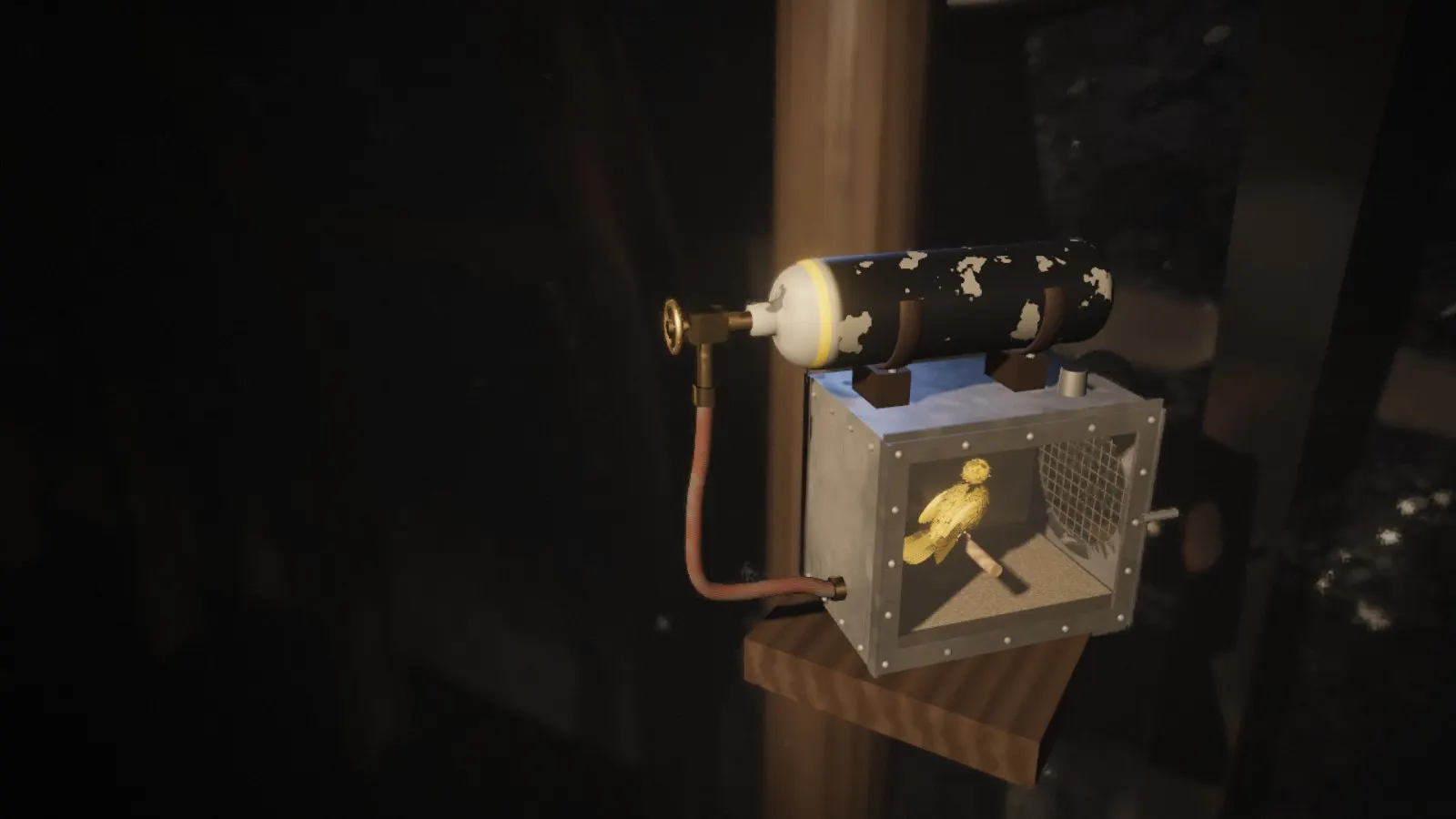
Picture a coal mine in Britain, hundreds of meters underground, where the only light comes from the lamp on your helmet and the coal walls are wet enough to shine. From 1911 until the late nineteen-eighties, every coal pit in Britain kept two canaries, and miners carried them right down into the tunnels. But look at this one, because it isn’t sitting in an ordinary birdcage. This canary had its own oxygen tank.
It’s a real device, made by a London company called Siebe Gorman, and one is still kept today by Britain’s Science Museum Group. Miners were afraid of carbon monoxide, a gas you can’t see, smell or taste, which can build up underground after a fire or an explosion. Canaries react to it much faster than people do, so a bird in trouble was the signal to get out.
And when a bird got into trouble, a miner shut this little round door, opened this valve, and let oxygen from the tank flow in to revive it. So why would a puff of oxygen fix a problem caused by a completely different gas? To answer that, we have to go into the bird’s blood, past its red blood cells, which in a bird are little ovals with a nucleus, and into the hemoglobin packed inside every one of them.
Each hemoglobin holds four iron atoms, and each one is a seat where one oxygen molecule can sit, which is how oxygen rides through the blood, in a bird and in you. But carbon monoxide fits the very same seat, and once it sits down, it holds on far more tightly than oxygen does. How much more tightly? For the hemoglobin in our own blood, chemists have measured it, and it’s about two hundred and thirty times.
That number is an equilibrium constant, and by the end of this lesson, you’ll be able to calculate it yourself from two measured numbers and work out what it says about every seat in the blood, and explain exactly why a tank of oxygen this small can win the seats back. To get there, we first need to calculate a K from scratch, and the best place to start is where the miners’ carbon monoxide came from in the first place, which is a fire.
When a fire starts deep in a coal seam, miners often can’t reach it, so they seal it off behind a brick wall like this one and watch the gas behind it through a pipe. Let’s go right through those bricks and take a look at what’s burning back there.
Back here the coal is smoldering without enough air, so the hot carbon pulls an oxygen atom off carbon dioxide and makes two molecules of carbon monoxide. Let’s zoom right down onto the glowing surface of the coal.
A carbon dioxide hits the hot carbon, and out come two carbon monoxides, and in the reverse, two carbon monoxides hand a carbon back and leave as one carbon dioxide, and both keep happening the whole time. Chemists measure this by sealing carbon dioxide in with red-hot carbon at a thousand kelvin, starting with half an atmosphere of carbon dioxide and no carbon monoxide at all.
The carbon dioxide falls, the carbon monoxide climbs, and then both level off, even though the molecules never stop reacting. That flat part is equilibrium, and it’s the only part K cares about. A reaction at equilibrium with its measured pressures is one of the classic setups on the AP exam, so let’s get really good at it.
Run the experiment yourself, and take your sample of the gas when you think the mixture has reached equilibrium. Let’s turn those two numbers into K. We measured pressures, so we write Kp, the equilibrium constant in partial pressures.
Products go on top, so that’s carbon monoxide’s pressure, squared, because the equation makes two of them. Carbon dioxide goes on the bottom, and the carbon is left out, because pure solids never appear in a K expression. Dropping in the equilibrium pressures, point six zero squared is point three six, and point three six divided by point two zero is one point eight.
Notice we didn’t use the starting pressures. Plugging in the half atmosphere and the zero we started with gives a K of zero, and that’s wrong, because K always comes from the equilibrium values. We write K as a plain number with no units, and a K of about two tells us neither gas wins by a landslide, so there’s plenty of carbon monoxide in that fire.
Kc from moles and liters, and Kp on the AP exam
Now let’s try concentrations, with the brown nitrogen dioxide you met last time, which pairs up into colorless dinitrogen tetroxide. A two-liter flask at twenty-five degrees Celsius reaches equilibrium holding point zero three two moles of nitrogen dioxide and point zero eight four moles of dinitrogen tetroxide. Kc uses molarity, which is moles per liter, with dinitrogen tetroxide on top and nitrogen dioxide on the bottom, squared, because of the two in front.
So first we turn moles into molarity. Point zero three two moles over two liters is point zero one six molar, and point zero eight four over two liters is point zero four two molar.
Now I want you to finish this one, so take those two molarities and calculate Kc for the flask. The mistake to watch for is skipping the molarity step, because plugging in moles gives eighty-two, which is off by a factor of two. The volume only cancels when the powers on the top and bottom match, and here they don’t.
Now let’s do one straight from the 2025 AP exam, where they gave the equilibrium pressures of all three gases. So using those three equilibrium pressures, what’s Kp for this reaction? Our K’s so far, about two, a hundred and sixty and a third, are pretty ordinary numbers, but real K’s run from unimaginably tiny to unimaginably huge, and the size of K tells you which side is favored at equilibrium. To see that, we need a very tall ladder.