
Topic 7.11 key terms
- saturated solution
- A solution holding as much of a solute as it can at that temperature, in equilibrium with the undissolved solid: ions leave and return to the solid at equal rates.
- dynamic equilibrium (dissolution)
- Dissolving and precipitating continue at equal rates, so the amounts of solid and dissolved ions stay constant even though individual ions keep moving.
- solubility product constant (Ksp)
- The equilibrium constant for a salt dissolving: the product of the equilibrium ion concentrations, each raised to its coefficient. The solid (and water) do not appear. Fixed at a given temperature.
- molar solubility (s)
- The number of moles of a salt that dissolve per liter of solution to make a saturated solution; units mol/L.
- sparingly soluble
- Dissolves only slightly (a small Ksp, much less than 1), but not zero: a liter of water dissolves about 1.3 g of gypsum at 25 °C in the ideal concentration model.
Transcript
1,774 words · 6 parts
Solubility equilibria: the Cave of the Crystals
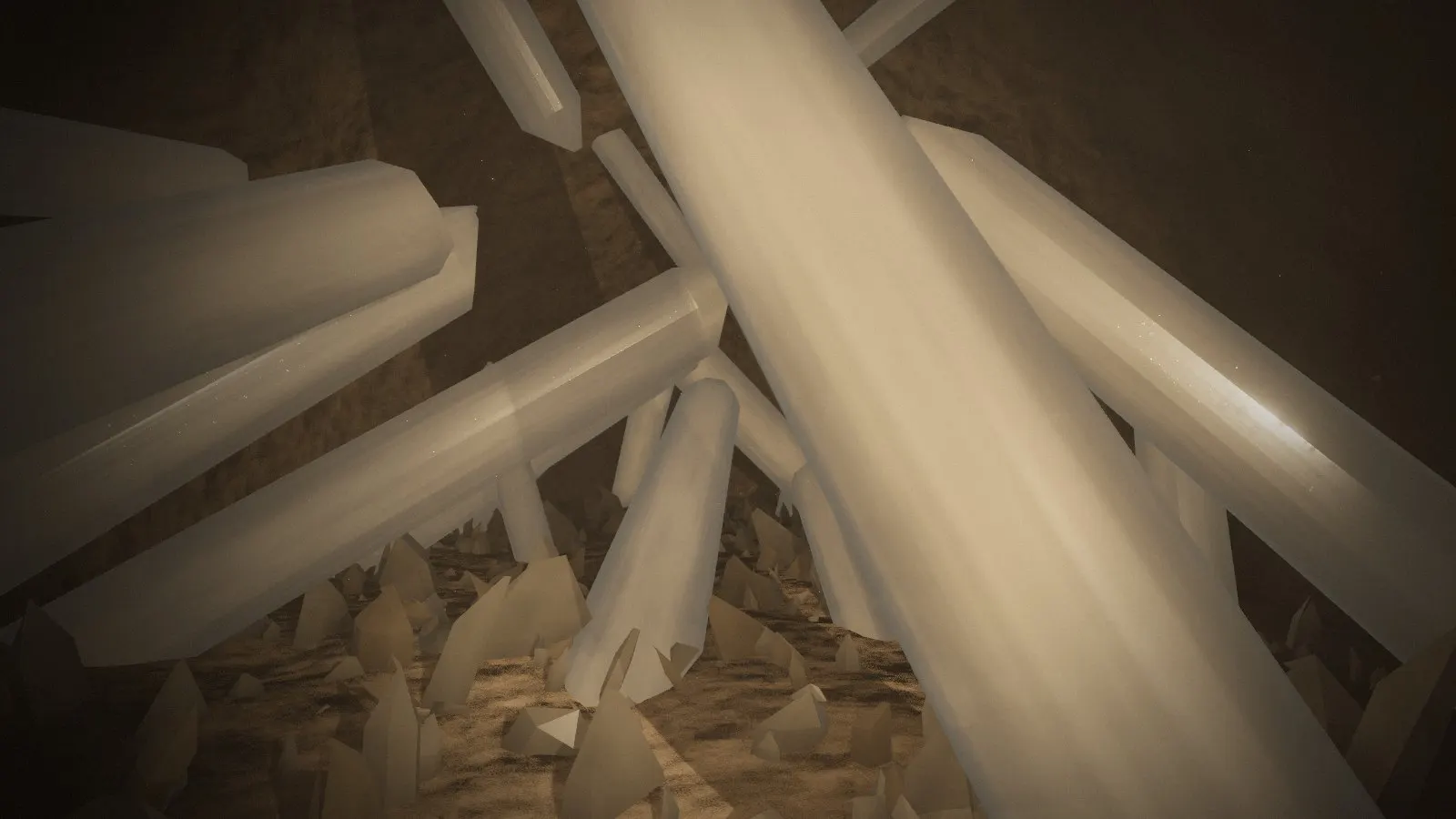
In April 2000, miners drilling a tunnel about three hundred meters under a mountain in northern Mexico broke into a room that nobody had ever seen, and when they pointed their lamps inside, this is what they found. Crystals, though not the kind you’d keep on a shelf. The biggest of these beams are eleven meters long, about as long as a school bus, and as thick as an old tree trunk, and they cross the room in every direction.
That’s a person, for scale. The air in here gets up to fifty-eight degrees Celsius, and the humidity is close to a hundred percent, so without a cooling suit packed with ice, you’d last about ten minutes before you had to get out. These crystals are gypsum, calcium sulfate with two water molecules built into every unit, the same mineral that’s ground up inside the drywall of your house.
But the strangest thing about them is where they grew, because for hundreds of thousands of years this whole room was full of hot water, and when the miners found it, it was only dry because the mine’s pumps were holding the water down. That should bother you a little, because water dissolves gypsum. So how does a crystal sit in water for hundreds of thousands of years and come out bigger instead of dissolved?
By the end of this lesson, you’ll be able to calculate how much of this crystal a liter of water can hold. And you’ll see how that changes when the water already carries some of the crystal’s own ions, and you’ll make solid crystal appear out of perfectly clear water, without cooling it or boiling anything off, just by adding the right ion.
So let’s go down to the surface of one of these crystals. Picture this room full of water again. Then let’s watch what that water is actually doing to the crystal. This is the edge of a layer of gypsum, and it’s built from two kinds of ions, calcium ions with a charge of plus two and sulfate ions, a sulfur with four oxygens that stays together as one unit with a charge of minus two.
And tucked between the layers are the crystal’s own water molecules. They’re the two H two O in its formula. If you watch the edge for a moment, you’ll see the water tug an ion loose every so often. That ion drifts off into the solution, wrapped in its own little crowd of water.
The ions that leave don’t go far, though, and as more of them build up in the water, some wander back and stick to the crystal again. So dissolving runs in both directions at once, with ions leaving and ions landing. The more ions there are in the water, the more often they land, until they’re landing exactly as fast as they’re leaving. Then the crystal stops shrinking, and we call the water saturated.
Nothing has actually stopped, though, because this calcium ion is leaving right now while a different one lands over here. The two rates are just equal, so the crystal stays the same size on average. And that picture, with both rates still running, is exactly what the AP exam is checking when it asks you about a saturated solution.
Okay, now I want you to find that balance yourself, so drag the dial to change how many ions are in the water, and find the setting where this face neither grows nor shrinks. Chemists write that balance as an equilibrium, so let’s put it on the board.
The solubility product, Ksp
When one formula unit of gypsum dissolves, it gives one calcium ion, one sulfate ion and its two waters, which just join the rest of the water. And there are arrows both ways because, as we just saw, ions are leaving and landing at the same time. The equilibrium constant for a salt dissolving has its own name, the solubility product constant, or K s p, and for gypsum it’s simply the calcium concentration times the sulfate concentration.
The solid never goes in the expression, and neither does the water. A bigger crystal has more surface where ions can leave, but it also has more surface where they can land, so the balance point doesn’t move, and the water is just the solvent all around them.
And this exact setup, a solid sitting in its own saturated solution, is a classic AP question, where writing this expression with the solid left out is a point you can earn. Just keep in mind that Ksp isn’t the solubility itself, it’s a different number, and we’ll get the solubility from it next.
How much gypsum can a liter hold?
To put a number on it, let’s take some gypsum into the lab. There we can work at twenty-five degrees and use a standard table. We’ll put two grams of it into one liter of pure water.
As we stir, the pile shrinks and the needle on this gauge climbs, because the gauge tracks the ion product, the calcium concentration times the sulfate concentration. Then the needle reaches this gold line and stops, and so does the pile, and that line is Ksp. There’s still solid on the bottom, so we know for sure that this solution is saturated.
So what do you think happens to the calcium concentration if I drop one more gram of gypsum into this saturated cell? So how much gypsum did that liter actually dissolve? Let’s work it out from Ksp.
A standard table gives gypsum’s Ksp as six point one times ten to the minus five at twenty-five degrees. Let’s set it up the way we did with equilibrium tables, starting with no calcium and no sulfate in the pure water.
I’ll call the amount that dissolves s, in moles per liter, and that’s the molar solubility. Every unit of gypsum that dissolves gives one calcium and one sulfate, so at equilibrium both concentrations equal s. Put those into the expression and Ksp is s times s, or s squared, so s is the square root of six point one times ten to the minus five, which is seven point eight times ten to the minus three moles per liter.
To turn that into grams, I multiply by gypsum’s molar mass, one hundred seventy-two point one seven grams per mole, the moles cancel, and the liter holds about one point three grams of gypsum, in the ideal model our lab cell follows, while real mineral water holds a bit more. And that matches the cell, because before I added that extra gram, the two-gram pile had shrunk down to about two-thirds of a gram.
A gram or so per liter isn’t much, so now think about the biggest beam in the cave, which weighs about twelve tonnes. Even if every liter of water gave up all the gypsum it held, that’s only a few grams, so that one crystal holds as much gypsum as millions of liters of water can carry, which means something kept feeding this water calcium and sulfate for a very long time, and we’ll find out what.
Two fluorides for every calcium
Gypsum was the easy case, with one calcium for every sulfate, but lots of salts aren’t that tidy. Let’s try calcium fluoride, the mineral fluorite, which has a Ksp of four point oh times ten to the minus eleven.
When one formula unit of calcium fluoride dissolves, it releases one calcium ion and two fluoride ions, so the equation gets a two in front of the fluoride. So if s moles of it dissolve in every liter, the calcium concentration is s and the fluoride concentration is two s, because every unit gave us two of them.
And in the Ksp expression, that coefficient of two turns into an exponent, so the fluoride concentration gets squared. Now put those two ideas together, and pick the expression that gives Ksp for calcium fluoride in terms of s.
So four s cubed equals four point oh times ten to the minus eleven. Dividing both sides by four, s cubed is one point oh times ten to the minus eleven, and taking the cube root, on your calculator if you like, s comes out to two point two times ten to the minus four moles per liter. That’s the molar solubility, how many moles of calcium fluoride dissolve in each liter, and the fluoride concentration is twice that, four point three times ten to the minus four moles per liter.
Smaller Ksp, but more dissolves
Now compare that with silver chloride, which has one silver for every chloride, so its Ksp is s squared, and its molar solubility is the square root of one point six times ten to the minus ten, about one point three times ten to the minus five moles per liter. Here are two saturated cells, one of each, sitting side by side in the lab. So which one do you think has more salt dissolved in every liter?
Back on the board, that’s calcium fluoride’s molar solubility, two point two times ten to the minus four molar, about seventeen times silver chloride’s. So you can only rank salts by their Ksp values when they break into ions in the same ratio, like two salts that each split one-to-one, and when they don’t, you calculate s for each one and compare those instead.
Remember the salts from Unit 4 that always dissolve, anything with sodium, potassium, ammonium or nitrate in it? Those have Ksp values bigger than one, which is what soluble looks like in numbers, while gypsum’s tiny Ksp means sparingly soluble, which is small but not zero, since our liter still held more than a gram. Here are four salts. Which one would you expect to have a Ksp greater than one?
Working backward: from solubility to Ksp
So far we’ve gone from Ksp to solubility, and the AP exam also likes to run it backward. This is a real question from the 2023 exam, about strontium hydroxide. Part (a) showed a drawing with equal numbers of strontium and hydroxide ions, and that’s wrong, because every strontium ion brings two hydroxides, which is also the only way the charges balance.
Part (b) says the saturated solution has a strontium ion concentration of zero point zero four three molar, so the hydroxide concentration is twice that, zero point zero eight six molar. And just like with fluoride, those two hydroxides make the hydroxide term squared in the Ksp expression.
Now you finish it, and use those two concentrations to calculate Ksp for strontium hydroxide. This question has a part (c) too. We’ll come back for it at the end, because it needs an idea we haven’t met yet.