
Topic 7.6 key terms
- reversing a reaction
- Reversing an equation inverts K: K' = 1/K.
- multiplying an equation
- Multiplying every coefficient by a factor c raises K to the power c: K' = Kc (½ gives a square root).
- adding reactions
- When reactions are added, the K of the overall reaction is the product of their K values: K = K₁K₂.
- Q follows K's algebra
- Q has the same form as K, so reversing, multiplying and adding work the same way on Q, using concentrations from one moment.
Transcript
1,091 words · 4 parts
Properties of K: reversing and multiplying a reaction
Let’s start with our brown gas, where nitrogen dioxide pairs up with a K of a hundred and sixty-four. Write it backwards, with dinitrogen tetroxide splitting into two nitrogen dioxides, and since products always go on top, the whole expression turns upside down, so the new K is one over the old one.
One over a hundred and sixty-four is about six point one times ten to the minus third, the very same equilibrium described from the other side, and reversing never makes K negative, because K is built out of concentrations and pressures. On our ladder, reversing a reaction is a mirror, so the cage two point two levels up drops straight through the ground and lands two point two levels down.
Now let’s cut the equation in half. Coefficients become exponents, so every exponent gets cut in half, which takes the square root of the whole expression, and the new K is the square root of a hundred and sixty-four, about twelve point eight. Double the equation instead, and every exponent doubles, so K gets squared, to about twenty-seven thousand. In general, multiplying the coefficients by any number raises K to that power. That only happens when we rewrite the equation, because putting twice as much gas into the flask doesn’t change K at all.
On the ladder, halving the equation halves the height, and doubling it doubles the height. Using that same K of a hundred and sixty-four, what’s K for two dinitrogen tetroxides turning into four nitrogen dioxides?
Adding reactions: the K’s multiply, and so do the Q’s
Here are two reactions at the same temperature, A turning into B with a K of four, and B turning into C with a K of twenty-five. If we add them, the B the first one makes is the B the second one uses up, so it cancels, and what’s left is A turning into C.
Now multiply their K expressions, B over A times C over B, and the B’s cancel here too, which leaves C over A, exactly the K expression for the overall reaction. So when reactions add, their K’s multiply, and four times twenty-five is a hundred.
On the ladder, multiplying K’s is stacking heights, about six tenths of a level, then about one and four tenths, and together that’s exactly two levels, a K of a hundred. It’s a lot like Hess’s law, except there the enthalpies add, and here the K’s multiply.
Using the same two reactions, what’s K for C turning back into A? The last rule is about Q, which has the same form as K but uses whatever concentrations you have right now. So let’s freeze one moment before equilibrium, with point two zero zero molar A, point one zero zero B and point three zero zero C.
For the first step, Q is B over A, which is point five, and for the second, C over B is three. Every rule we used on K works on Q as well, as long as every number comes from the same moment. So what’s Q for the overall reaction, A turning into C, at this exact moment?
The 2026 AP exam tested this same reverse-and-add move. They gave nitrous acid handing a proton to water, and water splitting into hydronium and hydroxide. Ka and Kw are just the K’s of those two reactions, and you’ll meet them again in Unit 8. Then they asked for K when nitrous acid reacts with hydroxide. Figure out which reaction has to run backwards, and then calculate K for the target reaction.
CO versus O2: building the canary’s number
Now we can do the canary. Oxygen binds a hemoglobin seat with a measured K of three point two times ten to the sixth, and carbon monoxide binds it with seven point five times ten to the eighth. We want the swap, a seat holding oxygen ending up with carbon monoxide, and the oxygen set free. Use the two binding reactions on the ladder to build the swap, riding each one forward or reversed until you’ve made exactly this equation.
On paper, we reverse the oxygen reaction, so its K becomes one over three point two times ten to the sixth, then add carbon monoxide binding, and the empty seat cancels, leaving exactly our swap. Multiplying carbon monoxide’s K by one over oxygen’s K gives seven point five times ten to the eighth over three point two times ten to the sixth, which is about two hundred and thirty-four.
And there it is, the two hundred and thirty from the start of the lesson, built out of two measured numbers with a pencil. Its expression, carbon monoxide seats times free oxygen over oxygen seats times free carbon monoxide, is the key to the oxygen tank.
Why the oxygen tank works
Back in the blood, the swap’s K stays at two hundred and thirty-four. Its expression has two pieces, the seats and the free gases. Move the free gases to the other side, and carbon monoxide seats over oxygen seats equals two hundred and thirty-four times carbon monoxide over oxygen.
Imagine the blood has just one carbon monoxide for every thousand oxygens. Two hundred and thirty-four times one over a thousand is about a quarter. That’s one carbon monoxide seat for every four oxygen seats.
Out of every five occupied seats, about one holds carbon monoxide, from just one molecule in a thousand. Now the tank. Pure oxygen has almost five times as much oxygen in it as air.
The tank raises the free oxygen five times, and carbon monoxide stays put. K can’t change. The seat ratio has to fall to a fifth, from one for every four to one for every twenty. Now only about one seat in twenty holds carbon monoxide. Here’s the valve, so open it up and see if you can get carbon monoxide down to just one seat in twenty.
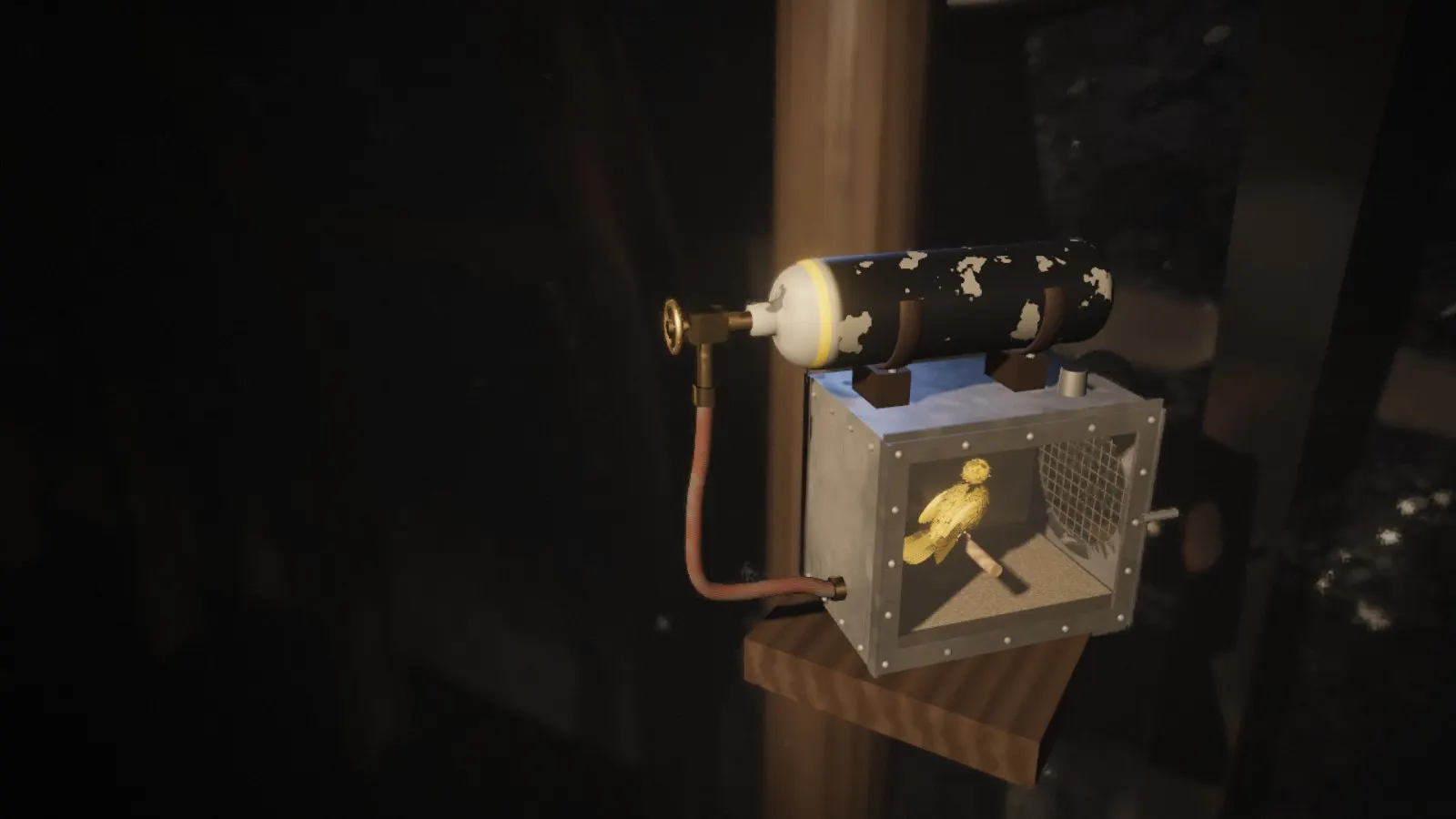
So back in the mine, when a bird was in trouble, the miner shut the round door and opened the valve, and seat by seat, carbon monoxide let go and oxygen took its place. K never changed, but the tank changed the numbers K had to work with.
So today you calculated K from equilibrium pressures and concentrations, saw that a huge K means a reaction is essentially done and a tiny K means it barely starts, with nothing to say about speed, and learned what reversing, multiplying and adding reactions do to K, and to Q. And with those rules you worked out the number behind this little oxygen tank, the same number chemists use for the hemoglobin in your own blood.