
Topic 7.8 key terms
- particulate representation of equilibrium
- A drawing of all species mixed in one container whose atom counts match the start and whose particle counts (with the stated scale) give Q = K.
Transcript
799 words · 3 parts
Representations of equilibrium: drawing the bulb
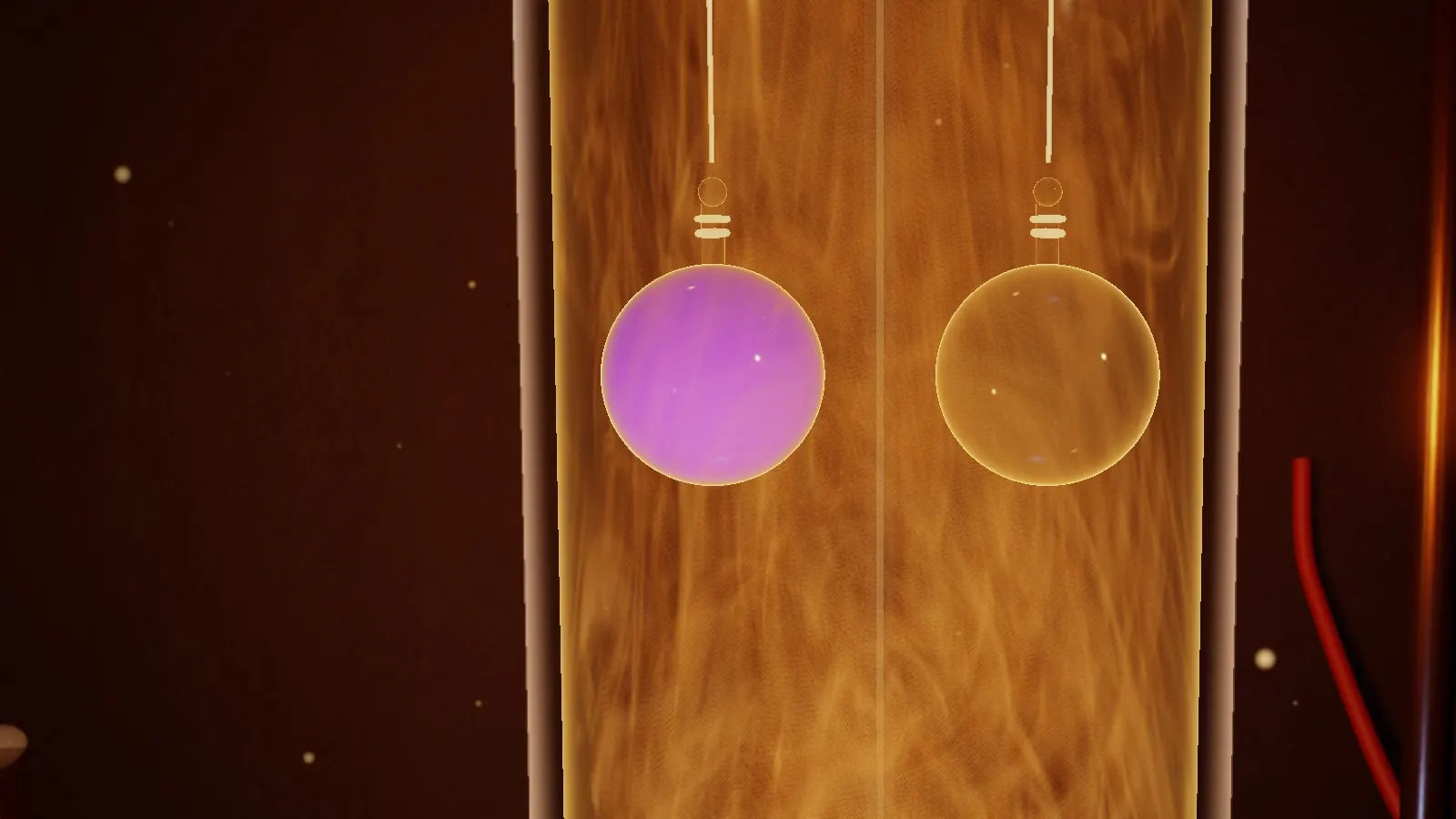
Those concentrations are numbers, though. What would a picture of the bulb have to show to make those numbers true? Let’s find out by building one. Here’s our cube from the violet bulb before it heats up, nine hydrogen and nine iodine, and the gauge shows Q, with a bright mark at K.
Step the reaction forward one event at a time, and stop when you think the picture is at equilibrium. And it doesn’t freeze there. The count flickers to three, three and twelve and comes right back, because the forward and reverse reactions keep happening at the same rate. The atoms never change, though. There are always eighteen hydrogen atoms and eighteen iodine atoms.
Forty-nine isn’t exactly fifty point four, because you can’t have part of a molecule. With a hundred molecules, the best picture is eleven, eleven and seventy-eight, and Q is fifty point three. A real bulb holds something like ten to the twentieth molecules, so it lands right on fifty point four. Let’s flatten it into the kind of box the AP exam uses.
Here’s our picture, before and after. We started with nine hydrogen and nine iodine, and at equilibrium there are two hydrogen, two iodine and fourteen hydrogen iodide. Seven of the nine hydrogen molecules reacted. That’s the same seventy-eight percent we calculated for the violet bulb.
Notice everything is mixed together in one box. The two sides of an equation are just a way of writing it, so a picture with reactants on one side and products on the other is wrong.
The atoms match the start, eighteen and eighteen, and Q is fourteen squared over two times two, forty-nine, which is about K. And it’s a snapshot of something still reacting. If you start with the clear bulb’s eighteen HI and run the reverse reaction twice, you land on exactly the same picture.
Why can raw counts go straight into Q here? Each concentration is the count times s, the concentration one molecule stands for in this box. Two concentrations sit on top and two on the bottom. Every s cancels. Which box shows the bulb at equilibrium?
Pictures the AP exam draws
Now the real thing, a question from the 2024 AP exam, redrawn. At a certain moment, a container holds three hydrogen and two iodine molecules, plus some hydrogen iodide that’s missing from the picture, and Q at that moment is zero point six seven.
Add the hydrogen iodide molecules that belong in the picture. Notice the question never says this is equilibrium. It gives Q at one moment. A picture’s Q equals K only if the picture is at equilibrium.
One more kind of picture trips people up. Two molecules of brown nitrogen dioxide can join into one N₂O₄. For N₂O₄ coming apart into two NO₂, K is point oh oh six two five at twenty-five degrees.
This box is two liters, and each molecule stands for a thousandth of a mole. Start with thirteen N₂O₄, let five of them come apart, and you get eight N₂O₄ and ten NO₂. The molecules went from thirteen to eighteen. That’s fine, because molecules don’t have to be conserved. Atoms do, and they are: twenty-six nitrogen and fifty-two oxygen. Here it is as an AP box.
Try the raw counts first, the way we did for hydrogen iodide. Ten squared over eight gives twelve point five. That’s nothing like K. Here we have to turn the counts into concentrations first. Each molecule in the drawing stands for a thousandth of a mole in two liters.
That’s point oh oh oh five molar. With those concentrations, Q comes out to point oh oh six two five. That’s K. Why did raw counts work for hydrogen iodide? Its Q has two concentrations on top and two on the bottom, and every s cancels.
Here, two on top meet only one on the bottom, so one s stays behind. Twelve point five times point oh oh oh five gives K. Now draw the same eight and ten in a one-liter box. Is that picture at equilibrium?
Why the bulbs met
Let’s go back to Heidelberg. Now you know what’s going on in these bulbs. Comparing Q with K tells you which way each bulb goes, an ICE table and K tell you how far, and the same atoms with the same K can only end at one mixture. One last experiment. Give the right bulb some extra iodine, then run them both.
Bodenstein didn’t stop at one temperature. He ran his bulbs at eleven different temperatures, from two hundred eighty-three degrees all the way up to five hundred eight, and K came out different every time. What a reaction does when you change its conditions, like its temperature, or how much of something is in it, is exactly where we’re going next.