
Topic 7.1 key terms
- reversible process
- A physical or chemical change that can run in both directions, written with a double arrow ⇌: evaporation and condensation, a gas dissolving and escaping, a salt dissolving and precipitating, proton transfer, electron transfer.
- equilibrium
- The state of a reversible process in a closed system at constant conditions where the forward and reverse rates are equal, so there is no net observable change; reactants and products are both present and their concentrations (or partial pressures) stay constant.
- dynamic equilibrium
- Equilibrium is dynamic: the forward and reverse processes keep happening at equal rates, so every particle that changes one way is replaced by one changing the other way.
- forward and reverse reactions
- The forward reaction runs left to right as the equation is written (2 NO₂ → N₂O₄); the reverse reaction runs right to left (N₂O₄ → 2 NO₂).
Transcript
1,319 words · 3 parts
Introduction to equilibrium: a garden sealed since 1972
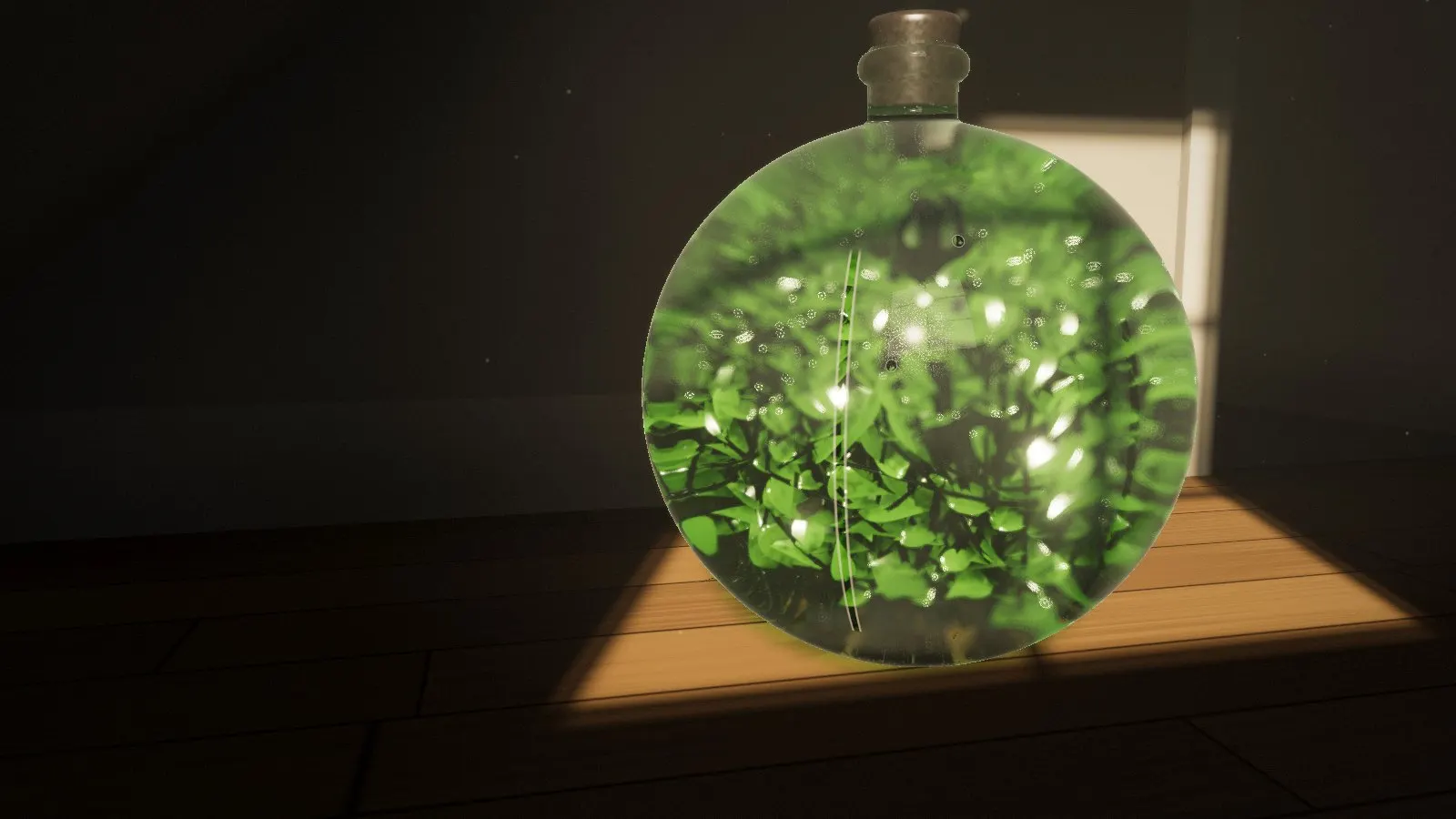
Every leaf in this little jungle grew inside a bottle that someone sealed shut in 1972, and every drop of water running down that curved glass sky has been in there ever since. Nobody opened it again, and for more than forty years it didn’t get another drop of water.
A man in England named David Latimer made it, and on Easter Sunday in 1960 he poured some compost into an old glass bottle that had once held sulfuric acid, and lowered a little spiderwort seedling in on a piece of wire. In 1972 he gave it one more drink of water, and greased the stopper so it wedged in tight.
When a newspaper wrote about it in 2013, the plant had filled the whole bottle, which sat under the stairs about six feet from a window, and he said his garden was ’incredibly dull in that it doesn’t do anything.’ But think about the water in there. All those years without a single new drop, and the plant never ran out of water, because the water kept leaving the soil and the leaves as vapor, beading up on the glass and running back down, over and over.
So from out here in the hallway nothing ever seemed to change, and yet in there the water never stopped moving. By the end of this lesson, you’ll be able to explain how something that looks perfectly still can really be running in two directions at once, and tell which way a reaction is going before anything changes. You’ll also be able to write the expression chemists use to keep score on any reversible reaction.
And when we come back to this bottle at the very end, you’ll be able to answer a question that sounds easy and isn’t. Is this garden at equilibrium? So let’s start small, with one drop of water on the inside of the glass. Here we are at the surface of that drop, and every one of these little bent shapes is a water molecule, one oxygen and two hydrogens, all jostling against each other.
Every so often a molecule at the surface gets a hard enough bump from its neighbors to break away into the air, and that’s evaporation. And every so often a molecule flying around in the air hits the surface and sticks, and that’s condensation. Sunlight and a growing plant make the bottle messy to measure, so I’ll set up a simpler version right next to it, a sealed flask of pure water held at exactly twenty-five degrees Celsius.
I’ll start it with completely dry air above the water and watch the pressure of the water vapor inside. It climbs fast at first, because there’s almost nothing in the air yet to come back down. Then it slows down, and then it stops, at three point one seven kilopascals, and it stays right there, with plenty of liquid and plenty of vapor, no matter how long we wait.
Here’s a classic AP question. The pressure in this flask hasn’t changed for a long time now, so what do you think the water molecules at the surface are doing?
And there’s our molecule, back in the liquid, and the pressure never budged. As a graph of rates, evaporation runs at a steady rate the whole time, while condensation starts at zero and climbs as the vapor builds up, until the two lines meet. When they meet, the flask has reached equilibrium, and since this is the heart of the whole lesson, I want to say it slowly. Nothing you can measure changes anymore, and yet both processes keep going, at exactly the same rate.
Chemists call this a dynamic equilibrium, because underneath the stillness, for every molecule that leaves, another one arrives. On the exam you might see it as a sealed container of water whose level has stopped changing. The answer that earns the point says evaporation and condensation are both still happening, at equal rates, and the answer that loses it says evaporation stopped. I want you to see this for yourself. Try to catch one molecule leaving the water and one coming back in.
Processes that run both ways
Water isn’t the only thing going back and forth in that bottle. The air inside has some carbon dioxide in it, and you can see a few of those molecules slipping into this drop, while others slip back out.
In fact, lots of processes can run in both directions, like water evaporating and condensing, a gas dissolving into a liquid and escaping, and a solid like salt dissolving into ions while those ions build the crystal back up. We usually count those three as physical changes, because nothing new gets made, and things only move from one phase to another or in and out of a solution.
These two are chemical reactions, where in one a proton, an H plus, moves from one particle to another, and in the other an electron does. This double arrow means the process can go either way. So any one of these, in a closed container at a steady temperature, can settle into the same kind of balance as our flask of water. Here’s a sealed jar of salt water with crystals sitting at the bottom, and the crystals haven’t changed size in a week, so what’s happening at their surface?
Equilibrium in a sealed tube of gas
We’ve watched physical changes and written down two chemical ones, so now let’s watch a chemical reaction actually happen. This sealed glass tube holds nitrogen dioxide, NO₂, a reddish-brown gas, and two NO₂ molecules can join into one molecule of N₂O₄, which has no color at all. Imagine we could fill a tube with pure NO₂ in an instant. In real life the next part takes a split second, so I’ve slowed it way down.
Watch the brown fade as pairs of NO₂ join up, then the fading slows, and then the color stops changing. From out here it looks like the reaction just stopped, so let’s go inside and check. And it hasn’t stopped at all. Here two NO₂ molecules bump nitrogen first and join into N₂O₄, and over there an N₂O₄ shakes itself apart into two NO₂ again.
Joining up is the forward reaction, left to right the way we wrote it, splitting apart is the reverse reaction, and in this tube both keep happening, all the time. Notice, too, that there’s still plenty of NO₂ in here, and plenty of N₂O₄, so at equilibrium the reactants and the products are both there, and their concentrations stay constant. Let’s turn all of this into a pair of graphs and put them on the board.
Here’s each gas over time. NO₂ starts at point one zero zero molar and falls, N₂O₄ rises from zero, and both flatten out, NO₂ at point zero one six and N₂O₄ at point zero four two. Underneath are the two rates, on the same time axis. The forward rate starts high, because there’s lots of NO₂ to pair up, and it drops as the pairing uses up the NO₂. The reverse rate starts at zero, because there’s no N₂O₄ to split yet, and it grows.
The moment the two rates meet is exactly the moment both concentration curves go flat. That’s equilibrium, where the rates are equal and the concentrations are constant, even though they aren’t equal to each other. Now, a lot of students fall into a trap right here. The two concentration curves cross, so for one instant there’s the same amount of each gas, and it’s tempting to call that equilibrium.
But look at the rates at that instant, where the forward rate is still far bigger than the reverse rate, so NO₂ keeps disappearing, and a moment later the curves have already moved apart. The signal you’re looking for is the rates meeting and the concentrations going flat. Looking at both graphs, when does this tube first reach equilibrium?