
Topic 7.5 key terms
- very large K
- K 1: products are strongly favored and the reaction proceeds essentially to completion (the reactant term in the expression is tiny, never exactly zero).
- very small K
- K 1: reactants are strongly favored and the reaction barely proceeds. K says nothing about how fast equilibrium is reached.
Transcript
679 words · 2 parts
Magnitude of K: what its size tells you
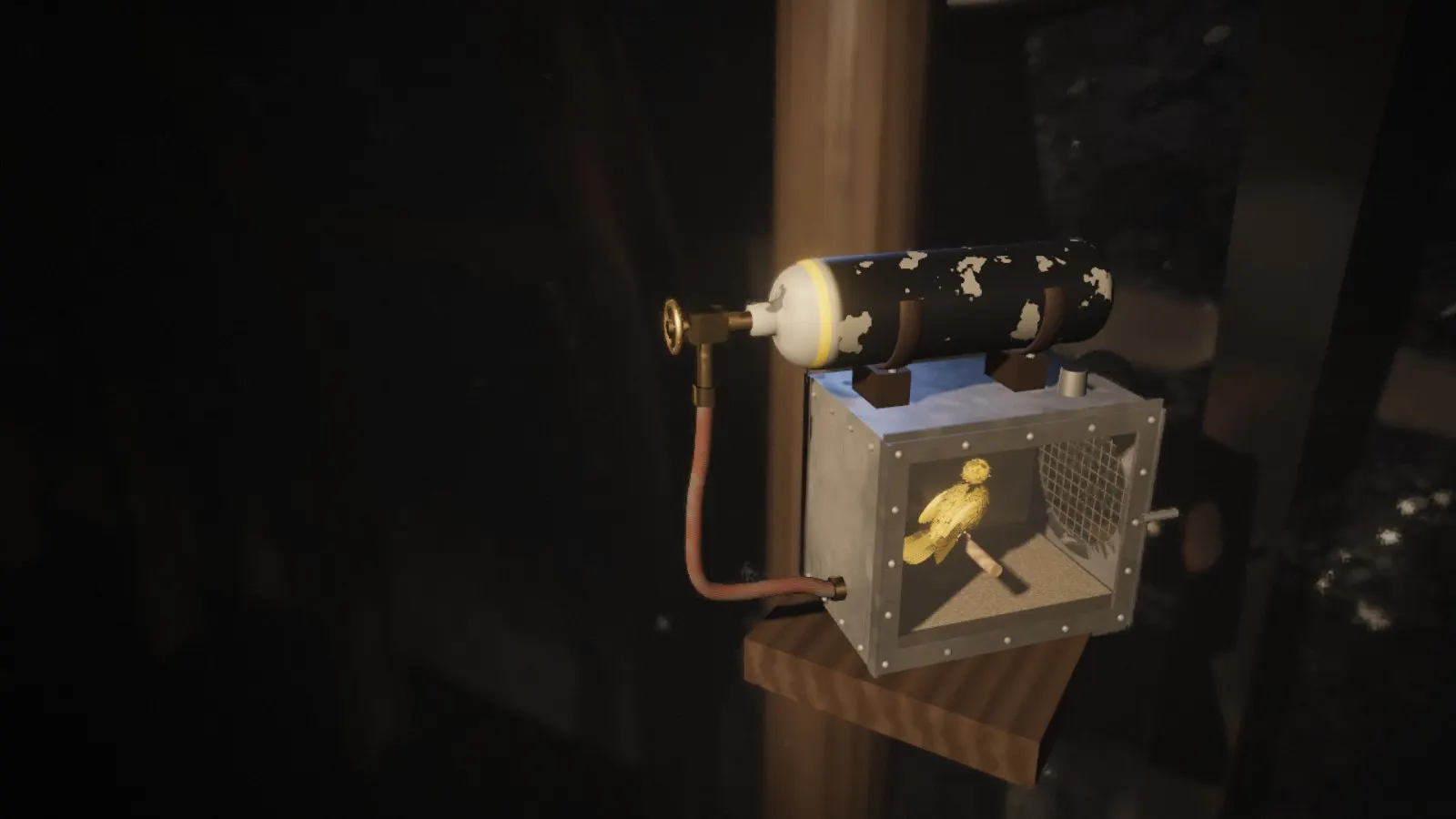
This is the top of a mine shaft at night, and let’s say ground level, where the cage waits, stands for a K of exactly one. Every level up the tower is ten times bigger, so ten, then a hundred, then a thousand, and every level down the shaft is ten times smaller.
The cage carries a window with the simplest reaction there is, A turning into B and back, A in gold and B in blue. At K equals one it’s half and half, with particles switching both ways all the time. Up one level, K is ten, and now there are ten B’s for every A. Up another level, K is a hundred, and the window is ninety-nine percent B.
Down the shaft it’s the mirror image, so at a hundredth there’s barely any B at all. So when K is very large, a reaction goes essentially to completion and products are strongly favored, and when K is very small, it barely gets going and reactants are strongly favored. And I mean essentially, because even six levels up there’s still one A in a million.
Grab the cage and send it to the level where the window is about ninety-nine percent B. Now let’s hang some real reactions on this ladder, with K values that chemists have measured. Thirty levels down is nitrogen and oxygen making nitric oxide, with a K of about four and a half times ten to the minus thirty-one at room temperature, which is why the air in this mine never turns into nitric oxide in any amount you’d notice.
At room temperature our coal-fire reaction sits twenty-one levels down, so carbon and carbon dioxide make essentially no carbon monoxide that way, but at a thousand kelvin it jumps up to one point eight, which is why every K comes with its temperature. Our brown gas sits about two levels up, and near the top of the tower are the two reactions from our blood, oxygen binding hemoglobin at about three million and carbon monoxide at about three quarters of a billion.
And way up in the stars, ninety levels up, carbon monoxide burning to carbon dioxide has a K of about ten to the ninetieth, about as close to finished as a reaction can get. For nitrogen and oxygen making nitric oxide at room temperature, which of these describes the mixture at equilibrium?
Huge K isn’t fast, and K = 1 isn’t half-and-half
That half-and-half window at ground level hides a trap, because it only works when one A turns into exactly one B. Suppose one A turns into two B’s, and at equilibrium we measure point two five zero molar A and point five zero zero molar B. K is B squared over A, which is point two five zero over point two five zero, exactly one, and yet B is twice as concentrated as A. So K equals one means the whole expression works out to one, not that everything in the flask is equal.
The other trap is speed. Carbon monoxide burning has a K of ten to the ninetieth, and yet carbon monoxide can hang around in a mine for a very long time, because without a flame that reaction is extremely slow. K tells you where a reaction ends up, and it never tells you how fast it gets there. A reaction has a K of one times ten to the ninetieth. Which statement about it has to be true?
Back in the blood, oxygen wins one race. It lands on a seat faster than carbon monoxide does. But oxygen stays only a few hundredths of a second, and carbon monoxide stays more than a minute.
K compares how often a gas lands with how often it lets go. Carbon monoxide lets go so rarely that its K ends up huge. It still can’t tell you how fast the blood gets there, only where it ends up. Who wins a seat when both gases are around? That’s a third reaction, and we can build its K out of the two we already have, with a few rules.