
Topic 1.1 key terms
- scalar
- A quantity described by its magnitude only, such as distance, speed, time, temperature or mass.
- vector
- A quantity described by both a magnitude and a direction, such as position, displacement, velocity or acceleration. Drawn as an arrow; written with an arrow over the symbol.
- magnitude
- The size of a quantity, never negative (zero only for a zero vector, like her displacement over the whole race): the length of a vector's arrow. The magnitude of a velocity is the speed.
- distance
- The total length of the path traveled, counting every meter in any direction. A scalar that never decreases.
- displacement
- The change in position: an arrow from where an object started to where it is. A vector; in 1D its sign gives its direction.
- speed
- How fast an object moves, with no direction. A scalar; the magnitude of the velocity.
- velocity
- How fast AND in which direction an object moves. A vector; in 1D, v sub x is positive or negative depending on the direction.
- position
- Where an object is, measured from an origin you choose along an axis. A vector; in 1D its sign says which side of the origin.
- acceleration
- How the velocity changes with time, including its direction. A vector: during a flip turn it points away from the wall.
- component
- The signed value of a vector along an axis, written without an arrow (v sub x). In one dimension its sign completely describes the direction.
- coordinate system
- Your choice of origin (where zero is) and positive direction. Positions depend on both; displacements depend only on the positive direction; the physics depends on neither.
- vector sum (1D)
- Add the signed components: opposite directions have opposite signs, e.g. (+50 m) + (−50 m) = 0 m.
Transcript
3,181 words · 8 parts
Fifteen hundred meters to nowhere
On a summer night in Paris in 2024, eight swimmers walked out for the Olympic final of the fifteen hundred meters freestyle, the longest race in the pool. In lane four was Katie Ledecky, and the pink line is the pace she was chasing, the world record, which happens to be her own from 2018. The race is thirty lengths of a fifty-meter pool, back and forth, and to win it she’d have to average more than a meter and a half every second for over fifteen minutes.
By the end of this lesson, you’ll be able to explain how she can race fifteen hundred meters at more than a meter and a half every second, and finish with an average velocity of exactly zero. And then the whole arena went quiet. She flipped at the wall twenty-nine times, and when she touched at the end, the swimmer in second place was still about seventeen meters from the wall.
But look at where she finished. She touched the very same wall she dove in from, so after fifteen hundred meters of swimming, she ended up right back where she started. So both of those numbers really are true at the same time, which only works if they’re two different kinds of number, so let’s go back into the race and see what the scoreboard is really telling us.
Magnitude, and direction
Here she is, frozen halfway down her fifteenth length. She’s swum seven hundred twenty-five meters so far, and right now the speedometer reads about one point six meters per second. So suppose all I tell you is her speed, one point six meters per second. Can you tell me where she’ll be one second from now?
You can’t, because she could be heading toward the far wall or back toward the start, and that number doesn’t say which. A speed tells you how fast, and nothing more. What you need is a direction, and physicists draw a quantity with a direction as an arrow. This one points the way she’s swimming, and its length shows how fast she’s going.
We call a quantity that has only a size a scalar, and that size is its magnitude. Distance and speed are both scalars. A quantity that has a size and a direction is a vector, and you need both to describe it. Position, displacement, velocity and acceleration are all vectors, and we’re going to meet every one of them in this race.
To show that a symbol stands for a vector, we draw a little arrow on top of it, so v with an arrow over it means the velocity vector, magnitude and direction together. Okay, now you sort some numbers from this lesson into scalars and vectors, and keep your eyes open, because a couple of these cards are trying to trick you.
That temperature card is worth a second look, because on a temperature a minus sign just means below zero, while along a line, a vector’s sign can carry its whole direction. This exact sort, which of these quantities are vectors, is a classic AP multiple-choice question, and a number with a minus sign in front of it is just the kind of trap it uses to catch people.
The sign is the direction
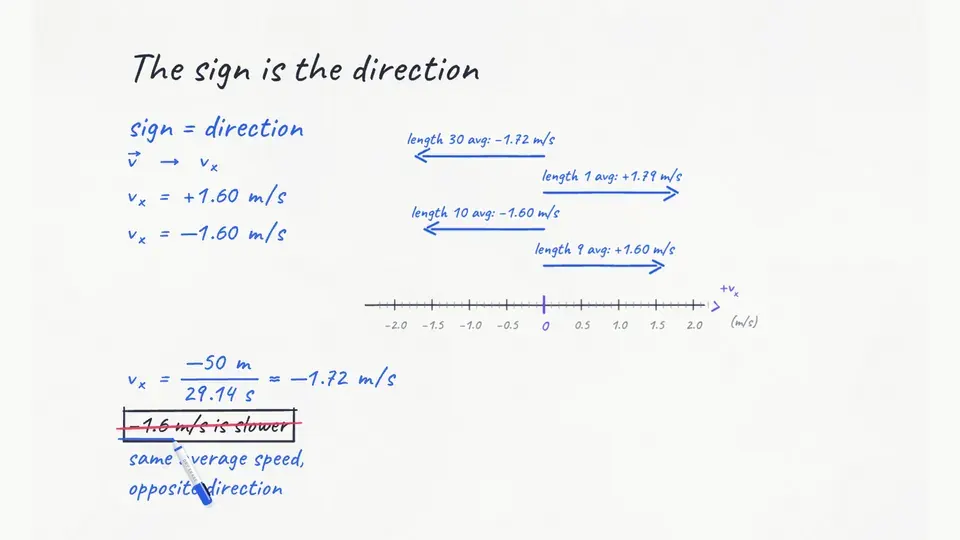
Back in the pool, everything happens along one line, so we can handle direction with a ruler. We lay it along her lane, with zero at the start wall and the positive direction pointing toward the far wall. This is her ninth length, heading away from the start, so along our ruler her velocity is positive, about plus one point six meters per second.
And here’s her tenth length, coming back. Now her velocity is negative one point six meters per second, and the negative sign just means she’s swimming back toward the start wall. And this really happened. In Paris, her ninth and tenth lengths took exactly the same time, thirty-one point two two seconds each, so on average she swam them at the same speed, and her average velocity flipped sign in between.
She’s about to turn at the far wall, and during the turn her velocity goes from positive to negative. Which way do you think her acceleration points while she’s turning? In slow motion, the velocity arrow shrinks to nothing as her feet hit the wall and grows back the other way, and through that whole turn the acceleration arrow points toward the start wall, which is the way the wall pushes her.
So along one line, a plus or minus sign describes the direction completely, which is why we can drop the arrow on top and just write v sub x, the velocity along our x-axis. Let’s draw her average velocity on each length as an arrow to scale. On length nine it was plus one point six meters per second, so I’ll draw an arrow that long, and length ten gets an arrow just as long, pointing back. Her first length, with the dive, was faster on average, so its arrow is a bit longer.
Now you draw one. Her last length was a sprint home, fifty meters in twenty-nine point one four seconds, so her average velocity was about negative one point seven two meters per second. Drag the new arrow so it shows that, to scale. You might read negative one point six meters per second as slower, but the two arrows are the same length, so her average speeds are equal, and the sign only tells us which way she’s going.
Adding arrows
Let’s watch two numbers as the race goes by. The odometer counts every meter she swims, and the green gauge shows her displacement, an arrow from where she started to where she is now. At every far-wall turn her displacement is plus fifty meters, and back at the start it’s zero again, because every length out cancels a length back, while the odometer just keeps climbing. Lay all thirty lengths end to end and you get fifteen hundred meters of water, almost a mile, and that’s how far she swam.
Now you get to fold them back up. Drag the last pool back over the one before it, one out-and-back pair at a time, and watch what happens to the distance and to the green arrow.
Fold them back into the one pool she actually swam in, and those thirty arrows add up to zero, which is her displacement. To add vectors in one dimension, we give each displacement its sign, plus toward the far wall and minus back toward the start, and then we just add the signed numbers.
After three lengths we add fifty meters out, negative fifty meters back, and fifty meters out again, so the first two cancel and her displacement is plus fifty meters, even though she’s swum a hundred and fifty meters. That’s why distance and displacement are different things. Distance adds up every meter she swims, and displacement only compares where she ends up with where she started.
Let’s work one out. Say we stop the race after four hundred twenty-five meters, and we want her distance and her displacement. That’s eight full lengths plus twenty-five meters, and eight lengths make four out-and-back pairs that each add up to zero, so at four hundred meters she’s back at the start wall.
Her ninth length heads away from the start, so those last twenty-five meters count as plus twenty-five meters. Her displacement is twenty-five meters toward the far wall, and her distance is all four hundred twenty-five meters. That makes sense. She’s out on the positive side of the start wall, and in this pool, she can never be more than fifty meters away.
Now you try one. After she’s swum eleven hundred eighty meters, what’s her displacement from the start, in meters, using the same axis? Notice that she’s swimming back toward the start, so her velocity is negative, but her displacement is still positive, because she’s still on the positive side of where she started.
Where is zero?
Let’s freeze her again at eleven hundred eighty meters, twenty meters from the start wall and swimming home. Now, who decided that zero goes at the start wall, and that positive points toward the far wall? The honest answer is that I did, a few minutes ago.
So let’s flip it and make positive point toward the start wall. Every vector reading on the screen flips its sign, and she doesn’t move a millimeter. Now let’s slide zero to the far wall. Her position changes again, to plus thirty meters, but her velocity and her displacement stay exactly the same.
The numbers on that screen kept changing, and the race didn’t change at all. That’s the big idea of this whole lesson. The coordinate system is a choice you make, and the physics never depends on it, but the signs of the vectors do. Now you get to choose the axis, so drag zero and flip the plus sign until her position and her velocity are both negative at this moment.
Her lane is fifty meters of one-dimensional space. Now let’s stack the highest and the lowest places on Earth on one vertical line, starting on the summit of Everest, almost nine kilometers up, and dropping to the floor of the deepest ocean trench. We cross sea level, the zero that every height on a map is measured from, and the light fades fast, until somewhere past a kilometer down the only light left comes from the animals themselves.
And this is the floor of the Challenger Deep, almost eleven kilometers down, where the water presses on everything with more than a thousand times the pressure of the air at the surface. Let’s step back and see the whole line at once. Zero is at sea level, and up is positive. The summit is at plus eight thousand eight hundred forty-nine meters. Call it plus nine kilometers.
The trench floor is about eleven kilometers below zero, so its position is about negative eleven kilometers. The displacement from the summit down to the trench floor is an arrow about twenty kilometers long, pointing down. With up as positive, its component is about negative twenty kilometers.
Before I touch anything, I want you to make a guess about that number. If I move zero all the way down to the floor of the trench, what happens to it? Zero slides down to the floor, and every position changes. The summit sits at about plus twenty kilometers. The displacement hasn’t changed at all, because it’s still the same arrow.
Let’s do it once more, a little slower. This time, we’ll put zero right on the summit. Now the summit is at zero, and the floor is at about negative twenty kilometers, and the green arrow still hasn’t moved at all. Sliding zero shifts every position by exactly the same amount, so the gap from the summit down to the floor, which is the displacement, can never change. Let’s put zero back at sea level, because there’s one more choice we get to make.
Now flip which way counts as positive, the way oceanographers do for depth, and that very same downward arrow gets a positive component, with exactly the same length. Nothing moved and nothing got longer, so the only thing that changed is the sign, because a sign just tells you how the arrow points compared with the direction you chose as positive. Let’s play with that mountain for a moment. Suppose we lower Everest by the depth of the trench, about eleven kilometers. Where does its summit end up?
Before it moves, make your prediction. Drag the ring to wherever you think the summit will end up. Down it goes, all eleven kilometers. Plus nine kilometers plus negative eleven kilometers is negative two kilometers. Its summit ends up about two kilometers under water.
Now you plan a dive to the deepest shipwreck ever found, the USS Samuel B. Roberts. It lies almost seven kilometers down, so aim for negative seven kilometers. Build your dive from the surface out of displacement arrows, tip to tail, and make at least one arrow point back up.
Here are three of those choices side by side, in kilometers. The summit, sea level and the trench floor go down the side, with a different axis in each column. Moving zero changes the positions, and flipping the positive direction flips their signs. To find a displacement, take where you end minus where you start. We write it as delta y equals y end minus y start.
In the first column, the arrow ends at the floor, at negative eleven, and it starts at the summit, at plus nine. Negative eleven minus plus nine is negative twenty kilometers. In the second column, zero sits on the floor. Zero minus plus twenty is negative twenty kilometers again.
Down is positive in the third column. The floor is at plus eleven, and the summit is at negative nine. Plus eleven minus negative nine is eleven plus nine, or plus twenty kilometers. The displacement is twenty kilometers long in every column. Its sign only changes when we flip the positive direction.
Now you try one. This time the trip starts at the trench floor and ends at the summit. With zero at sea level and up as positive, what’s its displacement in kilometers?
So be careful with the shortcut that going down always means a negative displacement, because that’s only true when up is positive. In every problem, decide which way positive points before you do anything else.
Signs in the equation
Signs matter most inside equations. This one, written with vector arrows, says the velocity after a time t equals the starting velocity plus the acceleration times t. You’ll see where this equation comes from in two lessons. For today, only its signs matter. Along one line we drop the arrows and use components, so the velocities and the acceleration now carry their directions in their signs.
Near Earth’s surface, a falling object’s acceleration points down, and its magnitude is g, about nine point eight one meters per second squared. On the AP exam you can round g to ten, and nine point eight is fine too. We’ll also ignore air resistance, which keeps that acceleration constant.
Let’s try it on a diver who jumps upward off a ten-meter platform at three meters per second. With up as positive, we want her velocity eight tenths of a second later. Her starting velocity points up, so it’s plus three meters per second. Her acceleration points down the whole time, whichever way she’s moving, so it’s negative ten meters per second squared.
So v sub y is three meters per second plus negative ten meters per second squared times zero point eight seconds, which is negative five meters per second, and the flipped sign tells us she’s already on her way down. That makes sense, because in eight tenths of a second, gravity adds eight meters per second of downward velocity, which is enough to turn three meters per second upward into five meters per second downward.
There’s a trap here. If you write g equals negative ten and then also put a minus sign in front of g, the two negatives cancel into a diver who falls upward. So keep g positive, because it’s a magnitude, and let a sub y carry the sign.
Here’s that same platform again, but this time the axis points down. Now you do the same jump, but with down as the positive direction. What’s her velocity eight tenths of a second after she jumps, in meters per second? Be careful, because this time the velocity and the acceleration both switch sign. It’s the same diver at the same moment, moving down at five meters per second either way, and the only thing that changed is the sign, because we chose a different axis.
Justify it
On the AP exam you’ll often have to justify a claim, which means saying what you think, pointing to the evidence and explaining the physics that connects them, in a few connected sentences. Let’s write one together.
Two students describe the same dive, from the summit of Everest to the floor of the trench. One writes a negative displacement, and the other writes a positive one with the same magnitude. Can they both be right?
I think both of them can be right, so that’s our claim. The evidence is that both answers have the same magnitude, twenty kilometers, and both describe the same arrow pointing down. The reasoning is the physics that connects them, and here it’s that displacement includes a direction, so along one line its sign only tells you how that arrow compares with the positive direction you chose.
Student A chose up as positive and student B chose down, so the same downward arrow is negative for one of them and positive for the other, and on the AP exam, that’s the sentence that earns the point. Compare that with an answer like “yes, because it depends on the axis.” It’s true, but it never explains how choosing the opposite positive direction flips the sign, and that explanation is exactly what a justification needs.
Now you be the grader. A student claims that Ledecky’s average velocity was the same on her ninth and tenth lengths, because she swam both at an average of one point six meters per second. Which response would earn full credit for disagreeing?
Back to the wall
Let’s go back to Paris for the last length. She’s heading home to the wall she started from. The odometer is about to reach fifteen hundred meters. And there’s the touch, fifteen minutes and thirty point zero two seconds, a new Olympic record.
If we treat her as a single point, the way physicists do, she starts and finishes at the same wall, so her displacement for the race is zero. Her average speed is fifteen hundred meters over about nine hundred thirty seconds, about one point six meters per second, and her velocity averaged over the race is zero meters over that time, exactly zero. So that’s how she can race fifteen hundred meters at more than a meter and a half every second, and finish with an average velocity of exactly zero, because each length back canceled the length out before it.
If you remember one thing from today, make it this: a scalar has only a size, and a vector has a size and a direction. We draw a vector as an arrow that points in its direction. Its length is proportional to its magnitude. Along one line, the sign of a component tells you its direction, so opposite directions get opposite signs, and adding vectors is just adding signed numbers.
And you choose the coordinate system, so moving zero changes every position but no displacement, and flipping positive flips the sign of every vector component, while the physics stays exactly the same. Next time we’ll take displacement, velocity and acceleration apart one at a time, starting with a drag racer that covers three hundred meters in less than four seconds.