
Topic 1.5 key terms
- component
- The part of a vector along one axis of a coordinate system: its "shadow" on that axis, with a sign that gives its direction. With θ measured from the x-axis, and .
- resultant
- The single vector equal to the sum of other vectors. A vector is the resultant of its two perpendicular components, placed tip to tail: , with magnitude .
- coordinate system
- The origin and the directions of the axes you choose. The components of a vector depend on that choice; the vector itself does not. For projectiles, choose horizontal and vertical axes.
- projectile motion
- Two-dimensional motion with zero acceleration in one dimension and a constant, nonzero acceleration in the other: near Earth with no air, and at every point of the flight.
- horizontal launch
- A projectile that starts moving only sideways (). Its time in the air comes from the vertical motion alone: ; the horizontal distance is .
- maximum height
- The top of a projectile's path, where the vertical component of the velocity is zero (the horizontal component is unchanged): .
- range
- The horizontal displacement of a projectile when it lands: . On level ground, .
Transcript
2,663 words · 10 parts
The Lighthouse of the Mediterranean
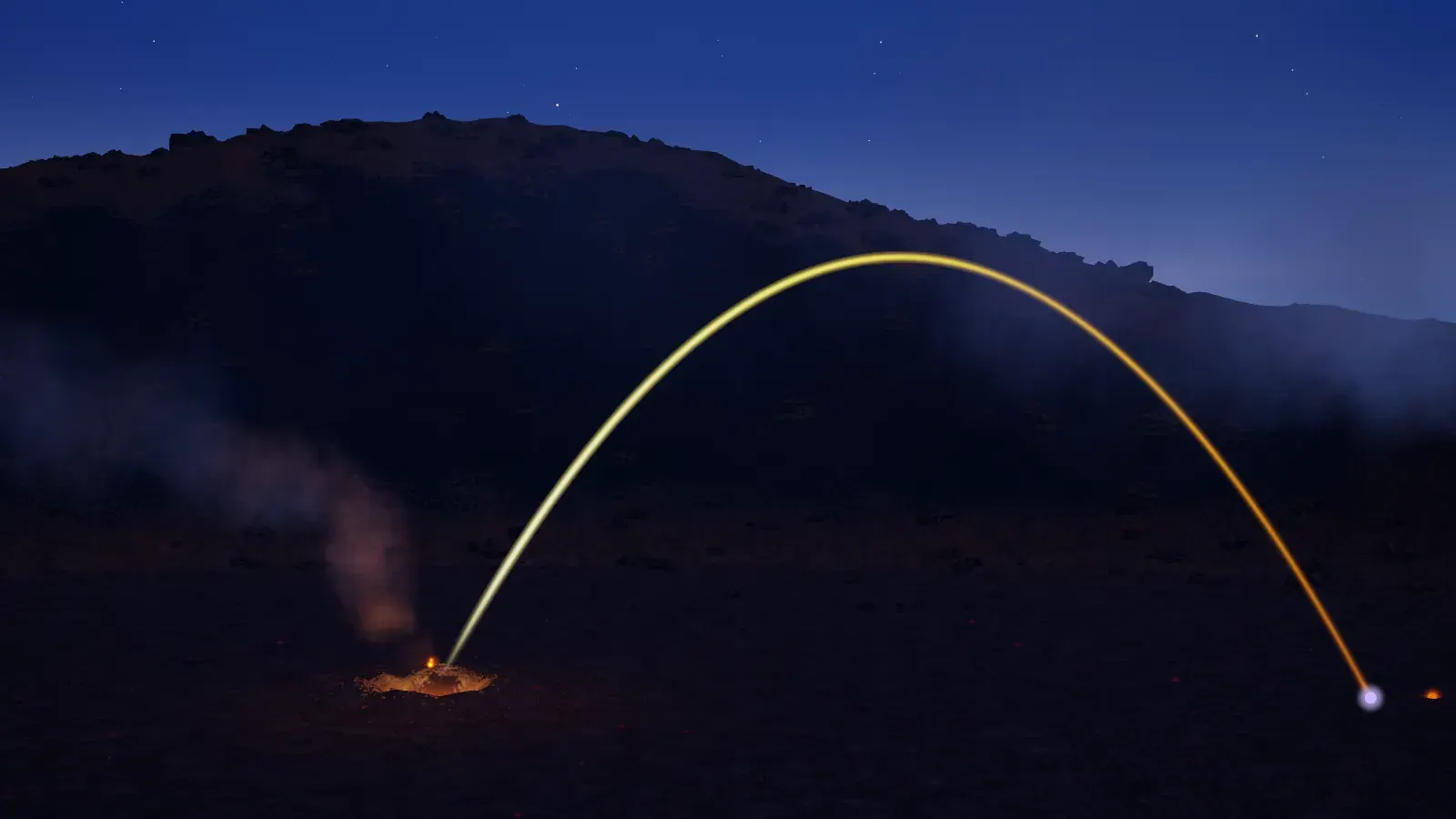
This is Stromboli, a volcano that rises straight out of the sea off the north coast of Sicily, and for at least two thousand years it has been doing the same thing a few times every hour. People have called it the Lighthouse of the Mediterranean since ancient times, because you can see its explosions glowing from far out at sea, and every one of those streaks is a lump of molten rock flying along its own curve.
Let’s follow just one of them. Right here, at the very top of its flight, it has stopped going up and it hasn’t started coming down yet, so how fast do you think it’s moving at this exact instant?
By the end of this lesson, you’ll be able to watch one of these rocks fly, and work out how fast it left the ground. And you’ll see the line that no rock at a given launch speed can ever cross, the first thing you’d need before deciding where it’s safe to stand. You already know enough to handle this curve. Watch the rock again, and keep one eye on how far sideways it goes, and one on how high.
Two motions, one clock
Here’s its shadow on the ground, as if a light were shining straight down on it. Look how steadily that shadow slides across the terrace. If we mark where it is every half second, the marks land eight meters apart every single time, so sideways the rock moves at a constant sixteen meters per second. Next, watch its height on this tall scale by the vent. The bead shoots up, slows down, stops for an instant and falls back faster and faster, just like a ball you toss straight up.
To see how true that is, let’s fire a second rock straight up at the same instant with the same upward speed, and watch it stay perfectly level with the first one, all the way up and all the way down. So the sideways drift doesn’t change the up-and-down motion even a little, and the only thing the two motions share is the clock.
Back to the question from the beginning, one of the AP exam’s favorite questions. The rock is at the very top of its flight. What is its velocity right now?
Let’s put the velocity arrow on the rock and split it into its two parts. The sideways part never changes length, while the upward part shrinks, disappears at the top and grows again pointing down. At the top, then, the velocity isn’t zero at all. Its vertical component is zero, and its horizontal component is still sixteen meters per second. The rock is moving straight sideways.
The acceleration isn’t zero at the top either. Gravity pulls this rock down the whole time, just as hard at the top as at the vent, so its acceleration is g, downward, at every point of the flight.
We’ll ignore air, and we’ll use ten meters per second squared for g, on the board and on the volcano. This same situation was the first free-response question on the released 2026 AP Physics 1 exam, with a drop of water from a fountain. First, it asked for a sketch of these two velocities over time.
Here are four pairs of graphs for our rock, from launch to landing. In each pair, the top graph is the horizontal velocity and the bottom one is the vertical. So which of these four pairs would you draw on the exam, for this rock?
The horizontal velocity stays at sixteen meters per second the whole flight. The vertical velocity starts at thirty and loses ten every second. It hits zero at the top, three seconds in, and lands at negative thirty.
That steady slope of negative ten meters per second squared is gravity itself. A sloped line here means an acceleration, and a flat line means none. AP readers say many students graph the vertical speed instead, this V that never goes negative. That loses the point.
Splitting an arrow
Every arrow on that rock was really two arrows working together. Let’s take one apart, on a new rock with friendlier numbers, thirty meters per second at fifty-three degrees above the horizontal. Shine a light straight down on the arrow, and its shadow on the ground is its horizontal component. Shine a light from the side, and its shadow on the wall is its vertical component.
Put the two shadows tip to tail and they add right back up to the original arrow, so the velocity is the vector sum of two perpendicular components, one along each axis. The arrow and its two components make a right triangle. Call the arrow’s length v and its angle theta. The side next to the angle is v times the cosine of theta, and the side across from it is v times the sine of theta.
Our angle starts at the horizontal, so the horizontal side is next to it. The cosine of fifty-three degrees is zero point six, so v sub x is eighteen meters per second. The sine is zero point eight, so v sub y is twenty-four. As a check, eighteen squared plus twenty-four squared is nine hundred, and the square root of nine hundred is thirty, so the two pieces rebuild the arrow.
There’s one habit that costs students points here, which is thinking the x component always gets the cosine. It doesn’t, because the cosine belongs to whichever side is next to the angle.
Now you try one. This rock leaves at twenty-five meters per second, thirty-seven degrees from the vertical, so what is its horizontal component, in meters per second? Switch the two lights back on, and the shadows agree. They show fifteen meters per second sideways and twenty upward, and they still rebuild the twenty-five.
Who decided the axes have to be horizontal and vertical? We did. Tilt them to match the slope of the volcano, and both components change, but the arrow stays the same thirty meters per second.
Which axes should we choose, then? Add gravity’s arrow. In these tilted axes, even gravity has two components, so both motions would be accelerating. See if you can turn the axes so that gravity lies along just one of them, with nothing left over on the other axis.
For anything coasting under gravity alone, we choose horizontal and vertical axes. Then the horizontal acceleration is zero, and the vertical acceleration is g, downward. That’s projectile motion, two one-dimensional motions sharing one clock.
The fish that does physics
Let’s start with the simplest projectile there is, one that leaves moving only sideways. This is a mangrove in Southeast Asia at the end of the day, and down in the water there’s a fish that hunts with physics.
The archerfish spits a jet of water at a fly on a leaf and knocks it off sideways. A tenth of a second later, while the fly is still falling, the fish is already racing to where it will land. It gets there a few hundredths of a second after the fly hits the water. Mark the fly every five hundredths of a second. The sideways gaps all match, while the drops keep growing, because the fly starts with no vertical velocity, and gravity builds it up from zero.
Now let’s put a second fly on the same leaf, and at the instant the jet knocks the first one sideways, the second one just lets go and drops. Which one hits the water first?
Look at that, the two splashes happen at exactly the same instant. The sideways speed changes where the fly lands, and it changes nothing about when.
Knocked off a leaf
Here’s that first fall, worked the way you would on the exam. Sketch it, put the origin at the leaf’s edge, and make positive x the way the jet knocks the fly and positive y up. Then we split everything we know into two columns. Sideways, the fly starts at one and a half meters per second with no acceleration at all.
Vertically it starts from zero and accelerates at negative ten meters per second squared. It falls twenty centimeters, so its displacement is negative zero point two meters. The two columns share only the time, and only the vertical column has enough information to tell us how long the fall lasts, so that’s where we start.
The vertical displacement is v sub y naught times t, plus one half a sub y t squared. The starting vertical velocity is zero, so negative zero point two meters equals one half of negative ten, times t squared.
Divide both sides by negative five, and t squared is zero point zero four seconds squared, so t is zero point two seconds. Now we carry that time over to the sideways motion. The horizontal displacement is v sub x times t, one and a half meters per second times zero point two seconds, which is zero point three meters. Does that make sense? Thirty centimeters is about the length of a sheet of paper, which fits the little fall we just watched.
What if we keep the leaf where it is and give the fly twice the sideways speed? Nothing in the vertical column changed, so the time stays the same, and the fly lands twice as far out.
To make the fall last twice as long, though, the leaf would have to be four times as high. Twice the time, squared, is four times the drop. If you ever think a faster sideways launch keeps something in the air longer, cross that thought right out. The time in the air belongs to the vertical motion alone.
Now you get to be the fish. This fly sits forty-five centimeters above the water, and the jet knocks it sideways at one point two meters per second. Drag the ring to where it will land, then let it fall.
Launched at an angle
Back to our first rock, the one whose velocity graphs we drew. It leaves the vent at sixteen meters per second sideways and thirty upward, and lands back on the level terrace. Sideways it moves at sixteen meters per second with no acceleration, and vertically it starts at positive thirty meters per second and loses ten meters per second of that every second.
At the very top the vertical velocity is zero, so let’s use that. Zero equals thirty minus ten t, so the rock reaches its highest point after three seconds, right where its graph crossed zero.
The velocity-squared equation on your sheet, written for y, has zero for the vertical velocity at the top and minus g for a sub y. That gives a height of thirty squared over twenty, forty-five meters. It lands at the height it started from. So the trip down takes as long as the trip up, six seconds in all. That only works on level ground.
You have everything you need to finish this one. How far from the vent does it land, in meters? We never used the rock’s mass. Without air, a pebble and a boulder launched the same way fly the same curve.
Reading a bomb
So far we went from the launch to the flight. Volcanologists can only film the flight, so they go the other way. On Stromboli they filmed three hundred forty-four explosions. Let’s test their method on our rock.
Now you be the volcanologist. Drag the short ruler until its ends sit on two of the marks, and then drag the tall ruler up to the very top of the flight. Eight meters every half second is sixteen meters per second sideways, and a top forty-five meters above the vent is all we need for the vertical velocity.
At the top the vertical velocity is zero. That means zero equals v sub y naught squared, minus two g H, the same equation that gave us the height. You have what the volcanologists had, sixteen meters per second sideways and a top forty-five meters up. What was the rock’s launch speed?
Thirty-four meters per second. For the direction, use the tangent, up over across. Tangent theta is thirty over sixteen, so theta is the inverse tangent of that, about sixty-two degrees above the horizontal. The method works, and thirty-four is no accident. Volcanologists measured an average of thirty-four at the crater rim for blasts like this one.
The exam asked for this in symbols, with a fountain instead of a volcano. It gave you the angle and the height, not the sideways speed. So the upward part is v naught times the sine of theta, and from the top of the flight, that has to equal the square root of two g H.
Divide both sides by the sine of theta, and you have v naught. Put in our rock’s numbers, thirty on top and the sine of sixty-two degrees below, and it gives thirty-four again.
Where is it safe to stand?
This time we fire rocks at twenty-five meters per second in every direction. Each flies its own curve, and together they fill a dome that no rock at that speed can leave. The top of the dome is the straight-up shot, twenty-five squared over twenty, about thirty-one meters. And the forty-five-degree shot lands farthest.
Here’s a target on the terrace, sixty meters from the vent. The launch speed stays at twenty-five meters per second, so turn the angle and fire until a rock lands on it.
The two hits are thirty-seven and fifty-three degrees. At twenty-five meters per second, the components just swap. Thirty-seven degrees gives twenty sideways and fifteen up, and fifty-three gives the reverse. Time in the air is twice the time to the top. At thirty-seven degrees the rock goes up at fifteen, so it flies three seconds, and twenty times three is sixty meters.
At fifty-three degrees it goes up at twenty, flies four seconds, and fifteen times four is sixty again. Double the launch speed, and the dome grows four times taller, because the height depends on the speed squared. It grows four times wider too, because the sideways speed and the time in the air both double.
Stand outside the dome of the fastest rock you expect, and nothing can reach you. That’s why volcanologists watch for the fastest rocks, and on their advice, the authorities decide where people may stand.
Justify it like the exam
Here’s one last question, written like an exam justify question. Two rocks leave the vent together and rise to the same maximum height. Rock A leaves much faster, and both land on the level terrace. Which one lands first, and why? Here are four answers from four students, so which one earns full credit?
Saying the gravity is the same is true, but it isn’t enough, because it’s true of every projectile. The full-credit answer walks from the equal heights to the equal vertical speeds to the time.
Two motions, one clock
Let’s pull it all together. A vector is the sum of two perpendicular components, and the cosine goes with whichever side is next to the angle. For anything coasting under gravity alone, choose horizontal and vertical axes. Then the horizontal acceleration is zero, and the vertical acceleration is g, downward, even at the top.
The two motions share only the time, and the vertical one decides how long the flight lasts. At the top, the vertical velocity is zero, and the horizontal velocity hasn’t changed at all. So the next time you see a photograph of Stromboli at night, full of glowing streaks, you’ll know that every one of them is a steady drift sideways and a straight-up toss happening at the same time.
Give me one of those streaks, just one, and you can work out how fast its rock left the ground. And give me a launch speed, any launch speed, and you can find how high the dome of its rocks will reach. Up to now in this unit, we’ve described how things move without asking why. Next we start asking what makes them move, and that’s where forces come in.