
Topic 1.4 key terms
- reference frame
- The point of view a measurement is made from: an observer with a ruler and a clock at rest relative to them, plus a chosen origin and positive direction. The frame decides the size and direction of every velocity measured in it.
- relative velocity
- The velocity of an object as measured by a particular observer. In one dimension: v(object rel. observer) = v(object rel. ground) − v(observer rel. ground), with every velocity signed on one axis.
- velocity addition (1D)
- v(object rel. ground) = v(object rel. frame) + v(frame rel. ground), e.g. : the inner letters match and drop out. Reversing the letters flips the sign: .
- inertial reference frame
- A frame that is not speeding up, slowing down or turning (moving at constant velocity). Every inertial frame measures the same acceleration for an object. On the AP exam, frames are assumed inertial unless stated otherwise.
- airspeed and ground speed
- An airplane’s speed relative to the air (airspeed, often given as a Mach number) and relative to the ground (what flight trackers show). They differ by the wind along the track.
Transcript
3,095 words · 10 parts
Faster than sound, and no boom
On a Monday night in February 2019, a Virgin Atlantic jet flying from Los Angeles to London crossed Pennsylvania at thirty-five thousand feet, riding inside something you normally never get to see, a river of wind blowing east at more than two hundred miles an hour. As the plane slid into the fastest part of that river, the flight trackers on the ground clocked it at eight hundred and one miles an hour, and up at that height sound moves through the air at only about six hundred sixty miles an hour.
So, going by those two numbers, an ordinary airliner was flying faster than sound, and yet it never made a sonic boom, and its Mach number, its speed compared with sound in the air around it, stayed at about point eight five, a perfectly ordinary cruise.
By the end of this lesson you’ll be able to explain exactly how that happened, and why “it broke the sound barrier” is the wrong way to tell it, and you’ll be able to work out how fast anything is moving for anyone who’s watching. And it all starts with a question that sounds almost too simple to ask, because that plane was going eight hundred miles an hour, but compared to what?
Fast compared to what?
Let’s put three honest observers into this picture. The first is standing on the ground, and from the ground, the plane is crossing the sky at eight hundred and one miles an hour, heading east. The second is a weather balloon, like the one launched from Long Island that night. Since it drifts with the wind, it measures the plane at five hundred sixty-one miles an hour, its calm-night speed.
And the third is a passenger in seat thirty-two A, who sees the seat in front of them going exactly nowhere, so for them the plane’s velocity is zero. So we’ve got three different numbers for the same plane at the same moment, and none of them is wrong, because each one compares the plane with something different. That’s why AP questions are so careful to say things like as measured by an observer on the ground, because that phrase is telling you exactly which frame to measure in.
This dial lets us ride along with any of them, and right now we’re measuring from the ground. Before we turn it, I want you to make the call yourself, so drag each arrow to the velocity you think we’ll measure for the plane, the air and the ground once we’re riding with the air, and then test it.
Let’s ride with the air together, slowly this time, and watch the river stop. Every streak just hangs there, the plane slides through them at about five hundred sixty miles an hour, and the whole ground starts sliding west at about two hundred forty miles an hour.
Now you take the dial. There’s one frame where the wind actually blows west, backward against the whole jet stream, and I want you to find it. Notice that while you turned that dial, the plane, the air and the ground kept doing exactly what they were doing, and the only thing that changed was who’s measuring.
Physicists call each of those viewpoints a reference frame, an observer holding a ruler and a clock that don’t move relative to them, plus a choice of where zero is and which way is positive, and for both of our flights, east is positive. Here are our three observers in a table. The ground measures plus eight hundred one miles an hour, the balloon plus five hundred sixty-one and the passenger zero, and look at the wind’s column, going east for the ground, still for the balloon and west for the passenger.
And look at that second column, because choosing a frame really comes down to choosing what counts as standing still, whether that’s the ground, the air or the plane itself, and then you measure every velocity in that row against it. That’s the first big idea of this lesson, and it’s worth saying slowly, because the frame you choose decides both the size and the direction of every velocity you measure. It’s tempting to call the ground’s number the real one, but the ground is just the frame we live in. From the balloon, the ground slides west.
Adding velocities
So how do those numbers fit together? Put the plane’s velocity through the air and the air’s velocity over the ground tail to tip, and together they make the plane’s velocity over the ground. We’ll label each velocity with who’s measuring, so v sub P A is the plane relative to the air, v sub A G is the air relative to the ground, and the two A’s in the middle touch like dominoes and leave v sub P G.
So read every label the same way, with the first letter for the thing that’s moving and the second for whoever’s measuring it, which makes v sub P G the plane as measured from the ground, exactly what the trackers saw. Let’s test it with real data, east positive. Mach point eight five means point eight five times six hundred sixty miles an hour, about plus five hundred sixty-one miles an hour.
For the wind, I don’t want the two hundred forty from our table, because we got that number from the trackers in the first place, eight hundred one minus five sixty-one, and checking the trackers against their own number would prove nothing. So we’ll use a completely separate measurement, the Long Island balloon’s two hundred thirty-one miles an hour.
Add them, and five sixty-one plus two thirty-one is plus seven hundred ninety-two miles an hour, about three hundred fifty meters per second, pointing east. The trackers measured eight hundred one miles an hour, so a balloon a couple of hundred miles away predicted the plane’s speed to within about one percent, and it’s bigger than either piece because both arrows point east.
You can also read these labels backward, so v sub G P is the ground measured from the plane, which is what our passenger sees out the window. Using the trackers’ eight hundred one miles an hour, what velocity does the passenger in seat thirty-two A measure for the ground, in miles per hour, with east positive?
What the other car sees
The AP course asks a question I love, which is why it might seem like you’re moving backward when a car passes you on the highway, so let’s put some cars on one axis and find out. Say you’re driving east at twenty-five meters per second, about fifty-five miles an hour, and another car comes up behind you at thirty meters per second, and this time you’re the observer. To get a velocity relative to you, you subtract your own velocity, so v sub C Y is v sub C G minus v sub Y G, thirty minus twenty-five, and the other car creeps forward at plus five meters per second.
That’s the same rule we used for the plane, just turned around, because the car’s velocity over the ground is its velocity relative to you plus your own, so taking your own away leaves exactly what you see out the window. From that car, though, you’re moving at negative five meters per second, backward, and when it fills your side window your brain treats it as standing still, so you feel yourself rolling backward.
Now a truck comes the other way, heading west at twenty meters per second, so its velocity over the ground is negative twenty. Using the same rule, what velocity do you measure for the truck, in meters per second, with east positive? People memorize a shortcut, adding speeds when things come at each other and subtracting when they go the same way, but it’s much safer to pick one axis, give every velocity its sign, and subtract the observer’s, and let the signs do the thinking.
The fastest crossing ever
The same kind of river can rewrite an airline record, so let’s go out over the North Atlantic. On the night of February eighth, 2020, a storm named Ciara was roaring toward Britain, and the jet stream above it was blowing at more than two hundred miles an hour. That night British Airways flight one twelve, a Boeing 747, rode that river from New York to London in just four hours and fifty-six minutes in the air, the fastest any airliner had ever made that trip, unless you count the Concorde.
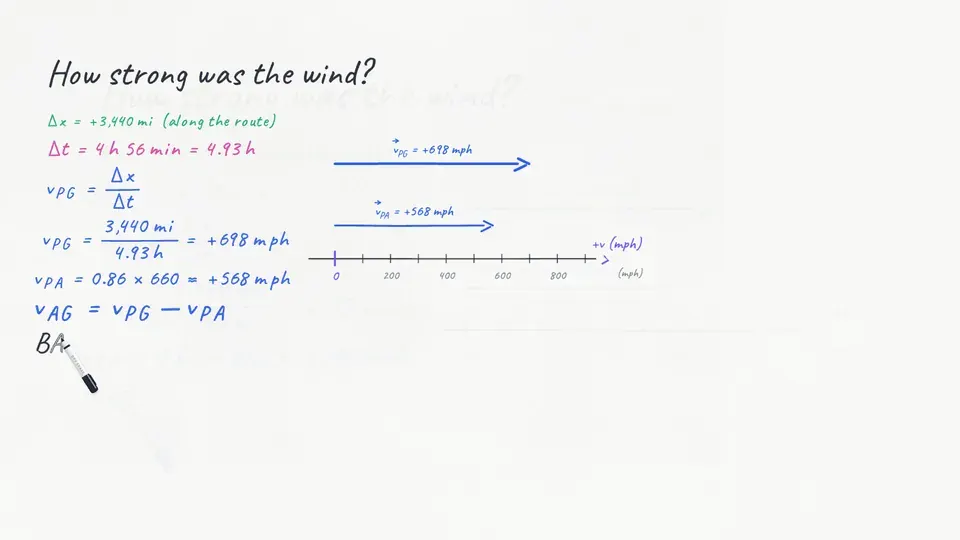
Its speed over the ground and its speed through the air tell us how strong the wind was. Averaged over the whole crossing, it moved at about plus six hundred ninety-eight miles an hour over the ground.
Through the air it held Mach point eight six, a hair faster than our first plane. That’s about five hundred sixty-eight miles an hour. The wind is the unknown this time, so the wind equals the plane over the ground minus the plane through the air. Go ahead and finish it. What was the average wind along BA112’s route, in miles per hour, with east positive?
Now you’re the dispatcher. Airlines redraw the routes across the North Atlantic every day to follow this wind, so steer this crossing through the river and try to beat the old record, five hours and thirteen minutes.
The long way home
So what about the trip home? Say the plane flies straight back through the same river at the same Mach point eight six, with east still positive. Its velocity through the air now points west, negative five hundred sixty-eight miles an hour, and the wind hasn’t changed at all, it’s still plus one hundred thirty. This one’s all yours. What’s the plane’s velocity relative to the ground on the way home, in miles per hour, with its sign?
Velocity, cancelled
Let’s come down to the ground, to a dry lake bed at sunset, where we’ve rebuilt an experiment the MythBusters’ Build Team really did in 2010. They put an air cannon on the back of a truck, pointing backward, drove the truck at sixty miles an hour, which is about twenty-seven meters per second, and fired a soccer ball out the back at sixty miles an hour relative to the truck.
Let’s call the truck’s direction positive. Before they fire, think about what someone standing beside that painted X on the lake bed, right where the ball leaves the truck, will see the ball do.
It took them a few tries to get the two speeds to match, and when they did, the ball’s sideways motion just vanished, right over the spot where it left the truck, and gravity pulled it straight down while the truck drove away from it. Now here’s the very same shot from a camera bolted to the tailgate, where the ball flies away backward at sixty miles an hour.
Both cameras are telling the truth, because the ball relative to the ground is the ball relative to the truck plus the truck relative to the ground, and negative twenty-six point eight meters per second plus twenty-six point eight is zero. Now let’s leave a ghost of the ball every tenth of a second in both cameras. Side to side, the ground camera’s ghosts stack straight down, and the tailgate camera’s spread far apart. But the gaps going down are exactly the same in both cameras, growing by the same amount every tenth of a second, so both observers see the very same fall, with the very same acceleration.
Now it’s your cannon. Set both speeds, drag the flag to where you think the ball will land, and call your shot into the bucket behind the X, and after your first hit the truck changes speed, so you’ll have to call it twice.
Every frame agrees on acceleration
So why did both cameras see the same fall? Our rule holds at every instant, so let’s write it at the start and at the end of a stretch of time. Subtracting them says the ball’s change in velocity over the ground equals its change relative to the truck, plus the truck’s own change.
But the truck is moving at a constant velocity, so its change in velocity is zero, and that leaves the ball’s change in velocity exactly the same in both frames. Divide both sides by the same time interval, and the accelerations are equal. Anyone moving at a constant velocity measures the same acceleration for the same object, even when they completely disagree about its velocity.
Here’s what that looks like as a graph. A sports car launches from rest beside the truck at four meters per second every second, so from the ground its velocity graph is a straight line starting at zero.
Now the truck, still doing twenty-seven meters per second, measures the same car. Which of these is the car’s velocity graph as measured from the truck? The truck’s line crosses zero at six point seven five seconds. At that instant the car matches the truck’s velocity, so from the truck, the car is momentarily at rest.
Back to the cannon, and the ball that dropped straight down. This time, the truck hits the brakes a second and a half after it fires. Watch the dashed line, the ball measured from the truck. When the brakes bite, that line bends, because now the truck is accelerating. Our proof needed the truck’s velocity to stay constant.
We call a frame that isn’t speeding up, slowing down or turning an inertial frame, and the equation sheet you get on the AP exam spells the rule out word for word, the frame of reference of any problem is assumed to be inertial unless otherwise stated. So unless a problem tells you a frame is accelerating, you can count on every observer in that problem measuring the same acceleration for the same object.
Galileo’s cabin and the missing boom
Now let’s climb inside that Virgin flight at eight hundred miles an hour. A flight attendant pours a cup of coffee, and it falls straight into the cup, exactly the way it would at the gate. A toy drone hovers in the aisle and a tossed orange falls the way oranges always fall, because everyone sitting in this cabin shares one frame, and in that frame the coffee and the orange behave exactly as they would in your kitchen.
Galileo imagined exactly this almost four hundred years ago, shut in the cabin of a ship, and wrote that as long as the motion is uniform, you shall not discern any the least alteration. In 1640 Pierre Gassendi tested it from the mast of a speeding galley, and every stone he dropped landed at the foot of the mast.
Only a change in the motion gives it away. Hit some turbulence and the coffee sloshes, because for a moment the cabin is accelerating, so it isn’t an inertial frame anymore. So let’s settle the boom. A plane booms when it outruns its own sound, and sound moves at about six hundred sixty miles an hour relative to the air, so in the air’s frame, at five hundred sixty-one miles an hour, the plane never catches it.
Before we switch frames, I want you to make the call yourself. Sound moves through the air at six hundred sixty miles an hour, and the air here moves east at about two hundred forty, so measured from the ground, what’s the velocity of the sound just ahead of the plane, in miles per hour, with east positive?
Now let’s switch to the ground’s frame, and keep your eye on the front of each ring as the dial turns. From the ground, the wind carries every ring east, so the sound just ahead of the plane moves at six hundred sixty plus the two hundred forty of wind, about nine hundred miles an hour, while the plane does eight hundred one, and in both frames the sound pulls ahead by about a hundred miles an hour.
Switching from the air to the ground adds the same two hundred forty to the plane and to its sound, and adding the same number to both never changes the gap between them, so the plane never catches its sound in either frame. So “it broke the sound barrier” compares numbers from two different frames, because eight hundred one is relative to the ground and six hundred sixty is relative to the air.
This is exactly the kind of claim an AP question asks you to justify, because a student could say the plane broke the sound barrier since eight hundred one miles an hour is bigger than six hundred sixty. Writing “no, because motion is relative” is true, but it doesn’t earn the point, since it never says what each speed is relative to.
Here’s an answer that earns full credit. The claim is that it didn’t break the sound barrier. The evidence is that relative to the air, the plane moved at five hundred sixty-one miles an hour, slower than the six hundred sixty that sound moves through that air.
And the reasoning is that outrunning your own sound depends on speeds in the same frame, and eight hundred one is relative to the ground, so you can’t compare it with a speed relative to the air. On the AP exam, what earns the point is comparing both speeds in the same frame and saying which frame, here relative to the air, though the ground’s frame works just as well, as long as you say so.
Let’s see if you can spot full credit on a new case. Flying west into that jet stream, a 787 shows a ground speed of only three hundred thirty miles an hour, and a student says the pilots must have throttled way back. Which of these responses earns full credit?
Compared to what?
So let’s pull it together. A reference frame is an observer with a ruler and a clock, and every velocity belongs to the frame it was measured in. One plane had three true velocities at once, and you convert between frames by adding along one axis, the plane relative to the ground is the plane relative to the air plus the air relative to the ground, and flipping the letters flips the sign.
To find what any observer sees, sign every velocity on one axis and subtract the observer’s, and remember that every inertial frame agrees on the acceleration. So the next time someone tells you how fast something is going, you’ll know exactly what to ask back, and next time we’ll send things flying across two dimensions at once.