
Topic 2.1 key terms
- system
- The object or collection of objects you choose to treat together, marked by a boundary you draw. Everything outside the boundary is the environment.
- internal interaction
- An interaction between two objects that are both inside the system (both ends of its line in a system schema are inside the boundary).
- external interaction
- An interaction between an object inside the system and one outside it; its line crosses the system boundary. For a jumper in the air, the Earth’s gravitational pull is external.
- center of mass
- The mass-weighted average position of a system’s parts, . It sits between the parts, closer to the heavier ones, and need not be inside any material.
- barycenter
- The center of mass of two or more bodies that orbit each other, such as the Earth and the Moon (inside the Earth, about 1,700 km down) or Pluto and Charon (in empty space).
- line of symmetry
- A line across which an object’s mass distribution is a mirror image. The center of mass of a symmetric object lies on every line of symmetry; a uniform object’s center of mass is at its geometric center.
- object model (system as one object)
- Treating a whole system as a single particle located at its center of mass, which is allowed when the parts and their interactions don’t matter for the behavior being modeled.
Transcript
3,051 words · 9 parts
Over backwards
On the twentieth of October, 1968, in Mexico City, the Olympic high jump came down to a twenty-one-year-old American named Dick Fosbury and a bar set at two point two four meters. The best jumpers in the world went over the bar like this, facing it and rolling over it belly-down.
Then Fosbury ran at the bar on a curve, turned his back to it, and went over head first, face up, with his body arched like a bridge. He landed on his shoulders in the foam, and that jump won him the gold medal with an Olympic record. People called his style the Fosbury Flop, a name he said came from a newspaper photo caption. Four years later, at the Munich Olympics, twenty-eight of the forty high jumpers went over his way, and when Javier Sotomayor set today’s men’s world record, two point four five meters, in 1993, he flopped too.
We’ve rebuilt his jump from measurements of elite high jumpers, so let’s slow it down and turn his body to glass, because something strange is hiding inside it. Every part of him holds a glowing bead, and the big purple one is the point that moves like his entire body. His hips sail more than twenty centimeters over the bar, but that purple point only just squeaks over.
By the end of this lesson, you’ll be able to find that point for almost anything, a body, a stack of books, even the Earth and the Moon, and calculate exactly where it is. And you’ll be able to explain how a high jumper gets every part of themselves over a bar that this point barely clears. And to find it, we first have to ask what we even mean by his whole body. A body isn’t one thing at all.
A body is a system
Pull a jumper apart and you get a head, a trunk, two arms and two legs, each with its own mass, held together at joints where muscles pull each part on the next. They aren’t equal partners, either, because the trunk alone carries about forty-three percent of the mass, each thigh about fourteen, and the head only about seven. When we draw a line around some objects and treat them together, we call them a system, and everything outside the line is its environment.
On the board we draw a bubble for each part and a line for each interaction. Then a dashed boundary goes around the system. The Earth sits outside, so its pull on him crosses the line and is external, while each pull at a joint has both ends inside, so it’s internal.
On the AP exam you’ll be expected to sort forces into internal and external like this, so this little drawing is worth getting good at. The system also has properties none of its parts has alone, like its total mass and that glowing point, its center of mass. They come from the parts and how they pull on each other, so when his muscles arch his back, the center of mass moves relative to his body.
Okay, now you try one. Right after his foot leaves the ground, with the jumper as our system, which of these interactions crosses the boundary?
And the line is ours to draw. Widen it to take in the whole Earth, and gravity becomes an internal interaction inside one bigger system, so you get to choose whichever system makes your question easiest. And when the insides don’t matter, we can treat a whole system as one object, the way we turned a dragster into a single point in Unit 1.
Here’s a case where the insides seem like they should matter. Three jumpers take off from the same spot with the same velocity, the same speed in the same direction, but one does the old scissors, one rolls over belly-down, and one flops. Once they’re in the air, whose center of mass goes the highest?
Look at that. Three bodies doing three completely different things, and three purple curves lying exactly on top of each other. The parts can move very differently from each other and from the whole, while the center of mass flies one smooth parabola, and the technique only changes how the body wraps around it, which decides how high a bar it can clear.
Closer to the heavy end
So where exactly is the center of mass? In a study of more than a thousand university physics students, researchers asked questions like this next one. A baseball bat balances on one finger, so the finger is right under its center of mass. Now imagine sawing the bat in two, right at the balance point, and weighing each piece. Which of the two pieces has more mass?
The barrel piece wins easily, with about twice the mass of the handle, even though the bat balanced perfectly on that spot. So the balance point doesn’t split the mass in half, and the reason is the biggest idea in this whole topic, which is that the center of mass is a weighted average of where the mass is.
You’ll find this equation on the equation sheet the AP exam hands you. You multiply each mass by its position, add those up, and divide by the total mass. Think of it as a vote, where every bit of mass votes for its own position and heavier parts get bigger votes, so the answer leans toward wherever the mass is.
And that’s exactly what the exam checks. On the 2026 AP exam, a free-response question about two colliding disks gave a point to graphs that kept the heavier disk closer to the center of mass than the lighter one.
Let’s try the simplest system there is, a six-kilogram ball and a two-kilogram ball four meters apart, with the origin at the big ball and positive pointing toward the small one. Six kilograms times zero is nothing, two kilograms times four meters is eight kilogram-meters, and the total mass is eight kilograms, so the center of mass is at one meter. That makes sense, because it’s between the two balls, which it always has to be. And it’s three times closer to the big ball, which has three times the mass.
And now the bat makes sense too. The barrel piece’s center of mass is only about twelve centimeters from the cut, while the handle piece’s is about twenty-four centimeters out, so for the two votes to cancel at the cut, the close piece needs twice the mass.
The balance point of worlds
The same weighted average works on the biggest systems there are. You’ve probably heard that the Moon goes around the Earth, but really the Earth and the Moon both go around their center of mass, so let’s find it.
I’ll put the origin at the Earth’s center. The Earth’s mass is five point nine seven times ten to the twenty-fourth kilograms, about eighty-one times the Moon’s, and they’re three hundred eighty-four thousand kilometers apart. The Earth sits at zero, so its term drops out, leaving the Moon’s mass times the distance over the total mass. That’s about four thousand six hundred seventy kilometers from the Earth’s center, which sounds far until you remember how big the Earth is.
The Earth’s radius is about six thousand three hundred seventy kilometers, so the point they both circle is inside the Earth, about seventeen hundred kilometers under the surface on the side that faces the Moon, and once a month the Earth’s center swings around it in a little loop. Before we leave the Earth and the Moon, here’s an idea from the very first lesson of the course. I put the origin at the Earth’s center, but that was my choice, and you could put it anywhere you like.
Drag the origin over to the Moon’s center, and before you let go, decide whether you think the pin will move. Now you try the strangest pair of all, Pluto and its moon Charon, where the moon has about an eighth of Pluto’s mass, and their centers are about nineteen thousand six hundred kilometers apart. How far from Pluto’s center is the center of mass of the Pluto–Charon system? Give your answer in kilometers.
And there it is, out in empty space, almost two Pluto radii from Pluto’s center, so Pluto and Charon spin around a point where there’s nothing at all. So the Earth–Moon point sits deep inside the Earth, and the Pluto–Charon point floats in space. How much heavier would our Moon need to be to pull its point out?
First set a mark on the dial where you think the balance point will leave the Earth. Then drag the Moon’s mass up and test your prediction. A weighted average is sensitive like that, so a little more mass on one side and the balance point marches toward it.
Let symmetry do the work
You might have noticed I treated the whole Earth as if all its mass sat at its center, and that’s allowed because when mass is spread out symmetrically, the center of mass sits on every line of symmetry, since the object can’t favor either side. For a uniform ball, stick or book, the lines cross right in the middle. For a ring they cross in the hole, where there’s no mass at all. So we can replace a uniform, symmetric object with a single particle at its center, carrying all of its mass.
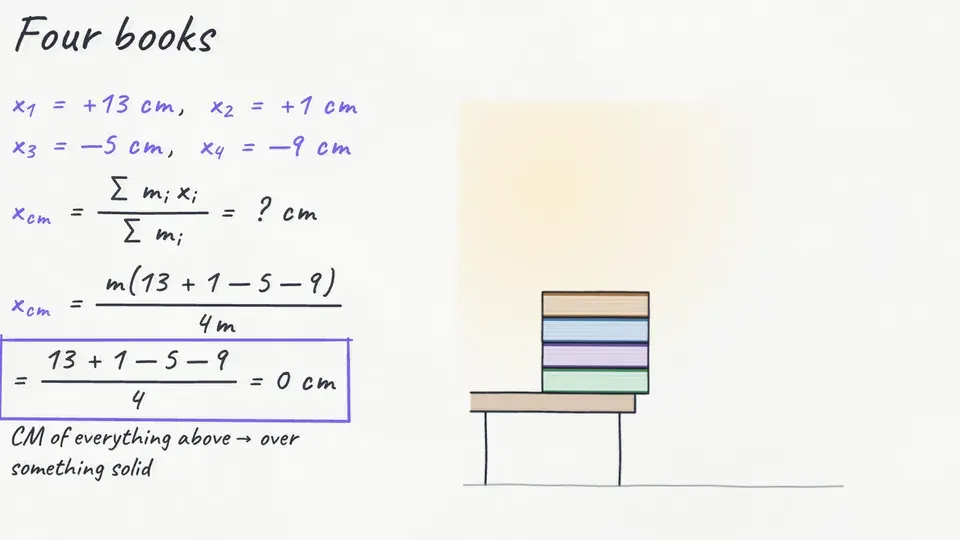
Here’s something you can try on your desk tonight. These are four identical books with nothing glued, and the top one sticks out completely past the edge of the table. With the origin at the table’s edge and positive out over the floor, each book’s center is at its middle, at positive thirteen, positive one, negative five and negative nine centimeters, and the negative ones sit back over the table.
Where is the center of mass of the whole stack, measured from the edge of the table? Give your answer in centimeters. The stack stands as long as the center of mass of everything above each book is over something solid, and why that works is a story for when we get to torque. These books sit right at that limit, so at home leave each one a few millimeters short.
Now you build one. Slide the books, one at a time, until the top book is completely past the edge of the table and the stack still stands.
Over the bar
Now back to the high jump. Let’s find his center of mass ourselves, at the very top of his jump. Fourteen parts is a lot of arithmetic, so let’s group them into five lumps, head, arms, trunk, thighs, and lower legs with feet, with masses of five, seven, thirty, twenty and eight kilograms. Five is also the most particles an AP question will ask you to handle. I’ll put the origin at the bar, with x pointing toward the pit and y pointing up, so negative heights are below the bar.
In two dimensions we do the weighted average twice, once for each axis, so let’s do x together. The head is forty centimeters past the bar, the arms and the trunk twenty, and the thighs and lower legs are twenty-five and fifty-five centimeters back.
On the pit side that gives two hundred kilogram-centimeters for the head, a hundred forty for the arms and six hundred for the trunk, and on the other side minus five hundred and minus four hundred forty, which add up to zero, so his center of mass is right above the bar. Now you do the height. Use the same steps, with the y column.
How high above the bar is his center of mass? Give your answer in centimeters. His center of mass is eight centimeters above the bar. His hips are twenty-two centimeters up, but his head and lower legs hang below the bar and drag the average down. In this pose, the point sits just outside his body.
Look under his arched back. The point that moves like his whole body floats right there, the way a ring’s center of mass sits in its hole. No part of him is there at all. You may have heard that a high jumper’s center of mass passes under the bar. A popular video with more than two million views says so.
Scientists filmed the finalists at the twenty eighteen World Indoor Championships and rebuilt their jumps in three dimensions. Their centers of mass cleared the bar by about eight centimeters on average, just like our five lumps. Their hips peaked about twenty-two centimeters over the bar. The parts that hang below the bar are the head and the legs.
The biomechanist Jesús Dapena put the trick in one sentence: “For a given peak height reached by the c.m., lowering some parts of the body allows other parts to go higher.” The whole game is to clear a bar set as close as possible under your center of mass. Our model’s jump clears about two point two five meters.
His center of mass peaks at two point three two meters, whatever he does in the air. I’m raising the bar to two point two seven meters, five centimeters under that peak. Your turn. Change his arch, his knees and the timing of his leg kick, then try the whole jump, until every part of him gets over a bar about five centimeters below the highest point his center of mass reaches.
Watch your jump again. His center of mass flew the same parabola on every try, and all you changed was how his body was arranged around it. We changed something outside the system, the height of the bar, and the arrangement of the parts inside had to change to cope.
When the system changes
Mass can cross a boundary, too. Apollo 11’s Saturn V rocket started with about two point nine four million kilograms, and in under three minutes its first stage threw about two point zero seven million kilograms of burned propellant out of its nozzles.
With the rocket as the system, about seventy percent of its starting mass crosses the boundary in those first three minutes. The hot exhaust carries a huge amount of energy out with it, too. Then the empty first stage drops away too, but draw the line around everything it started with, exhaust and all, and no mass leaves at all.
Even the Earth is a system, one point for its orbit around the Sun, but really rock, oceans, ice and air, and some of those parts move. Every April about two thousand four hundred billion tonnes of rain sits on the Amazon, and in 2026 NASA’s Jet Propulsion Laboratory reported that it shifts the center of mass of the whole planet about two point two millimeters toward South America, compared with the solid Earth around it. The seasons come from outside, from how the Sun’s light falls through the year, and they rearrange the water inside, so when you care about millimeters, the Earth’s insides matter.
The sentence that earns the point
Let’s finish with a problem in the style of the AP exam. Glider R, with a mass of half a kilogram, slides toward glider S, which has three times its mass and sits at rest, and this table gives where each one is every second. At two seconds they collide, R bounces back, and S slides away, so the two gliders do completely different things.
At the start, half a kilogram times zero plus one and a half kilograms times four point four meters, divided by two kilograms, puts the center of mass at three point three meters. One second later the same weighted average gives three point eight, and at two seconds it gives four point three. Now you plot the center of mass at three seconds and at four seconds, using the table.
Look at that line. R reverses and S takes off, but the center of mass’s line on this graph stays perfectly straight, with the same slope right through the collision, so its velocity never changes, and we’ll see why in just two lessons, when we get to the forces that the parts of a system exert on each other.
An AP-style question about a graph like this might ask you to justify where the center of mass is, and an answer that’s true but too vague often doesn’t earn the point. A full-credit answer makes a claim, that it’s closer to S, and gives evidence, point six meters from S and one point eight from R.
Then it gives the reasoning, that the center of mass is a mass-weighted average and S has three times R’s mass, so it sits three times closer to S. That last part ties the distances to the masses. It’s the sentence that earns the point in a rubric like this one. “Closer to S, because S is bigger” names the right glider, but bigger isn’t the same as more massive, and it never connects the answer to the weighted average, so it misses the point.
Now you write one. At four seconds, is the center of mass closer to R or to S? Give your claim, your evidence from the numbers, and the reasoning that ties them together.
Back over the bar
So let’s watch Fosbury one more time. The dashed line is the system, every bead is a part with its own mass, and the purple point is their weighted average, flying one parabola from the instant his foot leaves the ground. His hips sail high, his head and legs hang low, and his center of mass slips over with a few centimeters to spare, which is how a twenty-one-year-old won the Olympics on his back.
So if you remember one thing from today, make it this: the center of mass is a mass-weighted average of where the parts are, so it sits closer to the heavy parts and on every line of symmetry, and it doesn’t have to be inside anything at all. And a system is whatever you draw a line around, and when its insides don’t matter, it moves like one particle at its center of mass. Next time, that particle becomes the dot at the center of every free-body diagram you’ll draw, and the forces we draw on it will be exactly the external ones, the lines that cross your boundary.