
Topic 2.4 key terms
- net force
- The vector sum of all the forces exerted on a system, . Add the forces tip to tail, or add their components one direction at a time.
- translational equilibrium
- A configuration of forces whose sum is zero, . A system whose forces are in that configuration may be at rest or moving at a constant velocity, like a stone gliding on frictionless ice (Voyager 1, with its tiny net force, comes extremely close).
- Newton's first law
- If the net force exerted on a system is zero, the velocity of that system remains constant: the same speed in the same direction (rest is one constant velocity). Newton (1687): "Every body perseveres in its state of rest, or of uniform motion in a right line, unless it is compelled to change that state by forces impress'd thereon."
- balanced in one direction, unbalanced in another
- Forces can cancel along one axis but not another. The velocity then changes only along the unbalanced direction: a puck tapped sideways keeps its forward velocity and gains only sideways velocity.
- inertial reference frame
- A frame of reference from which an observer would verify Newton's first law. The ground is inertial enough for any lab; a braking vehicle, or Earth over a whole year of orbiting, is not. AP problems assume an inertial frame unless they say otherwise.
Transcript
3,302 words · 8 parts
One light-day
This is Voyager 1. It left Earth in 1977, and it’s farther from home than anything people have ever built, more than twenty-five billion kilometers away. In November 2026, it reaches one light-day from Earth, which means a radio message, moving at the speed of light, needs a whole day just to get there.
And it’s still moving at about seventeen kilometers every second, which would get you from New York to Los Angeles in less than four minutes. The part I still can’t get over is that Voyager hasn’t fired its rockets to speed up or change course since November 1980, four days before it flew past Saturn.
So let’s roll the years forward from the day in 1990 when it turned around and took the Pale Blue Dot, that famous photo of Earth as one tiny speck of light. It was doing about seventeen point nine kilometers per second then, and today it’s still doing about sixteen point nine, pointed in almost exactly the same direction.
By the end of this lesson, you’ll be able to add up the forces on anything from a spacecraft to an elevator and say whether its velocity can change. You’ll also know why Voyager never needed its engine to keep going, and why it has still slowed down a little.
For about two thousand years, the standard view, even among very smart people, was that anything moving needs something pushing it, or it stops. And honestly, almost everything you’ve ever seen on Earth agrees with them, so let’s go somewhere on Earth and figure out who’s right.
What stops a sliding stone?
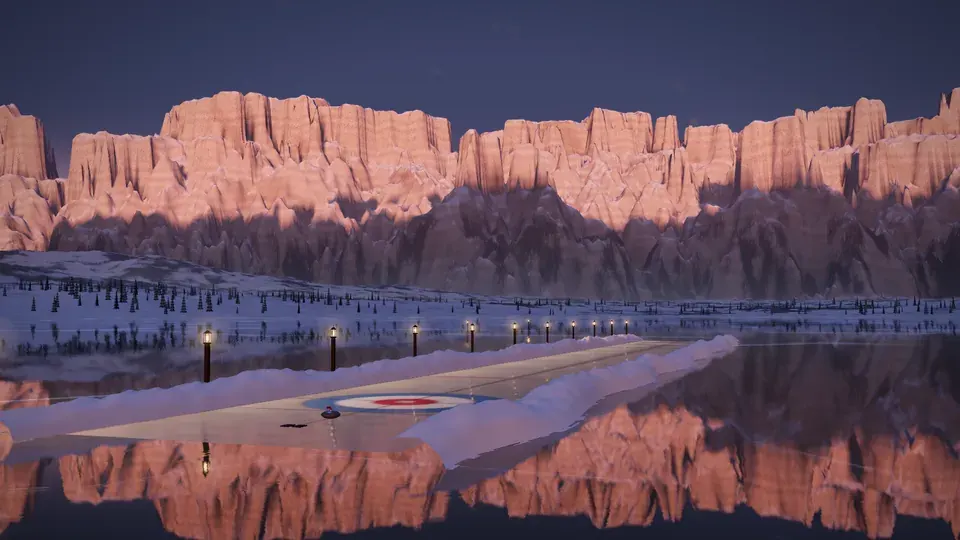
This is a frozen lake high in the Italian Dolomites, the mountains around Cortina, where the 2026 Winter Olympics held their curling, and the ice is so clear you can see bubbles frozen deep inside it. If you give a puck a shove across the snow on the shore, it stops almost right away. Give it the same shove out on the black ice, and it just keeps sliding, and sliding.
So when the puck stops, what stops it, and when it doesn’t stop, what keeps it going? Nobody got both of those right until Galileo, and the answer to the first one turns out to be the key to the second. Curling has a rule that makes this really clean. The player has to let go of the stone before this line, the hog line, and after that the rules say nobody may push it, yet it still slides almost thirty meters down the ice.
Let’s freeze it right here, halfway down the sheet, long after anyone touched it. Which forces are acting on the stone at this moment?
Here’s what’s really acting on it. Earth pulls it down with its weight, about two hundred newtons, the ice pushes up just as hard, and a tiny friction force, about two newtons, points backward, and that’s the whole list.
This exact picture, something sliding along with nobody pushing it, is a classic AP question, and the forward arrow people add is one of the mistakes the AP exam’s graders keep reporting on force diagrams. So the stone doesn’t need a force to keep it moving. The only force along the ice is friction, pointing backward, and it takes away only about a tenth of a meter per second, every second, which is why the stone looks like it’s coasting.
Galileo had a beautiful way to think about this, so let’s build his experiment out of ice. Let a puck go from this height on one side of a smooth bowl, and it climbs the other side to almost exactly the same height. Now make the far side gentler, and the puck still climbs back to that same height, so it has to travel farther to get there.
You take over now. Keep lowering the far side, watch how far the puck has to go, and see if you can set it up so the puck never comes back.
That’s Galileo’s argument, and in 1638 he wrote that a body sliding on a level plane without friction keeps a motion that is “uniform and perpetual, provided the plane has no limits.” And it works for our curling stone too. Make the ice perfect, and the friction arrow disappears, the forces add up to zero, and the stone sails off the end of the sheet at exactly the same speed the whole way.
Add up the forces
Let’s take that stone onto the board. To find out whether its velocity can change, we add up all of the forces on it as vectors, and we call that sum the net force. To keep the numbers simple, I’ll use g of about ten meters per second squared, which the exam allows, so the stone weighs about two hundred newtons.
Adding vectors means putting them tip to tail, so the weight goes first, two hundred newtons down, and then the ice’s push starts at its tip and goes two hundred newtons back up, which brings us right back to where we started. Then add the friction, two newtons backward, and the arrow from the very first tail to the very last tip is the net force, two newtons, pointing back up the sheet.
It’s often easier to add the forces one direction at a time. Up and down, two hundred minus two hundred is zero, so the stone’s vertical velocity stays zero and it never sinks into the ice or floats off it. Along the ice, taking down the sheet as positive, the sum is negative two newtons, so that’s the only direction in which its velocity changes.
Now you try it. Use the friction slider to make every force on the stone add up to zero, and watch what happens to the chain of arrows.
That’s the perfect ice again. The arrows close into a loop that ends exactly where it started, so the sum of all the forces is zero. When the forces cancel like that, we say the stone is in translational equilibrium. It’s a long name for a simple idea, that the forces add up to zero. We say translational because later on we’ll study things that spin.
In 1687, Isaac Newton made this the first of his three laws of motion, and in a translation from 1729 it reads, “Every body perseveres in its state of rest, or of uniform motion in a right line, unless it is compelled to change that state by forces impress’d thereon.” In today’s words, if the net force on a system is zero, its velocity stays constant, and Newton’s “uniform motion in a right line” is exactly what constant velocity means, the same speed in the same direction.
And notice what that does to a really common idea, that balanced forces mean the object isn’t moving. It’s wrong, because a stone gliding on perfect ice is in equilibrium too, since zero net force means the velocity is constant, and zero is just one possible constant. It fails the other way, too. A ball tossed straight up has zero velocity for an instant at the very top, but its velocity is still changing, so the forces on it aren’t balanced at all.
Let’s do our first problem the way you’d do it on the exam. Say you want to push the stone so it slides at a steady two meters per second, on real ice, where it still feels that two newtons of friction. How hard do you have to push?
I’ll point positive down the sheet and write down what we know, which is that the stone weighs about two hundred newtons, friction pulls back with two newtons, and its velocity stays constant. That last one is the key, because constant velocity means the net force is zero, by the first law, so the forces along the ice have to cancel.
The push minus the friction equals zero, so the push equals the friction, two newtons. That’s about a hundredth of the stone’s weight, and if you sped it up to twice the speed and then held it steady there, with the same friction, you’d still push with just two newtons, because the push doesn’t keep the stone moving, it only cancels the friction.
Now here’s a setup that’s a classic on the AP exam. A light rope runs from a twelve-kilogram sled on frictionless ice, over a light, frictionless pulley, to a three-kilogram bucket hanging off the dock, and a wooden stake in the ice holds the sled in place. The question says everything remains at rest, and on the exam that phrase is a gift, because it tells you the net force on every single object is zero.
Start with the bucket, since it’s the simplest. It has its weight, thirty newtons, pulling down, and the rope pulling up, and it stays at rest the whole time, so the rope’s pull must be thirty newtons. Now you finish it. What’s the size of the force the stake exerts on the sled, in newtons?
Balanced one way, not the other
Back on the lake, here’s a puck on perfect ice, so its velocity is constant, three meters per second straight ahead, and nothing at all sideways. Then, halfway across, someone will tap it, sideways, with a hockey stick.
Think about what the tap does, and what it doesn’t do. After the tap, what path does the puck follow? Watch it in slow motion. While the stick touches it, the sideways velocity jumps from zero to two meters per second, but the forward velocity doesn’t change at all, and once the stick is gone, both stay constant and the path is straight again. So the puck’s new velocity is three meters per second forward plus two sideways, and on perfect ice it would keep that forever.
Now you take the stick. There’s a gate of lanterns up ahead and off to the side, so first call your shot by dragging a line to where you think the puck will go, and then tap it just hard enough to slide it straight through. Make that one, and a second gate will be waiting on the other side.
Here are the forces at three moments. Before the tap, they cancel in every direction, but during the tap there’s a sideways force that nothing cancels, even though forward and backward they still cancel, and after the tap everything cancels again.
And that’s exactly what the velocity graphs show. The forward velocity is a flat line the whole time, and the sideways velocity steps up during the tap and then goes flat again. So forces can be balanced in one direction and unbalanced in another, and when they are, the velocity changes only in the direction of the unbalanced force.
Which means the idea that an object goes wherever it was last pushed is wrong, because the puck kept every bit of the forward velocity it had and just added some sideways velocity. It’s also why, in a famous lecture demo, a ball fired straight up from a cart rolling at a steady speed lands right back in the cart, because gravity only pulls down, so the ball’s horizontal velocity never changes, and it keeps pace with the cart the whole way up and down.
Engine off isn’t the rule
Let’s go back out to Voyager, because I told you nothing is pushing it forward, and that’s true, but something is pulling it backward. The Sun is still pulling on it, but so weakly that I’ve had to draw this arrow a million times longer just so you can see it. It’s a little more than one ten-thousandth of a newton, roughly the weight of a fifteen-milligram speck here on Earth.
And it does exactly what a tiny net force should do. Between 2016 and 2026, Voyager’s speed dropped by about half a percent, and these days it loses about six meters per second every year, out of almost seventeen thousand. Back in the early eighties it was much closer to the Sun, the pull was about three hundred times stronger, and its speed dropped much faster. As the force got smaller, the change got smaller, heading toward exactly what the first law says, which is no net force and no change at all.
But a tiny pull still adds up if you give it long enough. Go back to the Pale Blue Dot day, switch the Sun off, and let a ghost Voyager fly on with nothing pulling it at all. By today the ghost is more than eight hundred million kilometers ahead, farther than Jupiter is from the Sun, and that’s what a pull you could never feel does over more than thirty-six years.
Now compare a different spacecraft. In July 1969, Apollo 11 finished the big engine burn that sent it toward the Moon, and then it coasted, just like Voyager coasts now. Over its first day of coasting, what do you think happened to its speed?
Here’s Apollo 11 leaving Earth at almost eleven kilometers per second, with Earth’s pull on it drawn as an enormous arrow pointing toward Earth, and less than a day later it was down to about one and a half. It lost eighty-six percent of its speed, and apart from two three-second trims, its engine was off the whole time.
So that’s two spacecraft with their engines off and two completely different stories. “Engine off means constant velocity” is wrong, because what decides it is the net force. When it’s zero, the velocity stays constant, and for Voyager, today’s tiny pull changes its speed by only about six meters per second in a whole year.
Constant, according to whom?
We’ve measured Voyager’s speed from the Sun and Apollo’s from Earth, so let me ask you a sneaky one. What happens if we measure Voyager’s velocity from Earth instead? From Earth, Voyager’s speed swings between about nineteen and forty-four kilometers per second, every single year, and yet changing who’s watching doesn’t change the force on Voyager one bit.
So why does the speed swing when we watch from Earth? Because Earth whips around the Sun at about thirty kilometers per second and changes direction all year long. In one part of the year, we race the opposite way to Voyager. From here, it looks fast.
Six months later, we head roughly its way. Now it looks slow. Seen from Earth, Voyager’s velocity swings, but no big force acts on it. The first law seems to fail. The fault is our frame, not the law.
How do we test a frame? Watch something with no net force on it. Our ghost Voyager, the twin with the Sun switched off, has none. From a fair frame, its velocity stays constant.
Now you run the test. Turn on every observer from which the twin keeps a constant velocity, meaning its speed and its direction both stay steady.
A fair frame, where the first law checks out, has a name. Physicists call it an inertial reference frame. The Sun’s frame and the drifting probe’s both pass. Orbiting Earth, watched for a whole year, doesn’t.
Back on the lake, a sled glides at a steady speed with a puck on a frictionless tray, and from the sled the puck just sits there. Then the sled brakes hard, and from the sled, the puck shoots forward, even though nothing pushes it horizontally. But watch it from the shore. The puck didn’t do anything, it just kept the velocity it already had, and the sled slowed down underneath it. That’s exactly what your body does in a car that brakes hard, and it’s the whole reason seat belts exist.
So let’s write the test down. A frame is inertial if, when you watch from it, the first law checks out. The braking sled fails that test. So does orbiting Earth, if you watch for a whole year. For the experiments in this course, though, Earth’s acceleration around the Sun is so small next to g that we can treat the ground as an inertial frame, which is why every problem on the exam comes with this line, printed on the equation sheet, “The frame of reference of any problem is assumed to be inertial unless otherwise stated.”
The elevator trap
Now for a question that fools a lot of people. On a famous physics test, researchers asked a group of Arizona high school students about an elevator rising at a steady speed, and fifty-five percent said the cable pulls harder than the elevator’s weight. After a whole year of physics, that number went up, to sixty-three percent, so this idea survives a lot of practice.
Let’s see why that answer feels so tempting, and what a steady speed really tells us. The world’s fastest elevator, in Guangzhou, China, can climb at about twenty-one meters per second, but we’ll take a slower one. The car and its riders have a mass of fifteen hundred kilograms, they rise at a steady ten meters per second, and positive points up.
So for fifteen hundred kilograms rising at a steady ten meters per second, what’s the tension in the cable, in newtons? Use g equal to ten meters per second squared. And look at the algebra. The sum of the forces is T minus m g, and that’s zero, so T equals m g, and the speed isn’t anywhere in that answer.
Don’t take the algebra’s word for it. Drag the speed anywhere you like, all the way up to the world record and all the way down to parked, and watch the cable. At ten meters per second, at twenty-one, or parked at a floor, as long as the velocity is constant, the cable pulls with exactly the weight.
On the AP exam, a question like this usually ends with “justify your answer,” and this is the sentence that earns the point. “The elevator’s velocity is constant, so by Newton’s first law the net force on it is zero. The only forces are the cable’s tension up and gravity down, so the tension equals the weight.” Compare that with “the forces are balanced,” which leaves out why they balance, or “the tension is bigger because it’s moving up,” which uses the direction of motion instead of the change in velocity, and neither one earns the point.
That wrong answer feels right for a good reason. When an elevator starts upward from a floor and speeds up, the cable really does pull harder than the weight for a moment, and you can feel it in your knees. But the tension equals the weight only while the velocity is constant, and whenever the velocity changes, the forces stop canceling, which is exactly what the next lesson is about.
Here’s one more, in the style of an AP question. These graphs show an object’s horizontal and vertical velocity over time. Which force diagram could produce this motion?
Still coasting
Let’s pull it all together. The net force is all the forces added as vectors, and when it’s zero, the velocity stays constant, whether that’s at rest or cruising. Check each direction separately, because the velocity only changes along a direction where the forces don’t cancel.
The law holds in an inertial frame, which is any frame where you’d see it work, and the exam assumes you’re in one unless it says otherwise. And an engine being off proves nothing, because only the net force decides. So what happens when the forces don’t cancel? How quickly does the velocity change, and in which direction? That’s Newton’s second law, and it’s the next lesson.
And from November 2026 on, a message from Earth needs more than a whole day to catch Voyager 1, which just keeps coasting, almost exactly as fast as before, because the main thing still pulling on it is the Sun, far behind it, and that pull gets weaker every single day.