
Topic 2.8 key terms
- relaxed length
- The length of a spring when nothing is pulling or pushing on it (). Every stretch or compression in Hooke’s law is measured from it.
- stretch (Δx)
- The change in a spring’s length from its relaxed length: its size is , never the spring’s total length. In the vector law , is how far the spring’s end (the object) has moved from the relaxed position, and its sign comes from your axis.
- ideal spring
- A spring with negligible mass whose force is exactly proportional to its stretch. Because it has no mass, it pulls with the same force on whatever is at each end. The AP exam assumes springs are ideal unless it says otherwise.
- spring constant (k)
- How many newtons of force a spring exerts for each meter of stretch, in N/m: a property of the spring. It is the slope of a graph of force against stretch; a stiffer spring has a larger k.
- Hooke’s law
- : the force exerted by an ideal spring is proportional to its stretch from the relaxed length () and points opposite the displacement of the spring’s end from its relaxed position, back toward that position. It is printed on the AP equation sheet.
- equilibrium position
- Where an object attached to a spring can stay at rest because the net force on it is zero. For a block on a horizontal spring it is the relaxed position; for a hanging object it is a stretch below the relaxed length.
- elastic limit
- The largest stretch a real spring can take and still return to its relaxed length when the load comes off; past it, the spring stays permanently longer. The force usually stops being proportional to the stretch a little before that (the proportional limit), which is where Hooke’s law ends.
Transcript
2,981 words · 8 parts
Three times your weight
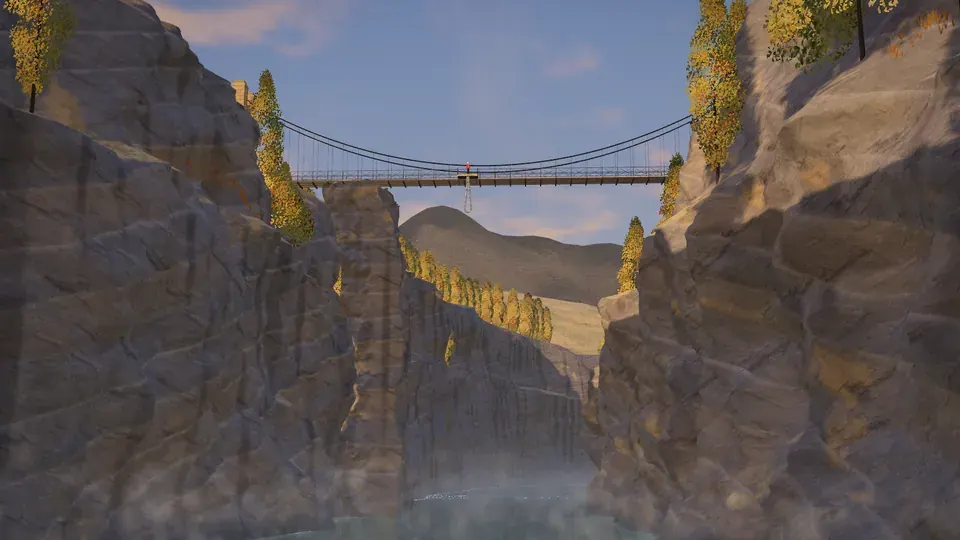
This is the Kawarau Bridge in New Zealand, and in 1988 a man named A. J. Hackett, who’d been arrested the year before for jumping off the Eiffel Tower on a bungee cord, opened the world’s first permanent commercial bungee site right here. Ever since, people have paid to tie a giant rubber cord to their ankles and jump forty-three meters toward the river.
Keep your eyes on the cord as they jump, because the cord is the whole story. At the very bottom, this person isn’t moving at all. Yet the cord is pulling up on them with almost three times their weight.
Our cord here is a model, but it’s built to match real jumps, because a 1998 study put sensors on ten real bungee jumpers, and at the bottom of the fall their sensors read about two point seven g on average, never more than three. And there’s something even stranger hiding in this jump, so watch the speed this time, because the cord goes tight and starts pulling up, and yet the jumper keeps getting faster for another ten meters.
By the end of this lesson, you’ll be able to work out how hard a bungee cord pulls on a jumper anywhere in the fall and which way it pulls, and explain why, after the cord goes tight, the jumper keeps speeding up. In London in 1676, Robert Hooke hid the rule a cord like this obeys in a scrambled puzzle of fourteen letters, so let’s go and see what he was hiding.
As the stretch, so the force
This is a room like the one Robert Hooke worked in, and on his desk is the puzzle, c, e, i, i, i, n, o, s, s, s, t, t, u, u, printed in 1676. People in his day sometimes published a discovery scrambled like this, to prove later that they’d had it first, and we’re going to unscramble it by doing his experiment.
Here’s his spring, hanging with nothing on it, and the pointer sits at twenty centimeters, which we call the relaxed length, the length a spring has when nothing is pulling or pushing on it. Now let’s hang one small weight on it, a hundred grams, which pulls down with about one newton, and the pointer drops to twenty-four point nine centimeters. But the number we care about isn’t the twenty-four point nine, because the spring itself only stretched four point nine centimeters, and that change from the relaxed length is what we call the stretch, delta x, and keeping those two numbers straight is worth real points on the AP exam.
Okay, now it’s your turn with the weights, and I want you to hang just enough of them to bring the pointer down to the thirty-five centimeter mark. Look at the marks, because they’re perfectly evenly spaced, and that’s exactly what Hooke saw, the way he described it, one pound stretches it one inch, two pounds stretch it two inches, three pounds three, and so forwards.
You already know this law in your hands, because if you squeeze a spring it pushes back, and if you pull it, it pulls back, and the harder you squeeze or pull, the harder it fights you. So let’s write it down properly, with L naught for the relaxed length and L for the length right now, and then the stretch is delta x equals L minus L naught.
For our one weight, that’s twenty-four point nine minus twenty, or four point nine centimeters. What Hooke discovered is that the force a spring exerts is proportional to its stretch, so twice the stretch means twice the force, as long as you measure the stretch from the relaxed length. A spring that does this perfectly, with so little mass that we can ignore it, is what we call an ideal spring, and real springs come wonderfully close until you stretch them too far.
k is a slope
Let’s put every weight on a graph, the way you would in a lab today, with the force up the side and the stretch along the bottom, one point for each weight. Now you make the graph, so drag each reading onto the grid, then move the two ends of the line until it runs right through your points.
Let’s redraw it the way you would on the exam, one row per weight, with the force equal to the weight, about one newton per hundred grams, and the stretch converted to meters, so for the first row twenty-four point nine minus twenty is four point nine centimeters, or point oh four nine meters. Let’s measure how steep that line is, and it rises four point nine newtons over a run of point two four five meters, so dividing the rise by the run gives twenty newtons per meter.
That number is the spring constant, k, and its units say exactly what it means, twenty newtons for every meter of stretch, or one newton every five centimeters, which is the spacing of Hooke’s marks. Hang the same weights on a stiffer steel spring, and its points climb a much steeper line, fifty newtons per meter, so on a graph of force against stretch, a steeper line means a stiffer spring.
That’s Hooke’s law, the force from a spring is k times the stretch, and your exam’s equation sheet gives it to you. Since the sheet hands you the formula, the exam asks about the two things it can’t hand you, where the stretch is measured from and which way the force points, and the direction is the job of that little minus sign.
If an exam question asks you to design this experiment, you need pairs of force and stretch, so hang known masses one at a time, measure the length each time and subtract the relaxed length, plot force against stretch, and take k from the slope of the best-fit line. Why take the slope of many points, and not one force over one stretch? Real readings always wobble a little. A line through all of them averages the wobble out.
Now watch what happens if you plot the spring’s total length instead of the stretch, because the line keeps exactly the same slope, but it misses the origin by twenty centimeters, the relaxed length you forgot to subtract. On one AP exam question, about half of the answers used the spring’s whole length for delta x, so remember that the stretch is always measured from the relaxed length.
Let’s try one together. A spring is twelve centimeters long with nothing on it and fifteen centimeters long with a block hanging from it, and its spring constant is two hundred newtons per meter, so how hard does it pull on the block?
Now let’s try a spring from a real competition trampoline. In 2008 a researcher in England studied one whose bed hangs on a hundred and eighteen steel springs, took one of those springs, hung it from a bar, added weights, and measured seven hundred and six newtons per meter.
That spring is about point two four meters long when it’s relaxed, and at the bottom of a big jump it stretches to about point six oh meters, so treating it as an ideal spring with that measured stiffness, work out how hard that one spring pulls on the bed.
Real springs obey Hooke’s law only up to a point. Overload Hooke’s spring, and past about eight weights the points bend away from the line. Take the weights off, and it stays three centimeters longer than it started. The ideal-spring model only works well before that bend. And now Hooke’s puzzle unscrambles itself into ut tensio sic vis, which is Latin for “as the stretch, so the force”.
Always back toward home
That’s how hard a spring pulls. The other half of the law is which way. So let’s lay the spring on its side and hook it to a block on a frictionless track. With zero where the spring is relaxed and right as positive, I’ll pull the block ten centimeters to the right, so delta x is plus point one oh meters, and the spring pulls it back to the left with two newtons, a force of negative two newtons. Now push it ten centimeters to the left, squashing the spring, and delta x is negative point one oh meters, and the squashed spring pushes the block back to the right, plus two newtons.
That’s what the minus sign has been doing all along, because the force always points opposite the stretch, so stretched springs pull, squashed springs push, and either way the force points back toward the relaxed position. If you graph the force against the stretch for both sides, you get one straight line through the origin, sloping down, and that downward slope is negative k, the whole law in one picture.
On a flat track, the relaxed position is also the equilibrium position, the one place the block could sit still, because nothing else pushes along the track, so the spring force always points home. On one AP question, about a quarter of the answers drew the spring force the wrong way, as if a stretched spring pushes, so whenever you draw a spring force, ask yourself which way is home.
Here’s one that catches a lot of people. The spring is squashed, and the block is still sliding toward the wall, squashing it even more. Which way does the spring push on the block right now?
Now let’s release it from ten centimeters out and watch both arrows, as the force shrinks near home and the speed grows, until right at the relaxed position the force is gone and the block is at top speed. The block is passing through the relaxed position, moving faster than at any other point. What is the force from the spring right at that instant?
Two lines on the cliff
Let’s go back to the river, where our jumper has stopped bouncing and is just hanging there, because a hanging jumper is a spring problem we can solve completely. This cord is ten meters long when it’s relaxed, so the first line marks where it goes straight, ten meters below the bridge, and above that line the cord is slack and pulls with no force at all. But the jumper hangs about ten meters lower, on a second line called the equilibrium position, the one place they can hang perfectly still, and look at the arrows, because the cord pulls up exactly as hard as gravity pulls down.
Let’s find that equilibrium line, so the jumper becomes a dot, with up as positive, the cord pulls up with k times the stretch, and gravity pulls down with m g. The jumper has settled and stays at rest, so the acceleration is zero and the forces balance, which means k times delta x equals m g, and dividing both sides by k, delta x equals m g over k, the stretch of any ideal spring holding a weight still.
Our jumper is seventy kilograms, we’ll use g as ten meters per second squared like the AP exam, and k is seventy newtons per meter, so delta x is seven hundred newtons over seventy newtons per meter, which is ten meters. The units leave meters, and the jumper hangs twenty meters below the bridge, exactly twice the cord’s relaxed length, the minimum that a bungee safety code asks for.
And this formula answers comparison questions instantly, because if you double the jumper’s mass, the stretch doubles to twenty meters, and if you use a cord twice as stiff, you get half the stretch, just five meters. The cord always pulls up, toward its relaxed length, but the net force points toward the equilibrium line, up when you’re below it and down when you’re above it, so the cord force and the net force have different homes. The stretched cord is always trying to shrink back to ten meters, while the net force always points back toward the twenty-meter line, where the jumper hangs still.
Now you set one up. A heavier jumper, ninety kilograms, wants to hang still right on that target line, twenty meters below the bridge, with the same ten-meter cord, so work out how stiff the cord should be, set it, and jump to test it.
Speeding up on a stretching cord
Now we can finally explain the jump. Here’s the instant the cord goes straight, ten meters down, and the jumper is falling at about fourteen meters per second. From this moment on, the cord is stretching and pulling up. What happens to the jumper’s speed over the next few meters?
Watch the speed, fifteen, sixteen, seventeen meters per second, still climbing right until the cord’s pull equals the weight, here at the equilibrium line. And only below that line, where the cord pulls harder than gravity, does the jumper finally start to slow down.
This graph is the whole jump in one picture, with the cord’s pull plotted against how far down the jumper is, and the pull stays flat at zero while the cord is slack, because a cord can’t push, then climbs in a straight line whose slope is k, and right where that line crosses the weight, the blue speed curve reaches its peak. Now let’s go all the way to the bottom, where the jumper stops for an instant, about thirty-seven meters below the bridge, with the cord stretched twenty-seven meters past its relaxed length. The velocity is zero right now. What’s the net force on the jumper at this instant?
Let’s put a number on it together. At the lowest point the cord is stretched about twenty-seven meters, and k is seventy newtons per meter, so how hard is the cord pulling up?
This is a classic AP-style question, usually phrased as explain why the jumper is not in equilibrium at the lowest point, and the answer that loses the point says the jumper stops, so the forces must balance. An answer that earns it says the jumper is not in equilibrium, because the cord is stretched about twenty-seven meters, so it pulls up with about nineteen hundred newtons, more than the seven-hundred-newton weight, so the net force and the acceleration point up, even with zero velocity.
The comparison is what does the work here, because Hooke’s law gives an upward pull bigger than the weight, so Newton’s second law gives an upward acceleration, and that’s the sentence that earns the point. And it connects back to the sliding block, which was fastest where the spring force was zero, while the jumper is fastest where the cord pull equals the weight, because in both cases that’s where the net force is zero. So whenever a question asks where something on a spring is moving fastest, look for the place where the net force is zero, and for a hanging spring that’s the equilibrium line, not the relaxed length.
Cut the rope
An ideal spring has negligible mass, and that matters, because a massless spring pulls with the same force on whatever is at each end, which is also why a spring scale reads the force on its hook. So when two springs hang end to end with a weight at the bottom, each spring carries the whole weight. The bottom one carries it because the weight hangs on it, and the top one carries it because it holds up the bottom one.
Here’s a famous spring puzzle, two identical springs end to end, joined by a short rope, with two longer safety ropes hanging slack, and each spring stretched twenty centimeters by the weight. We’re going to cut the short rope in the middle, so the two long ropes take over and the springs end up side by side. When things settle, where will the weight sit compared with that glowing line?
Before the cut, each spring carries the whole weight, so each stretches m g over k, twenty centimeters. After the cut, the two springs hang side by side and share the weight, so work out how far each spring will be stretched then, in centimeters.
Let’s check that with real lengths, where each spring is ten centimeters long when it’s relaxed. Before the cut, the path from the hook down to the weight runs through both stretched springs and the little rope, sixty-two centimeters in all. After the cut, each path is just one spring, stretched only ten, plus a long rope of thirty-six centimeters, which makes fifty-six.
That means the weight should end up six centimeters higher than where it started, so test it yourself, and cut the short rope with the shears. Six centimeters higher than before. And all we did was cut the thing holding it up.
So after the cut, each spring carries half the weight and stretches half as much. The new path, one spring plus one long rope, comes out six centimeters shorter than the old one, so the weight rises. And in 1991 two scientists writing in the journal Nature described a rig like this one as the mechanical twin of a famous traffic puzzle, where adding a new road to a busy city can make everyone’s trip slower, so the next time you’re stuck in traffic, think of these two springs.
Ut tensio, sic vis
The stretch is measured from the relaxed length, the force is k times that stretch, with k as the slope of the graph, and the force always points back toward the relaxed length. And the last two are that the spring force isn’t the net force, and that an ideal spring pulls the same at both ends.
And that’s exactly what we promised at the start, how hard a bungee cord pulls anywhere in the fall, which way, and why the jumper keeps speeding up after the cord goes tight. And it all comes from fourteen scrambled letters printed in 1676, as the stretch, so the force.