
Topic 2.2 key terms
- force
- A push or a pull that one object exerts on another: an interaction between two objects. A vector, measured in newtons (N).
- agent
- The object that exerts a force. Every force has one: "the force by the rock on Alex". No agent, no force.
- newton (N)
- The SI unit of force: 1 N = 1 kg·m/s². A small apple (about 100 g) weighs about 1 N.
- internal force
- A force between two parts of the same object or system. Internal forces cancel in pairs, so an object or system cannot exert a net force on itself.
- contact force
- A force between objects that touch: normal force, friction, tension. It is the large-scale effect of electric forces between atoms.
- gravitational force (F_g)
- The pull of the Earth (or Mars) on an object: a non-contact force, straight toward the planet's center. Near Earth, F_g = mg with g ≈ 10 m/s².
- free-body diagram
- A dot (the center of mass) with one straight, labeled arrow for each force exerted on the object or system by its environment. Forces, not components; same-direction forces side by side.
- normal force (F_N)
- The push of a surface on an object, perpendicular ("normal") to the surface, pointing away from it. It equals the weight only in special cases.
- friction (F_f)
- The force of a surface on an object along the surface, opposing sliding (or the tendency to slide).
- tension (F_T)
- The pull of a rope, string or cord on an object, directed along the cord, away from the object.
- system
- The object or group of objects you choose to circle. Forces between parts of the system are internal and do not appear on its free-body diagram.
- tilted axes
- On a slope, choose one axis parallel to the surface (the direction of any acceleration) and one perpendicular to it; only gravity then needs components, and only in the algebra.
Transcript
3,669 words · 10 parts
No rope
This is El Capitan, in Yosemite National Park, about nine hundred meters of nearly vertical granite, and early on the morning of June third, 2017, a climber named Alex Honnold walked up to the bottom of it and started climbing, alone. If you look closely, there he is, that tiny speck on the wall, and what made this climb famous is something you can’t see, because it isn’t there.
Climbers almost always trail a rope that would catch them if they slipped, and Honnold climbed with no rope and no harness at all, just his climbing shoes and a little bag of chalk, for three hours and fifty-six minutes. That makes him the perfect person to think about forces with, because without a rope, the list of things that could push or pull on him was incredibly short. The Earth pulls him down the entire time he’s on that wall, so what’s holding him up?
By the end of this lesson, you’ll be able to draw every force that kept him on that wall, say exactly which object was doing the pushing for each one, and explain why every push that lifted him up those nine hundred meters came from the rock, and not from his own muscles. That last part sounds wrong, I know, since he obviously worked incredibly hard up there, so let’s start with the idea underneath all of it, which is what a force actually is.
A force takes two
Let’s freeze him on a small ledge. His feet are on the ledge, and his fingertips grip a hold above his head. If we want every force on him right now, the only question we need to ask is a surprisingly simple one, which is what’s touching him? Every push or pull on him has to come from some other object.
So you do the finding this time. Tap everything that’s pushing or pulling on him right now, and don’t forget that one of them doesn’t need to touch him at all. So the whole list is three things, the ledge, the hold, and the Earth, and notice what isn’t on it, because his chalk bag, his arms and his legs are all part of him, so none of those can push on him from the outside.
Each thing on that list pushes or pulls on him, and that’s exactly what a force is in physics, a push or a pull that one object exerts on another object, so every force involves exactly two objects, the one doing the pushing and the one being pushed. So when I write a force down, I name both objects, the force by the rock on Alex, and if you ever can’t finish that sentence, because there’s no object doing the pushing, then the force isn’t real.
A force has a size and a direction, so it’s a vector, just like velocity in Unit 1, and we measure it in newtons, where a small apple resting in your palm pushes down on it with about one newton. Physics teachers love a quick map for this. Circle the object you care about, write everything that interacts with it around the outside, and connect each one to it, the rock that pushes and the Earth that pulls.
Every line is an interaction, and each one gives him at least one arrow. The rock touches him on two separate surfaces, the ledge and the hold. That’s one push for each surface he touches, so the rock gives him two. The rule that saves you on tests runs the other way. Every arrow has to come from one of these lines.
This matters on the AP exam. The teachers who grade it wrote in their report on the 2022 exam that each force on a free-body diagram depicts a unique interaction between objects, which is exactly this idea, that every arrow needs a real interaction with another object behind it.
Now back to that strange promise. In an old tall tale, Baron Münchhausen pulls himself out of a swamp by yanking up on his own hair, so why can’t that possibly work? His hand and his hair are both inside the circle. His hand pulls up on his hair, his hair pulls down on his hand just as hard, so those two pulls cancel inside him.
So an object can’t exert a net force on itself, and why those pulls always come in matching pairs is the whole next lesson. It’s the same for Alex. His muscles are incredibly strong, and they’re how he presses down and in against the rock, but a push from his muscles is one part of him pushing on another part, so it can’t lift all of him. Every push that lifted him up that wall came from the rock, pushing back on him.
Touching is electric
Let’s test that on the simplest case of all. When he’s standing perfectly still on that ledge, does the ledge actually push up on him? So how does a lump of rock push? Let’s zoom in on one fingertip pressed against the granite, past the ridges of his fingerprint and the grains of chalk, into a single crystal of feldspar, and keep going until we can see the atoms.
Every atom wears a cloud of negatively charged electrons, so when the atoms of his skin are pressed close to the atoms of the rock, their electron clouds push back against each other. Atoms don’t touch the way two billiard balls do, and what feels like touching is an electric push between atoms that resist being squeezed. The harder he presses, the more he squeezes those clouds together and the harder they push back, so the rock acts like an incredibly stiff spring, pushing back exactly as hard as it needs to, right up until it breaks.
Richard Feynman said it perfectly in his famous lectures, that when atoms or molecules get too close they repel with a very large repulsion, and that is what keeps us from falling through the floor. So every contact force in this lesson, the ledge, the hold, friction on his shoes, a rope or a cord, is really the electric pushes and pulls of an enormous number of atoms, all added up. The complete story needs quantum mechanics, but for us and for the exam, contact forces are electric, and gravity is the one force here that reaches him without any contact at all.
Shrink him to a dot
Let’s pull back out and draw what we found. The rock pushes up at the ledge under his feet and at the hold under his fingertips, and the Earth pulls down on all of him, which we draw from one point near his middle, his center of mass.
Now watch what happens when we shrink him down to that one point. Every arrow slides over until its tail sits on the dot, and we call that drawing, a dot with one arrow for every force on it, a free-body diagram. The dot is his center of mass, from the last lesson, and we treat him as if all his mass were packed into it. The two upward pushes point the same way, so they sit side by side, never on top of each other.
I should be honest about one thing. The rock really pushes on his toes and fingertips, not on his belly button, so the dot is a simplification, and a useful one, because how his whole body moves depends only on the forces, not on where they land, at least until we get to rotation.
Free-body diagrams showed up on the AP exam almost every year from 2015 to 2024, with the instructions printed in nearly the same words each time, and the new exam still expects you to draw one whenever a question needs it. Here’s how the 2024 exam put it, draw and label the forces, not components, that are exerted on the block, and each force must be represented by a distinct arrow starting on, and pointing away from, the dot.
Let’s decode it one phrase at a time. Forces, not components means each force stays one whole arrow, even when it’s slanted, and a distinct arrow means every force gets its own, with arrows pointing the same way side by side. Starting on the dot means every tail is on the dot, and label means each arrow says which force it is.
A few things keep showing up on students’ free-body diagrams that never belong there, like an arrow for the velocity, an arrow for the acceleration, an extra arrow for the net force, or a force of motion that’s supposed to keep something going. None of those is a push or a pull by another object, so none of them gets an arrow.
Here are four students’ diagrams of Alex on the ledge, and only one of them would earn full credit. Pick the one that follows every rule.
I do: the summit
Let’s put the whole routine together, starting with the easiest moment of his day, at nine twenty-eight in the morning, when he pulled himself over the top and stood on a sandy ledge that National Geographic called the size of a child’s bedroom.
I’ll do this first one, following the same six steps every time, so you can steal them. Step one, circle the object, which is Alex, and step two, list everything touching him, which up here is just the summit rock. Step three, add the Earth, because it pulls on him whether anything touches him or not, and step four, one arrow for each force, tail on the dot, so one straight down for gravity and one straight up for the rock’s push.
His two feet press on one flat floor, so the rock gives him just one push. Step five, label them, with the gravitational force, F sub g, by the Earth, and the normal force, F sub N, by the rock, where normal is an old geometry word for perpendicular, because it’s the part of the rock’s push that points straight out of its surface. Step six, check every arrow for an object, and both of ours pass.
Now let’s put in the numbers. We don’t have a measured mass for him, so let’s say about seventy kilograms, and the pull of the Earth on something is its mass times g, which gets its own lesson soon. The AP exam lets us use ten meters per second squared for g, so F sub g is about seventy times ten, or seven hundred newtons.
He’s standing still, so neither force can be winning, and we draw the two arrows the same length, which is Newton’s first law, coming up in two lessons. And look what the diagram just handed us, an equation. With up as positive, the rock’s push counts as plus and the Earth’s pull counts as minus, so F sub N minus F sub g equals zero, which means the rock pushes up on him with about seven hundred newtons.
Let’s sanity-check that. It’s positive, so it points up, which is right for the rock under his feet, and the size makes sense, because a bathroom scale under him would read his weight, and a scale really measures this push. And newtons are the right unit for a force.
We do: tilt your axes
Now let’s try a harder one. About a hundred and eighty meters up, the route crosses smooth, glacier-polished slabs where, in National Geographic’s words, the granite here offers no holds, so his shoes held on by friction while the rock pushed straight back against them, and he said it’s like walking up glass.
Here the rock pushes on his shoes in two ways, straight out of the surface, which is the normal force again, and along the surface, gripping so his feet don’t slide down, which is friction. The Earth still pulls straight down. With ordinary level axes, two of the three arrows, the normal force and friction, are slanted, so we’d have to split both of them into pieces before writing a single equation.
There’s a much better choice, so you find it. Turn the axes until this diagram is as simple as it can possibly be. That’s the trick for every slope. Put one axis along the surface, the direction he’d slide if he slipped, which is where any acceleration would point, and the other perpendicular to it, and now only gravity is slanted.
On the board, let’s model those slabs at forty degrees, which is our assumption, and notice that gravity still points straight down, because the Earth doesn’t care how we tilt our axes. A really common mistake is to draw gravity perpendicular to the slab, as if it pointed into the rock, so cross that out, because gravity always points toward the center of the Earth.
We do split gravity along our axes to write equations, but only on a separate scratch drawing, because the exam’s rule was forces, not components. F sub g sine theta points down the slab, and F sub g cosine theta points into it. Why the sine and the cosine? Tilting the axes forty degrees also puts gravity forty degrees away from the direction straight into the rock, so the piece along that direction, right next to the angle, gets the cosine, and the piece down the slab, across from the angle, gets the sine.
Let’s do the perpendicular direction together. He isn’t sinking into the rock or lifting off it, so F sub N minus F sub g cosine theta equals zero, which makes F sub N seven hundred newtons times the cosine of forty degrees, about five hundred forty newtons. Along the slab he isn’t sliding either, so F sub f minus F sub g sine theta equals zero.
I’ll let you finish this one. How big is the friction force holding him on the slab, in newtons? Now let’s do the sanity checks, which are my favorite part. The normal force, five hundred forty newtons, is less than his weight, so it isn’t true that the normal force always equals the weight, a mistake that costs students points on the exam.
And the extremes check out. On flat rock, cosine is one and sine is zero, so the rock pushes up with all seven hundred newtons and friction vanishes, which is the summit again, and our forty-degree slab sits in between. On a vertical wall, the normal force drops to zero, nothing presses his shoes against the rock, and friction can’t hold him, which is exactly why a blank vertical wall is impossible to climb.
Your turn to push it. Drag the marker to the angle where you think his shoes would start to slip, then steepen the slab, and keep an eye on the normal force as you go.
So as the slab steepened, the normal force shrank and the friction he needed grew, while gravity didn’t change at all, because the Earth pulls on him the same way whatever he’s standing on. In one lab test, the grippiest shoe rubber on clean granite could hold up to about fifty degrees, so in our model, any steeper than that and friction can’t keep up, and he’d slide.
You do: bridged across a corner
Now it’s your turn to build one from scratch. Imagine him bridged across a corner, with one foot and one hand on each of two walls that face each other. A minute ago a blank vertical wall was impossible, because nothing pressed his shoes into it, and here he solves that himself, pushing outward on both walls, so both walls push back on him, and that gives friction something to grip.
Use the six steps. Drag every force that really acts on him onto the dot and point it the right way, and be careful, because some of the arrows in that tray are traps.
Notice that three objects gave us five arrows, because each wall pushes on him in two ways at once, straight out of its surface and along it. His hand and his foot press on one flat wall. That wall gives him one normal force and one friction, not two of each. The ledge and the hold were two separate surfaces, so they gave him two pushes. Count the surfaces, not the hands and feet.
Try one. Picture him with both feet on one ledge and both hands on one hold. How many normal forces does the rock put on him?
Choose your system
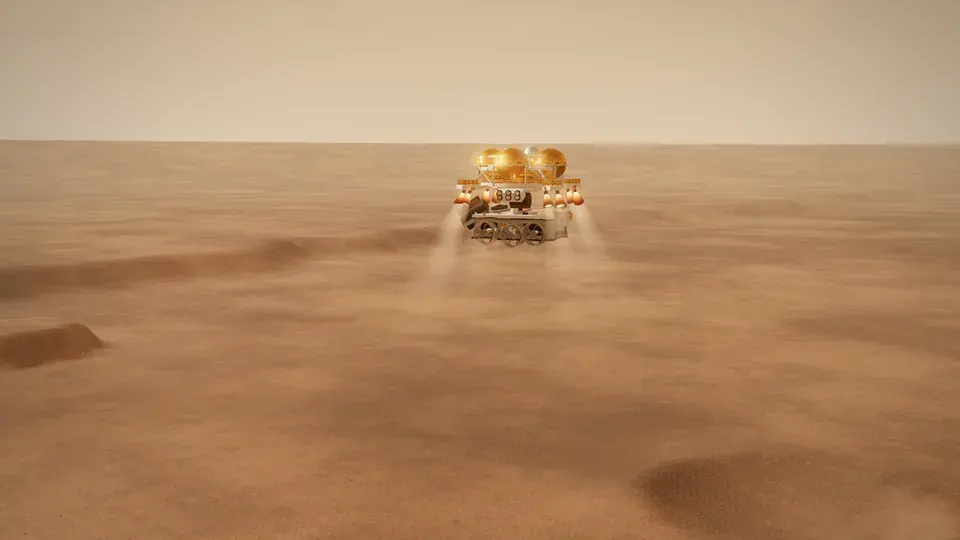
Every diagram so far had the same object at its center, so let’s see why that choice matters somewhere stranger than Yosemite. On February eighteenth, 2021, NASA had to set a one-tonne rover gently down on Mars, and the way they did it still looks made up.
About twenty meters up, a descent stage, holding itself up on its rocket engines and sinking at a steady three quarters of a meter per second, lowered the rover beneath it on nylon cords, and about twelve seconds after the cords started spooling out, the wheels touched Mars. So what’s touching the rover? During the rocket-powered descent it’s bolted under the descent stage, then the cords hold it, and at the very end the ground takes over, while Mars pulls down on it the whole time without touching it.
Here’s the rover’s diagram while it hangs, with Mars pulling down and the cords pulling up. Some students would add one more arrow for the rockets’ thrust, so does that belong on the rover’s diagram?
The exhaust pushes on the engines, and the engines are bolted to the descent stage, not the rover, so the thrust goes on the stage’s diagram. The rockets help hold the rover up only through the cords, and the cords’ pull is already on its diagram. So the descent stage’s own diagram has Mars pulling it down, the exhaust pushing it up, and the cords pulling it down, toward the rover hanging below.
The cords show up on both of those diagrams, so let’s try to make them disappear. Draw a loop around a system for which the cords don’t appear on the free-body diagram at all.
With the rover and the descent stage circled together, the cords pull up on the rover and down on the stage, and those pulls cancel inside the system, just like the baron’s hand and hair. A system can’t exert a net force on itself, so what’s left is Mars pulling down on the whole thing and the exhaust pushing it up.
It’s the same machine at the same moment, but three different systems give us three different free-body diagrams. Nothing about the landing changed, only what we decided to circle, which is why every diagram starts with step one.
Then came touchdown. As the wheels pressed into the ground, the ground’s push grew while the cords’ pull faded away, blades cut the cords, and the descent stage flew off to crash a safe distance away. The rover itself never changed, but its list of neighbors did, and its diagram went from Mars and the cords to Mars and the ground.
What, if anything, is wrong?
Back to Yosemite for one more, and this time you’re the grader. Climbers who spend days on El Capitan haul their food and water in a heavy haul bag on a rope, and here’s a student’s free-body diagram of one being dragged up a slab.
It has four mistakes. Find all four, and for each one, think about which rule it breaks. Once it’s fixed, the diagram has just four arrows, the rope pulling along its length, the slab pushing straight out of its surface, friction along the slab against the sliding, and the Earth pulling straight down, each with an object behind it.
Now let’s see what a full-credit justify answer looks like. Say the exam tells you that a student claims the hanging rover’s free-body diagram should include the rockets’ thrust, and asks whether you agree, and to justify your answer. A lot of students would write no, because the thrust isn’t on the rover, and that loses the point, because it only restates the claim, with no physics behind it.
A full-credit answer has three parts, the claim, I disagree, then the evidence, that the thrust is a push by the exhaust gas on the descent stage’s engines, and only the cords and Mars interact with the rover. Then the reasoning, which ties it to a principle, that a free-body diagram includes only the forces exerted on the chosen object by other objects, and that last sentence is the one that earns the point.
Try one yourself. A student says an astronaut floating inside the space station should have an empty free-body diagram, because she’s weightless. Every reply below starts from the same rule, that a free-body diagram shows every force exerted by another object, so which one earns full credit?
Two arrows at the top
Let’s go back to where we started. At nine twenty-eight that morning, Alex Honnold stood on top of El Capitan, and his free-body diagram was as simple as they come, the Earth pulling down and the rock pushing up. Every push that raised him those nine hundred meters, at every ledge and hold and every smear of rubber on glassy granite, was a push by the rock, built from the electric pushes and pulls between countless atoms.
So here’s what to keep. A force is a push or pull by one object on another, so every arrow needs an object, and to find them, circle the object, list what touches it, and add the Earth.
Contact forces are electric forces between atoms, while gravity needs no contact at all. On the diagram, every force gets one straight, labeled arrow from the dot, arrows that point the same way sit side by side, and on a slope, one axis runs along the slope.
One last thing to think about. The rock pushes on Alex, and at the same moment Alex pushes on the rock, and that partner force lives on the rock’s diagram, not his, which is the whole next lesson.